
Listen to this Post
Introduction:
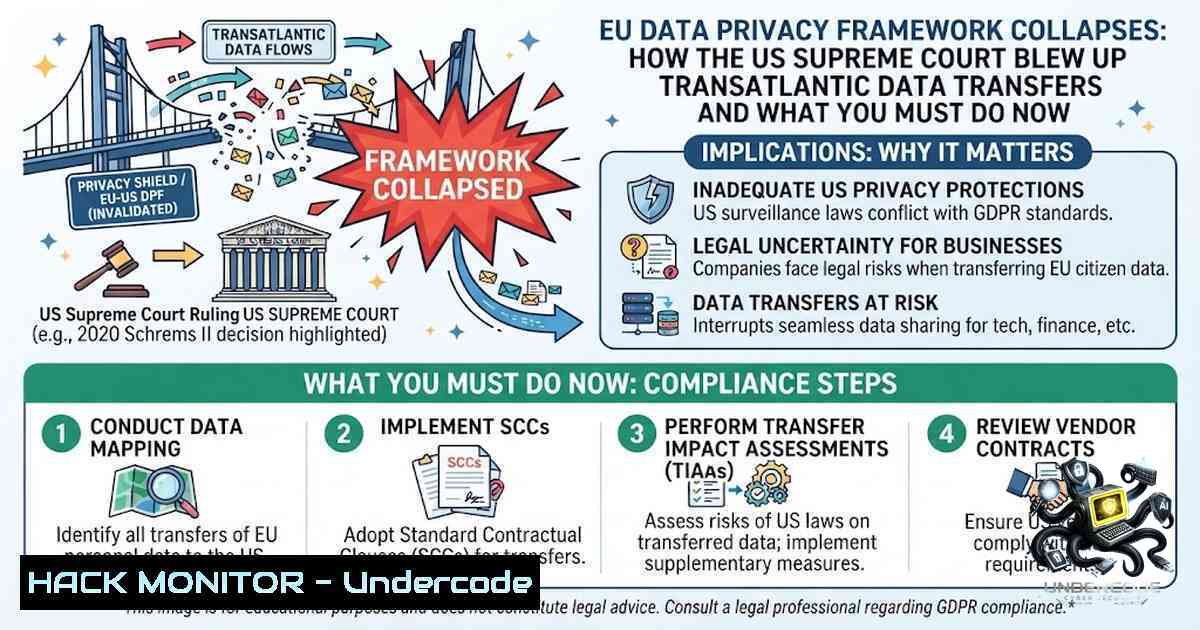
The US Supreme Court’s ruling in Trump v Slaughter (Case No. 25–332) has declared the Federal Trade Commission’s independence unconstitutional, effectively demolishing the legal foundation of the EU-US Data Privacy Framework (DPF). With the European Commission having referenced the FTC’s oversight function 259 times in its adequacy decision, the entire structure of transatlantic data transfers now hangs by a thread. Max Schrems and his privacy organization Noyb have formally demanded the Commission repeal the adequacy decision, warning that organizations relying on US cloud infrastructure face unprecedented legal exposure.
Learning Objectives:
- Understand the technical and legal implications of the FTC independence ruling on EU-US data transfers
- Master the implementation of data sovereignty strategies including sovereign cloud migration and encryption controls
- Learn to conduct Transfer Impact Assessments (TIAs) under the new legal reality
- Configure Linux and Windows systems for GDPR-compliant data localization
- Implement client-side scanning detection and end-to-end encryption verification
- The FTC Independence Ruling: Technical Implications for Data Controllers
The Supreme Court’s decision rests on the “Unitary Executive Theory,” holding that the President must have unrestricted control over all federal agencies. For organizations transferring EU personal data to the US, this means the Data Protection Review Court—established by Executive Order 14086—could be dissolved at any moment, as its independence relies solely on presidential discretion.
What this means technically:
Any US-based cloud service (AWS, Azure, Google Cloud, Oracle) that processes EU personal data now operates on legally shaky ground. The DPF certification that many US companies rely upon is no longer a safe harbor.
Linux Command: Audit Data Residency
 Audit where your cloud storage buckets are located
aws s3api list-buckets --query 'Buckets[].[Name, CreationDate]' --output table

Check Azure region assignments
az storage account list --query '[].{Name:name, Location:primaryLocation}' --output table

Verify GCP bucket locations
gsutil ls -L -b gs://YOUR_BUCKET | grep "Location constraint"

For on-premises, identify where sensitive data resides
sudo find / -type f -exec grep -l "personal data|GDPR|EU citizen" {} \; 2>/dev/null | head -20
Windows PowerShell: Identify Data Flows
 Audit network connections to US-based IP ranges
Get-1etTCPConnection | Where-Object {$_.RemoteAddress -match "^52.|^54.|^35.|^3."} | Format-Table

Check for data export scripts
Get-ChildItem -Path C:\ -Recurse -Include .ps1,.bat,.py | Select-String -Pattern "upload|export|s3|azure|gcs"
2. Sovereign Cloud Migration: A Step-by-Step Technical Guide
With the DPF’s collapse, organizations must migrate to EU-based cloud providers or implement sovereign cloud architectures. The principle is simple: place the right workload in the right environment.
Step 1: Data Classification and Mapping
 Install and run a data discovery tool (example with Tika)
wget https://dlcdn.apache.org/tika/2.9.0/tika-app-2.9.0.jar
java -jar tika-app-2.9.0.jar --detect /path/to/data

Use open-source classification
pip install pandas numpy
python -c "
import pandas as pd
 Load your data inventory
df = pd.read_csv('data_inventory.csv')
 Flag EU personal data
eu_pii = df[df['data_type'].str.contains('personal|PII|GDPR', case=False)]
print(f'Found {len(eu_pii)} records requiring EU residency')
"
Step 2: Select EU-1ative Cloud Infrastructure
European providers offering sovereign cloud services include:
- OVHcloud (France) – GDPR-compliant with data centers in EU
- Hetzner (Germany) – Focus on data sovereignty
- Scaleway (France) – EU-based cloud with strong encryption
- Stackable (Germany) – Open-source data platform
Step 3: Configure Encryption and Access Controls
 Generate a sovereign encryption key (EU-based HSM recommended)
openssl genrsa -aes256 -out sovereign_key.pem 4096

Encrypt data before any cross-border transfer
openssl enc -aes-256-cbc -salt -in sensitive_data.csv -out sensitive_data.enc -pass file:sovereign_key.pem

Verify encryption
file sensitive_data.enc
 Output: sensitive_data.enc: openssl enc'd data with salted password
Windows: BitLocker and EFS for Data-at-Rest
 Enable BitLocker on system drive
Manage-bde -on C: -RecoveryPassword -EncryptionMethod XtsAes256

Encrypt specific folders with EFS
cipher /E /S:C:\SensitiveData
- Transfer Impact Assessments (TIAs) Under the New Legal Reality
With the DPF invalidated, organizations must rely on Standard Contractual Clauses (SCCs) or Binding Corporate Rules (BCRs). However, Section 14 of the SCCs requires a Transfer Impact Assessment that must now conclude that US law does not provide essentially equivalent protection.
Step-by-Step TIA Process:
Step 1: Map All Data Transfers
 Use mitmproxy to capture data flows
mitmproxy --mode transparent --showhost

Or use Wireshark for deep packet inspection
tshark -i eth0 -f "host 52.0.0.0/8 or host 54.0.0.0/8" -w data_flows.pcap
Step 2: Assess US Surveillance Laws
The assessment must consider FISA, Section 702, and Executive Order 12333. Under the new Supreme Court ruling, no US oversight body can be considered independent.
Step 3: Document Technical Safeguards
 Example TIA documentation structure (save as tia_report.yaml)
transfer:
exporter: "EU_Company_XYZ"
importer: "US_Cloud_Provider"
data_types:
- "Customer names and email addresses"
- "Payment processing data"
- "Analytics telemetry"
safeguards:
encryption: "AES-256-GCM with EU-managed keys"
pseudonymization: true
access_controls: "Zero-trust with EU-based IdP"
assessment_conclusion: "US law does not provide essentially equivalent protection"
supplementary_measures: "End-to-end encryption with no US key access"
4. Chatkontrolle 2.0: Technical Countermeasures Against Mass Surveillance
The EU’s Chatkontrolle proposal would mandate client-side scanning of encrypted messages, effectively breaking end-to-end encryption. The Council and EVP are attempting to revive the expired Chatkontrolle 1.0 through a legal loophole—creating an identical but formally new law to bypass parliamentary scrutiny.
Technical Implications:
Client-side scanning requires uploading hash databases to user devices and scanning all communications before encryption. This creates a backdoor that undermines cryptographic integrity.
Linux: Verify End-to-End Encryption Integrity
 Check Signal desktop encryption
signal-cli -u YOUR_NUMBER receive

Verify WireGuard VPN configuration (bypass potential scanning)
sudo wg show

Test for TLS interception (MITM detection)
openssl s_client -connect whatsapp.com:443 -showcerts </dev/null 2>/dev/null | openssl x509 -text | grep -A5 "Subject:"
Windows: Detect Client-Side Scanning Artifacts
 Monitor for suspicious hash database downloads
Get-1etTCPConnection | Where-Object {$<em>.State -eq "Established" -and $</em>.RemotePort -eq 443} | ForEach-Object {
$connection = $_
$process = Get-Process -Id $connection.OwningProcess -ErrorAction SilentlyContinue
if ($process.ProcessName -match "signal|telegram|whatsapp|messenger") {
Write-Host "Monitoring: $($process.ProcessName) - $($connection.RemoteAddress)"
}
}

Check for modified hosts file (potential scanning bypass)
Get-Content C:\Windows\System32\drivers\etc\hosts
Encryption Bypass Detection Script:
!/bin/bash
 detect_scanning.sh - Check for client-side scanning indicators

echo "Checking for potential client-side scanning..."

Look for known scanning hash databases
find / -1ame ".csam" -o -1ame "hashdb" 2>/dev/null

Check for suspicious browser extensions
ls ~/.mozilla/firefox//extensions/ 2>/dev/null | grep -i "scan|monitor"

Verify PGP/GPG integrity
gpg --list-keys
gpg --check-signatures

Test DNS for scanning service domains
for domain in "scanning.eu.int" "childprotection.ec.europa.eu"; do
if nslookup $domain >/dev/null 2>&1; then
echo "WARNING: $domain resolves - potential scanning infrastructure"
fi
done
- GDPR 49 Derogations: When and How to Use Them
49 provides exceptions for data transfers without an adequacy decision. However, these are narrow and must be interpreted strictly.
Valid Derogations Include:
- Explicit consent from the data subject after being informed of risks
- Performance of a contract between the data subject and controller
- Important reasons of public interest
- Establishment, exercise, or defense of legal claims
- Protection of vital interests
- Transfer from a public register
Technical Implementation of Consent Management:
 consent_manager.py - GDPR-compliant consent logging
import json
import hashlib
from datetime import datetime

def log_consent(user_id, purpose, risk_disclosure):
consent_record = {
"user_id": hashlib.sha256(user_id.encode()).hexdigest(),
"purpose": purpose,
"risk_disclosure": risk_disclosure,
"timestamp": datetime.utcnow().isoformat(),
"ip_address": "anonymized",
"user_agent": "anonymized"
}
with open(f"/var/log/gdpr_consents/{datetime.now().date()}.json", "a") as f:
json.dump(consent_record, f)
f.write("\n")
return "Consent logged successfully"

Usage
log_consent("[email protected]", "data transfer to US processor", "US law may not provide adequate protection")
6. VPN, TOR, and Alternative Messaging: Technical Implementation
To circumvent potential Chatkontrolle surveillance, technically savvy users can employ VPNs, TOR, or alternative messaging services outside EU jurisdiction.
Linux: Configure OpenVPN with EU-Based Exit Nodes
 Install OpenVPN
sudo apt-get update && sudo apt-get install openvpn -y

Download EU-based OpenVPN configuration
wget https://your-eu-vpn-provider.com/config.ovpn

Connect
sudo openvpn --config config.ovpn

Verify exit location
curl ifconfig.me
Windows: TOR Browser Setup for Anonymous Communication
 Download and verify TOR Browser signature
Invoke-WebRequest -Uri "https://dist.torproject.org/torbrowser/13.0/tor-browser-windows-x86_64-portable-13.0.exe" -OutFile "tor-browser.exe"

Verify with GPG (if installed)
gpg --verify tor-browser.exe.asc tor-browser.exe

Launch TOR Browser
Start-Process -FilePath "tor-browser.exe"
Signal Desktop with Proxy Configuration:
 Run Signal through SOCKS5 proxy (TOR)
signal-desktop --proxy socks5://127.0.0.1:9050 &
7. Linux and Windows Hardening for Data Sovereignty
Linux: Harden SSH and Disable Unnecessary Services
 Disable root login and enforce key-based authentication
sudo sed -i 's/PermitRootLogin yes/PermitRootLogin no/' /etc/ssh/sshd_config
sudo sed -i 's/PasswordAuthentication yes/PasswordAuthentication no/' /etc/ssh/sshd_config
sudo systemctl restart sshd

Enable auditd for data access monitoring
sudo apt-get install auditd -y
sudo auditctl -w /etc/passwd -p wa -k identity_data
sudo auditctl -w /var/www -p rwxa -k web_data

Check audit logs
sudo ausearch -k identity_data
Windows: Configure Group Policy for Data Localization
 Restrict OneDrive to EU regions only
Set-ItemProperty -Path "HKCU:\Software\Microsoft\OneDrive" -1ame "Region" -Value "EU"

Disable telemetry to US servers
Set-ItemProperty -Path "HKLM:\SOFTWARE\Policies\Microsoft\Windows\DataCollection" -1ame "AllowTelemetry" -Value 0

Configure Windows Firewall to block US IP ranges
$usRanges = @("52.0.0.0/8", "54.0.0.0/8", "35.0.0.0/8", "3.0.0.0/8")
foreach ($range in $usRanges) {
New-1etFirewallRule -DisplayName "Block US IP $range" -Direction Outbound -RemoteAddress $range -Action Block
}
What Undercode Say:
- The FTC ruling is not just a legal technicality—it is a systemic collapse. The EU Commission referenced the FTC 259 times in its adequacy decision. With that foundation gone, every US-based cloud contract is now legally contestable.
-
Sovereign cloud is no longer optional—it is a compliance imperative. Organizations still relying on AWS, Azure, or GCP for EU personal data face existential legal risk. Migration to EU-1ative providers must begin immediately.
-
Chatkontrolle represents the greatest threat to encryption since the Crypto Wars. Client-side scanning is a backdoor by another name. The EU Council’s attempt to revive Chatkontrolle 1.0 through procedural trickery demonstrates the depth of the surveillance push.
-
Transfer Impact Assessments are now impossible to pass. With no independent US oversight body, any TIA must conclude that US law does not provide essentially equivalent protection. Organizations must disclose this reality to their data subjects.
-
The next two to three years will be a period of legal chaos. Noyb is preparing litigation that will reach the CJEU. Until then, the Digital Economy operates in a regulatory vacuum.
Prediction:
-
-1 The CJEU will likely strike down the DPF within two to three years, mirroring the Safe Harbor and Privacy Shield rulings. This will trigger massive disruption for thousands of US-based SaaS providers serving EU customers.
-
-1 US cloud providers will face a wave of regulatory enforcement actions from EU Data Protection Authorities, with fines potentially reaching 4% of global annual turnover under GDPR.
-
+1 European sovereign cloud providers will experience explosive growth, with the EU cloud market projected to expand by 40-60% as organizations scramble to repatriate data.
-
+1 End-to-end encryption will become a competitive differentiator, with privacy-first messaging apps gaining significant market share as users flee platforms susceptible to client-side scanning.
-
-1 The legal uncertainty will drive a chilling effect on innovation, with EU startups potentially relocating to avoid compliance nightmares, undermining the EU’s digital single market ambitions.
▶️ Related Video (64% Match):
https://www.youtube.com/watch?v=0aBaTkSAJRM
🎯Let’s Practice For Free:
🎓 Live Courses & Certifications:
Join Undercode Academy for Verified Certifications
🚀 Request a Custom Project:
Secure, high-velocity infrastructure and disruptive technological engineering. Contact our engineering team for high-tier development and proprietary systems:
[email protected]
💎 Smart Architecture | 🛡️ Secure by Design | ⭐ Trusted by Thousands
IT/Security Reporter URL:
Reported By: Bernhard Biedermann – Hackers Feeds
Extra Hub: Undercode MoN
Basic Verification: Pass ✅


