Listen to this Post
Introduction:
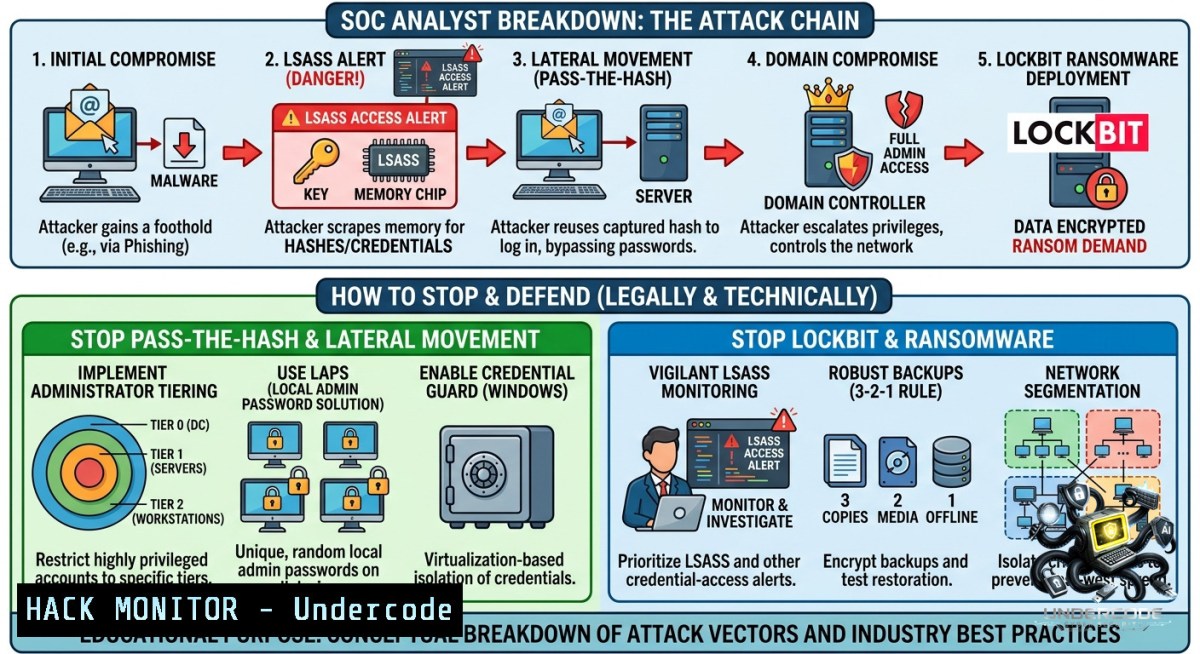
A medium-severity LSASS alert ignored for eight hours can spiral into full domain takeover. In a real-world SOC L2 assessment, an attacker used renamed ProcDump to steal NTLM hashes, waited for the admin to leave, then executed Pass-the-Hash lateral movement across 11 servers—including domain controllers. Meanwhile, a separate LockBit 3.0 ransomware attack exploited three-year-old RDP credentials and a legitimate `conhost.exe` process to encrypt 47,832 files. These incidents prove that alerts are not isolated; they are attack chains requiring behavioral analysis, not just dashboard monitoring.
Learning Objectives:
– Analyze Pass-the-Hash lateral movement using MITRE ATT&CK T1550.002 and KQL log correlation.
– Implement Windows Defender Credential Guard and LSASS protection to block credential dumping.
– Detect Living-off-the-Land (LOLBin) ransomware behaviors (LockBit) via EDR behavioral rules and KQL hunting queries.
You Should Know:
1. Pass-the-Hash Attack Chain: From lsass.exe Dump to Domain Compromise
Extended from the post: The attacker gained initial access on a helpdesk workstation (FAB-HELPDESK-07), renamed `procdump.exe` to `svcupdate.exe` for evasion, and executed it from `C:\ProgramData\Temp` to dump LSASS memory. The privileged account `svc-domainadm` (used for patch deployment) had its NTLM hash stolen at 2:33 PM. When admin Aaron Singh left at 6 PM, the attacker used Pass-the-Hash at 11:14 PM to authenticate to 11 systems, including HR file server, payroll, treasury, and two domain controllers.
Step-by-step guide to detect and block PtH:
A. Detect NTLM hash dumping via KQL (Microsoft Sentinel / Log Analytics):
// Detect renamed ProcDump or LSASS access
DeviceProcessEvents
| where FolderPath contains @"\procdump.exe" or ProcessCommandLine contains "lsass"
| where ProcessCommandLine has_any ("-ma", "-accepteula", "lsass")
| extend IsRenamed = iff(FileName != "procdump.exe", true, false)
| project Timestamp, DeviceName, FileName, ProcessCommandLine, InitiatingProcessAccountName, IsRenamed
B. Windows commands to enable LSASS protection (Credential Guard & LSA Protection):
 Enable LSA Protection (Run as Admin)
reg add "HKLM\SYSTEM\CurrentControlSet\Control\Lsa" /v RunAsPPL /t REG_DWORD /d 1 /f
 Enable Windows Defender Credential Guard (Requires reboot)
reg add "HKLM\System\CurrentControlSet\Control\DeviceGuard\Scenarios\CredentialGuard" /v Enabled /t REG_DWORD /d 1 /f
 Verify
reg query "HKLM\SYSTEM\CurrentControlSet\Control\Lsa" /v RunAsPPL
C. Linux equivalent (PTH mitigation – disable NTLM-like auth on Samba):
 Restrict NTLMv1 and weak protocols in smb.conf
echo "ntlm auth = no" >> /etc/samba/smb.conf
echo "lanman auth = no" >> /etc/samba/smb.conf
systemctl restart smbd
D. Configure EDR auto-quarantine (CrowdStrike example policy):
– Create rule: `lsass.exe` access by any non-`lsass.exe` process → Severity: Critical → Action: Quarantine host.
2. LockBit Ransomware: Living-off-the-Land (LOLBin) via conhost.exe
Extended from the post: Attackers accessed PrimeForge Manufacturing via RDP (port 3389 exposed to internet) from Tunisia on Saturday 22 Feb at 11:28 PM using service account `PFMsvc-backup` with unchanged password for 3 years. Reconnaissance occurred Sunday. On Monday 04:11 AM, LockBit 3.0 encrypted 47,832 files across 14 shared folders using `conhost.exe` – a legitimate Windows console host – to bypass EDR. Encryption window lasted 2h 32m.
Step-by-step guide to hunt and block LOLBin ransomware:
A. KQL query to detect conhost.exe performing bulk file operations:
// Identify conhost.exe with mass file rename/encryption patterns
DeviceFileEvents
| where Timestamp between (datetime(2025-02-24 04:00:00) .. datetime(2025-02-24 07:00:00))
| where InitiatingProcessFileName == "conhost.exe"
| summarize FileCount = dcount(FileName), UniqueFolders = dcount(FolderPath) by DeviceName, InitiatingProcessCommandLine
| where FileCount > 1000 // Unusual bulk activity
B. Windows command to monitor file system changes for rapid encryption (audit policy):
 Enable advanced audit policy for file creation/deletion
auditpol /set /subcategory:"File System" /success:enable /failure:enable
 Use PowerShell to monitor specific folder (real-time)
$watcher = New-Object System.IO.FileSystemWatcher
$watcher.Path = "E:\SharedFolders"
$watcher.IncludeSubdirectories = $true
$watcher.EnableRaisingEvents = $true
Register-ObjectEvent $watcher "Created" -Action { Write-Host "File created: $($Event.SourceEventArgs.FullPath)" }
C. Linux command to detect ransom-like mass renames (using auditd):
 Install auditd, monitor /shared for rename operations
auditctl -w /shared -p wa -k ransomware_detect
 Search for bulk renames (>500 events per minute)
ausearch -k ransomware_detect --format raw | awk '{print $NF}' | sort | uniq -c | awk '$1>500'
D. Mitigation: Block RDP brute force with firewall rules (Windows):
 Limit RDP connections per IP using New-1etFirewallRule (rate limiting via PS)
New-1etFirewallRule -DisplayName "RDP Rate Limit" -Direction Inbound -Protocol TCP -LocalPort 3389 -Action Block -RemoteAddress 196.203.44.17
 Enable NLA (Network Level Authentication)
Set-ItemProperty -Path "HKLM:\System\CurrentControlSet\Control\Terminal Server\WinStations\RDP-Tcp" -1ame "UserAuthentication" -Value 1
3. EvilGinx2 MFA Bypass: Session Hijacking Without Credentials
Extended from the post: A valid MFA session can be hijacked. EvilGinx2 acts as a reverse proxy, capturing session cookies after the user authenticates to a fake Microsoft/Okta login page. The attacker bypasses MFA entirely because the user already provided the second factor to the real service.
Step-by-step guide to detect and block adversary-in-the-middle (AitM) phishing:
A. KQL hunt for abnormal authentication geography or user agent (Microsoft Sentinel):
AADSignInEventsBeta
| where Application == "Office 365"
| where Timestamp > ago(1d)
| summarize LoginCount = count(), DistinctIPs = dcount(IPAddress) by UserPrincipalName, UserAgent
| where DistinctIPs > 3 or UserAgent contains "EvilGinx" or UserAgent contains "phishing"
B. Linux command to set up EvilGinx2 detection via HTTP proxy log analysis (e.g., with Squid):
 Grep for suspicious Referer headers or rapid session replay
tail -f /var/log/squid/access.log | grep -E "login.microsoftonline.com|accounts.google.com" | awk '{print $7}' | sort | uniq -c | awk '$1>10'
C. Windows registry hardening to enforce device compliance (Conditional Access):
 Require Hybrid Join or Compliant Device to block token replay from non-enrolled machines
Set-MsolDomainFederationSettings -DomainName "yourdomain.com" -SupportsMfa $true -PreferredAuthenticationProtocol "WsFed"
 Block legacy auth (prevents token reuse)
Set-CsAuthenticationConfiguration -AllowedAuthProtocols "WebAuthn,Passthru"
4. Root Cause Analysis (RCA) Template for SOC Analysts
Extended from the post: The SOC L2 assessment required three-dimensional RCA: Human/Training, Process/Policy, Technology. Missing dimensions lead to repeat incidents.
Step-by-step RCA framework (apply to any intrusion):
A. Human/Training failures:
– Did the SOC analyst investigate the medium-severity LSASS alert? (No – marked “noted in queue”)
– Was password rotation training enforced for service accounts? (No – unchanged 3 years)
– Remediation: Quarterly purple team exercises with live PtH simulations.
B. Process/Policy failures:
– No SLA for medium-severity alerts (8+ hours unattended)
– No firewall rule review process (RDP rule from 2022 remained active)
– Remediation: Implement 1-hour SLA for credential dumping alerts; monthly rule review.
C. Technology control gaps:
– Credential Guard not enabled → LSASS accessible
– EDR lacked behavioral rule for `conhost.exe` bulk renames
– No network segmentation between IT and OT
– Remediation: Deploy LSA Protection via GPO; create EDR rules for mass file operations.
5. KQL Queries for Proactive Threat Hunting (Based on Interview Answers)
Extended from the post: Candidate queries had syntax errors. Below are corrected, production-ready KQL queries for lateral movement and ransomware.
A. Pass-the-Hash lateral movement detection:
SecurityEvent
| where EventID == 4624
| where LogonType == 3
| where SubStatus == "0x0"
| where IpAddress == "10.40.12.88"
| where TimeGenerated between (datetime(2025-03-07 23:14:00) .. datetime(2025-03-07 23:18:00))
| project Computer, TargetUserName, SourceIpAddress=IpAddress, TimeGenerated
| order by TimeGenerated asc
B. Ransomware encryption detection via file extension changes:
DeviceFileEvents
| where FolderPath contains "\\Shared\\"
| where ActionType == "FileRenamed"
| extend NewExtension = extract(@"\.([^\.]+)$", 1, FileName)
| where NewExtension in ("encrypted", "lockbit", "crypt")
| summarize EncryptionCount = count() by DeviceName, InitiatingProcessFileName, NewExtension
| where EncryptionCount > 100
C. Service account abuse (logon type 10 – remote interactive):
IdentityLogonEvents
| where LogonType == 10
| where AccountName contains "svc-"
| where isnotempty(RemoteIP)
| extend DaysSinceLastPwdChange = datetime_diff('day', now(), TimeGenerated)
| where DaysSinceLastPwdChange > 90
| project AccountName, RemoteIP, TargetDeviceName, DaysSinceLastPwdChange
What Undercode Say:
– Key Takeaway 1: A medium-severity alert is never just “medium.” The LSASS credential dump ignored for 8 hours directly enabled domain compromise. SOC analysts must escalate based on attack behavior (e.g., renamed ProcDump, LSASS access from non-standard path) not just severity scores.
– Key Takeaway 2: Living-off-the-Land techniques (conhost.exe, renamed binaries) are the new ransomware gold standard. EDRs without behavioral rules for mass file operations are blind to LockBit 3.0. Immutable backups and network segmentation are the only reliable fallbacks.
Analysis (10 lines):
The assessment reveals systemic failures common in mid-sized enterprises: stale firewall rules, unchanged service account passwords (3 years!), and SOC alert fatigue. The attacker exploited timing (after hours) and legitimacy (renamed tools, LOLBins) – two variables that SIEM dashboards cannot capture without contextual KQL hunting. The candidate correctly identified the attack chain but missed technical specifics like Credential Guard and NTLM logging. For blue teams, the lesson is clear: invest in behavioral detection rules, enforce LSA Protection via GPO, and conduct regular purple team exercises that simulate delayed lateral movement. Organizations still exposing RDP port 3389 to the internet without MFA or Conditional Access are inviting LockBit. The shift from alert-centric to attacker-centric mindset is not optional – it is survival.
Prediction:
– -1 By 2027, Pass-the-Hash will remain prevalent as NTLM cannot be fully disabled in hybrid AD environments. Attackers will increasingly target helpdesk workstations because of their privileged session overlap.
– -1 EvilGinx2-style AitM phishing will render SMS and TOTP MFA obsolete within 18 months. Only WebAuthn (FIDO2) and certificate-based MFA will survive.
– +1 AI-driven SOC co-pilots (e.g., Microsoft Security Copilot) will reduce median time to detect lateral movement from hours to minutes by automatically correlating renamed LSASS access with after-hours NTLM logons.
– -1 Ransomware groups will shift to “encryptionless” extortion (data theft + leak threats) to bypass EDR behavioral rules, making file system monitoring less effective.
– +1 The demand for SOC analysts proficient in KQL, MITRE ATT&CK, and LOLBin hunting will increase 300% by 2028, driving specialized certification growth (e.g., SC-200, CySA+).
▶️ Related Video (68% Match):
🎯Let’s Practice For Free:
🎓 Live Courses & Certifications:
[Join Undercode Academy for Verified Certifications](https://undercode.co.uk/certifications/)
🚀 Request a Custom Project:
Secure, high-velocity infrastructure and disruptive technological engineering. Contact our engineering team for high-tier development and proprietary systems:
[[email protected]](mailto:[email protected])
💎 Smart Architecture | 🛡️ Secure by Design | ⭐ Trusted by Thousands
IT/Security Reporter URL:
Reported By: [Firdevs Balaban](https://www.linkedin.com/posts/firdevs-balaban_soc-l2-interview-assessment-complete-analysis-ugcPost-7465471378771808256-JNV7/) – Hackers Feeds
Extra Hub: Undercode MoN
Basic Verification: Pass ✅
🔐JOIN OUR CYBER WORLD [ CVE News • HackMonitor • UndercodeNews ]
[💬 Whatsapp](https://undercode.help/whatsapp) | [💬 Telegram](https://t.me/UndercodeCommunity)
📢 Follow UndercodeTesting & Stay Tuned:
[𝕏 formerly Twitter 🐦](https://x.com/undercodeupdate) | [@ Threads](https://www.threads.net/@undercodetesting) | [🔗 Linkedin](https://www.linkedin.com/company/undercodetesting/) | [🦋BlueSky](https://bsky.app/profile/undercode.bsky.social)


