Listen to this Post
Introduction:
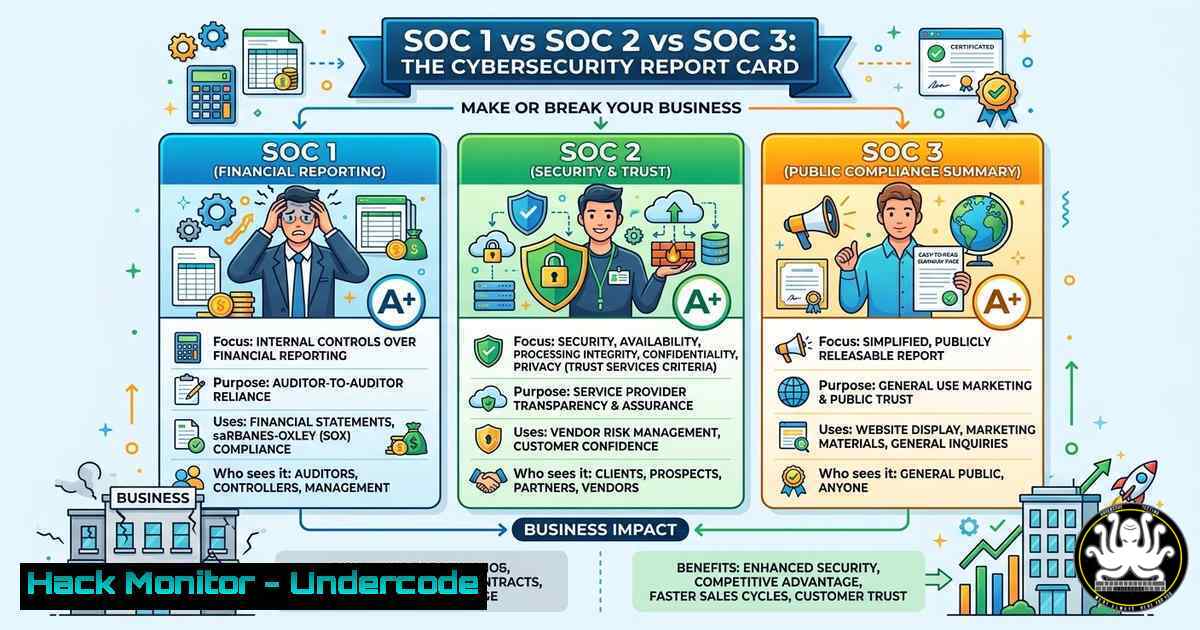
In the complex landscape of modern compliance, System and Organization Controls (SOC) reports serve as the critical bridge between technical security implementation and business trust. While often viewed merely as audit checkboxes, SOC 1, SOC 2, and SOC 3 reports are fundamentally about validating that an organization’s internal controls—spanning financial integrity, data security, and operational resilience—are not just designed but are operating effectively. For cybersecurity professionals, understanding these reports is essential for translating technical safeguards into the language of business assurance and customer confidence.
Learning Objectives:
- Differentiate between the distinct scopes of SOC 1, SOC 2, and SOC 3 reports and their specific applicability to various business contexts.
- Identify the technical control objectives underlying SOC 2’s Trust Services Criteria, including security, availability, processing integrity, confidentiality, and privacy.
- Apply practical command-line and configuration techniques to audit and harden systems against the control requirements of a SOC 2 examination.
You Should Know:
1. Determining Which SOC Report Your Infrastructure Requires
The selection of a SOC report is not arbitrary; it is dictated by the nature of your services and the demands of your clients. If your organization provides services that impact a client’s financial statement, such as a payroll processor or a loan servicing platform, a SOC 1 (SSAE 18) report is mandatory to satisfy the requirements of their external auditors. Conversely, if your value proposition revolves around data security and cloud infrastructure, a SOC 2 report is the definitive standard. A SOC 3 serves as a public-facing, high-level summary of a SOC 2 examination, ideal for marketing and website display without revealing sensitive operational details.
To determine the correct path, start by analyzing your client contracts. Use the following command on a Linux system to parse contract directories for keywords like “financial,” “audit,” or “security compliance,” which can help prioritize which framework to implement first.
 Linux: Search for contract files containing specific compliance keywords
grep -rliE "(financial audit|security compliance|SOC 2|privacy)" /path/to/contracts/
For Windows environments, you can achieve a similar discovery using PowerShell to scan for relevant terms in client requirement documents.
 Windows PowerShell: Find files with compliance-related terms
Get-ChildItem -Path "C:\Contracts\" -Recurse | Select-String -Pattern "SOC 1","SOC 2","financial audit" | Group-Object Path | Select-Object Name
- Building a Technical Control Matrix for SOC 2
SOC 2 is built upon the Trust Services Criteria (TSC), which are principle-based rather than prescriptive. This means you must translate these principles into technical controls. For the “Security” principle, this often translates to a robust access control and monitoring strategy. For instance, to meet the logical access criteria, you must enforce multifactor authentication (MFA) and principle of least privilege across all systems.
A fundamental technical step is auditing user access. On Linux, you can list all users with sudo privileges to ensure no unnecessary privileged accounts exist.
 Linux: List users with sudo privileges
grep -Po '^sudo.+:\K.$' /etc/group | tr ',' '\n'
In a Windows Active Directory environment, generating a report of high-privilege accounts is a key audit procedure.
 Windows PowerShell: List members of the Domain Admins group
Get-ADGroupMember -Identity "Domain Admins" | Select-Object Name, ObjectClass, distinguishedName
3. Configuring Logging and Monitoring for Audit Readiness
A critical component of any SOC 2 examination is evidence that security events are logged, monitored, and reviewed. A common failure point is the lack of centralized logging and the absence of a Security Information and Event Management (SIEM) system configured to alert on anomalous behavior. The audit will request proof that logs are being collected for a defined retention period (typically a minimum of six months to one year) and that alerts are actionable.
To harden Linux logging, ensure the `auditd` service is running and configured to monitor key files like /etc/passwd.
 Linux: Install and configure auditd for key file monitoring
sudo apt-get install auditd -y
sudo auditctl -w /etc/passwd -p wa -k identity_changes
sudo systemctl enable auditd
For cloud environments like AWS, which is central to many SOC 2 scopes, enabling CloudTrail in all regions is non-negotiable. The following AWS CLI command validates that a trail is logging to an S3 bucket with proper protection.
 AWS CLI: Verify CloudTrail is enabled and logging
aws cloudtrail describe-trails --query 'trailList[].[Name,IsMultiRegionTrail,LogFileValidationEnabled]' --output table
- API Security Hardening Against SOC 2 Privacy Criteria
As applications shift toward API-first architectures, the Privacy and Confidentiality criteria of SOC 2 require that sensitive data transmitted via APIs is encrypted and access-controlled. Merely using HTTPS is insufficient; you must implement robust authentication and authorization mechanisms, such as OAuth 2.0 or mutual TLS (mTLS), to prevent unauthorized data exposure.
A practical step to validate API security is to test for sensitive data exposure in logs. On a Linux server handling API requests, use `grep` to ensure that tokens or Personally Identifiable Information (PII) are not being written to plaintext logs.
 Linux: Check API logs for accidental exposure of tokens
grep -iE "(token|password|credit card|ssn)" /var/log/nginx/access.log
For developers, integrating a tool like `nmap` with an NSE script can identify insecure API endpoints. The following command scans a target for exposed Swagger or OpenAPI documentation, which often leaks internal API structures.
 Linux: Nmap scan for exposed API documentation endpoints
nmap -p 443 --script http-swagger-enum.nse --script-args 'http-swagger-enum.path=/api-docs' target.com
5. Mitigating Vulnerabilities to Support Availability Criteria
The “Availability” criterion in SOC 2 is not just about uptime; it is about ensuring that the system remains accessible to authorized users as contractually agreed. This directly implicates cybersecurity measures against Distributed Denial of Service (DDoS) and ransomware. Implementing Web Application Firewall (WAF) rules and DDoS protection layers is a technical control that demonstrates proactive risk management.
For a Linux-based web server, configuring rate limiting with `iptables` can mitigate basic DDoS and brute-force attacks, supporting the availability principle.
 Linux: Use iptables to limit SSH connections per minute
sudo iptables -A INPUT -p tcp --dport 22 -m state --state NEW -m recent --set
sudo iptables -A INPUT -p tcp --dport 22 -m state --state NEW -m recent --update --seconds 60 --hitcount 4 -j DROP
In a cloud context, utilizing infrastructure-as-code (IaC) tools like Terraform can enforce these controls across environments. The snippet below shows how to define a standard AWS WAF rule to block SQL injection attempts, a control that auditors will examine for the security and availability criteria.
 Terraform: AWS WAFv2 rule to block SQL injection
resource "aws_wafv2_web_acl" "main" {
name = "soc2-protection"
scope = "REGIONAL"

default_action {
allow {}
}

rule {
name = "block-sqli"
priority = 1

action {
block {}
}

statement {
sql_injection_match_statement {
field_to_match {
all_query_arguments {}
}
text_transformation {
priority = 1
type = "URL_DECODE"
}
}
}

visibility_config {
cloudwatch_metrics_enabled = true
metric_name = "sqlInjectionRule"
sampled_requests_enabled = true
}
}
}
- Evidence Collection for the SOC 2 Type II Examination
A SOC 2 Type II report requires evidence that controls were operating effectively over a period of time (typically 6-12 months). This demands a disciplined approach to evidence gathering. Automation is key to preventing the frantic “audit crunch” that plagues many organizations. Scripting the collection of system configurations and user access reviews can streamline the process significantly.
The following script automates the collection of critical system state information on a Linux server to provide evidence of continuous compliance.
!/bin/bash
 Linux: Automated evidence collection script
mkdir -p /tmp/soc_evidence_$(date +%Y%m%d)
 Collect user accounts
cat /etc/passwd > /tmp/soc_evidence_$(date +%Y%m%d)/user_accounts.txt
 Collect running services
systemctl list-units --type=service --state=running > /tmp/soc_evidence_$(date +%Y%m%d)/running_services.txt
 Collect firewall rules
iptables-save > /tmp/soc_evidence_$(date +%Y%m%d)/firewall_rules.txt
echo "Evidence collected for SOC 2 review."
For Windows systems, a similar PowerShell script can capture critical configurations to demonstrate operational control.
 Windows PowerShell: Automated evidence collection for Windows
$date = Get-Date -Format "yyyyMMdd"
$path = "C:\SOC_Evidence_$date"
New-Item -ItemType Directory -Path $path -Force
Get-LocalUser | Out-File "$path\local_users.txt"
Get-Service | Where-Object {$_.Status -eq 'Running'} | Out-File "$path\running_services.txt"
netsh advfirewall show allprofiles > "$path\firewall_profiles.txt"
What Undercode Say:
- Trust is Technical: The distinction between SOC 1, SOC 2, and SOC 3 is not just a marketing exercise; it forces an organization to map abstract business risks to concrete technical controls. For security engineers, this means every firewall rule, IAM policy, and logging configuration directly contributes to an audit report that defines the company’s credibility.
- Automation is the Auditor’s Best Friend: Manually gathering evidence for a SOC 2 Type II examination is unsustainable. The most successful organizations implement infrastructure-as-code and automated collection scripts from day one, ensuring that the state of compliance is always known and verifiable, turning a reactive audit scramble into a proactive operational reality.
Prediction:
As artificial intelligence integrates deeper into IT operations, SOC reports will evolve to include criteria specifically for AI governance and model integrity. The future of SOC 2 will likely mandate controls for AI model drift, data poisoning prevention, and the ethical use of algorithms, forcing organizations to treat their AI pipelines with the same rigorous security scrutiny as their traditional infrastructure. The convergence of AI, cloud-native architectures, and stringent compliance will blur the lines between DevOps, SecOps, and GRC, making a unified technical and compliance skillset the most valuable asset in cybersecurity.
🎯Let’s Practice For Free:
IT/Security Reporter URL:
Reported By: Priombiswas Infosec – Hackers Feeds
Extra Hub: Undercode MoN
Basic Verification: Pass ✅


