Listen to this Post
Introduction:
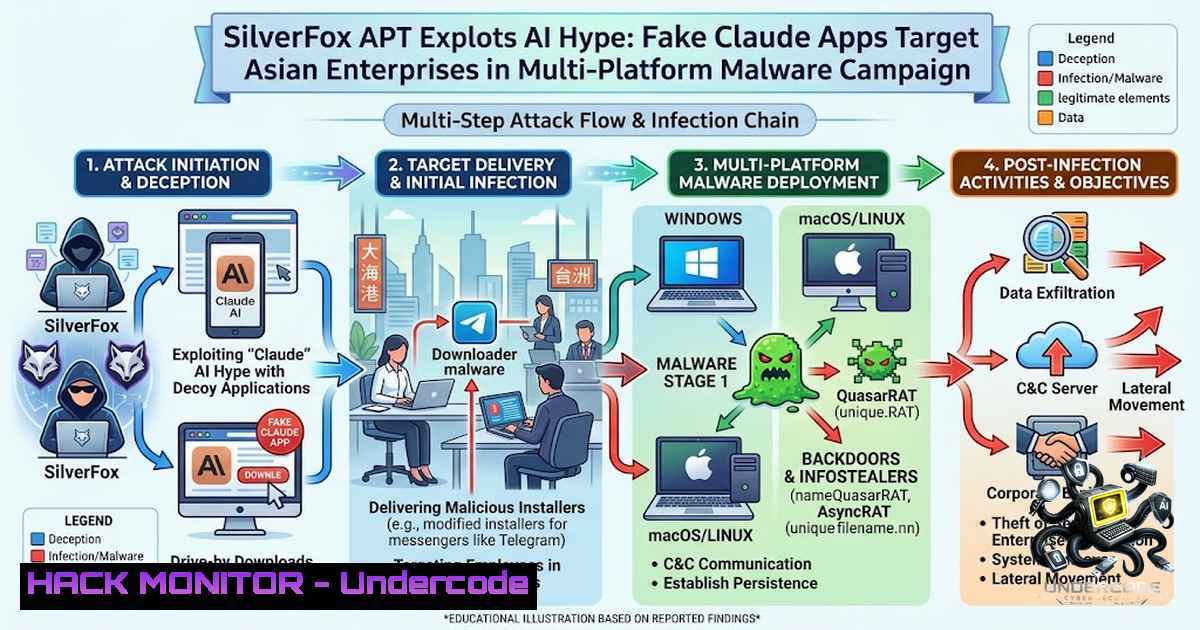
The convergence of artificial intelligence adoption and sophisticated cyber threats has created a dangerous new attack vector, as evidenced by the SilverFox advanced persistent threat (APT) group’s latest campaign. According to Kaspersky’s Global Research and Analysis Team (GReAT), SilverFox—one of the most active threat groups in the Asia-Pacific region—is now distributing fake Claude AI applications across Windows, macOS, and Linux to infiltrate corporate networks. This campaign exploits organizations’ growing reliance on AI tools, transforming legitimate user interest into a primary infection vector. With over 92,000 malware attacks disguised as AI services detected globally in 2026 and SilverFox concentrating more than 90% of its attacks on Greater China, this threat demands immediate defensive action from security teams across all sectors.
Learning Objectives & Secrets:
- Objective 1: Understand SilverFox’s Multi-Platform Attack Chain — Master the complete infection lifecycle, from initial lure through fake Claude applications to persistent backdoor deployment across Windows, macOS, and Linux environments.
-
Objective 2 Secret Tip: Identify Segmented Infrastructure Patterns — SilverFox uses different IP addresses and domains at each attack stage, making traditional IoC-based detection ineffective. Security teams must track behavioral patterns rather than relying solely on static indicators.
-
Objective 3 Secret Tip: Leverage AI-Specific Detection Rules — Create custom detection rules that identify anomalous AI application behaviors, including unexpected network connections, unusual file system modifications, and unauthorized process executions that deviate from legitimate AI tool operations.
You Should Know:
- The SilverFox Attack Chain: From Fake Claude to Full Compromise
SilverFox employs a sophisticated multi-stage attack process that begins with social engineering and culminates in persistent remote access. The group’s primary entry vectors include fake websites mimicking legitimate AI platforms, phishing emails disguised as tax audit notifications, and malicious files distributed through social messaging apps.
Step-by-Step Attack Analysis:
- Stage 1 — Initial Lure: Attackers distribute fake Claude AI installers for Windows, macOS, and Linux through typosquatted domains, SEO-poisoned search results, and phishing campaigns. In one documented campaign, over 1,600 malicious emails were detected between January and February 2026, often posing as official tax authority communications.
-
Stage 2 — Execution: When executed, the fake installer silently deploys malware onto the victim’s device. The malicious payload establishes persistence through various mechanisms, including Windows Registry Run keys and scheduled tasks.
-
Stage 3 — C2 Communication: The malware establishes encrypted communication with command-and-control servers. SilverFox has been observed using HTTPS with asynchronous Socket.IO messaging, WebSocket connections, and QUIC protocols to blend with normal web traffic.
-
Stage 4 — Payload Delivery: The initial malware downloads additional stages, including backdoors such as ValleyRAT (also known as Winos 4.0), ABCDoor, Sauron backdoor, and Go-based RATs.
-
Stage 5 — Persistence and Exfiltration: Once established, the malware enables long-term cyberespionage, sensitive data gathering, screen capture, keystroke logging, and active application monitoring.
Detection Commands:
Linux — Check for Suspicious AI-Related Processes:
ps aux | grep -i claude | grep -v grep
lsof -i -P -1 | grep -E '443|8443' | grep -v 'systemd|sshd'
find /opt /usr/local /home -1ame "claude" -type f -mtime -30 2>/dev/null
Windows — Detect Fake Claude Installers and C2 Connections:
Get-Process | Where-Object {$<em>.ProcessName -match "claude|anthropic|ai"}
Get-1etTCPConnection | Where-Object {$</em>.State -eq "Established" -and $<em>.RemotePort -in (443,8443,8080)}
Get-ScheduledTask | Where-Object {$</em>.TaskName -match "updater|claude|ai"}
Network Monitoring — Identify Suspicious Outbound Connections:
sudo tcpdump -i any -1n 'host not 192.168.0.0/16 and host not 10.0.0.0/8 and port 443' -c 100
2. Infrastructure Segmentation: Breaking the Attack Chain
SilverFox’s use of segmented infrastructure—with different domains and IP addresses at each attack stage—makes it exceptionally difficult for security teams to identify and block the complete attack chain. This approach requires defenders to adopt a holistic, behavior-based detection strategy rather than relying on static blocklists.
Step-by-Step Infrastructure Hardening:
- Step 1 — DNS and Domain Monitoring: Implement DNS sinkholing and monitor for typosquatted domains impersonating legitimate AI services. SilverFox has been observed using domains mimicking trusted software brands.
-
Step 2 — Egress Filtering: Restrict outbound traffic to only approved destinations. Block connections to known malicious infrastructure, including observed C2 servers such as `https://jun616.oss-cn-beijing.aliyuncs.com/tad/payload.exe`.
-
Step 3 — SSL/TLS Inspection: Deploy SSL decryption at the perimeter to inspect encrypted traffic for C2 communication patterns, including unusual certificate fingerprints and non-standard TLS handshakes.
-
Step 4 — Endpoint Detection and Response (EDR): Configure EDR solutions to alert on suspicious process behaviors, including unexpected child processes spawned from AI applications, anomalous registry modifications, and unauthorized scheduled task creation.
Implementation Commands:
Linux — Egress Filtering with iptables:
 Block known SilverFox C2 ranges (example - update with current IoCs)
sudo iptables -A OUTPUT -d 103.235.0.0/16 -j DROP
sudo iptables -A OUTPUT -d 47.254.0.0/16 -j DROP
 Log all outbound connections to non-standard ports
sudo iptables -A OUTPUT -p tcp --dport 8443 -j LOG --log-prefix "SUSPECT_C2: "
Windows — Advanced Audit Policy for Process Creation:
auditpol /set /subcategory:"Process Creation" /success:enable /failure:enable
 Enable PowerShell script block logging for suspicious AI-related scripts
Set-ItemProperty -Path "HKLM:\SOFTWARE\Policies\Microsoft\Windows\PowerShell\ScriptBlockLogging" -1ame "EnableScriptBlockLogging" -Value 1
SIEM Query — Detect Suspicious Process Chains:
-- Splunk/Elastic search for AI application spawning unexpected processes
index= process_name=claude OR process_name=claude
| where child_process_name IN ("powershell.exe", "cmd.exe", "wscript.exe", "python.exe")
| stats count by host, user, parent_process, child_process
3. BYOVD and Kernel-Level Evasion Techniques
SilverFox has expanded its toolkit to include Bring Your Own Vulnerable Driver (BYOVD) attacks, using legitimate but vulnerable kernel drivers to disable security tools. This technique allows the malware to operate with kernel-level privileges, making detection and removal significantly more challenging.
Step-by-Step BYOVD Mitigation:
- Step 1 — Driver Blocklisting: Maintain and enforce a blocklist of known vulnerable drivers. SilverFox has been observed using multiple drivers in a single attack chain to disable antivirus and monitoring tools.
-
Step 2 — Kernel-Mode Code Signing: Enforce strict driver signing requirements. Only allow drivers signed by Microsoft’s WHQL program or trusted vendors.
-
Step 3 — Memory Integrity: Enable Hypervisor-protected Code Integrity (HVCI) and Virtualization-Based Security (VBS) to prevent kernel-level code injection.
-
Step 4 — Endpoint Hardening: Disable unnecessary kernel drivers and services. Implement application whitelisting to prevent unauthorized driver installations.
Verification Commands:
Windows — List Loaded Kernel Drivers:
Get-WindowsDriver -Online | Where-Object {$<em>.ProviderName -match "Unknown|Suspicious"}
driverquery /v | findstr /i "silverfox valleyrat"
 Check for unsigned drivers
Get-SignedDriver | Where-Object {$</em>.IsSigned -eq $false}
Linux — Kernel Module Auditing:
 List all loaded kernel modules
lsmod | sort
 Check for suspicious modules
lsmod | grep -E "rootkit|hide|cloak"
 Monitor module loading events
sudo auditctl -w /sys/kernel/security/lockdown -p wa -k kernel_module
4. AI-Powered Defense Against AI-Driven Threats
Kaspersky researchers warn that AI is lowering the cost and technical expertise required to launch sophisticated cyberattacks. The emergence of fully LLM-driven threats like JADEPUFFER—which can diagnose failed attacks, adjust tactics, and relaunch within 31 seconds—demonstrates the urgent need for AI-powered defense mechanisms.
Step-by-Step AI Defense Implementation:
- Step 1 — Deploy AI-Driven Threat Hunting: Implement AI-based detection and response solutions that can identify anomalous patterns across endpoints, networks, and cloud environments.
-
Step 2 — Zero Trust Architecture: Adopt Zero Trust principles, including continuous verification of user identities, device health, and contextual access controls.
-
Step 3 — AI-Specific Security Policies: Create governance frameworks for AI tool usage, including approved vendor lists, usage monitoring, and data handling policies.
-
Step 4 — Managed Detection and Response: For organizations lacking in-house cybersecurity expertise, implement managed security services such as MDR and Incident Response to ensure 24/7 threat monitoring and remediation.
5. Sector-Specific Risk Assessment and Mitigation
SilverFox’s attacks are concentrated in specific sectors and regions, with manufacturing accounting for more than one-third of all attacks, followed by IT, services, healthcare, and finance. Greater China represents over 90% of SilverFox’s malicious activity, with mainland China alone accounting for 71%.
Regional and Sectoral Defense Strategies:
- Manufacturing: Implement OT/ICS security measures, including network segmentation between IT and operational technology, and regular vulnerability assessments of industrial control systems.
-
Healthcare: Deploy enhanced data protection measures for patient records, implement strict access controls, and conduct regular security awareness training for medical staff.
-
Finance: Implement advanced fraud detection systems, deploy API security measures, and enforce multi-factor authentication for all financial transactions.
-
IT Services: Conduct regular penetration testing, implement supply chain security assessments, and maintain rigorous patch management processes.
What Undercode Say:
-
Key Takeaway 1: SilverFox’s exploitation of AI tools represents a fundamental shift in APT tactics—attackers are now weaponizing enterprise trust in emerging technologies. Organizations must treat any AI application download as a potential security risk, regardless of the source’s apparent legitimacy.
-
Key Takeaway 2: The multi-platform nature of this campaign (Windows, macOS, and Linux) demands a unified security strategy. Traditional endpoint protection focused solely on Windows is insufficient; security teams must implement cross-platform detection and response capabilities.
-
Key Takeaway 3: Segmented infrastructure and multi-stage attacks require a paradigm shift from reactive IoC-based detection to proactive behavioral analysis. Security teams should prioritize anomaly detection, user and entity behavior analytics (UEBA), and continuous monitoring over signature-based solutions.
-
Key Takeaway 4: The rise of AI-driven attacks like JADEPUFFER signals an imminent future where cyberattacks become fully autonomous. Defenders must match this speed with AI-powered security operations, including automated incident response and predictive threat intelligence.
-
Key Takeaway 5: The concentration of attacks in specific regions and sectors highlights the importance of threat intelligence sharing. Organizations in high-risk sectors should participate in Information Sharing and Analysis Centers (ISACs) and collaborate with industry peers to stay ahead of emerging threats.
Prediction:
-
+1 Organizations that rapidly adopt AI-powered defense mechanisms and Zero Trust architectures will gain a significant advantage over attackers, potentially reducing dwell time from weeks to hours.
-
-1 The accessibility of AI-powered attack tools will democratize sophisticated cyberattacks, enabling less-skilled threat actors to launch campaigns previously reserved for nation-state APT groups.
-
-1 Without immediate action, fake AI application campaigns will proliferate across all major AI platforms, with attackers expanding beyond Claude to target Gemini, ChatGPT, and emerging agentic AI tools.
-
+1 Regulatory bodies will likely introduce mandatory AI security frameworks, forcing organizations to implement standardized protections against AI-themed threats.
-
-1 The manufacturing and healthcare sectors—already under-resourced in cybersecurity—face disproportionate risk and may experience significant operational disruptions before adequate defenses are implemented.
-
-1 SilverFox’s successful campaign will inspire copycat groups, leading to a wave of AI-themed social engineering attacks across all global regions within the next 6-12 months.
-
+1 The cybersecurity industry will accelerate development of AI-specific threat detection models, creating new specialized tools and training programs to address this emerging threat vector.
-
-1 Organizations that fail to update their security policies to address AI-specific threats will remain vulnerable, with the average cost of a SilverFox-style breach likely exceeding $5 million per incident.
▶️ Related Video (78% Match):
https://www.youtube.com/watch?v=6BfURuBDS4o
🎯Let’s Practice For Free:
🎓 Live Courses & Certifications:
Join Undercode Academy for Verified Certifications
🚀 Request a Custom Project:
Secure, high-velocity infrastructure and disruptive technological engineering. Contact our engineering team for high-tier development and proprietary systems:
[email protected]
💎 Smart Architecture | 🛡️ Secure by Design | ⭐ Trusted by Thousands
IT/Security Reporter URL:
Reported By: https://lnkd.in/p/eje-vFne – Hackers Feeds
Extra Hub: Undercode MoN
Basic Verification: Pass ✅


