Listen to this Post
Introduction:
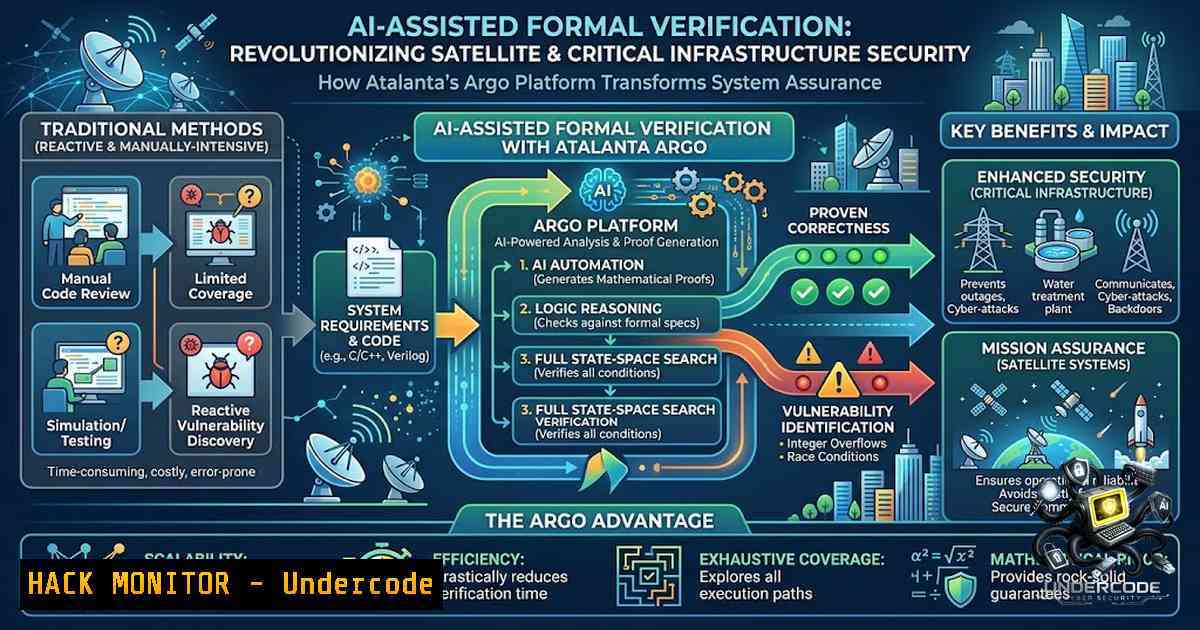
On February 24, 2022—the same day Russia invaded Ukraine—thousands of satellite modems across Ukraine and Europe were remotely disabled in a coordinated cyberattack that targeted the Viasat KA-SAT network. The attack, attributed to Russian military intelligence, exploited a misconfigured VPN appliance to issue legitimate management commands that wiped modems with destructive malware. In response, cybersecurity firm Atalanta has released “Argo,” an AI-assisted platform that combines formal mathematical proof techniques with artificial intelligence to analyze, verify, and harden complex software systems against such vulnerabilities. This technology, which was instrumental in securing Viasat’s network post-attack, represents a paradigm shift in how critical infrastructure—from satellite communications to autonomous nuclear reactors—can be defended in an era of escalating cyberwarfare.
Learning Objectives & Secrets:
- Objective 1: Understand Formal Verification vs. Traditional Security Testing – Learn how Argo’s “software understanding” combines advanced mathematics and AI to generate machine-verifiable evidence of system behavior, going far beyond static analysis or vulnerability scanners that only catch known signatures.
- Objective 2 Secret Tip: Leverage Mathematical Proof for Zero-Trust Assurance – Discover how to integrate formal reasoning into CI/CD pipelines to validate architectural assumptions, verify critical system properties, and produce assurance artifacts that support Continuous Authority to Operate (cATO) and Zero Trust initiatives.
- Objective 3 Secret Tip: Preemptively Model Attack Scenarios – Use Argo’s architecture analysis to model concurrency issues, integration risks, and unintended system behaviors before deployment—catching the kind of “legitimate command” exploitation that crippled Viasat.
You Should Know:
- The Viasat KA-SAT Attack: A Case Study in Supply-Chain and Configuration Vulnerabilities
The 2022 Viasat hack was not a zero-day exploit but rather a failure of configuration and access control. Attackers gained entry through a poorly secured VPN appliance, then used legitimate management interfaces to issue destructive commands that bricked tens of thousands of modems. This highlights a critical lesson: trusted systems with legitimate access can be weaponized. The malware, believed to be a variant of the Russian-linked VPNFilter wiper, rendered modems unusable, forcing Viasat to ship nearly 30,000 replacement units.
Step‑by‑step guide to auditing against similar VPN-based attacks:
Linux/Unix (audit VPN appliance config):
 Check for misconfigured VPN access rules
sudo grep -r "permit" /etc/strongswan/ | grep -v "deny"
 Review firewall rules allowing management interfaces
sudo iptables -L -1 -v | grep -E "443|8443|22"
 Audit listening services on management interfaces
sudo ss -tulpn | grep -E ":443|:8443|:22"
Windows (PowerShell – check for exposed management ports):
 Check listening ports for management services
Get-1etTCPConnection | Where-Object {$<em>.LocalPort -in @(22,443,8443,8080)} | Format-Table
 Review Windows Firewall rules allowing remote management
Get-1etFirewallRule | Where-Object {$</em>.Direction -eq 'Inbound' -and $_.Action -eq 'Allow'}
Hardening recommendation: Implement network segmentation so management interfaces are only accessible via dedicated jump hosts with multifactor authentication, and enforce strict egress filtering to prevent outbound malicious commands.
2. Understanding “Software Understanding”: Formal Methods Meets AI
Atalanta’s Argo platform is built on a concept called “software understanding”—a hybrid approach that uses complex mathematics (theorem proving, formal verification) alongside AI to analyze how software behaves under all possible conditions. Unlike traditional testing, which checks a finite set of inputs, formal methods mathematically prove that certain properties hold true for all inputs and states. DARPA has invested over $2 billion over two decades in advancing these formal methods, and Argo represents their commercial fruition.
Step‑by‑step guide to integrating formal verification into DevSecOps:
- Map critical system properties – Define invariants (e.g., “memory safety,” “no unauthorized network egress,” “all state transitions are authenticated”).
- Integrate Argo as a formal reasoning layer within your existing CI/CD pipeline (Jenkins, GitLab CI, GitHub Actions).
- Run architecture verification on each build to validate that code changes do not violate critical properties.
- Generate machine-verifiable evidence – Argo produces mathematical proofs that can be submitted as assurance artifacts for compliance (cATO, FedRAMP, etc.).
5. Continuously reassess as dependencies and configurations evolve.
Example CI/CD integration (GitHub Actions YAML snippet):
- name: Run Argo Formal Verification
run: |
argo verify --target ./build/ --properties ./security-properties.yaml
argo generate-report --format=cato > assurance-artifact.json
- Critical Infrastructure at Risk: From Satellites to Nuclear Reactors
The Viasat attack was not an isolated incident. Iranian hackers have recently targeted water and wastewater systems, while the Department of Energy has tapped Atalanta’s technology for the Genesis Mission—an initiative to create autonomous nuclear reactors. Greg Shannon of Idaho National Laboratory predicts that formal verification will become “just part of the standard development tool kits” within a decade.
Step‑by‑step guide to hardening SCADA/ICS environments:
Linux (audit industrial control system network interfaces):
 List all active network interfaces and their IPs
ip addr show
 Check for unauthorized serial-to-IP converters (common in legacy ICS)
sudo lsusb | grep -i "serial"
 Review Modbus/TCP exposure (port 502)
sudo nmap -p 502 --open <target-ip-range>
Windows (check for exposed OPC/DCOM services):
 Check for DCOM exposed endpoints (often used in OPC)
Get-WmiObject -Class Win32_DCOMApplication | Select-Object AppID, Name
 Review firewall rules for port 135 (RPC) and 102 (ISO-TSAP)
Get-1etFirewallRule | Where-Object {$_.LocalPort -in @(135,102,502)}
Hardening recommendation: Implement network-based intrusion detection (Zeek/Snort) with custom rules for industrial protocols, and segment OT networks from IT using unidirectional gateways where possible.
- Cloud and API Security: Formal Verification for Microservices
Modern satellite ground systems and critical infrastructure increasingly rely on cloud-1ative microservices and APIs. The same “legitimate command” exploitation that hit Viasat can manifest as API abuse—where attackers use valid credentials to perform destructive actions.
Step‑by‑step guide to API security hardening with formal methods:
- Define API state machines – Model all valid state transitions for each API endpoint (e.g., “authenticated → authorized → action → audit”).
- Apply formal verification to prove that no sequence of API calls can lead to an unauthorized state (e.g., deleting a satellite modem without proper multi-party approval).
- Enforce rate limiting and anomaly detection – Use AI to detect deviations from verified state machines.
Linux (audit API endpoints with OWASP ZAP):
 Baseline scan of API endpoints
zap-cli quick-scan --self-contained --start-options '-config api.disablekey=true' http://api.example.com/v1/
 Generate OpenAPI spec for formal modeling
curl -s http://api.example.com/v1/openapi.json | jq '.'
Cloud (AWS – check IAM policies for over-privileged roles):
aws iam list-roles --query 'Roles[?AssumeRolePolicyDocument.Statement[?Effect==<code>Allow</code>]]' --output table
 Use IAM Access Analyzer to identify unused or excessive permissions
aws accessanalyzer validate-policy --policy-document file://policy.json
- The Future: AI-Enabled Autonomous Systems and the DoD Gold Standard
Emil Michael, the Pentagon’s chief technology officer, has stated that he wants Atalanta’s mathematical underpinnings to “become the DoD’s gold standard” for cybersecurity. As AI-enabled autonomous systems—from drones to space-based defense platforms—become operational, the ability to mathematically prove safety and security will be non-1egotiable.
Step‑by‑step guide to securing AI/ML pipelines:
- Model adversarial inputs – Use formal methods to define the space of possible inputs and prove that the model’s outputs remain within safe bounds.
- Implement robust logging and attestation – Ensure every decision made by an autonomous system is cryptographically signed and auditable.
- Continuous verification – Re-verify the system after each model update or retraining cycle.
Linux (audit ML model integrity):
 Generate SHA-256 hash of model file for integrity verification
sha256sum /path/to/model.pkl
 Monitor for unauthorized changes using AIDE (Advanced Intrusion Detection Environment)
sudo aide --check
Windows (PowerShell – check for unauthorized model tampering):
 Compute file hash
Get-FileHash -Path "C:\Models\model.onnx" -Algorithm SHA256
 Set up File System Watcher to alert on changes
$watcher = New-Object System.IO.FileSystemWatcher
$watcher.Path = "C:\Models"
$watcher.Filter = ".onnx"
Register-ObjectEvent $watcher "Changed" -Action { Write-Host "Model changed!" }
What Undercode Say:
- Key Takeaway 1: The Viasat hack was a wake-up call that traditional perimeter security and vulnerability scanners are insufficient. The attack succeeded not through sophisticated zero-days but through misconfigured VPNs and abuse of legitimate management commands—exactly the kind of “trusted” vector that formal verification can preemptively eliminate.
-
Key Takeaway 2: Atalanta’s Argo platform represents the commercial maturation of over $2 billion in DARPA-funded research into formal methods. By combining AI with mathematical proof, it offers a path to verifiable security—not just “we tested it and found no bugs,” but “we mathematically proved this property holds for all possible inputs.” This is the difference between security as a checklist and security as a guarantee.
Analysis: The convergence of AI and formal methods is poised to redefine cybersecurity assurance. For decades, the industry has relied on reactive measures—patching vulnerabilities after discovery, scanning for known signatures, and hoping that zero-days remain undiscovered. Argo flips this model: it proactively proves that certain classes of vulnerabilities cannot exist. This is particularly critical for space systems, where patching is impractical, and for autonomous systems, where human oversight is limited. However, the technology is not a silver bullet. Formal verification requires expertise, and modeling complex systems is non-trivial. Moreover, it addresses only software correctness—not social engineering or insider threats. Nevertheless, as the DoD and critical infrastructure operators adopt this standard, we can expect a new generation of systems that are not just resilient but mathematically guaranteed to be secure in specific, provable ways. The next frontier will be extending these techniques to hardware and supply chain verification, ensuring that the entire stack—from silicon to satellite—can be formally assured.
Prediction:
- +1 Formal verification will become mandatory for all DoD and critical infrastructure software contracts within 5–7 years, mirroring the adoption of FIPS 140-2 for cryptography.
- +1 AI-assisted formal methods will democratize access to mathematical proof, with open-source tooling emerging to lower the barrier for smaller organizations.
- -1 Adversaries will shift tactics toward exploiting human factors (phishing, insider threats) and physical supply chains, as software becomes mathematically harder to break.
- -1 The shortage of professionals trained in both cybersecurity and formal mathematics will create a critical skills gap, potentially slowing adoption despite technical readiness.
- +1 Space-based systems will lead the way in adopting verifiable security, as the inability to patch satellites makes formal proof the only viable assurance mechanism.
▶️ Related Video (80% Match):
🎯Let’s Practice For Free:
🎓 Live Courses & Certifications:
Join Undercode Academy for Verified Certifications
🚀 Request a Custom Project:
Secure, high-velocity infrastructure and disruptive technological engineering. Contact our engineering team for high-tier development and proprietary systems:
[email protected]
💎 Smart Architecture | 🛡️ Secure by Design | ⭐ Trusted by Thousands
IT/Security Reporter URL:
Reported By: https://lnkd.in/p/eVdsKng8 – Hackers Feeds
Extra Hub: Undercode MoN
Basic Verification: Pass ✅


