Listen to this Post
Introduction:
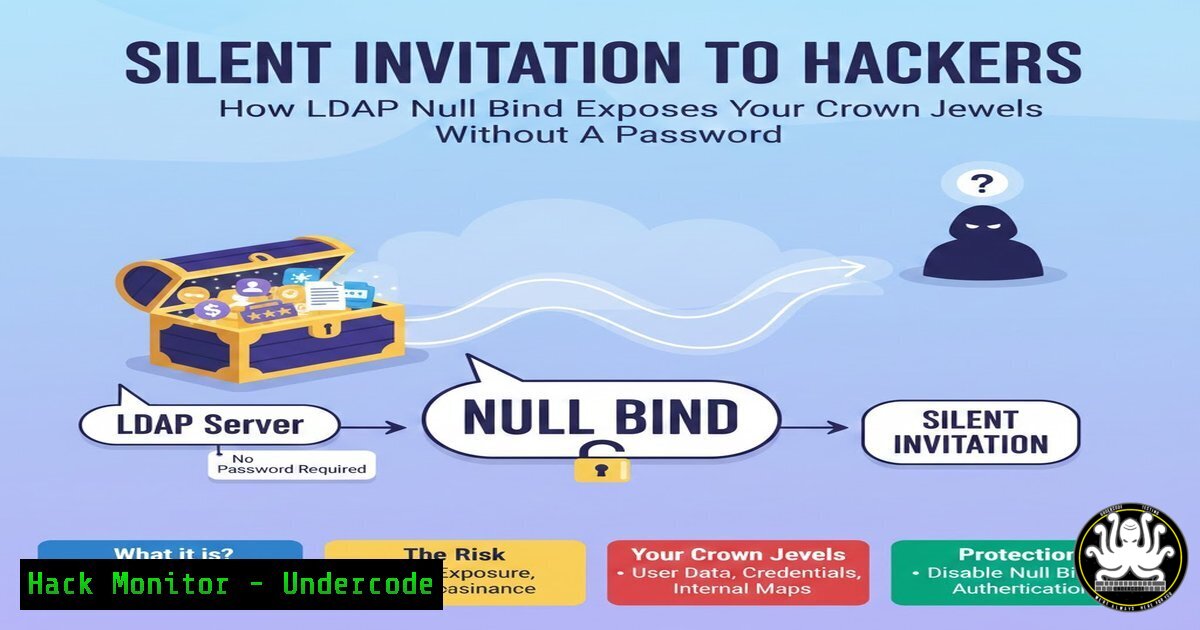
In the complex architecture of enterprise identity management, the Lightweight Directory Access Protocol (LDAP) serves as the critical phonebook, connecting users to resources. However, a legacy feature known as “Null Bind” or “Anonymous Bind” can transform this directory into an open book for attackers. This severe misconfiguration allows anyone to query the LDAP service without a username or password, potentially leaking sensitive employee data, system credentials, and network architecture details, paving the way for devastating breaches.
Learning Objectives:
- Understand the technical mechanism and inherent danger of the LDAP Null Bind vulnerability.
- Learn to identify and test for Null Bind misconfigurations in both Linux and Windows Active Directory environments.
- Implement definitive mitigation strategies to secure LDAP and AD LDS services across your infrastructure.
You Should Know:
- The Anatomy of an Open Door: What is LDAP Null Bind?
LDAP authentication typically follows a “bind” operation where a client presents a username (Distinguished Name) and password. A Null Bind occurs when a client sends an empty DN and an empty password. Historically, this was used for service discovery, but in modern contexts, permitting it is a critical flaw. A misconfigured server that accepts this bind grants the client anonymous, read-only access to the directory tree. The extent of data leakage depends on the directory’s Access Control Lists (ACLs), but it often includes user attributes (names, emails, departments), group memberships, and sometimes even system information, providing a treasure trove for reconnaissance. -
The Hunter’s Toolkit: How to Test for Null Bind Vulnerability
Testing for this vulnerability is straightforward and does not require advanced hacking tools. The process involves attempting to connect to the LDAP service anonymously and performing a simple query.
On Linux (using `ldapsearch`):
 Install LDAP utilities if needed: sudo apt-get install ldap-utils
 Test for Null Bind against a target server
ldapsearch -x -H ldap://<target_ip> -b "dc=example,dc=com" -s sub "(objectClass=)"
`-x`: Uses simple authentication.
`-H`: Target LDAP server URI.
-b: Base Distinguished Name for the search (you may need to guess or find this).
`-s sub`: Search scope.
"(objectClass=)": A filter to return all object types.
A successful return of data without being prompted for credentials confirms the vulnerability.
On Windows (using PowerShell):
 Create a directory entry object for anonymous bind
$ldapPath = "LDAP://<target_ip>/DC=example,DC=com"
$entry = New-Object System.DirectoryServices.DirectoryEntry($ldapPath, $null, $null)
if ($entry.Name -ne $null) {
Write-Host "[!] Vulnerable to Null Bind!" -ForegroundColor Red
$searcher = New-Object System.DirectoryServices.DirectorySearcher($entry)
$searcher.Filter = "(objectClass=)"
$results = $searcher.FindAll()
foreach ($result in $results) { $result.Properties }
} else {
Write-Host "[+] Null Bind not allowed." -ForegroundColor Green
}
3. From Recon to Ruin: Exploiting Extracted Data
The data gleaned from a Null Bind is rarely an endpoint in itself. It is fuel for more advanced attacks. Attackers use this information for:
Password Spraying: Compiling a list of valid usernames (e.g., jdoe, awhite) to launch targeted password-guessing attacks against other services (OWA, VPN, SSH).
Spear-Phishing Campaigns: Using real names, job titles, and email addresses to craft highly convincing phishing emails.
Network Mapping: Understanding organizational structure and identifying high-value targets (e.g., “Domain Admins” group members).
Brute-Force Amplification: Using the discovered user list to launch more efficient LDAP brute-force attacks if a single weak password is found elsewhere.
- The Definitive Lockdown: Mitigating Null Bind on Key Platforms
The universal mitigation is to disable anonymous/unauthenticated access. The method varies by platform.For OpenLDAP (Linux): Edit the `slapd.conf` file and ensure the following directive is present and not commented out:
disallow bind_anon
After making the change, restart the `slapd` service.
For Microsoft Active Directory / AD LDS: The setting is controlled via Group Policy.
1. Open the Group Policy Management Console (GPMC).
- Edit the appropriate GPO (e.g., Default Domain Controllers Policy).
- Navigate to: Computer Configuration -> Policies -> Windows Settings -> Security Settings -> Local Policies -> Security Options.
- Find the policy: “Network security: Restrict NTLM: Incoming NTLM traffic” and related LDAP policies. More critically, ensure “Domain controller: LDAP server signing requirements” is set to “Require signing” to block simple unauthenticated binds.
- Also, configure “Domain controller: Allow anonymous LDAP access” to Disabled.
For Apache Directory Server: Set the `allow-anonymous-access` directive to `false` in the configuration.
-
Beyond the Basics: Hardening Your Overall LDAP/AD Posture
Fixing Null Bind is just the first step. A robust defense includes:
Enforce LDAPS (LDAP over SSL/TLS): Encrypt all LDAP traffic to prevent eavesdropping on queries and data. Ensure certificates are valid.
Implement Strong ACLs: Follow the principle of least privilege. Even for authenticated users, restrict access to directory data to only what is necessary for their role.
Audit and Monitor LDAP Logs: Continuously monitor LDAP access logs for unusual patterns, such as a sudden surge in simple bind requests or queries from unexpected sources.
Network Segmentation: Restrict access to LDAP servers (port 389/636) to only authorized management subnets and application servers that absolutely require it.
What Undercode Say:
Key Takeaway 1: The LDAP Null Bind vulnerability is not a complex exploit; it is a catastrophic misconfiguration. Its presence indicates a fundamental gap in security hygiene and patch/configuration management processes, often stemming from legacy system setups or oversight during deployment.
Key Takeaway 2: The real danger of this flaw is its role as a force multiplier. It doesn’t directly compromise systems but efficiently hands attackers the map and the name list needed to plan a precise, effective, and difficult-to-detect campaign, turning a simple check into a breach catalyst.
Analysis:
The persistence of vulnerabilities like LDAP Null Bind underscores a critical disconnect between security policy and operational configuration. While organizations invest in advanced threat detection, foundational doors are left unlocked. This flaw is particularly insidious in hybrid cloud environments where legacy AD infrastructure interacts with modern applications, sometimes leading to permissive settings being re-enabled for “compatibility.” It serves as a potent reminder that offensive security tools like those used in pentesting are essential for proactive defense, as they simulate the very attacker mindset that exploits these oversight gaps. The finding emphasizes that asset discovery and continuous configuration auditing are as vital as any firewall rule.
Prediction:
As identity becomes the new perimeter with the shift to cloud and zero-trust models, attacks on directory services will intensify. While Null Bind itself is a well-known issue, we predict a rise in automated scanning tools used by botnets to mass-scan the internet for this and related LDAP/AD misconfigurations (like weak signing requirements). Successfully enumerated data from these scans will be commoditized and sold on dark web forums as “Access Intelligence Packs,” lowering the entry barrier for less sophisticated ransomware groups. Furthermore, the integration of AI will allow attackers to correlate data from anonymous LDAP queries with publicly leaked information from social media and breaches to generate hyper-realistic social engineering campaigns, making the initial data leak from this “easy P3 bug” the first domino in increasingly automated and personalized attack chains.
▶️ Related Video (78% Match):
🎯Let’s Practice For Free:
IT/Security Reporter URL:
Reported By: Abhirup Konwar – Hackers Feeds
Extra Hub: Undercode MoN
Basic Verification: Pass ✅


