Listen to this Post
Introduction:
The cybersecurity paradigm has fundamentally shifted. With attackers weaponizing generative AI to compress the window between vulnerability discovery and exploitation from months to minutes, traditional reactive security models are obsolete. ServiceNow’s unveiling of its Autonomous Security suite at Black Hat 2026 introduces a prevention-first, AI-1ative architecture designed to operate at machine speed, consolidating six critical security domains into a unified operational framework. This article provides a technical deep-dive into the architecture, implementation strategies, and operational commands necessary for security professionals to leverage this new paradigm.
Learning Objectives:
- Understand the architectural pillars of ServiceNow Autonomous Security and the “Shift Zero” philosophy.
- Master the configuration and utilization of AI Specialists for autonomous vulnerability remediation and incident response.
- Implement unified identity governance encompassing both human and non-human identities using the integrated Veza platform.
- Operationalize cyber-physical security by integrating Armis for OT/IoT asset visibility and risk management.
- Leverage the AI Control Tower for continuous governance, observability, and control over agentic AI workflows.
You Should Know:
- Architecting the Shift Zero Framework: From Reactive to Predictive Security
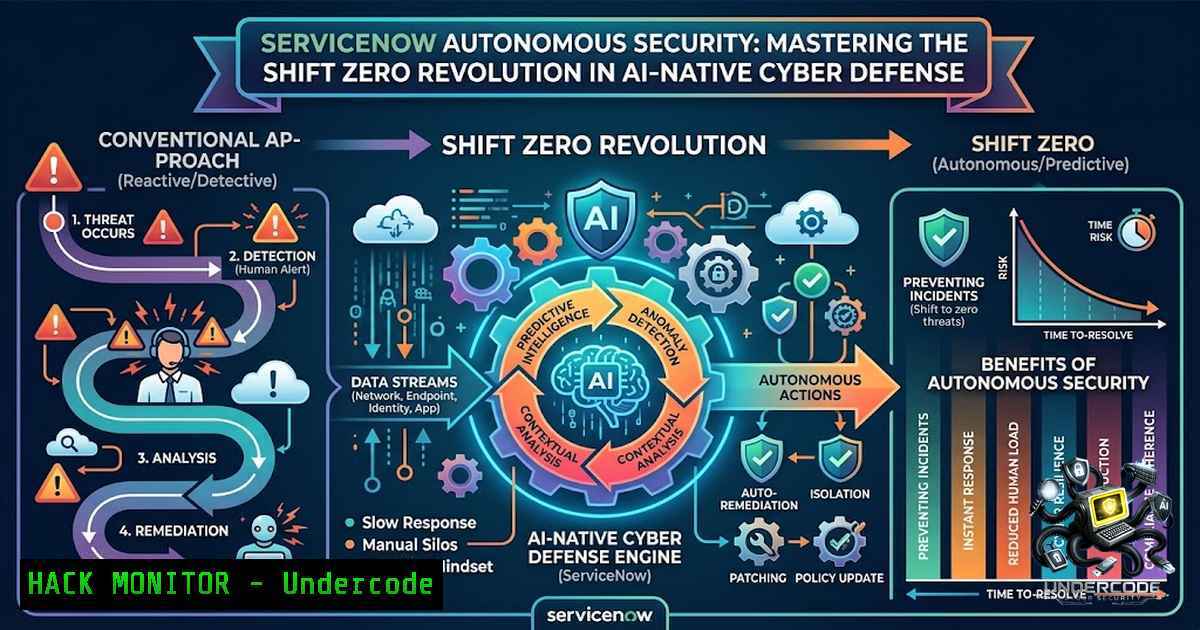
The core philosophy driving ServiceNow’s new offering is “Shift Zero”—a strategic move away from fragmented, reactive security tooling toward a state where prevention is embedded at every layer, with the goal of maintaining zero exposure at all times. This is not merely an incremental update but a fundamental re-architecture of how security operations are conducted. The platform achieves this through a “single, continuously updated plane and security graph” that synthesizes data across identities, assets, vulnerabilities, and workflows.
For implementers, this means moving beyond deploying isolated modules. You must understand how the ServiceNow AI Platform now serves as the operational backbone, ingesting telemetry from Armis (for unmanaged and cyber-physical assets) and Veza (for identity permissions) to create a unified data model. The architecture relies on a closed-loop system where the platform can “sense, decide, act, and secure” across the entire enterprise.
Step‑by‑step guide: Initial Architecture Assessment
- Inventory Existing Security Stack: Document all current security tools (e.g., vulnerability scanners, SIEM, IAM solutions). The average enterprise runs more than 70 security tools, and consolidation is key.
- Map Data Sources to ServiceNow: Identify which data sources will feed into the ServiceNow security graph. This includes vulnerability findings, asset inventories, identity stores (Active Directory, Entra ID, Okta), and cloud provider APIs (AWS, Azure, GCP).
- Define Business Context: Work with business units to tag and classify assets based on criticality. Autonomous remediation prioritization relies on understanding which assets matter most.
- Configure Unified Exposure Management: Set up the initial ingestion and normalization of vulnerability findings from all sources into a single stream. This is the foundation for the AI Specialists to operate.
- Establish AI Control Tower Integration: Ensure the AI Control Tower is enabled and configured to observe, govern, and secure all AI agents and workflows across the enterprise.
2. Operationalizing Autonomous Remediation with AI Specialists
A cornerstone of the Autonomous Security suite is the introduction of AI Specialists that autonomously complete security workflows. The Vulnerability Resolution AI Specialist is designed to orchestrate triage and remediation at enterprise scale, executing low-risk patches and systematically clearing exposure backlogs. This moves the security team’s role from manual remediation to oversight and validation of autonomous actions.
The AI Specialist operates by ingesting the prioritized list from Agentic Exposure Management, which enriches findings with Early Warning threat intelligence and Fix Intelligence. It then determines the optimal remediation path, executes the fix (e.g., applying a patch, updating a configuration), and documents the entire process for auditability. ServiceNow’s own security operations team reportedly handles incidents seven times faster using this autonomous workflow.
Step‑by‑step guide: Configuring Vulnerability Resolution AI Specialist
- Define Remediation Policies: In the ServiceNow Security Operations module, establish policies that define the scope of autonomous action. For example, allow the AI to automatically apply “critical” patches to non-production systems but require human approval for production environments.
- Integrate Patch Management Tools: Connect the platform to your existing patch management solutions (e.g., AWS Systems Manager, Azure Update Management, Microsoft SCCM) to enable automated execution.
- Set Up Fix Intelligence: Ensure that the platform has access to threat intelligence feeds and vendor patch databases to validate the safety and efficacy of proposed fixes.
- Create a “Playbook” for Triage: Define the workflow rules for the AI Specialist. For instance, if a vulnerability is detected and a patch exists that has been tested for
days, the AI can proceed with remediation. - Enable Monitoring and Audit Trails: Configure the AI Control Tower to monitor the actions of the Vulnerability Resolution AI Specialist, ensuring every decision and action is documented for compliance and review.
3. Implementing Non-Human Identity Management and Governance
With the integration of Veza, ServiceNow has extended identity governance to cover the burgeoning landscape of non-human identities (NHIs)—including service accounts, API keys, and AI agents. The challenge is that machine identities are doubling every 18 months, and traditional permission architectures designed for humans are inadequate for the speed and scale of AI. This capability is critical because every new AI agent and line of code multiplies the attack surface.
The integrated solution provides a single operational framework to surface risk, enforce least privilege at the point of action, trigger downstream remediation, and build a traceable audit trail for regulators. For security engineers, this means integrating Veza with ServiceNow to get visibility into permissions across both human and non-human identities, understanding which identities can access which assets, and identifying where risk needs to be reduced.
Step‑by‑step guide: Governing Non-Human Identities
- Discover and Inventory NHIs: Use the integrated Veza capabilities to discover all service accounts, API keys, and machine identities across your cloud and on-premises environments.
- Analyze Permission Bloat: Run an analysis to identify NHIs with excessive permissions (e.g., service accounts with administrative privileges). The platform visualizes the permission graph, highlighting risky over-privileged identities.
- Enforce Least Privilege: Use the governance framework to automatically generate and recommend least-privilege access policies for NHIs. This can be configured to trigger automated remediation workflows to revoke unnecessary permissions.
- Integrate with ITSM: Link identity governance with IT Service Management (ITSM) so that access requests and approvals for NHIs are handled within the same operational workflow.
- Continuous Monitoring: Set up continuous monitoring and alerts for any anomalous behavior or permission changes related to non-human identities, using the AI Control Tower’s observability features.
-
Securing the Cyber-Physical Gap: OT and IoT Integration
Through the acquisition of Armis, ServiceNow now provides agentless, real-time discovery and classification of managed and unmanaged assets, including Operational Technology (OT), IoT, medical devices, and industrial equipment. This is a critical advancement, as cyber-physical systems have traditionally been a blind spot for enterprise security, creating massive risk for industries like manufacturing and healthcare.
The integration allows ServiceNow’s CMDB and Vulnerability Response products to ingest in-depth details of cyber-physical systems across the Extended Internet of Things (XIoT), automatically discovered and profiled by Armis. This ensures that vulnerabilities in these critical assets are not just seen but are contextualized and prioritized alongside traditional IT risks.
Step‑by‑step guide: Integrating Cyber-Physical Security
- Deploy Armis Centrix: Ensure the Armis solution is deployed across your network to begin passive, agentless monitoring of all connected assets, including OT and IoT devices.
- Connect Armis to ServiceNow Service Graph: Configure the Armis-ServiceNow integration to automatically populate the CMDB with cyber-physical asset data. This creates a single source of truth for all assets.
- Enable Vulnerability Response for OT/IoT: Extend ServiceNow’s Vulnerability Response (VR) capabilities to include the vulnerabilities identified by Armis in OT/IoT devices.
- Contextualize Risk: Tag OT/IoT assets with business context (e.g., “Production Line 1,” “ICU Patient Monitor”) so that the Unified Exposure Management module can accurately prioritize vulnerabilities based on business impact.
- Establish Incident Response Workflows: Create specific incident response playbooks for cyber-physical threats, integrating with the Agentic Incident Response capabilities to automate containment and remediation actions.
-
Mastering the AI Control Tower for Continuous Governance
The AI Control Tower is the centralized command system that provides unified governance and observability across every AI system, agent, and workflow. It has evolved from a simple monitoring dashboard into a comprehensive governance hub that allows organizations to manage and secure AI models deployed across any system in the enterprise, including those running outside the ServiceNow platform.
Key features include continuous runtime monitoring with live alerts (replacing periodic manual audits), agent kill switches for emergency deactivation, and integration with major AI ecosystems like Microsoft Agent 365 and NVIDIA Enterprise AI Factory. This allows security teams to set thresholds for agent behavior, detect statistical variations in data access patterns, and enforce governance policies in real-time.
Step‑by‑step guide: Setting Up AI Control Tower Governance
- Onboard AI Agents: Register all AI agents and models (both ServiceNow-1ative and third-party) into the AI Control Tower for centralized management.
- Define Governance Policies: Establish policies for acceptable AI behavior, including data access permissions, allowed actions, and operational boundaries.
- Configure Observability: Set up live metrics and alerts to monitor agent performance and behavior. Define thresholds for anomaly detection.
- Implement Kill Switch Protocols: Configure the agent kill switch capabilities to enable immediate deactivation of any agent exhibiting malicious or anomalous behavior.
- Continuous Compliance: Use the platform to generate continuous compliance reports, replacing the need for periodic, manual reviews with real-time governance.
What Undercode Say:
- Key Takeaway 1: The “Shift Zero” philosophy is not a marketing slogan but a technical mandate. Implementers must focus on integrating the security graph across all six solution areas—unified exposure management, continuous vulnerability detection, cyber-physical security, identity and access security, agentic incident response, and cyber risk and compliance—to achieve true autonomous security.
- Key Takeaway 2: The integration of Armis and Veza marks a pivotal moment where ServiceNow transitions from a workflow platform to a comprehensive security control plane. Mastering the data ingestion and context enrichment from these acquisitions is the key differentiator for successful implementation.
Analysis: The launch of Autonomous Security represents a significant escalation in the platform’s capabilities, moving it into direct competition with established SIEM and SOAR vendors. For partners and implementers, the opportunity lies in moving beyond traditional “configuration” work to providing strategic advisory services on security architecture and AI governance. The challenge will be in helping clients navigate the cultural and operational shift required to trust AI with autonomous remediation actions. The emphasis on proof of action and accountability (who acted, why, and who is accountable) is designed to build this trust. Security teams must evolve from being the “brakes” on innovation to becoming “accelerants” by leveraging governed autonomy.
Expected Output:
The information provided in this article serves as a foundational guide for security professionals and ServiceNow implementers looking to understand and deploy the Autonomous Security suite. The technical steps outlined for architecture assessment, AI Specialist configuration, NHI governance, cyber-physical integration, and AI Control Tower setup provide a practical roadmap for leveraging this transformative platform. The core message is clear: the future of cybersecurity is autonomous, prevention-first, and governed at machine speed.
Prediction:
- +1 ServiceNow’s Autonomous Security suite will become the de facto standard for enterprise security operations within 24 months, forcing legacy SIEM and SOAR vendors to accelerate their own AI-1ative transformations.
- -1 Organizations that fail to adapt their identity governance strategies to account for the explosion of non-human identities and AI agents will experience a significant increase in breach risk, as traditional access controls become obsolete.
▶️ Related Video (84% Match):
🎯Let’s Practice For Free:
🎓 Live Courses & Certifications:
Join Undercode Academy for Verified Certifications
🚀 Request a Custom Project:
Secure, high-velocity infrastructure and disruptive technological engineering. Contact our engineering team for high-tier development and proprietary systems:
[email protected]
💎 Smart Architecture | 🛡️ Secure by Design | ⭐ Trusted by Thousands
IT/Security Reporter URL:
Reported By: Arnaud Bretz – Hackers Feeds
Extra Hub: Undercode MoN
Basic Verification: Pass ✅


