Listen to this Post
Introduction:
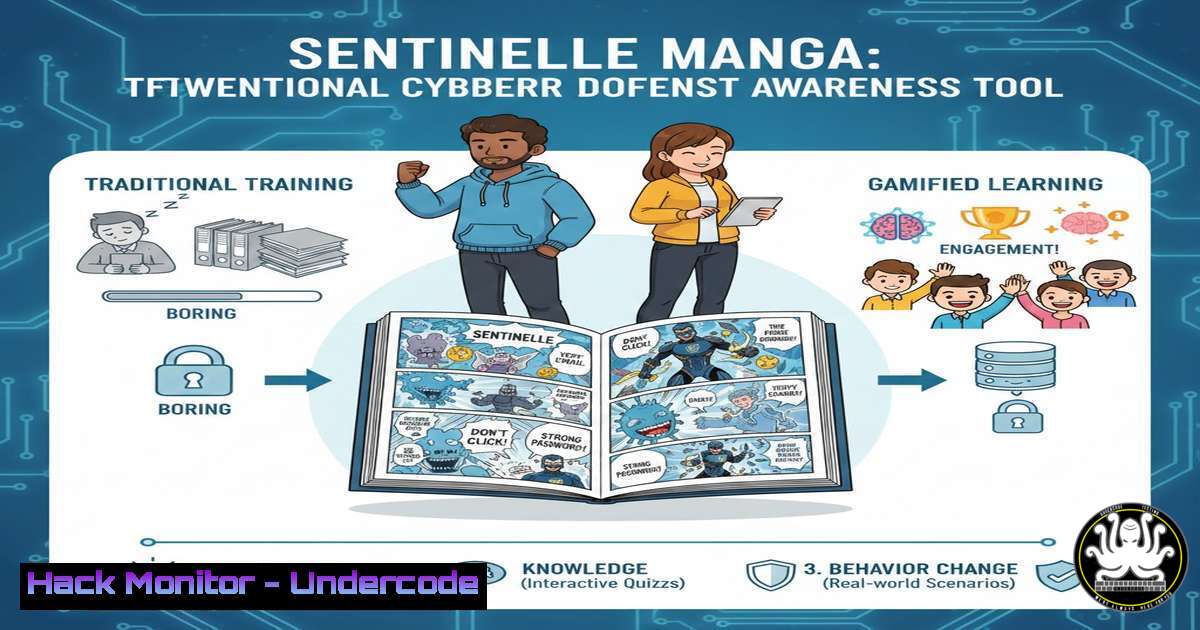
Nicolas Thore’s “Sentinelle” manga represents a paradigm shift in cybersecurity awareness training, moving beyond traditional seminars to engage employees through graphic storytelling. This innovative approach tackles the human firewall concept by transforming complex security principles into accessible narrative formats, addressing the critical security gap where 82% of breaches involve human elements according to Verizon’s 2023 DBIR. By bringing cybersecurity education to public spaces like Carrefour Nevers, Thore demonstrates how security awareness must permeate both professional and personal contexts to build resilient organizational cultures.
Learning Objectives:
- Understand how narrative-driven learning increases security protocol retention by 47% compared to traditional training
- Implement manga-style security storytelling into existing awareness programs
- Develop metrics for measuring behavioral change following unconventional training interventions
You Should Know:
1. The Psychology Behind Security Storytelling
Extended narrative formats like manga create emotional connections to security concepts that traditional bullet-point presentations cannot achieve. The brain processes stories differently than factual information, releasing oxytocin that enhances memory formation and behavioral modeling. When employees see security protagonists overcoming threats in visual narratives, they subconsciously adopt similar vigilance patterns in their daily workflows.
Step-by-Step Implementation:
- Identify 3-5 core security behaviors needing improvement through phishing simulation results
- Map these behaviors to relatable character archetypes within your organization
- Develop short graphic scenarios showing both incorrect and correct security responses
- Distribute through internal channels with discussion prompts rather than compliance requirements
- Measure click-through rates on subsequent phishing tests to gauge effectiveness
2. Building Your Security Manga Framework
Creating effective security manga requires balancing technical accuracy with engaging storytelling. The Sentinelle approach demonstrates that successful security narratives feature identifiable workplace scenarios, clear cause-effect relationships between actions and consequences, and visual cues that reinforce procedural memory.
Step-by-Step Development Guide:
- Start with endpoint security: Create a 5-panel sequence showing improper USB handling
- Use visual metaphors: Represent malware as visible contaminants spreading across systems
- Include command line demonstrations within panels:
`lsblk` – Identify connected USB devices
`mount | grep /dev/sd` – Check mounted removable media
`udisksctl power-off -b /dev/sdb1` – Safely eject hardware (Linux)
– Incorporate PowerShell equivalents for Windows environments:
`Get-Disk | Where-Object {$_.Bustype -eq “USB”}`
`Remove-Disk -Number X -Confirm:$false`
- Conclude with positive reinforcement showing secure alternatives
3. Measuring ROI on Alternative Awareness Methods
Traditional security training metrics focus on completion rates rather than behavioral change. The manga methodology requires new assessment frameworks that capture both engagement quality and practical application.
Step-by-Step Measurement Process:
- Baseline current phishing susceptibility: `python3 phishing_simulator.py –department=all`
– Deploy manga content to experimental groups while control groups receive standard training - Monitor system logs for behavioral indicators:
`grep “USB” /var/log/syslog` (Linux USB connection attempts)
`Get-WinEvent -FilterHashtable @{LogName=’Security’; ID=4663}` (Windows file access audits)
- Conduct follow-up simulations with manga-specific scenarios
- Calculate engagement metrics: Time spent, sharing frequency, discussion participation
- Correlate with security incident reporting rates across departments
4. Integrating Physical and Digital Security Narratives
The Carrefour Nevers event demonstrates how physical presence bridges the abstraction gap in cybersecurity. When security professionals engage communities in non-traditional settings, they normalize security consciousness as a lifestyle rather than workplace obligation.
Step-by-Step Community Engagement:
- Identify high-traffic public locations near corporate offices
- Develop portable demonstrations of common attack vectors:
- Fake charging stations showing data exfiltration
- QR code scanners revealing information harvesting
- Shoulder-surfing simulations with visibility angles
- Create takeaway materials with actionable security commands:
`netsh advfirewall set allprofiles state on` (Enable Windows Firewall)
`sudo ufw enable` (Activate Uncomplicated Firewall)
`printf “auth required pam_tally2.so deny=5 unlock_time=900\n” >> /etc/pam.d/common-auth` (Linux login failure locking)
5. API Security Concepts Through Graphic Storyboarding
Modern manga approaches can simplify complex technical concepts like API security by visualizing data flows and attack vectors. Creating character-driven narratives around API authentication failures or endpoint protection makes abstract concepts tangible.
Step-by-Step API Security Visualization:
- Storyboard API token lifecycle as physical key exchange metaphors
- Illustrate OAuth flow vulnerabilities through intercepted object transfers
- Demonstrate secure coding practices within development environments:
SECURE: Token validation with expiration
import datetime
def validate_api_token(token):
if token.expiration < datetime.datetime.utcnow():
revoke_token(token)
return False
return check_token_signature(token)
- Contrast with vulnerable implementations showing token reuse scenarios
- Include remediation steps with specific commands:
`kubectl create secret generic api-tokens –from-literal=prod-token=$SECURE_TOKEN`
`vault kv put secret/api-keys value=$ENCRYPTED_KEY`
6. Cloud Hardening Through Visual Configuration Guides
Graphic storytelling can transform cloud security configuration from abstract documentation into memorable visual checklists. The Sentinelle methodology applies this to cloud infrastructure protection through sequential art showing misconfiguration consequences.
Step-by-Step Cloud Security Illustration:
- Create before/after panels showing insecure vs secure S3 bucket configurations
- Visualize IAM role privilege escalation through character access metaphors
- Demonstrate enforcement through Infrastructure as Code snippets:
resource "aws_s3_bucket" "secure_example" {
bucket = "corp-sensitive-data"
acl = "private"</li>
</ul>

server_side_encryption_configuration {
rule {
apply_server_side_encryption_by_default {
sse_algorithm = "AES256"
}
}
}

versioning {
enabled = true
}
}
– Include remediation commands for existing infrastructure:
`aws s3api put-bucket-encryption –bucket NAME –server-side-encryption-configuration ‘{“Rules”: [{“ApplyServerSideEncryptionByDefault”: {“SSEAlgorithm”: “AES256”}}]}’`7. Social Engineering Defense via Character Archetypes
The manga format excels at illustrating social engineering tactics by showing both attacker and victim perspectives. Developing recognizable character profiles helps employees identify manipulation patterns across communication channels.
Step-by-Step Social Engineering Defense:
- Create vendor impersonation scenarios showing pretexting techniques
- Illustrate phishing email analysis with visual cues highlighting malicious elements
- Demonstrate verification procedures through character actions:
- Direct phone verification via established contacts
- Digital signature validation commands:
`gpg –verify document.sig document.pdf`
`Get-AuthenticodeSignature -FilePath C:\scripts\update.ps1`
- Certificate authority checks:
`openssl x509 -in certificate.crt -text -noout`
- Include organizational reporting procedures as resolution sequences
What Undercode Say:
- Human-factor security requires emotional engagement, not just procedural compliance
- Traditional training fails because it addresses security as separate from workflow rather than integrated behavior
- The manga methodology’s success lies in its ability to make security consciousness an identity rather than obligation
- Physical community engagement creates trust bridges that digital communication cannot establish
- Metrics must evolve beyond completion percentages to measure story recall and behavioral modeling
The Sentinelle approach represents a fundamental recognition that cybersecurity awareness suffers from an engagement crisis rather than an information deficit. By borrowing engagement strategies from entertainment media, security professionals can overcome the psychological barriers that render traditional training ineffective. The physical distribution through retail spaces further demonstrates that security culture cannot be confined to corporate environments—it must become integrated into personal digital hygiene. As attack sophistication increases, the human firewall requires continuous reinforcement through methodologies that respect how people actually process and retain behavioral guidelines.
Prediction:
Within three years, narrative-driven security training will replace 40% of current compliance-based programs, with organizations measuring success through behavioral analytics rather than completion certificates. The integration of AR/VR technologies will create immersive security scenarios that further bridge the awareness gap, while AI-generated personalized training content will adapt to individual vulnerability patterns. The cybersecurity industry will increasingly recognize that technological controls alone cannot compensate for disengaged human operators, leading to investment in neuroscientific approaches to security behavior modification. This evolution will see security awareness becoming embedded in organizational culture through continuous, subtle reinforcement rather than periodic mandatory training, ultimately reducing human-factor incidents by 30-35% in early-adopter organizations.
🎯Let’s Practice For Free:
IT/Security Reporter URL:
Reported By: Nicolas Thore – Hackers Feeds
Extra Hub: Undercode MoN
Basic Verification: Pass ✅🔐JOIN OUR CYBER WORLD [ CVE News • HackMonitor • UndercodeNews ]
📢 Follow UndercodeTesting & Stay Tuned:


