
Listen to this Post
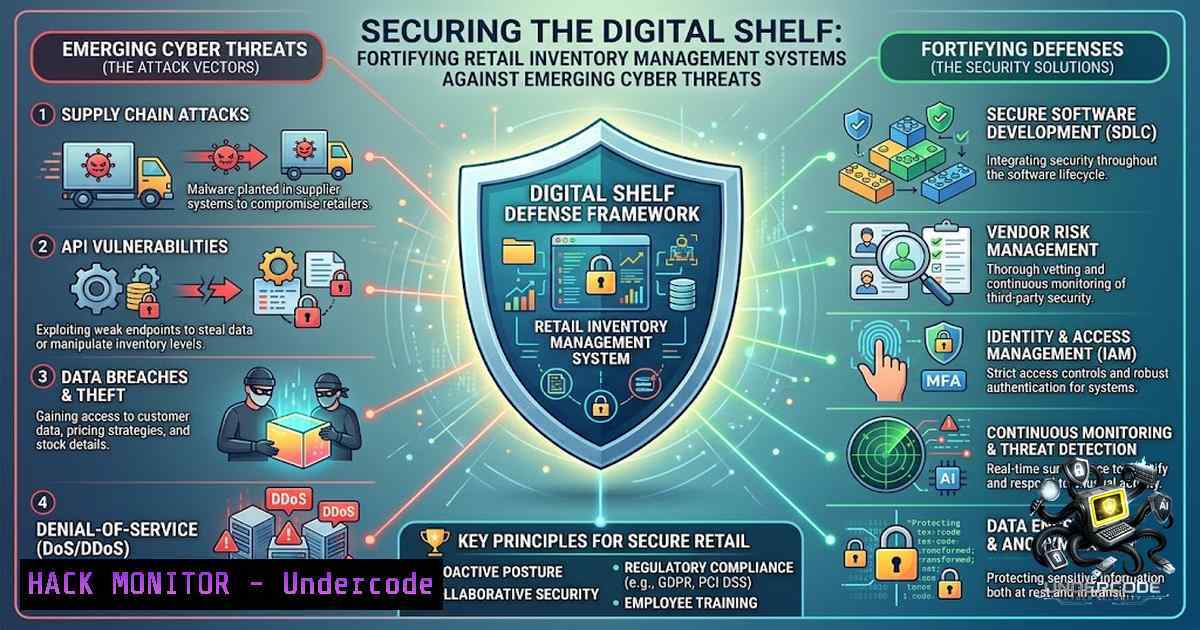
Introduction:
As automotive and heavy equipment OEMs aggressively integrate Artificial Intelligence (AI) and cloud-1ative architectures into their Retail Inventory Management (RIM) systems, the attack surface expands exponentially. These systems, now critical to dealer fill rates and customer satisfaction, are transitioning from isolated legacy databases to interconnected digital supply chain hubs that interface with upstream suppliers and downstream dealers. This convergence of operational technology (OT) and information technology (IT) necessitates a robust security posture that not only protects inventory data but also ensures system availability to prevent costly stockouts or, conversely, crippling overstock due to ransomware-induced downtime.
Learning Objectives & Secrets:
- Objective 1: Supply Chain API Hardening – Understand how to secure the Application Programming Interfaces (APIs) that connect OEM RIM systems with dealer management software and third-party logistics providers to prevent data exfiltration.
- Objective 2: AI Logic Exploitation Mitigation – Learn to identify vulnerabilities in AI-driven demand forecasting models to prevent adversarial attacks that skew inventory recommendations.
- Objective 3: Container Security for Next-Gen Demos – Master the security configuration of containerized environments (e.g., Docker/Kubernetes) used in live system demos and production deployments to avoid privilege escalation.
You Should Know:
1. Securing the Upstream Supply Chain Connection
Modern RIM systems are no longer silos; they rely heavily on real-time data from tier-1 suppliers to adjust stocking logic dynamically. This integration relies on EDI (Electronic Data Interchange) over HTTPS, RESTful APIs, or message queues like RabbitMQ and Kafka. A compromise here could inject false lead-time data, causing massive financial losses.
Step‑by‑Step Guide: API Authentication & Monitoring
- Step 1: Implement OAuth 2.0 with JWT Validation. Ensure that any API consuming supplier data uses short-lived tokens (e.g., 15-minute expiry) and validates the signature against a public key stored in a hardware security module (HSM). Use the following Linux command to decode a JWT token for validation:
Decode JWT header and payload using jq
echo "your_jwt_token_here" | cut -d'.' -f2 | base64 -d | jq .
- Step 2: Enforce Strict Rate Limiting. To prevent brute-force attacks or Denial of Service (DoS) attempts against inventory endpoints. Use `iptables` or a Web Application Firewall (WAF).
Limit connections to port 443 to 10 per second using iptables (Linux)
sudo iptables -A INPUT -p tcp --dport 443 -m state --state NEW -m recent --set --1ame API_RATE
sudo iptables -A INPUT -p tcp --dport 443 -m state --state NEW -m recent --update --seconds 1 --hitcount 10 --1ame API_RATE -j DROP
- Step 3: Enable TLS 1.3 Only. Disable legacy protocols to ensure encrypted data-in-transit, securing KPI data against man-in-the-middle attacks.
2. Defending AI-Driven Stocking Logic (Model Poisoning)
The “Next Generation Technology” featuring AI is a double-edged sword. Attackers can manipulate the training data pipeline to cause the AI to overstock slow-moving parts or understock fast-moving ones, effectively sabotaging the business. This requires hardening the data ingestion pipeline.
Step‑by‑Step Guide: Data Integrity Checks for ML Pipelines
- Step 1: Checksum Verification of Input Datasets. Ensure the historical sales data fed into the AI model hasn’t been tampered with. Use `sha256sum` to verify the integrity of CSV/Parquet files before they are loaded into the model.
sha256sum inventory_historical_data.csv > checksum_inventory.txt
Compare later: sha256sum -c checksum_inventory.txt
- Step 2: Anomaly Detection in Input Features. Deploy statistical outlier detection (e.g., Z-Score) to spot abnormal inventory levels being suggested by the model. Use Python to validate the model’s output before it updates the production database.
Python snippet for Z-Score analysis of AI inventory predictions import numpy as np from scipy import stats predictions = [120, 130, 125, 1500, 135] 1500 is an anomaly z_scores = np.abs(stats.zscore(predictions)) if max(z_scores) > 2.5: Trigger alert and halt automated ordering print("Suspicious AI prediction detected! Manual approval required.") - Step 3: Implement RBAC (Role-Based Access Control) for the data pipeline to ensure only authorized data scientists can modify training datasets.
3. Hardening Live System Demos (Next-Gen Tech)
Often, RIM systems are showcased using live demo environments that mirror production. These demos are sometimes accessible via lower-security networks. A breach here could expose intellectual property regarding the OEM’s specific stocking algorithms and benchmark KPIs.
Step‑by‑Step Guide: Demo Environment Isolation
- Step 1: Network Segmentation. Isolate the demo infrastructure in a separate VLAN (Virtual Local Area Network) with strict firewall rules. On Windows, verify the network profile is set to “Public” to disable file sharing.
Windows PowerShell command to check network profile
Get-1etConnectionProfile
Set to Public if necessary
Set-1etConnectionProfile -InterfaceAlias "Ethernet" -1etworkCategory Public
- Step 2: Container Security. If the demo runs on Docker, ensure you are not running as root. Use read-only file systems and drop all unnecessary Linux capabilities.
Docker run command with enhanced security
docker run --read-only --cap-drop=ALL --cap-add=NET_BIND_SERVICE --security-opt=no-1ew-privileges:true your-demo-image:latest
- Step 3: Dynamic Secrets. Use tools like HashiCorp Vault to inject database credentials as environment variables for the demo, ensuring they rotate frequently and are never hardcoded in the codebase.
4. Vulnerability Management in Third-Party Logistics Software
The “Terms and Conditions” mentioned in RIM often relate to third-party logistics (3PL) interfaces. If a 3PL provider’s system is compromised, it could be used as a pivot point into the OEM’s network. Regular scanning and patch management are critical.
Step‑by‑Step Guide: Scanning for Exploitable Weaknesses
- Step 1: Perform an Automated Vulnerability Scan. Use tools like `Nmap` and `Nessus` against the interfaces connecting to 3PLs.
Nmap scan for open ports and SSL/TLS vulnerabilities on the vendor endpoint
nmap -sV --script ssl-enum-ciphers -p 443,8443 vendor-3pl-endpoint.com
- Step 2: Check for Known CVEs (Common Vulnerabilities and Exposures) in the libraries used for EDI translation. If using a Linux server, scan installed packages:
Debian/Ubuntu package audit
sudo apt-get update && sudo apt-get install lynis -y
sudo lynis audit system
- Step 3: Configure a SIEM (Security Information and Event Management) to correlate logs from these connections, alerting on unusual access times (e.g., 3 AM logins) that indicate potential credential compromise.
5. Cloud-Hardening for Retail Inventory Systems
As OEMs move RIM to the cloud (AWS, Azure, GCP), misconfigurations become the primary risk. The “system updates” mentioned often involve cloud-1ative components. Securing the Identity and Access Management (IAM) is paramount.
Step‑by‑Step Guide: IAM and CSPM Configuration
- Step 1: Enforce MFA (Multi-Factor Authentication) for all cloud administrative roles.
- Step 2: Implement a Cloud Security Posture Management (CSPM) tool to monitor for open S3 buckets or Azure Blob Storage exposed to the public. Run a query to check for public blobs.
Azure CLI command to list public containers
az storage container list --query "[?publicAccess != 'off']" --output table
- Step 3: Apply the Principle of Least Privilege. If using a Linux bastion host to manage the RIM application, restrict SSH access using `iptables` to allow connections only from specific corporate IPs.
Allow SSH only from a specific management subnet
sudo iptables -A INPUT -p tcp --dport 22 -s 192.168.1.0/24 -j ACCEPT
sudo iptables -A INPUT -p tcp --dport 22 -j DROP
What Undercode Say:
- Key Takeaway 1: The future of inventory management is not just about shelf availability but the resilience of the data pipeline. A breached supply chain data feed is more financially devastating than a simple stockout, as it manipulates decision-making at scale.
- Key Takeaway 2: AI in RIM introduces a unique “Logic Exploit” attack vector. Standard firewalls cannot see the difference between a clean prediction and a poisoned one; therefore, model monitoring must be elevated to a security function rather than just a performance function.
Prediction:
- +1 As OEMs adopt NIST AI RMF (Risk Management Framework), we will see the rise of “Inventory Firewalls” that validate AI outputs before executing orders, creating a new cybersecurity niche specific to supply chain logistics.
- -1 There is a high probability that between now and the September 2026 conference, a high-profile automotive OEM will suffer a ransomware attack originating from a compromised third-party logistics API, forcing the industry to accelerate zero-trust adoption.
- +1 The focus on “next generation technology” will drive integrations with Blockchain for immutable ledger tracking, significantly reducing audit costs and enhancing trust in the data integrity.
- +1 Organizations that proactively implement AI bias and security checks will gain a competitive advantage, turning their inventory system into a secure moat against competitors relying solely on legacy logic.
- -1 Legacy infrastructure upgrades remain slow, and until Edge computing security standards are finalized, many real-time IoT sensors feeding RIM data will remain vulnerable to physical spoofing attacks.
▶️ Related Video (82% Match):
🎯Let’s Practice For Free:
🎓 Live Courses & Certifications:
Join Undercode Academy for Verified Certifications
🚀 Request a Custom Project:
Secure, high-velocity infrastructure and disruptive technological engineering. Contact our engineering team for high-tier development and proprietary systems:
[email protected]
💎 Smart Architecture | 🛡️ Secure by Design | ⭐ Trusted by Thousands
IT/Security Reporter URL:
Reported By: https://lnkd.in/p/eHWg6VEd – Hackers Feeds
Extra Hub: Undercode MoN
Basic Verification: Pass ✅


