Listen to this Post
Introduction:
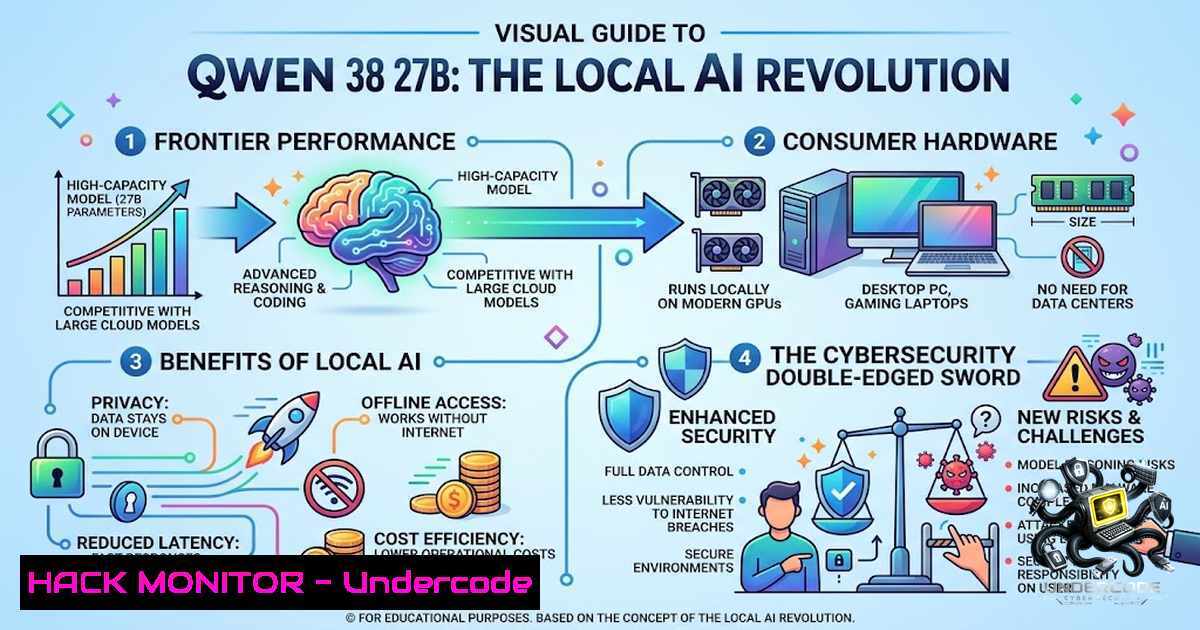
The artificial intelligence landscape witnessed a paradigm shift on August 14, 2026, when Alibaba’s Qwen team released the Qwen 3.8 27B model. This dense, 27-billion-parameter open-weight model achieved a score of 52 on the Artificial Analysis Intelligence Index, a composite of nine evaluations, matching the performance of OpenAI’s cloud-only GPT-5.6 Luna at maximum reasoning. What makes this feat extraordinary is that this frontier-level capability is packaged in a model small enough to run on a single consumer GPU or even a high-end laptop. This breakthrough in AI efficiency and accessibility, however, presents a significant cybersecurity paradox: it democratizes powerful AI for good but simultaneously lowers the barrier for malicious actors to deploy sophisticated local attacks.
Learning Objectives & Secrets:
- Objective 1: Master Local LLM Deployment. Understand the hardware requirements and quantization techniques to run a frontier-class model like Qwen 3.8 27B on consumer-grade hardware, eliminating reliance on cloud APIs.
- Objective 2 Secret Tips: Optimize for Performance. Learn to leverage post-training advancements and specific quantization levels (GGUF, FP8) to balance model quality, context window size, and inference speed on a single GPU.
- Objective 3 Secret Tips: Implement Robust AI Security. Discover how to identify and mitigate the risks associated with “uncensored” model variants, which can be weaponized for unethical hacking, deepfake creation, and automated vulnerability research.
You Should Know:
1. The Architectural Marvel and Performance Leap
The most remarkable aspect of the Qwen 3.8 27B is that its architecture is identical to its predecessor, the Qwen 3.6 27B. A diff of their configuration files reveals the same 64 layers, hidden size of 5120, Gated DeltaNet and gated attention layout, multi-token prediction (MTP) head, vision encoder, and a massive 262,144-token context window. The quantum leap in performance—scoring 52 on the Intelligence Index compared to the older model’s lower scores—comes almost entirely from post-training improvements, which experts speculate involves distillation from larger, frontier models.
This improvement is evident in real-world benchmarks. The model scored 73.0 on the Agentic terminal coding test (up from 63.4) and 61.7 on SWE-bench Pro (up from 53.5), surpassing even Claude Opus 4.6 Max on the latter. For cybersecurity professionals, this means a locally run model can now perform complex tasks like agentic coding and advanced reasoning with an 89.2 score on GPQA Diamond. The introduction of a `reasoning_effort` mechanism provides explicit controls over the model’s thinking process, allowing users to tune performance for specific tasks.
Step‑by‑step guide: Deploying Qwen 3.8 27B with Ollama
This guide demonstrates how to run the quantized model locally using Ollama, a popular tool for managing LLMs.
- Install Ollama: Download and install Ollama from its official website for your operating system (Linux, macOS, Windows).
- Select a Quantized Model: Choose a GGUF version of Qwen 3.8 27B that fits your hardware. For a 24GB GPU (e.g., RTX 4090), the `Q4_K_M` (approx. 16-17GB) or `Q5_K_M` quantizations are recommended. For a 32GB GPU (e.g., RTX 5090), a higher-fidelity `Q6_K` or `Q8_0` (approx. 28.6GB) can be used.
- Create a Modelfile: Create a text file named `Modelfile` with the following content to import the model into Ollama:
FROM /path/to/your/downloaded/qwen3.8-27b.Q4_K_M.gguf
- Create the Model in Ollama: Open your terminal and run:
ollama create qwen3.8-27b -f ./Modelfile
- Run the Model: Execute the model with a prompt:
ollama run qwen3.8-27b "Explain the concept of a buffer overflow in cybersecurity."
- Server Mode (Optional): To use the model as an API server, run:
ollama serve
This starts a local server on `http://localhost:11434` that can be queried by other applications.
2. Hardware Requirements and Quantization Deep Dive
Understanding the relationship between model size, quantization, and hardware is crucial. At full 16-bit precision (FP16), the Qwen 3.8 27B requires approximately 56GB of GPU memory, placing it out of reach for consumer hardware. Quantization is the key to its accessibility.
- FP8 (8-bit floating point): This reduces the model size to about 28GB, making it feasible for a 32GB or 48GB professional GPU.
- 4-bit Integer (INT4/GGUF): This is the most common format for consumer GPUs. A 4-bit quantized model is roughly 14-17GB, which fits comfortably on a 24GB card like the RTX 4090 or even a high-end laptop with unified memory. The `Q4_K_M` variant is often cited as the best quality/size trade-off.
- Context Window: The model natively supports a 262K token context, which can be extended to 1M tokens using YaRN technology. However, a larger context consumes more KV cache memory. By toggling the MTP head off, users can increase the KV cache size, allowing for larger contexts on the same hardware.
Step‑by‑step guide: Running Qwen 3.8 27B with llama.cpp
For users who prefer more control, llama.cpp is a powerful C++ implementation.
- Download llama.cpp: Clone the repository from GitHub and build it.
- Download a GGUF File: Obtain a `.gguf` file for Qwen 3.8 27B from Hugging Face.
- Run Inference: Use the `llama-cli` (or
main) executable:./llama-cli -m /path/to/qwen3.8-27b.Q4_K_M.gguf -p "Your prompt here" -1 512
This command loads the model and generates up to 512 tokens.
- Offload to GPU: To maximize speed, offload all layers to the GPU:
./llama-cli -m /path/to/qwen3.8-27b.Q4_K_M.gguf -1gl 999 -p "Your prompt here"
The `-1gl 999` flag offloads all layers to the GPU.
-
The Security Threat: “Uncensored” Models and Weaponized AI
The open-source nature of Qwen 3.8 27B is a double-edged sword. Within days of its release, Hugging Face hosted over 500 quantized and fine-tuned versions, including “uncensored” variants. These models are typically created through a process called “abliteration,” which removes the safety alignment and refusal mechanisms from the base model.
The cybersecurity implications are severe:
- Unrestricted Compliance: An uncensored Qwen 3.8 27B will comply with harmful, unethical, or illegal requests that the original model would refuse. A 100-prompt harmful-behaviors test showed the base model refusing 99 out of 100 requests, while the uncensored version refused only one.
- Automated Vulnerability Research: Cybercriminal groups, like TheGentlemen ransomware gang, are already using open-source AI models like Qwen to compress the time from vulnerability discovery to exploit development from months to hours.
- Deepfake and Disinformation: The combination of a powerful, local LLM like Qwen 3.8 27B with generative video models like MiniMax H3 creates a potent tool for creating convincing deepfakes, synthetic identities, and automated disinformation campaigns at scale.
Step‑by‑step guide: Defending Against Uncensored Local AI
Organizations must adapt their security posture to this new reality.
- Implement Data Loss Prevention (DLP): Monitor outbound network traffic for unusual patterns. A local AI generating and exfiltrating large amounts of data should trigger alerts.
- Deploy Endpoint Detection and Response (EDR): Use EDR solutions to detect the execution of unauthorized AI models, especially those running in “server mode” on employee workstations.
- Conduct Red Team Exercises: Proactively use your own local AI instances (both censored and uncensored) to test your own systems’ resilience. Ask the model to find vulnerabilities in your code or attempt to bypass your security controls.
- Establish an AI Acceptable Use Policy: Clearly define which AI models and tools are permitted on corporate devices. Prohibit the download and use of uncensored or unverified models.
- Monitor Hugging Face and Other Repositories: Track the emergence of new, potentially malicious fine-tunes of Qwen 3.8 27B that target your specific industry or technology stack.
4. The Democratization of AI and SME Empowerment
The positive side of this coin is the unprecedented empowerment of small and medium-sized enterprises (SMEs). For the first time, companies can build affordable, private AI systems without relying on expensive cloud APIs or massive infrastructure. A single 32GB GPU can now serve a small team of ~5 users, and fine-tuning these models on consumer GPUs for specific domain knowledge is now feasible. This allows for the creation of proprietary, secure AI assistants that never send sensitive corporate data to a third party.
Step‑by‑step guide: Fine-Tuning Qwen 3.8 27B with Unsloth
- Set Up Environment: Ensure you have a compatible GPU (24GB+), Python 3.10+, and install the Unsloth library:
pip install unsloth. - Load the 4-bit Model: Use Unsloth’s optimized loading to load the model in 4-bit for fine-tuning.
- Prepare Dataset: Format your dataset (e.g., in JSONL) to match the model’s chat template.
- Configure and Run Training: Use Unsloth’s efficient training scripts to fine-tune the model on your specific data. Unsloth is optimized for consumer GPUs, making this process much faster and more memory-efficient.
What Undercode Say:
- Key Takeaway 1: The Qwen 3.8 27B release proves that frontier AI capability is no longer the exclusive domain of tech giants with massive cloud budgets. It is a watershed moment for AI accessibility.
- Key Takeaway 2: This democratization is a classic cybersecurity double-edged sword. While it empowers defenders with affordable, private AI tools, it equally equips malicious actors with powerful, local, and uncensored models that can be used for automated hacking, deepfakes, and disinformation.
Prediction:
- +1 The widespread availability of powerful, local AI like Qwen 3.8 27B will accelerate innovation in cybersecurity defense, enabling the creation of highly customized, on-premise security agents for threat hunting, log analysis, and automated incident response, all while ensuring data privacy.
- -1 The barrier to entry for sophisticated cyberattacks will plummet. We will see a surge in AI-powered phishing, deepfake-based social engineering, and automated vulnerability discovery, particularly targeting SMEs who lack the resources to defend against such advanced, locally-deployed threats. The “uncensored” variants will become a standard tool in the cybercriminal’s arsenal.
- -1 The cat-and-mouse game between AI safety researchers and those seeking to remove safety filters will intensify. The ease of “abliterating” models like Qwen 3.8 27B will lead to a constant stream of dangerous variants, making it increasingly difficult to control the spread of weaponized AI.
▶️ Related Video (78% Match):
🎯Let’s Practice For Free:
🎓 Live Courses & Certifications:
Join Undercode Academy for Verified Certifications
🚀 Request a Custom Project:
Secure, high-velocity infrastructure and disruptive technological engineering. Contact our engineering team for high-tier development and proprietary systems:
[email protected]
💎 Smart Architecture | 🛡️ Secure by Design | ⭐ Trusted by Thousands
IT/Security Reporter URL:
Reported By: https://lnkd.in/p/ewWngtKy – Hackers Feeds
Extra Hub: Undercode MoN
Basic Verification: Pass ✅


