Listen to this Post
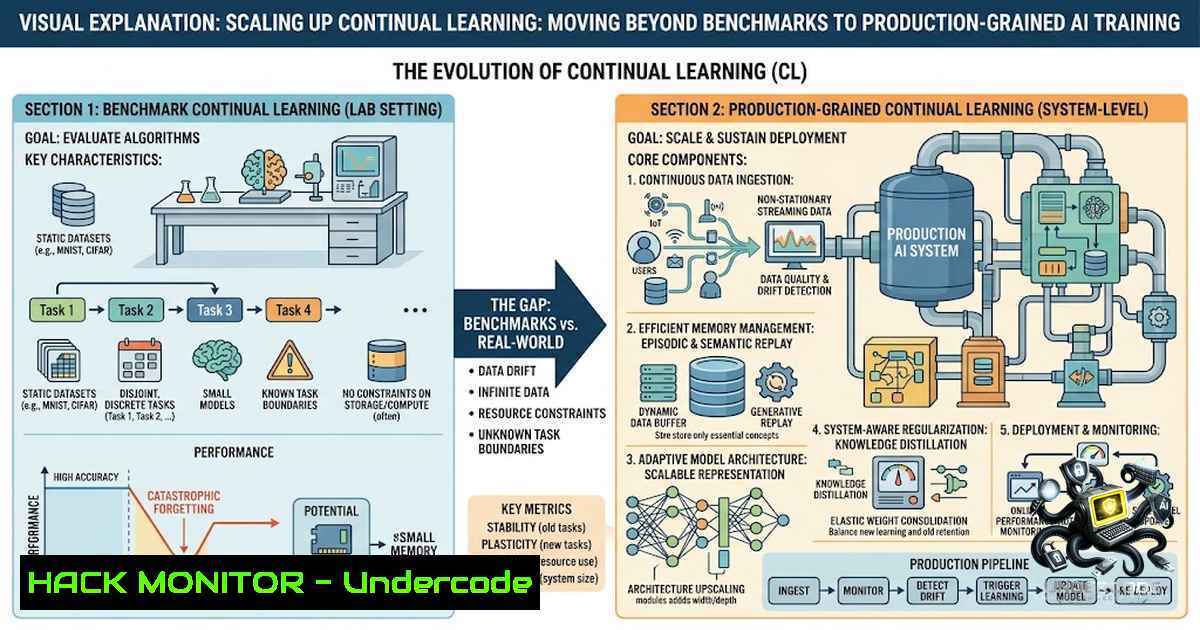
Introduction:
The prevailing paradigm for training large language models (LLMs) remains fundamentally broken. As Ronak Malde, CEO of Trajectory and former DeepMind researcher, highlighted in his talk at AI Engineer World’s Fair, benchmarks now consume four to six hours—sometimes several days—to build, yet they fail to reflect how people actually use AI in production. Meanwhile, the industry burns hundreds of trillions of tokens daily on inference, discarding every signal embedded in those interactions. The solution, Malde argues, lies in scaling up continual learning—training models directly on production traffic rather than curated benchmarks. This shift requires rethinking foundational algorithms like Group Relative Policy Optimization (GRPO) and introducing new approaches such as On-Policy Self-Distillation (OPSD).
Learning Objectives & Secrets:
- Objective 1: Understand the limitations of current RL methods for LLM post-training. GRPO, DPO, and RLHF each make trade-offs across four critical criteria: online task distribution, on-policy sampling, parallelism of one, and per-token reward. None satisfies all simultaneously, creating bottlenecks when scaling to real-world agentic tasks.
-
Objective 2 Secret Tip: Leverage OPSD for token-efficient reasoning. On-Policy Self-Distillation enables a single model to act as both teacher and student by conditioning on different contexts—the student sees only the problem while the teacher additionally sees privileged information. This achieves 4–8× token efficiency compared to GRPO while eliminating the need for a separate teacher model.
-
Objective 3 Secret Tip: Detect and mitigate “hint leakage” in self-distillation. When privileged information (ground-truth solutions) is exposed in the teacher context, models learn to output the answer first and back-fill reasoning traces they would never produce in production. Cut the hint in half, obtain log probs from both partial and full teacher contexts, and take a linear combination to prevent pushing the model into territory where it has no overlap.
You Should Know:
1. GRPO’s Reward Is a Straw—Here’s Why
Group Relative Policy Optimization compares responses within a group rather than using a separate value critic, eliminating the need for an additional model. However, its reward signal is fundamentally weak: a single end-state score for an entire rollout—like receiving 87 out of 100 on an essay and having to infer what “good” means from scratch. This sparsity creates noisy training signals that break down when scaling to long-horizon agentic tasks with 100+ tool calls.
Step-by-Step Guide: Implementing GRPO with NeMo-RL
 Clone the NeMo-RL repository
git clone [email protected]:NVIDIA-1eMo/RL.git
cd nemo-rl

Install uv for dependency management
pip install uv

Train with increasing context lengths (8K → 16K → 24K)
 This controls the long-tail distribution of rollout sequences
python -m nemo_rl.train \
--model Qwen-1.5B \
--algorithm grpo \
--max_seq_len 8192 \
--config configs/grpo_qwen.yaml
What This Does: GRPO trains the model by generating multiple rollouts per prompt, comparing them internally, and updating the policy based on relative performance. The staged context-length approach prevents the model from collapsing to excessively long reasoning traces, a common failure mode in RL training.
2. On-Policy Self-Distillation: The Teacher Is the Student
OPSD addresses the fundamental limitation of traditional distillation: the requirement for a separate, often larger, teacher model. Instead, the same model plays both roles with different contexts. The teacher conditions on privileged information (e.g., ground-truth solutions), while the student sees only the question. Training minimizes per-token KL divergence between these distributions over the student’s own rollouts.
Step-by-Step Guide: Implementing OPSD
import torch
import torch.nn.functional as F

def opsd_loss(student_logits, teacher_logits, student_trajectory):
"""
Compute OPSD loss: per-token KL divergence between student and teacher
distributions over the student's own rollouts.
"""
 Convert logits to log probabilities
student_log_probs = F.log_softmax(student_logits, dim=-1)
teacher_log_probs = F.log_softmax(teacher_logits, dim=-1)

Compute KL divergence per token
kl_div = F.kl_div(
student_log_probs,
teacher_log_probs,
reduction='none',
log_target=True
)

Apply step-level divergence as weight
 Measure student-teacher KL per step and multiply token weight by it
step_weights = kl_div.mean(dim=-1)  Average over vocabulary
weighted_loss = (kl_div  step_weights.unsqueeze(-1)).mean()

return weighted_loss
What This Does: Instead of matching only the sampled token (which shifts distributions rather than sharpening them), OPSD matches every token across the full 65K vocabulary. Tokens the student never selected get pushed up, creating a richer training signal. Importantly, OPSD doesn’t incentivize longer reasoning—hard problems get solved in fewer tokens compared to RL methods where token count collapses.
- The “But Wait” Problem: When Self-Distillation Goes Wrong
On long trajectories, a dangerous phenomenon emerges: the student drifts, the teacher course-corrects at every step, and the model converges on a hedging strategy. The word cloud fills with “wait” and “maybe”—a telltale sign that the model is overfitting to corrective signals rather than learning robust reasoning.
Step-by-Step Guide: Detecting and Mitigating Divergence
 Monitor KL divergence during training
 Set up logging for per-step student-teacher KL
python -m opsd.monitor \
--model_path /path/to/model \
--eval_dataset reasoning_benchmark.jsonl \
--output_dir ./divergence_logs/

Generate divergence report
python -m opsd.analyze \
--log_dir ./divergence_logs/ \
--threshold 0.15  Flag trajectories exceeding this threshold
Mitigation Strategy: Measure student-teacher KL per step and multiply the token weight by it. A trajectory that goes off track and recovers gets trained accordingly, while trajectories with persistent drift receive lower weight. This prevents the model from learning to hedge.
4. Residual Guidance: Preventing Reward Hacking
Hint leakage is OPSD’s equivalent of reward hacking—give away the answer in the hint and the model writes the answer first, then back-fills a reasoning trace it would never produce in production. Residual guidance provides a defense: cut the hint in half, obtain log probs from both the partial teacher and the full teacher, and take a linear combination.
Step-by-Step Guide: Implementing Residual Guidance
def residual_guidance(student_logits, partial_teacher_logits, full_teacher_logits, alpha=0.5):
"""
Linear combination of partial and full teacher guidance.
Prevents pushing the model into territory where it has no overlap.
"""
 Compute log probabilities from both teachers
partial_log_probs = F.log_softmax(partial_teacher_logits, dim=-1)
full_log_probs = F.log_softmax(full_teacher_logits, dim=-1)

Linear combination
combined_teacher = alpha  partial_log_probs + (1 - alpha)  full_log_probs

Compute KL divergence against combined teacher
student_log_probs = F.log_softmax(student_logits, dim=-1)
loss = F.kl_div(student_log_probs, combined_teacher, reduction='batchmean', log_target=True)

return loss
What This Does: By interpolating between partial and full teacher signals, residual guidance prevents the model from being shoved into territory where it has no overlap. This stabilizes training and preserves the model’s natural distribution.
5. Production Scaling: Where OPSD Holds Up
Trajectory has scaled OPSD to a 120B parameter model on Mercor Apex agents with 100+ tool calls—surpassing what GRPO achieved on Live Code Bench, where it saturated around Sonnet-level performance. The key insight: OPSD’s token efficiency (4–8× better than GRPO) makes it viable for production-scale continual learning where every training pass must deliver maximal signal per compute dollar.
Step-by-Step Guide: Production Deployment Considerations
 For Linux production environments
 Set up monitoring for inference signals
sudo apt-get install prometheus node-exporter
pip install trajectory-sdk

Configure continual learning pipeline
trajectory init --model 120B --env production
trajectory configure --learning-rate 1e-6 --batch-size 32

Start collecting inference signals
trajectory collect --source inference_logs --output ./training_data/

Launch continual training loop
trajectory train --algorithm opsd --checkpoint-interval 3600
For Windows Environments:
 Install WSL2 for Linux compatibility
wsl --install -d Ubuntu

Within WSL, follow Linux commands
 Set up Python environment
python -m venv trajectory_env
trajectory_env\Scripts\activate
pip install trajectory-sdk
What Undercode Say:
- Key Takeaway 1: Benchmarks are obsolete for measuring real AI capability. The industry spends days building benchmarks that don’t reflect production usage, while trillions of tokens of valuable inference signals are discarded daily. The future belongs to systems that learn continuously from user interactions.
-
Key Takeaway 2: OPSD represents a paradigm shift in LLM post-training. By eliminating the need for a separate teacher model and achieving 4–8× token efficiency over GRPO, OPSD makes continual learning economically viable at scale. The algorithm’s ability to learn from single trajectories—with failures still producing signal—is transformative for agentic AI.
Analysis: The shift from offline benchmarks to online continual learning represents a fundamental reorientation of AI development. Traditional RL methods like GRPO and PPO were designed for controlled environments with clear reward signals—they break when applied to the messy, open-ended world of production AI. OPSD’s innovation is treating the model itself as both source and recipient of supervision, creating a closed-loop learning system that improves with every user interaction. This is not merely an incremental improvement; it’s the architectural foundation for AI that truly learns from experience. However, challenges remain: the “but wait” problem and hint leakage demonstrate that self-distillation is brittle and requires careful monitoring. Trajectory’s success in scaling to 120B parameters suggests these challenges are solvable, but the broader community must develop robust tooling for detecting divergence and preventing reward hacking in production systems.
Prediction:
- +1 Continual learning platforms like Trajectory will become standard infrastructure for enterprise AI within 24 months. The economic argument is compelling: companies already pay for inference; turning that inference into training signal creates a compounding returns loop.
-
+1 OPSD and its variants will replace GRPO as the dominant post-training method for agentic AI. The 4–8× token efficiency gain is too significant to ignore, especially as models scale to trillions of parameters.
-
-1 The “but wait” problem could cause production failures in safety-critical applications. Models that learn to hedge rather than reason robustly may produce unreliable outputs when deployed in high-stakes environments like healthcare or finance.
-
-1 Hint leakage and reward hacking will become attack vectors. Malicious actors could craft inputs that exploit the teacher-student dynamic, causing models to produce plausible but incorrect reasoning traces.
▶️ Related Video (86% Match):
https://www.youtube.com/watch?v=-06Vsigu_cg
🎯Let’s Practice For Free:
🎓 Live Courses & Certifications:
Join Undercode Academy for Verified Certifications
🚀 Request a Custom Project:
Secure, high-velocity infrastructure and disruptive technological engineering. Contact our engineering team for high-tier development and proprietary systems:
[email protected]
💎 Smart Architecture | 🛡️ Secure by Design | ⭐ Trusted by Thousands
IT/Security Reporter URL:
Reported By: https://lnkd.in/p/eH8qRnkn – Hackers Feeds
Extra Hub: Undercode MoN
Basic Verification: Pass ✅


