Listen to this Post
Introduction:
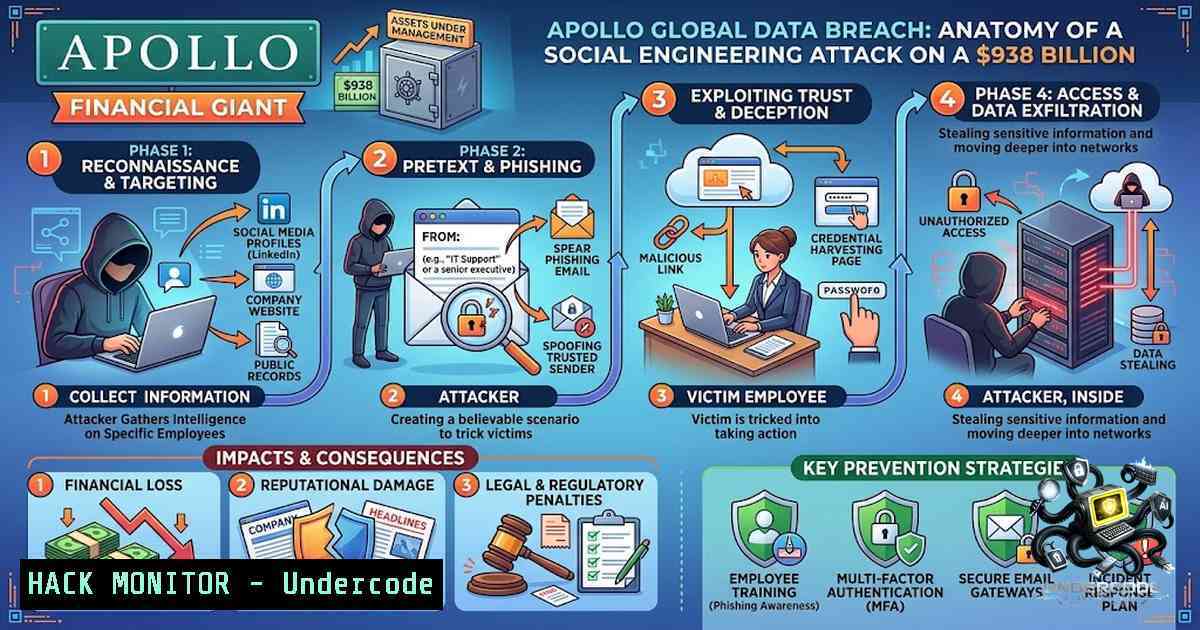
Private equity giant Apollo Global Management confirmed a significant data breach in August 2026, revealing that attackers leveraged social engineering techniques to compromise its cloud environment between July 6 and July 10. The breach exposed highly sensitive personal information including names, birth dates, contact details, home addresses, and Social Security numbers. This incident is part of a broader, coordinated hacking wave targeting major financial and private equity firms, which Google researchers had warned about weeks prior. The attack underscores a critical vulnerability in modern enterprise security: the human element remains the weakest link, even for organizations managing nearly a trillion dollars in assets.
Learning Objectives & Secrets:
- Objective 1: Understand the Mechanics of Modern Vishing Campaigns – Learn how threat actors use voice phishing (vishing) to impersonate IT helpdesk personnel, tricking employees into revealing credentials and MFA codes through sophisticated social engineering.
-
Objective 2 (Secret Tip): Implement Phishing-Resistant Authentication – Traditional MFA (SMS, TOTP, push notifications) is no longer sufficient against adversary-in-the-middle (AiTM) attacks. Secret: Deploy FIDO2 security keys or passkeys (WebAuthn) which are cryptographically bound to the origin domain, making them immune to credential phishing.
-
Objective 3 (Secret Tip): Build a Human-Centric Defense-in-Depth – Secret: Combine AI-driven behavioral threat detection with continuous security awareness training that simulates real-world vishing and deepfake scenarios. Employees must be trained to verify all IT support requests through out-of-band channels (e.g., calling back via a known official number).
You Should Know:
- The Vishing Attack Chain: How Hackers Bypassed Apollo’s Defenses
The Apollo breach exemplifies a sophisticated multi-stage attack chain. According to Google Threat Intelligence Group (GTIG), threat actors tracked as UNC6671—operating under extortion brands including Falcon, Helix, Pink, and Redact—executed a coordinated vishing campaign targeting financial services and private equity firms.
Step-by-step guide explaining how the attack unfolded:
- Reconnaissance: Attackers research target employees via LinkedIn and other public sources to identify roles, reporting structures, and contact information.
- Impersonation: Using spoofed caller IDs, attackers pose as internal IT support or helpdesk staff.
- Credential Harvesting: Employees are directed to fake login portals designed to steal passwords and multi-factor authentication codes.
- Cloud Compromise: With stolen credentials, attackers access corporate cloud platforms (Apollo’s breach occurred between July 6–10).
- Data Exfiltration: Sensitive data—names, birth dates, SSNs, addresses—is stolen from cloud storage.
- Extortion: Stolen data is used as leverage to demand ransom payments, with some attacks netting up to $750,000 per victim, according to Google.
Defensive Commands & Configurations:
Linux/Unix – Monitor for Suspicious Authentication Attempts:
 Monitor failed SSH login attempts
sudo grep "Failed password" /var/log/auth.log | awk '{print $9}' | sort | uniq -c | sort -1r

Check for unusual sudo usage
sudo grep "sudo" /var/log/auth.log | grep -v "COMMAND"

Monitor cloud API calls for anomalies (AWS CLI example)
aws cloudtrail lookup-events --lookup-attributes AttributeKey=EventName,AttributeValue=ConsoleLogin --max-items 20
Windows – Audit Logon Events:
 Check for failed logon attempts (Event ID 4625)
Get-WinEvent -FilterHashtable @{LogName='Security'; ID=4625} -MaxEvents 50 | Format-List

Review successful logons from unusual hours (Event ID 4624)
Get-WinEvent -FilterHashtable @{LogName='Security'; ID=4624} | Where-Object { $<em>.TimeCreated.Hour -lt 6 -or $</em>.TimeCreated.Hour -gt 20 }
2. Cloud Security Hardening: Preventing Unauthorized Access
Apollo’s breach involved unauthorized access to cloud platforms. Organizations must adopt Zero Trust Architecture principles, moving beyond perimeter-based security toward identity-centric protection.
Step-by-step guide for cloud security hardening:
- Enforce Phishing-Resistant MFA: Replace SMS and TOTP-based MFA with FIDO2 security keys or passkeys for all users, especially privileged accounts.
- Eliminate Standing Privileges: Implement Just-in-Time (JIT) privileged access and reduce reliance on long-lived credentials.
- Extend Governance to Non-Human Identities: Service accounts and machine identities are often overlooked—implement machine IAM with ephemeral credentials.
- Enable Comprehensive Logging: Activate cloud audit trails (AWS CloudTrail, Azure Monitor, GCP Audit Logs) with alerts for anomalous behavior.
- Implement Conditional Access Policies: Restrict access based on device compliance, geolocation, and risk signals.
Cloud Hardening Commands:
AWS – Enable Block Public Access on S3 Buckets (Prevent Data Exposure):
 Enable Block Public Access at the account level
aws s3control put-public-access-block \
--public-access-block-configuration BlockPublicAcls=true,IgnorePublicAcls=true,BlockPublicPolicy=true,RestrictPublicBuckets=true \
--account-id YOUR_ACCOUNT_ID

Apply bucket-level encryption
aws s3 put-bucket-encryption --bucket YOUR_BUCKET_NAME \
--server-side-encryption-configuration '{"Rules":[{"ApplyServerSideEncryptionByDefault":{"SSEAlgorithm":"AES256"}}]}'

Audit all buckets for public access
aws s3api get-public-access-block --bucket YOUR_BUCKET_NAME
Azure – Enforce Conditional Access Policies:
 Create a Conditional Access policy requiring phishing-resistant MFA
New-AzureADMSConditionalAccessPolicy -DisplayName "Require Phishing-Resistant MFA for All Users" `
-Conditions @{Applications=@{IncludeApplications="All"}} `
-GrantControls @{BuiltInControls="MFA"; CustomControls=$null; Operator="OR"} `
-State "Enabled"
3. Social Engineering Defense: Building Human Firewalls
The FBI has warned that threat actors like the Silent Ransom Group (SRG) are increasingly using fake IT support calls—and even in-person visits—to breach organizations. Defending against social engineering requires a multi-layered approach.
Step-by-step guide for social engineering defense:
- Implement Callback Verification: Establish a strict policy where employees must verify any unsolicited IT support request by calling back through officially published numbers.
- Conduct Regular Simulation Exercises: Test workforce readiness against vishing, deepfake voice calls, and SMS lures. Automatically generate simulations based on live threat intelligence.
- Deploy AI-Based Behavioral Threat Detection: Use tools that analyze user behavior patterns to detect anomalies indicative of compromised accounts.
- Promote a Culture of Verification: Train employees to recognize psychological manipulation techniques including urgency, authority pressure, fear, and emotional appeals.
- Implement Approval Delays: Introduce delays for sensitive financial transactions or privileged access requests to allow for secondary verification.
Security Awareness Commands & Tools:
Linux – Monitor for Unusual Process Execution (Potential Indicators of Compromise):
 Monitor for new network connections
sudo netstat -tunap | grep ESTABLISHED

Check for unusual cron jobs
sudo crontab -l
sudo cat /etc/crontab

Audit SUID binaries (potential privilege escalation vectors)
sudo find / -perm -4000 -type f 2>/dev/null
Windows – Monitor for Suspicious Activities:
 Check for scheduled tasks created recently
Get-ScheduledTask | Where-Object { $_.Date -gt (Get-Date).AddDays(-7) }

Review PowerShell script execution logs
Get-WinEvent -LogName "Microsoft-Windows-PowerShell/Operational" | Where-Object { $_.Id -eq 4104 } | Select-Object TimeCreated, Message
4. Incident Response and Breach Notification
Apollo disclosed the breach through a letter filed with California’s attorney general, complying with California’s new data breach notification law (SB 446) which took effect January 1, 2026.
Step-by-step guide for breach response:
- Detection and Containment: Immediately isolate affected systems, revoke compromised credentials, and engage forensic experts.
- Investigation: Determine the scope of unauthorized access, data exfiltrated, and attack vector used.
- Notification: Under California SB 446, businesses must notify affected individuals within 30 calendar days of discovery. For breaches affecting more than 500 California residents, the Attorney General must be notified within 15 calendar days after notifying individuals.
- Remediation: Enhance security protocols, deploy additional monitoring, and implement lessons learned.
- Public Disclosure: Issue transparent communication to stakeholders while coordinating with law enforcement.
Incident Response Checklist (Linux/Windows):
Linux – Collect Forensic Data:
 Capture running processes
ps auxwf > running_processes.txt

Capture network connections
ss -tulpn > network_connections.txt

Capture system logs
sudo journalctl --since "2026-07-06" --until "2026-07-10" > system_logs.txt

Capture file system changes
sudo find / -type f -mtime -7 -ls > files_changed.txt
Windows – Collect Forensic Data:
 Collect running processes
Get-Process | Export-Csv -Path running_processes.csv

Collect recent event logs
Get-WinEvent -LogName Security,Application,System -MaxEvents 1000 | Export-Csv -Path event_logs.csv

Collect scheduled tasks
Get-ScheduledTask | Export-Csv -Path scheduled_tasks.csv
5. Regulatory Compliance and Third-Party Risk Management
Financial services firms face increasing regulatory scrutiny regarding data protection. SOC 2 compliance, particularly the Security and Privacy Trust Services Criteria, provides a framework for protecting sensitive data.
Step-by-step guide for compliance and risk management:
- Conduct Regular Third-Party Risk Assessments: Evaluate the security posture of all vendors and partners with access to sensitive data.
- Implement Data Classification and Encryption: Classify data by sensitivity and enforce encryption at rest and in transit.
- Maintain Comprehensive Audit Trails: Ensure all access to sensitive data is logged and monitored.
- Regular Penetration Testing: Conduct simulated attacks to identify vulnerabilities before threat actors do.
- Develop and Test Incident Response Plans: Regularly rehearse breach scenarios to ensure rapid, effective response.
Compliance Commands & Configurations:
AWS – Enforce Encryption and Logging:
 Enable CloudTrail for all regions
aws cloudtrail create-trail --1ame "All-Region-Trail" --s3-bucket-1ame YOUR_BUCKET --is-multi-region-trail

Enable S3 server access logging
aws s3api put-bucket-logging --bucket YOUR_BUCKET --bucket-logging-status '{"LoggingEnabled":{"TargetBucket":"LOG_BUCKET","TargetPrefix":"s3-logs/"}}'

Enforce bucket policies with least privilege
aws s3api put-bucket-policy --bucket YOUR_BUCKET --policy '{"Version":"2012-10-17","Statement":[{"Effect":"Deny","Principal":"","Action":"s3:","Resource":"arn:aws:s3:::YOUR_BUCKET/","Condition":{"Bool":{"aws:SecureTransport":"false"}}}]}'
- The Broader Threat Landscape: Financial Sector Under Siege
The Apollo breach is not an isolated incident. Google researchers identified a widespread extortion campaign targeting major financial and investment firms including Blackstone, Bridgewater Associates, Bain Capital, KKR, and Moody’s. The attackers use sophisticated social engineering techniques to gain initial access, then steal data for extortion purposes. The FBI has also warned about the Silent Ransom Group (SRG), which has been conducting data theft and extortion operations since at least 2022, posing as IT department employees.
Key defensive measures for the financial sector:
- Share Threat Intelligence: Participate in industry information-sharing groups (e.g., FS-ISAC) to stay informed about emerging threats.
- Implement Network Segmentation: Limit lateral movement by segmenting networks and applying zero-trust principles.
- Deploy Endpoint Detection and Response (EDR): Use advanced EDR tools to detect and respond to threats in real-time.
- Regular Security Awareness Training: Continuously educate employees about evolving social engineering tactics.
What Undercode Say:
- Key Takeaway 1: The Apollo breach demonstrates that social engineering—not sophisticated zero-day exploits—remains the most effective vector for compromising enterprise security. Attackers are exploiting human psychology, not technical vulnerabilities.
-
Key Takeaway 2: Traditional MFA is no longer sufficient. Organizations must urgently migrate to phishing-resistant authentication methods like FIDO2 security keys and passkeys to defend against AiTM attacks.
Analysis: The financial services sector faces an unprecedented wave of targeted social engineering attacks. The convergence of sophisticated vishing campaigns, AI-powered deepfakes, and extortion-motivated threat actors creates a perfect storm. Apollo’s breach—exposing SSNs, addresses, and other PII of what is likely employees and portfolio company staff—represents a systemic risk that extends beyond the firm itself. The data stolen can be used for identity theft, financial fraud, and future targeted attacks against individuals. Organizations must recognize that security is no longer just about technology—it requires a fundamental shift in how we manage human risk, with continuous training, verification protocols, and phishing-resistant authentication becoming non-1egotiable requirements. The fact that Apollo, a $938 billion asset manager, fell victim to this attack underscores that no organization is immune, regardless of size or resources.
Prediction:
- +1 The Apollo breach will accelerate regulatory action, with other states following California’s lead in mandating stricter breach notification timelines and more robust data protection requirements.
-
-1 The sophistication of vishing and deepfake attacks will continue to evolve, making it increasingly difficult for employees to distinguish legitimate IT support from malicious impersonators.
-
+1 Organizations will accelerate investment in phishing-resistant authentication (FIDO2/passkeys) and AI-driven behavioral analytics, creating new market opportunities for cybersecurity vendors.
-
-1 The stolen PII from Apollo and similar breaches will fuel a surge in identity theft and targeted spear-phishing campaigns against high-1et-worth individuals and corporate executives.
-
-1 The financial sector will face increased scrutiny from regulators and investors, potentially impacting valuations and M&A activity as cybersecurity due diligence becomes a critical factor in investment decisions.
▶️ Related Video (76% Match):
https://www.youtube.com/watch?v=-P3RWd_KczY
🎯Let’s Practice For Free:
🎓 Live Courses & Certifications:
Join Undercode Academy for Verified Certifications
🚀 Request a Custom Project:
Secure, high-velocity infrastructure and disruptive technological engineering. Contact our engineering team for high-tier development and proprietary systems:
[email protected]
💎 Smart Architecture | 🛡️ Secure by Design | ⭐ Trusted by Thousands
IT/Security Reporter URL:
Reported By: https://lnkd.in/p/e8qx76qv – Hackers Feeds
Extra Hub: Undercode MoN
Basic Verification: Pass ✅


