Listen to this Post
Introduction:
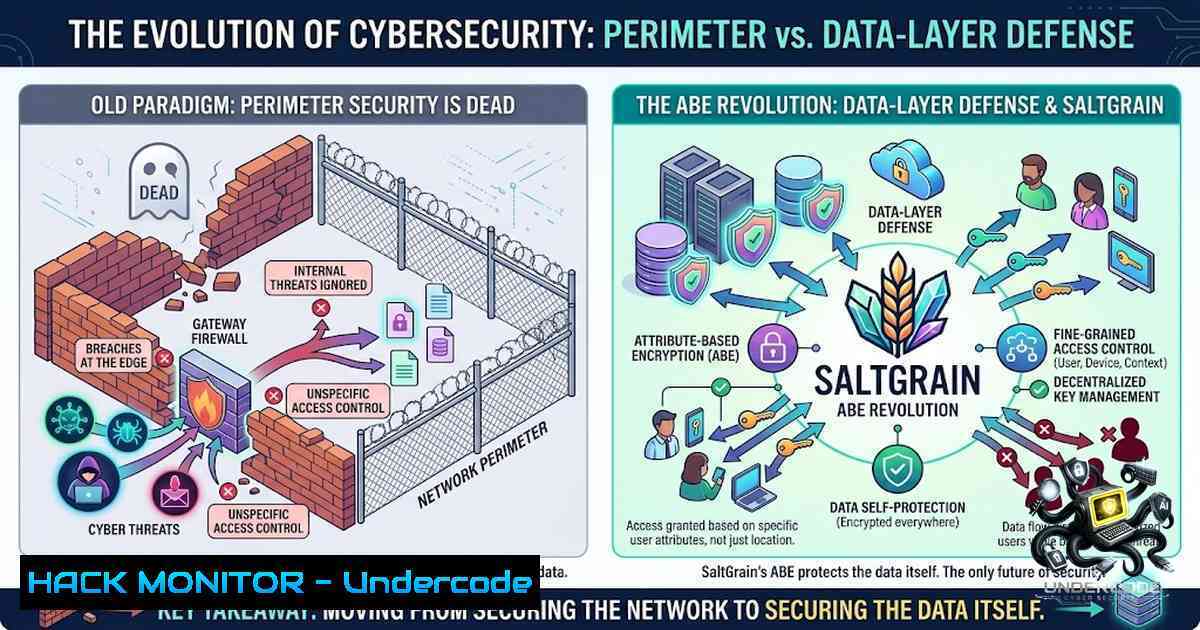
The traditional cybersecurity paradigm—building taller walls around corporate networks—is fundamentally broken. As organizations accelerate AI adoption, edge computing, and hybrid cloud strategies, data no longer resides within a defensible perimeter. Attribute-Based Encryption (ABE) flips this model entirely: instead of protecting the systems that house data, ABE protects the data itself, embedding access policies directly into the ciphertext. NTT DATA’s SaltGrain platform, built on this cryptographic primitive and debuting at the Dell Technologies Forum in Sydney on 11 August 2026, represents the first commercially viable Zero Trust Data Security (ZTDS) platform that renders stolen data useless even if every system-level defense fails.
Learning Objectives:
- Understand the cryptographic foundation of Attribute-Based Encryption (ABE) and how it differs from traditional public-key infrastructure (PKI) and role-based access control (RBAC).
- Master the architecture and deployment considerations of NTT DATA’s SaltGrain Zero Trust Data Security platform in hybrid and multi-cloud environments.
- Acquire hands-on skills for implementing ABE-based data-centric security using open-source cryptographic libraries (OpenABE, Charm-Crypto) and integrating them into enterprise workflows.
You Should Know:
- Attribute-Based Encryption (ABE): Cryptography That Thinks in Policies, Not Identities
Traditional public-key encryption ties decryption power to a specific identity—a single user’s private key. ABE, first proposed in 2004 by Dr. Amit Sahai and Dr. Brent Waters (now director of NTT Research’s Cryptography & Information Security Lab), replaces identity with attributes. A file encrypted under the policy `(“Department: Finance” AND “Clearance: Top Secret”) OR “Role: Auditor”` can be decrypted only by users whose attribute sets satisfy that Boolean logic. The access policy is cryptographically bound to the ciphertext itself—not stored in a database, not enforced by an application, and not dependent on a network perimeter.
SaltGrain wraps this ABE functionality within a zero-trust framework, enabling use cases that involve document sharing while protecting sensitive portions within documents. The platform breaks the “all-or-1othing” file-access paradigm that has plagued enterprise security for decades. Even if an attacker compromises an Active Directory server, steals VPN credentials, and gains shell access to a file server, the exfiltrated data remains encrypted and indecipherable because the attacker lacks the required attributes.
From a threat-modeling perspective, ABE addresses the “harvest now, decrypt later” attack vector: attackers have been stockpiling encrypted data in anticipation of quantum computers that can break RSA and ECC. SaltGrain is designed with post-quantum security in mind, making it resistant to both current and future cryptographic attacks.
- Deploying ABE in the Enterprise: The SaltGrain Architecture
SaltGrain is the industry’s first Zero Trust Data Security (ZTDS) platform powered by ABE that focuses solely on protecting the Corporate Data Estate utilizing patented, fine-grained data encryption to keep sensitive data safe regardless of the system, across any format, at rest or in transit. The architecture consists of three core pillars:
- Attribute Authority: A centralized or distributed service that issues attribute-based private keys to users. Attributes might include
Role,Clearance,Department,Location,Project, or custom tags. - Encryption Gateway: An API or proxy layer that intercepts data writes, evaluates the desired access policy, and encrypts the data using ABE before storage.
- Decryption Client: A lightweight agent or SDK that handles decryption requests, verifying that the user’s attribute set satisfies the policy embedded in the ciphertext.
For enterprises already invested in Dell infrastructure, SaltGrain integrates natively with Dell’s hybrid cloud and edge solutions. At the Dell Technologies Forum in Sydney, NTT DATA will demonstrate live how SaltGrain protects data across Dell PowerEdge servers, Dell APEX cloud services, and edge computing nodes.
3. Hands-On ABE Implementation: OpenABE Library (Linux/Windows)
For security engineers and architects who want to understand ABE at the code level, the OpenABE library provides a production-grade, open-source implementation. Below is a practical guide to setting up OpenABE and performing ABE encryption and decryption.
Step-by-Step Guide: OpenABE Setup and Basic Operations
Prerequisites: Ubuntu/Debian Linux (20.04+) or Windows 10/11 with WSL2, or native Windows build environment.
Linux Installation:
 Install dependencies
sudo apt-get update
sudo apt-get install -y git cmake build-essential libssl-dev libgmp-dev libpbc-dev

Clone and build OpenABE
git clone https://github.com/zeutro/openabe.git
cd openabe
mkdir build && cd build
cmake .. -DCMAKE_BUILD_TYPE=Release
make -j$(nproc)
sudo make install
Windows Installation (using WSL2):
 In PowerShell as Administrator
wsl --install -d Ubuntu
 Then follow the Linux instructions inside WSL
Basic ABE Workflow:
After installation, the OpenABE toolkit provides command-line utilities:
 1. Generate system parameters and master keys
openabe setup

<ol>
<li>Create a user with specific attributes
openabe keygen --attributes "Department=Finance,Clearance=TopSecret" --user-id alice</p></li>
<li><p>Encrypt a file under a policy
openabe encrypt --policy "(Department=Finance AND Clearance=TopSecret) OR Role=Auditor" \
--input sensitive_report.pdf --output sensitive_report.abe</p></li>
<li><p>Decrypt (only if user's attributes satisfy the policy)
openabe decrypt --input sensitive_report.abe --output decrypted_report.pdf --user-id alice
Programmatic Usage (C/C++):
include <openabe/openabe.h>
using namespace oabe;

// Initialize the crypto system
OpenABECryptoContext context("CP-ABE");
context.generateParams();

// Encrypt with a policy
std::string policy = "(Department:Finance AND Clearance:TopSecret)";
std::string ciphertext = context.encrypt(plaintext, policy);

// Decrypt (requires user key with matching attributes)
std::string recovered = context.decrypt(ciphertext);
4. Python Implementation with Charm-Crypto
For rapid prototyping and integration with AI/ML pipelines, Charm-Crypto provides a Python framework for ABE schemes.
Installation:
pip install charm-crypto
CP-ABE Example (Ciphertext-Policy ABE):
from charm.toolbox.pairinggroup import PairingGroup, GT
from charm.schemes.abenc.abenc_bsw07 import CPabe_BSW07

Initialize
group = PairingGroup('SS512')
cpabe = CPabe_BSW07(group)

Setup
master_public_key, master_secret_key = cpabe.setup()

Key generation for a user with attributes
attributes = ['Finance', 'TopSecret', 'Manager']
secret_key = cpabe.keygen(master_public_key, master_secret_key, attributes)

Encrypt under a policy
policy = '("Finance" and "TopSecret") or "Auditor"'
message = group.random(GT)  In practice, this would be a symmetric key for hybrid encryption
ciphertext = cpabe.encrypt(master_public_key, message, policy)

Decrypt (only if user attributes satisfy policy)
decrypted = cpabe.decrypt(master_public_key, secret_key, ciphertext)
assert decrypted == message
- Hybrid Encryption: Combining ABE with AES for Performance
ABE operations on bilinear pairings are computationally expensive for large files. The industry-standard approach is hybrid encryption:
1. Generate a random AES-256 symmetric key.
2. Encrypt the large file with AES-GCM.
- Encrypt the AES key using ABE under the desired attribute policy.
- Package the ABE-encrypted key with the AES-encrypted file.
This approach delivers the fine-grained access control of ABE with the performance of symmetric encryption.
Implementation Snippet (Conceptual):
 Generate AES key
openssl rand -out aes_key.bin 32

Encrypt file with AES
openssl enc -aes-256-gcm -in confidential.pdf -out confidential.pdf.aes -K $(cat aes_key.bin | xxd -p) -iv 00000000000000000000000000000000

Encrypt AES key with ABE policy
openabe encrypt --policy "Department=R&D AND Project=ProjectX" --input aes_key.bin --output aes_key.abe

Package both
cat confidential.pdf.aes aes_key.abe > confidential.package
6. Zero-Trust Integration: SaltGrain in the Enterprise Stack
SaltGrain’s value proposition extends beyond cryptography—it’s about operationalizing ABE within existing security stacks. Key integration points include:
- SIEM Integration: SaltGrain generates audit logs for every decryption attempt, providing granular visibility into who accessed what data and when.
- Identity Providers: Integration with Okta, Azure AD, and Ping Identity allows dynamic attribute assignment based on user context (location, device posture, time of day).
- Data Loss Prevention (DLP): ABE-encrypted data remains protected even when exfiltrated, rendering traditional DLP “block” and “quarantine” responses less critical.
- AI/ML Pipelines: SaltGrain enables encrypted data processing in machine learning models, as the ABE-encrypted data can be decrypted only by authorized model execution contexts.
7. Mitigating the Quantum Threat: Post-Quantum ABE
NTT Research has advanced the underlying ABE implementation to operate with post-quantum security while maintaining strong performance. This is achieved through lattice-based cryptography extensions to the ABE scheme, ensuring that even a sufficiently powerful quantum computer cannot derive private keys from public parameters. Organizations preparing for the quantum era should prioritize data-layer encryption schemes like SaltGrain that are designed with post-quantum resilience from the ground up.
What Undercode Say:
- Key Takeaway 1: Perimeter-based security is obsolete. ABE represents a paradigm shift from “protect the system” to “protect the data itself,” rendering network breaches far less catastrophic.
-
Key Takeaway 2: SaltGrain is not just another encryption tool—it’s the first commercially viable platform that operationalizes ABE at enterprise scale, with post-quantum security baked in and zero-trust principles enforced at the cryptographic layer.
Analysis: The significance of SaltGrain’s debut at the Dell Technologies Forum cannot be overstated. NTT DATA is positioning itself at the intersection of three megatrends: the explosion of AI agents that require fine-grained data access, the death of the traditional network perimeter in hybrid cloud environments, and the looming quantum threat to classical encryption. By partnering with Dell, NTT DATA ensures that SaltGrain integrates with the infrastructure that powers the world’s largest enterprises—from PowerEdge servers to APEX cloud services. The live demo at booth S12 will likely showcase real-world scenarios: a healthcare provider sharing patient records with researchers under strict attribute policies, a financial institution securing M&A documents that must be accessible only to “Deal Team” members with “Need-to-Know” clearance, and an AI training pipeline that can process encrypted data without exposing raw sensitive information. The market readiness of SaltGrain, as articulated by NTT Research President Kazu Gomi, reflects a broader industry realization: the “all-or-1othing” file-access model is no longer acceptable in an era of sophisticated cyber threats and regulatory scrutiny. For CISOs and security architects, SaltGrain offers a path toward genuine data-centric security—not as a theoretical ideal, but as a deployable, integratable, and scalable solution.
Prediction:
- +1 SaltGrain will catalyze a wave of ABE-based security products from competitors, accelerating the transition from network-centric to data-centric security architectures across Fortune 500 enterprises within 24–36 months.
- +1 The NTT DATA–Dell partnership will establish a de facto standard for ABE integration with enterprise infrastructure, similar to how Intel’s SGX and AMD’s SEV defined the trusted execution environment market.
- -1 Organizations that delay adopting data-layer encryption will face exponentially higher breach costs as AI-driven attacks become more sophisticated and regulatory fines for data exposure escalate.
- +1 Post-quantum ABE implementations like SaltGrain will become mandatory for government and defense contractors within five years, creating a multi-billion-dollar market for quantum-safe data protection.
- -1 The complexity of ABE attribute management and policy definition will create a skills gap, requiring significant investment in security engineering talent and training programs.
- +1 Integration of ABE with AI/ML workflows will unlock new use cases for privacy-preserving analytics, enabling organizations to derive insights from encrypted data without compromising confidentiality.
▶️ Related Video (74% Match):
🎯Let’s Practice For Free:
🎓 Live Courses & Certifications:
Join Undercode Academy for Verified Certifications
🚀 Request a Custom Project:
Secure, high-velocity infrastructure and disruptive technological engineering. Contact our engineering team for high-tier development and proprietary systems:
[email protected]
💎 Smart Architecture | 🛡️ Secure by Design | ⭐ Trusted by Thousands
IT/Security Reporter URL:
Reported By: Nttdataapac Aiadoption – Hackers Feeds
Extra Hub: Undercode MoN
Basic Verification: Pass ✅


