Listen to this Post
Introduction:
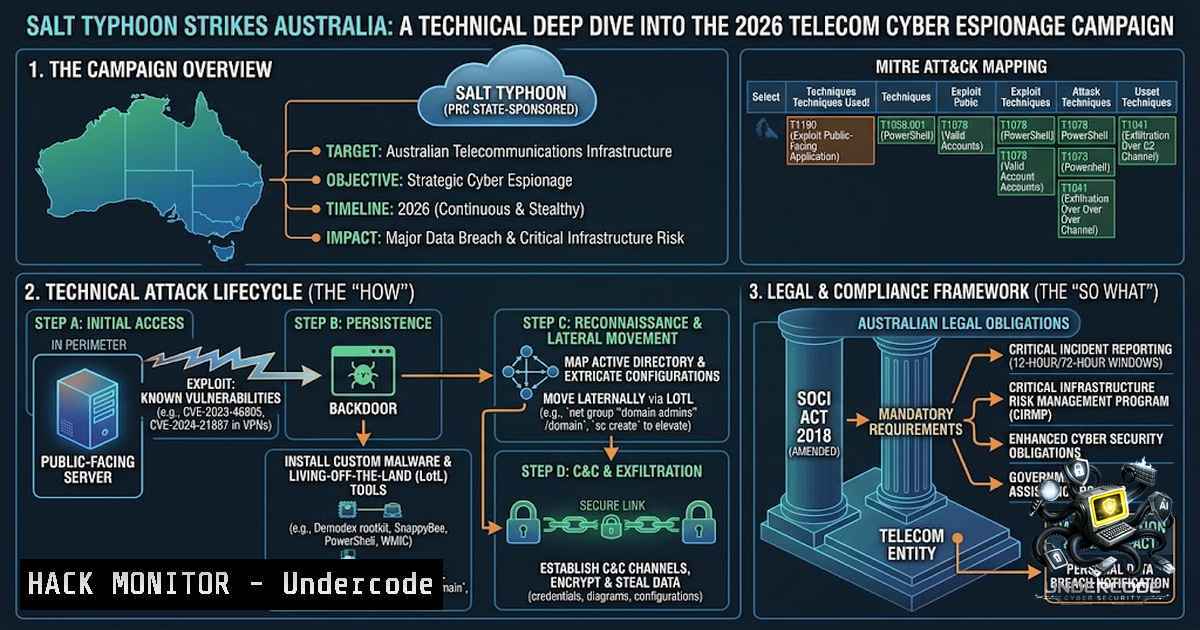
In early 2026, Australia’s telecommunications sector became the latest frontline in a global cyber espionage campaign conducted by Salt Typhoon, a Chinese state-sponsored advanced persistent threat (APT) group. The group, which has been active since at least 2019 and is attributed to the People’s Republic of China, successfully breached two of Australia’s three Tier 1 telecommunications carriers through unauthorized access. Deputy Prime Minister and Defence Minister Richard Marles has consistently emphasized the urgent need for Australian companies to fortify their cyber defenses, warning that the consequences of security breaches are dire. This incident underscores a fundamental truth in modern cybersecurity: nation-state adversaries are no longer targeting only government networks—they are systematically infiltrating the critical infrastructure that underpins national communications, economy, and security.
Learning Objectives & Secrets:
- Objective 1: Understand Salt Typhoon’s Attack Vectors — Gain comprehensive knowledge of the vulnerabilities exploited by Salt Typhoon, including Cisco IOS XE (CVE-2023-20198, CVE-2023-20273), Cisco Smart Install (CVE-2018-0171), Ivanti Connect Secure (CVE-2024-21887), and Palo Alto PAN-OS GlobalProtect (CVE-2024-3400).
-
Objective 2 Secret Tip: Detect Living-Off-the-Land (LOTL) Techniques — Salt Typhoon avoids traditional malware, instead leveraging built-in network tools and legitimate credentials to evade detection. Security teams must monitor for abnormal use of native Cisco IOS commands, Guest Shell script execution, and unauthorized GRE or IPsec tunnel configurations—not just malicious file signatures.
-
Objective 3 Secret Tip: Hunt for Persistence Mechanisms — The group establishes long-term access by modifying Access Control Lists (typically naming them “access-list 20”), opening non-standard ports (SSH on 22×22 or xxx22, HTTP on 18xxx), and enabling Cisco Guest Shell to run malicious Python and Tcl scripts (siet.py, TCLproxy.tcl, map.tcl). Proactive threat hunting should focus on these specific configuration anomalies rather than waiting for signature-based alerts.
You Should Know:
- Understanding Salt Typhoon’s Tactics, Techniques, and Procedures (TTPs)
Salt Typhoon’s operational playbook represents a sophisticated evolution in state-sponsored cyber espionage. Unlike ransomware groups that prioritize financial gain, Salt Typhoon’s primary objective is persistent, undetected access to telecommunications infrastructure for intelligence gathering and pre-positioning for potential future disruption.
The attack chain typically unfolds as follows:
- Initial Access: The group exploits known vulnerabilities in edge devices—VPNs, firewalls, and routers—or leverages stolen employee credentials to gain a foothold.
- Persistence Establishment: After initial compromise, Salt Typhoon modifies device configurations, creates local accounts, and establishes covert communication channels via GRE or IPsec tunnels.
- Lateral Movement: Using “living-off-the-land” techniques, the group pivots across the network using built-in Cisco tools, enabling Guest Shell access, and abusing legitimate administrative protocols.
- Data Exfiltration: The group collects network management data, subscriber information, and call records, exfiltrating them through encrypted tunnels while systematically deleting logs to cover their tracks.
Step-by-Step Guide: Detecting Salt Typhoon Activity on Cisco IOS XE Devices
Security teams should execute the following commands on Cisco IOS XE routers and switches to identify potential compromise:
Check for unauthorized local user accounts:
show running-config | include username
show users
Review Access Control Lists for suspicious entries (look for “access-list 20” or similarly named ACLs):
show access-lists
show running-config | include access-list
Identify unauthorized GRE tunnels:
show interface tunnel
show running-config | include tunnel
Check for abnormal SSH and HTTP listening ports:
show ip ssh
show ip http server status
show running-config | include ip http
Verify Guest Shell configuration and activity:
show guestshell
show running-config | include guestshell
Review system logs for anomalous events:
show logging
show clock
Examine running processes for unauthorized scripts:
show processes
- The BadCandy Implant: A Case Study in Router Compromise
The Australian Signals Directorate (ASD) has warned of ongoing attacks exploiting CVE-2023-20198 (CVSS 10.0) to deploy the “BadCandy” web shell implant on unpatched Cisco IOS XE devices. BadCandy is a stealthy Lua-based web shell that grants attackers root-level access to compromised networking devices. By mid-2025, hundreds of devices in Australia alone had been compromised.
Step-by-Step Guide: Remediating BadCandy Infections
- Identify Vulnerable Devices: Run `show version` to determine IOS XE version. Affected versions include 17.9, 17.6, 17.3, and 16.12 (Catalyst 3650 and 3850 only).
-
Check for Web UI Exploitation: The vulnerability is exploited via the web user interface. Verify if the HTTP/HTTPS server is enabled:
show running-config | include ip http
show running-config | include ip https
-
Apply Patches Immediately: Upgrade to fixed IOS XE versions as per Cisco’s security advisories. There are no viable workarounds—patching is imperative.
-
Restrict Web UI Access: If patching is not immediately possible, restrict web UI access to trusted IP ranges only:
ip http access-class 10
access-list 10 permit [bash]
-
Search for BadCandy Indicators: Check for the presence of unauthorized Lua scripts in the device filesystem:
show filesystem
dir flash:
-
Implement MFA for Administrative Access: Enforce multi-factor authentication for all administrative accounts to prevent credential-based attacks.
-
Disable Unused Services: Turn off Smart Install, Guest Shell, and other unnecessary features to reduce attack surface.
3. Network Hardening Against Advanced Persistent Threats
The Salt Typhoon campaign demonstrates that traditional perimeter defenses are insufficient against nation-state adversaries. A defense-in-depth strategy is essential.
Linux Commands for Network Monitoring and Anomaly Detection:
Detect GRE tunnel traffic (protocol 47):
sudo tcpdump -i eth0 "proto gre" -1
Monitor for unusual outbound connections on non-standard ports:
sudo netstat -tunap | grep -E ":(22[0-9]{2}|18[0-9]{3})"
Check for unauthorized SSH daemons running on high ports:
sudo ss -tlnp | grep ssh
Audit system logs for suspicious authentication attempts:
sudo grep "Failed password" /var/log/auth.log
sudo grep "Accepted password" /var/log/auth.log
Use Zeek (formerly Bro) for deep packet inspection:
zeek -r capture.pcap
Windows Commands for Enterprise Network Hardening:
Audit Active Directory for anomalous account creations:
Get-ADUser -Filter -Properties Created | Where-Object {$_.Created -gt (Get-Date).AddDays(-30)}
Check for unauthorized scheduled tasks:
Get-ScheduledTask | Where-Object {$_.State -1e "Disabled"}
Review firewall rules for suspicious inbound/outbound exceptions:
New-1etFirewallRule -DisplayName "Block Suspicious Port" -Direction Inbound -LocalPort 57722 -Protocol TCP -Action Block
Enable advanced audit logging:
auditpol /set /subcategory:"Logon" /success:enable /failure:enable
- API Security and Cloud Hardening for Telecom Operators
Telecommunications providers increasingly rely on APIs for network management, billing, and customer services—creating new attack surfaces that Salt Typhoon and similar adversaries actively target.
API Security Best Practices:
- Implement strict authentication and authorization using OAuth 2.0 with PKCE.
- Enforce rate limiting to prevent brute-force attacks.
- Validate all input to prevent injection attacks.
- Use API gateways with built-in threat detection.
- Regularly audit API access logs for anomalous patterns.
Cloud Hardening Commands (AWS CLI):
Audit IAM roles and policies for over-privileged accounts:
aws iam list-users
aws iam list-attached-user-policies --user-1ame [bash]
Enable CloudTrail for comprehensive logging:
aws cloudtrail create-trail --1ame [bash] --s3-bucket-1ame [bash]
aws cloudtrail start-logging --1ame [bash]
Review security group rules for overly permissive configurations:
aws ec2 describe-security-groups --group-ids [bash]
- Incident Response and Recovery: Lessons from the Australian Telecom Breach
The OAIC’s ongoing investigations into telecommunications data breaches—including the recent determination that Optus breached Australian Privacy Principle 11.1—highlight the regulatory and reputational consequences of inadequate security.
Step-by-Step Incident Response Framework:
- Preparation: Establish an incident response team with clearly defined roles. Conduct regular tabletop exercises simulating nation-state APT scenarios.
-
Identification: Deploy SIEM solutions with custom detection rules for Salt Typhoon IOCs, including:
– Unauthorized ACL modifications
– GRE tunnel creation
– Guest Shell activation
– Abnormal administrative logins from non-Australian IP addresses
- Containment: Isolate compromised devices immediately. Block outbound connections to known malicious IP addresses.
-
Eradication: Remove malicious configurations, scripts, and backdoors. Reimage compromised devices from known-good backups.
-
Recovery: Restore services from clean backups. Implement additional monitoring on restored systems.
-
Lessons Learned: Conduct a post-incident review. Update security policies and controls based on findings.
What Undercode Say:
-
Key Takeaway 1: Salt Typhoon’s ability to remain undetected for extended periods—often months or years—demonstrates that traditional signature-based detection is inadequate against sophisticated APTs. Organizations must adopt proactive threat hunting, continuous monitoring, and behavioral analytics to identify subtle indicators of compromise.
-
Key Takeaway 2: The Australian government’s establishment of the Cyber Incident Review Board (CIRB) in May 2026, modeled on the disbanded US Cyber Safety Review Board, represents a significant step toward systemic cybersecurity improvement. Unlike its US predecessor, Australia’s CIRB has compulsory information-gathering powers, enabling more effective post-incident analysis and recommendations.
Analysis: The Salt Typhoon campaign against Australian telecommunications carriers reveals a troubling escalation in state-sponsored cyber espionage. The group’s focus on telecommunications infrastructure—the backbone of modern society—indicates that adversaries are targeting not just data but the very fabric of national communications. The fact that two of Australia’s three Tier 1 carriers were breached simultaneously suggests coordinated, long-term planning and deep operational capabilities. The Australian Signals Directorate’s warnings about ongoing BadCandy attacks, with hundreds of Cisco devices compromised in Australia alone, underscore the urgent need for organizations to patch known vulnerabilities, implement defense-in-depth strategies, and adopt a “presume breach” mindset. The establishment of the CIRB, while welcome, must be accompanied by concrete action from both government and the private sector to close the gaps that enabled these breaches.
Prediction:
- +1 Australia’s Cyber Incident Review Board will become a global model for post-incident analysis, influencing similar initiatives in other Five Eyes nations and beyond. Its compulsory information-gathering powers will yield actionable insights that significantly improve national cyber resilience.
-
-1 Salt Typhoon and similar APT groups will continue to target Australian critical infrastructure, with attacks expanding beyond telecommunications to energy, water, and transportation sectors—sectors where the group has already pre-positioned itself.
-
-1 The exploitation of legacy vulnerabilities (CVE-2018-0171, first disclosed in 2018) remains a persistent threat, indicating that many organizations still lack effective patch management programs. Until this fundamental security hygiene gap is addressed, attackers will continue to leverage years-old vulnerabilities with devastating effect.
-
+1 The breach will accelerate adoption of zero-trust architectures and mandatory security frameworks like the ASD Essential Eight across Australian critical infrastructure, driving a new wave of cybersecurity investment and maturity.
-
-1 The OAIC’s intensified scrutiny of telecommunications data breaches will result in significant financial penalties and class-action lawsuits, potentially reshaping the Australian cyber insurance market and forcing boards to prioritize cybersecurity at the highest levels.
▶️ Related Video (78% Match):
https://www.youtube.com/watch?v=3C3Mz-VUx1M
🎯Let’s Practice For Free:
🎓 Live Courses & Certifications:
Join Undercode Academy for Verified Certifications
🚀 Request a Custom Project:
Secure, high-velocity infrastructure and disruptive technological engineering. Contact our engineering team for high-tier development and proprietary systems:
[email protected]
💎 Smart Architecture | 🛡️ Secure by Design | ⭐ Trusted by Thousands
IT/Security Reporter URL:
Reported By: https://lnkd.in/p/eZcyiEeM – Hackers Feeds
Extra Hub: Undercode MoN
Basic Verification: Pass ✅


