Listen to this Post
Introduction:
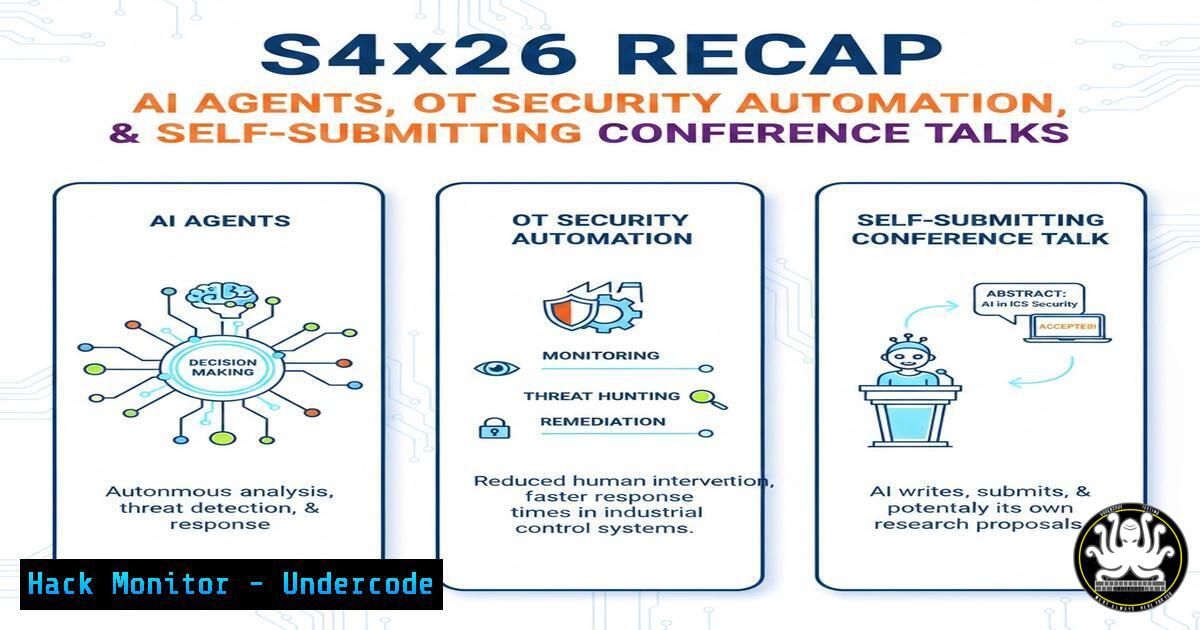
The S4x26 conference, a cornerstone event for Industrial Control System (ICS) and Operational Technology (OT) security, concluded with a significant shift in focus from theoretical threats to practical, automated defense. Discussions moved beyond simple asset inventory to the integration of AI agents capable of dynamic response and even autonomous interaction with conference infrastructure. This article breaks down the technical undercurrents of the event, providing actionable insights and commands for security professionals looking to implement these next-generation security postures.
Learning Objectives:
- Understand the practical applications of AI in OT security automation, moving beyond traditional monitoring.
- Learn how to configure basic testbeds for experimenting with AI-driven log analysis and incident response.
- Identify the cultural and technical barriers to adopting automation in legacy industrial environments.
You Should Know:
- The Rise of the AI Agent in OT
Chris Sistrunk’s humorous remark, “next year my AI will submit a talk,” underscores a serious trend: the move towards autonomous AI agents. In an OT context, this doesn’t mean AI writing Python scripts to patch PLCs without oversight, but rather AI acting as a sophisticated co-pilot. These agents can ingest vast amounts of historian data, network logs, and threat intelligence to correlate events that a human analyst might miss.
Step‑by‑step guide to simulating an AI log analysis agent on a Linux system:
To understand how an agent might parse logs, you can use a simple combination of grep, awk, and a large language model (LLM) API for analysis. This simulates an agent triaging a log file.
- Simulate OT Log Data: Create a sample log file (
sim_plc.log).echo "2026-03-08 10:32:15 ERROR: Modbus TCP write to coil 0x01 from 192.168.1.50" >> sim_plc.log echo "2026-03-08 10:32:16 ALERT: Function code 90 (illegal) detected on slave 10" >> sim_plc.log echo "2026-03-08 10:32:17 INFO: CPU load at 15%" >> sim_plc.log
2. Extract High-Severity Events: Isolate critical events.
grep -E "ERROR|ALERT" sim_plc.log > critical_alerts.log
- Format for AI Consumption: Prepare the data for an API call.
alert_data=$(cat critical_alerts.log)
echo "Analyze these OT alerts and provide a risk assessment and suggested immediate action: $alert_data"
(Note: This output would then be the prompt sent to a secured, locally-run LLM or a private API endpoint to simulate the “agent” analyzing the context.)
2. Women in ICS Security and Community Building
Megan Samford’s proposal for a women’s dinner to support a local shelter highlights a critical aspect of cybersecurity: community and mentorship. While not a technical command, building a diverse team is a security strategy. A homogenous team often has blind spots. The technical takeaway here is the concept of Secure by Design principles applied to team culture—ensuring resilience through diversity of thought.
Step‑by‑step guide to auditing your team’s communication channels:
- Review Access Control Lists (ACLs): On your team’s shared drives or communication platforms (like Slack/Teams), ensure that critical incident response plans are accessible to all shifts and diverse team members, not just a core group.
Example Linux command to check group permissions on a response plan
ls -la /opt/ot_response_plan/
If the file is owned by a single user, change it to a group
sudo chown :security_team incident_response_manual.pdf
sudo chmod 660 incident_response_manual.pdf
- Implement a Mentorship Onboarding Script: Create an automated onboarding script that assigns a mentor to new hires based on skills gaps, ensuring knowledge transfer is systematic and documented, not ad-hoc.
-
The “Backyard and Frontyard” Engineer vs. Specialized Security
Ron Fabela’s comment about the substation engineer who “could mow the backyard and the frontyard” speaks to the reality of OT: generalists are the norm. For security professionals, this means tools must be intuitive. High-complexity, enterprise-grade tools fail in OT because the engineers maintaining the power grid or water system are not full-time security analysts.
Step‑by‑step guide to creating a simple, unified monitoring dashboard for a generalist:
Using telegraf, influxdb, and `grafana` (the TICK stack) on a Linux jump box, you can combine IT and OT metrics.
- Install Telegraf: Configure it to collect both system metrics and simulate Modbus data.
sudo apt-get update && sudo apt-get install telegraf
- Edit Telegraf Config: Uncomment the `[[inputs.modbus]]` section in `/etc/telegraf/telegraf.conf` and point it to a simulation IP (e.g.,
127.0.0.1:502). Also ensure `[[inputs.cpu]]` and `[[inputs.mem]]` are active.
3. Start Telegraf:
sudo systemctl start telegraf
sudo systemctl enable telegraf
4. Visualize in Grafana: Connect Grafana to the InfluxDB database where Telegraf is writing. Create a single dashboard showing CPU load (IT health) next to coil statuses from the PLC (OT health). This gives the “frontyard/backyard” engineer a single pane of glass.
4. Vendor Innovation in the POC Pavilion
The discussion around the POC (Proof of Concept) Pavilion highlights the need for hands-on validation. In OT, you cannot patch and pray. You must test in a digital twin or a lab. This section is about using Infrastructure as Code (IaC) to build disposable test environments.
Step‑by‑step guide to deploying a mini OT testbed using Vagrant:
1. Create a Vagrantfile: Define two machines: an attacker machine (Kali Linux) and a target (a simulated PLC like OpenPLC).
Vagrant.configure("2") do |config|
config.vm.define "attacker" do |attacker|
attacker.vm.box = "kalilinux/rolling"
attacker.vm.network "private_network", ip: "192.168.56.10"
end
config.vm.define "plc" do |plc|
plc.vm.box = "ubuntu/focal64"
plc.vm.network "private_network", ip: "192.168.56.20"
plc.vm.provision "shell", inline: <<-SHELL
sudo apt-get update
sudo apt-get install -y openplc  Example install command
SHELL
end
end
2. Spin up the environment:
vagrant up
3. Test Exploits Safely: From the attacker machine (vagrant ssh attacker), you can now safely scan and attempt exploits against the simulated PLC at `192.168.56.20` without risking production environments.
- The Future of S4 Talks: Automation and AI-Generated Content
The idea of an AI submitting a talk implies that the security community will soon be dealing with AI-generated attack scripts, AI-generated defense strategies, and the noise in between. This requires a shift to validation over generation. We must focus on verifying the output of AI tools.
Step‑by‑step guide to validating AI-generated firewall rules for an OT network:
1. Generate a Rule: Ask an AI tool to “Write an iptables rule to allow only specific Modbus function codes from the HMI server to the PLC.”
2. Review the Output (Hypothetical):
 AI might generate:
sudo iptables -A FORWARD -s 10.0.0.10 -d 10.0.0.20 -p tcp --dport 502 -m string --string "function code 3" --algo bm -j ACCEPT
sudo iptables -A FORWARD -s 10.0.0.10 -d 10.0.0.20 -p tcp --dport 502 -j DROP
3. Manual Validation: The `string` match for “function code 3” is inefficient and may miss fragmented packets. The correct approach is to use a proper application-layer gateway or a more sophisticated IPS. Validate by checking if the AI’s rule is syntactically correct (iptables -vL) and logically sound (does it actually block function code 90?).
 Check if the rule was applied
sudo iptables -L FORWARD -v -n
What Undercode Say:
- Automation is inevitable, but context is king: The move towards AI in OT, as hinted at by the S4 commentary, will not replace engineers but will force them to become programmers and prompt engineers. The key takeaway is that security automation must be built with a deep understanding of the physical process, not just network packets.
- Community as a security control: The discussions about inclusivity and event culture (cabana management, women’s dinners) are not separate from security. A stressed, homogenous, and siloed team is a security vulnerability. Building robust communication channels and supporting all team members is a form of risk mitigation often overlooked in technical hardening guides.
Prediction:
Within the next three years, we will see the first major OT security incident initiated by an AI agent—not by malicious intent, but through the exploitation of an AI-driven management tool that was given overly broad permissions. The response will lead to the development of “constrained AI” frameworks specifically for industrial environments, similar to the concept of safety instrumented systems (SIS) but for logic, ensuring that autonomous agents operate within a strict, physically-safe boundary. The conversation at S4x27 will not be about if an AI can submit a talk, but about the approval workflow for that submission.
▶️ Related Video (78% Match):
🎯Let’s Practice For Free:
IT/Security Reporter URL:
Reported By: Dale Peterson – Hackers Feeds
Extra Hub: Undercode MoN
Basic Verification: Pass ✅


