Listen to this Post
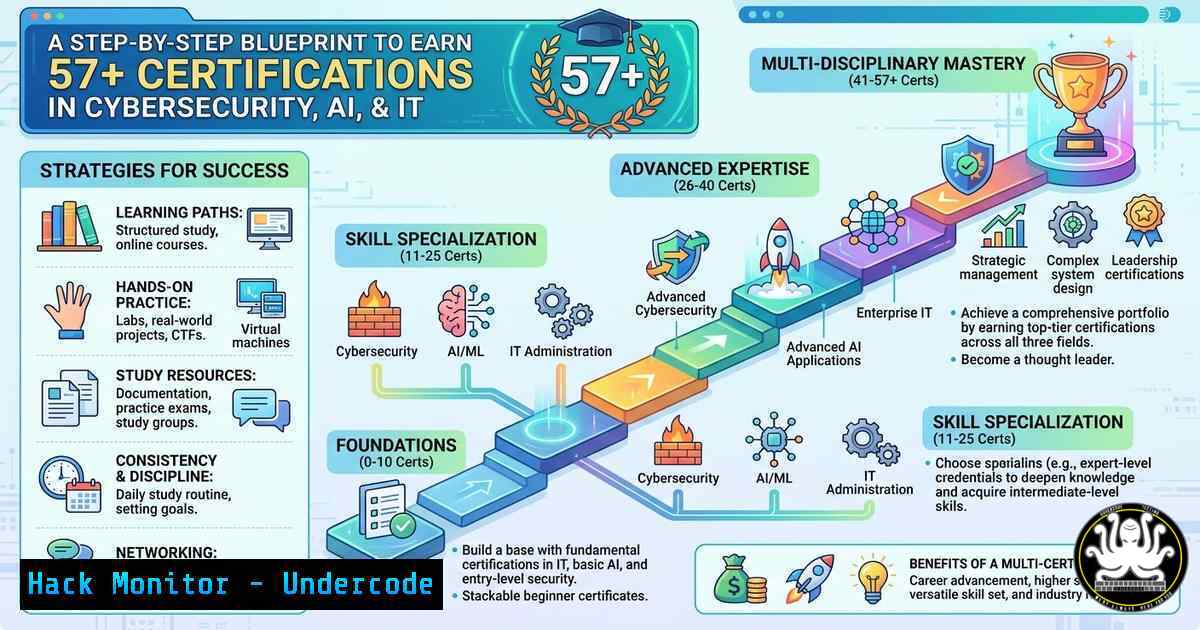
Introduction:
In the rapidly evolving landscape of information technology, professionals like Tony Moukbel—who holds 57 certifications across cybersecurity, forensics, programming, and electronics—demonstrate the power of continuous upskilling. Earning multiple, high‑level certifications not only validates expertise but also equips you to tackle complex, interdisciplinary challenges. This article breaks down the essential domains, learning paths, and hands‑on techniques that can help you build a similarly diverse skill set, blending AI security, ethical hacking, cloud hardening, and digital forensics.
Learning Objectives:
- Understand the core certification pathways in cybersecurity, AI, and IT.
- Learn practical commands and configurations for penetration testing, system hardening, and forensic analysis.
- Develop a structured approach to combining theoretical knowledge with real‑world labs and exercises.
You Should Know:
1. Building a Foundation: Core Certifications and Prerequisites
Start with industry‑recognized certifications that cover fundamental concepts. For cybersecurity, begin with CompTIA Security+ or (ISC)² SSCP. For AI and machine learning, consider certifications like Microsoft Certified: Azure AI Fundamentals or AWS Certified Machine Learning – Specialty. These provide the vocabulary and baseline knowledge required for advanced topics.
Step‑by‑step guide:
- Research certification requirements on official sites (e.g., CompTIA, (ISC)², Microsoft Learn).
- Set up a study schedule: dedicate 1‑2 hours daily.
- Use practice exams and labs. For Security+, for instance, set up a home lab with VirtualBox to experiment with Windows and Linux VMs.
Example commands to practice basic network reconnaissance (Linux):
 Check network interfaces
ip a
 Scan local network with nmap
nmap -sn 192.168.1.0/24
 Test open ports on a target
nmap -sS -p 1-1000 192.168.1.10
2. Penetration Testing: From Theory to Exploitation
Certifications like CEH (Certified Ethical Hacker) or OSCP (Offensive Security Certified Professional) require hands‑on exploitation skills. You need to be comfortable with tools like Metasploit, Burp Suite, and custom scripting.
Step‑by‑step guide – exploiting a vulnerable machine (e.g., Metasploitable):
– Download and set up Metasploitable 2 in a virtual machine.
– From your Kali Linux VM, scan for open ports:
nmap -sV 192.168.1.20
– Identify a vulnerable service (e.g., vsftpd 2.3.4).
– Launch Metasploit:
msfconsole
search vsftpd
use exploit/unix/ftp/vsftpd_234_backdoor
set RHOST 192.168.1.20
exploit
– Upon successful exploitation, you gain a shell. Document the process for your certification lab notes.
3. Cloud Security and Hardening
With the shift to cloud, certifications like AWS Certified Security – Specialty or CCSP are invaluable. They cover identity management, encryption, and compliance. Practical cloud hardening involves configuring security groups, IAM policies, and monitoring.
Step‑by‑step guide – securing an AWS EC2 instance:
- Launch an EC2 instance with Amazon Linux 2.
- Create a security group that only allows SSH from your IP:
aws ec2 authorize-security-group-ingress --group-id sg-xxxx --protocol tcp --port 22 --cidr $(curl -s http://checkip.amazonaws.com)/32
- Enable CloudTrail for API logging.
- Set up AWS Config rules to detect non‑compliant resources.
- For Windows instances, use PowerShell to enable Windows Firewall rules:
New-NetFirewallRule -DisplayName "Block All Inbound" -Direction Inbound -Action Block
4. Digital Forensics and Incident Response
Certifications such as GCFE (GIAC Certified Forensic Examiner) or CHFI (Computer Hacking Forensic Investigator) teach you to acquire and analyze evidence. You’ll need tools like FTK Imager, Autopsy, and command‑line forensic utilities.
Step‑by‑step guide – acquiring a memory image from a Windows system:
– Download and run FTK Imager (as administrator).
– Select File > Capture Memory.
– Choose a destination path and enable “Include pagefile”.
– Click “Capture” to create a .mem file.
– For Linux, use LiME:
sudo insmod lime.ko "path=/home/forensics/memory.lime format=lime"
– Analyze the image with Volatility:
volatility -f memory.lime imageinfo
volatility -f memory.lime --profile=Win7SP1x64 pslist
5. AI Security: Adversarial Machine Learning
As AI integrates into security products, understanding how models can be attacked is crucial. Certifications like GIAC GAI (AI Security) or NVIDIA’s AI infrastructure certifications cover this. You’ll learn to identify vulnerabilities in ML pipelines.
Step‑by‑step guide – crafting an adversarial example using TensorFlow:
– Install required libraries:
pip install tensorflow adversarial-robustness-toolbox
– Load a pretrained model (e.g., MNIST classifier).
– Use the ART library to generate a Fast Gradient Method attack:
from art.attacks.evasion import FastGradientMethod
from art.estimators.classification import TensorFlowV2Classifier

Assume classifier is a trained model
attack = FastGradientMethod(estimator=classifier, eps=0.2)
x_test_adv = attack.generate(x=x_test)
– Evaluate the model’s accuracy on adversarial samples.
– Implement defensive techniques like adversarial training.
6. Windows and Linux System Hardening
Both operating systems form the backbone of IT infrastructure. Certifications like Microsoft Certified: Windows Server Hybrid Administrator or Red Hat Certified Engineer (RHCE) require deep system knowledge.
Step‑by‑step guide – hardening a Windows Server 2019:
- Apply security baselines using Microsoft Security Compliance Toolkit.
- Use PowerShell to disable unnecessary services:
Get-Service -Name "Spooler" | Stop-Service -Force
Set-Service -Name "Spooler" -StartupType Disabled
- Enable Windows Defender Credential Guard via Group Policy.
- For Linux (Ubuntu), secure SSH:
sudo nano /etc/ssh/sshd_config
Set PermitRootLogin no, PasswordAuthentication no
sudo systemctl restart sshd
- Install and configure a firewall:
sudo ufw allow 22/tcp
sudo ufw enable
7. API Security and Microservices
Modern applications rely heavily on APIs. Certifications like API Security Analyst or courses from OWASP teach you to test and secure APIs. You’ll use tools like Postman, OWASP ZAP, and custom scripts.
Step‑by‑step guide – testing an API for vulnerabilities:
- Intercept traffic with Burp Suite or ZAP.
- Use ZAP’s active scanner against a test API:
zap-cli quick-scan --self-contained --spider -r http://testapi.local
- Manually test for broken object level authorization (BOLA) by changing IDs in requests.
- Implement rate limiting and input validation on the server side:
Flask example with Flask-Limiter
from flask_limiter import Limiter
limiter = Limiter(app, key_func=lambda: request.remote_addr)
@app.route("/api/data")
@limiter.limit("5 per minute")
def get_data():
return jsonify(data)
What Undercode Say:
- Key Takeaway 1: A multi‑certification journey requires a blend of theory and relentless hands‑on practice. Simulate real‑world environments using virtual labs, cloud sandboxes, and capture‑the‑flag platforms.
- Key Takeaway 2: Interdisciplinary knowledge—combining AI, cloud, forensics, and traditional IT—positions you to address modern threats that span across domains. Continuous learning is not optional; it is the baseline.
Analysis: The pursuit of 57 certifications, as exemplified by Tony Moukbel, reflects an era where breadth and depth are equally valued. However, quantity must be paired with practical application. Each certification should translate into tangible skills—whether it’s writing a custom Nmap script, hardening a Kubernetes cluster, or detecting deepfakes. The future belongs to those who can integrate these islands of knowledge into a cohesive security strategy. As AI and quantum computing emerge, the next wave of certifications will demand even more adaptive learning, making today’s efforts the foundation for tomorrow’s innovations.
Prediction:
As cyber threats become more automated and AI‑driven, the demand for professionals with hybrid expertise will skyrocket. We will see a convergence of certification tracks—for instance, “AI Security Engineer” or “Cloud Forensics Analyst”—that require proficiency in both offensive and defensive techniques. Organizations will increasingly value continuous, verifiable learning over static degrees, making portfolios of certifications a primary hiring signal. The next five years will likely witness the rise of micro‑credentials and stackable certifications, allowing professionals to tailor their learning to emerging attack vectors such as adversarial AI, quantum‑safe cryptography, and serverless security.
▶️ Related Video (82% Match):
🎯Let’s Practice For Free:
IT/Security Reporter URL:
Reported By: Greg Dearing – Hackers Feeds
Extra Hub: Undercode MoN
Basic Verification: Pass ✅


