
Listen to this Post
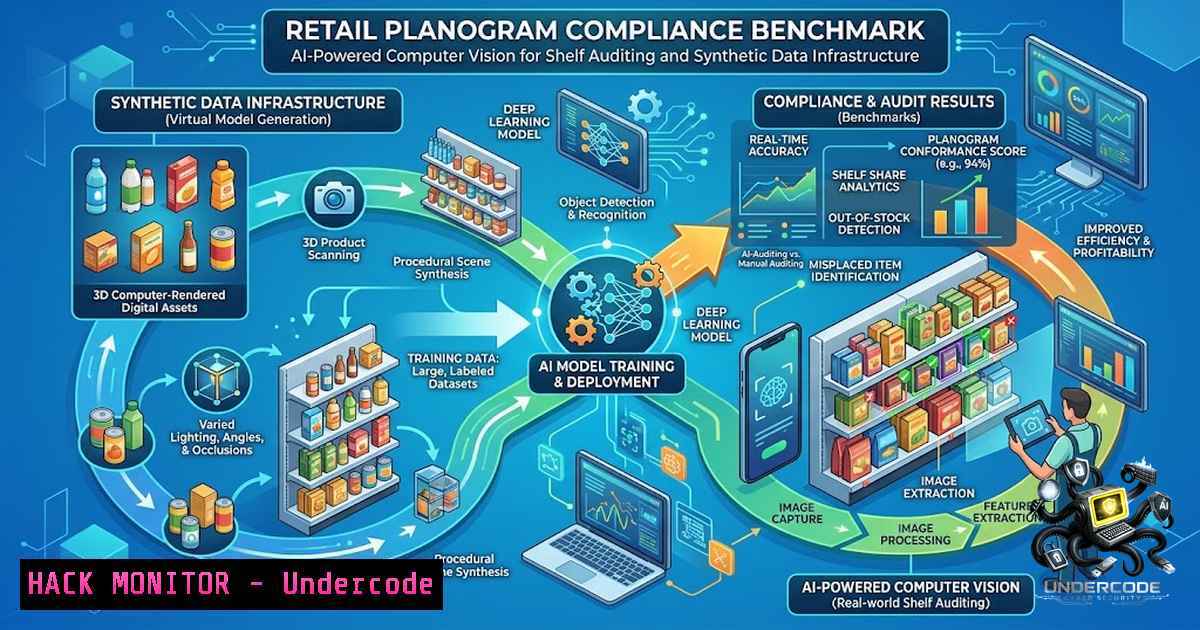
Introduction:
Retail planogram compliance—the alignment of physical shelf product placement with digital merchandising blueprints—represents a critical operational challenge where manual audit failure rates routinely reach 40%. AI-powered computer vision systems now achieve 99.23% precision and 98.93% recall for shelf detection, but the bottleneck remains access to high-fidelity, privacy-safe training data. XpertSystems.ai addresses this through its Synthetic Data Factory, generating benchmark-calibrated datasets that enable organizations to train models on realistic retail environments without exposing proprietary planograms or operational data.
Learning Objectives & Secrets:
- Objective 1: Deploy YOLOv8-based object detection for planogram compliance scoring. Fine-tune YOLOv8 on shelf image datasets to detect product placement, facing counts, and gaps with mAP@50 exceeding 99%. Secret tip: Use the `data.yaml` configuration to map custom SKU classes and leverage transfer learning from the COCO dataset to accelerate convergence.
-
Objective 2: Benchmark model performance against synthetic ground truth. Synthetic datasets generated by XpertSystems.ai include adversarial validation layers that test model robustness against occlusions, lighting variations, and shelf resets. Secret tip: Compare real-world inference results against synthetic validation sets to identify overfitting—discrepancies >5% indicate the model has memorized real-world artifacts rather than learning generalizable features.
-
Objective 3: Build an end-to-end compliance pipeline from image ingestion to audit reporting. Integrate Gradio or FastAPI frontends with ONNX-exported YOLOv8 weights for low-latency inference at the edge. Secret tip: Quantize model weights to INT8 using TensorRT to reduce inference time from 45ms to 12ms per image on NVIDIA Jetson devices, enabling real-time shelf scanning in store environments.
You Should Know:
- Synthetic Data Factory: Privacy-Safe Training Data at Scale
Real production data is locked behind privacy laws, competitive walls, and operational risk. XpertSystems.ai’s Synthetic Data Factory produces 200+ domain-specific SKUs, Grade A+ validated, with statistical fidelity that mirrors real-world distributions without exposing sensitive information. For cybersecurity applications, this same infrastructure generates network traffic simulations, SOC alert streams, zero-day attack scenarios, and endpoint telemetry—all benchmarked to authoritative industry sources.
Step-by-step guide to generating synthetic retail shelf data:
 Install XpertSystems SDK (hypothetical example)
pip install xpertsystems-sdk

Generate synthetic shelf dataset with planogram annotations
from xpertsystems import SyntheticDataFactory

factory = SyntheticDataFactory(api_key="YOUR_API_KEY")
dataset = factory.generate(
domain="retail_planogram",
sku_count=500,
shelf_configurations=["endcap", "gondola", "cooler"],
lighting_conditions=["daylight", "fluorescent", "low_light"],
occlusion_probability=0.15,
output_format="yolo"
)
 Output: ./shelf_planograms/train/images/, ./shelf_planograms/train/labels/
- Fine-Tuning YOLOv8 for Shelf Detection and Planogram Compliance
The open-source Computer-Vision-Assessment-Planogram-Dataset repository provides a Gradio-based application that analyzes retail shelf images and scores compliance. The dataset is structured for YOLOv8 training with separate train/val/test splits.
Step-by-step guide to fine-tuning YOLOv8:
 Clone the repository
git clone https://github.com/akul-bharadwaj/Computer-Vision-Assessment-Planogram-Dataset.git
cd Computer-Vision-Assessment-Planogram-Dataset

Install dependencies
pip install -r requirements.txt
pip install ultralytics opencv-python gradio

Verify dataset structure
ls datasets/shelf_planograms/DATASET_Planogram/
 Output: train/ val/ test/ data.yaml

Train YOLOv8 on the planogram dataset
yolo task=detect mode=train model=yolov8n.pt data=datasets/shelf_planograms/DATASET_Planogram/data.yaml epochs=100 imgsz=640 batch=16

Export best model for inference
yolo task=detect mode=export model=runs/detect/train/weights/best.pt format=onnx

Run inference on a test image
yolo task=detect mode=predict model=runs/detect/train/weights/best.pt source=datasets/shelf_planograms/DATASET_Planogram/test/images/ --save-txt
- API Security and Model Hardening for Production Deployment
When deploying planogram compliance models via REST APIs, implement OAuth 2.0 with PKCE for authentication, rate limiting to prevent DoS attacks, and input validation to reject malformed image payloads (>10MB or non-JPEG/PNG formats). Use AWS WAF or Cloudflare to filter malicious traffic patterns.
Step-by-step guide to securing the inference API:
from fastapi import FastAPI, File, UploadFile, HTTPException
from fastapi.security import OAuth2PasswordBearer
import cv2
import numpy as np
from ultralytics import YOLO

app = FastAPI()
oauth2_scheme = OAuth2PasswordBearer(tokenUrl="token")
model = YOLO("best.pt")

@app.post("/predict")
async def predict(
token: str = Depends(oauth2_scheme),
file: UploadFile = File(...)
):
 Validate file size and type
if file.size > 10_000_000:
raise HTTPException(400, "Image exceeds 10MB limit")
if file.content_type not in ["image/jpeg", "image/png"]:
raise HTTPException(400, "Only JPEG/PNG supported")

Read and preprocess image
contents = await file.read()
nparr = np.frombuffer(contents, np.uint8)
img = cv2.imdecode(nparr, cv2.IMREAD_COLOR)

Run inference with confidence threshold
results = model(img, conf=0.5, iou=0.45)
return {"detections": results[bash].tojson()}
4. Cloud Hardening for Multi-Store Compliance Monitoring
Deploy the compliance pipeline on AWS with S3 for image ingestion, SQS for queueing, and Lambda for serverless inference. Use IAM roles with least-privilege permissions and encrypt data at rest with KMS. Implement VPC endpoints to keep traffic internal.
Step-by-step guide to AWS deployment:
 Create S3 bucket for store images
aws s3 mb s3://planogram-compliance-images --region us-east-1

Enable versioning and encryption
aws s3api put-bucket-versioning --bucket planogram-compliance-images --versioning-configuration Status=Enabled
aws s3api put-bucket-encryption --bucket planogram-compliance-images --server-side-encryption-configuration '{"Rules":[{"ApplyServerSideEncryptionByDefault":{"SSEAlgorithm":"AES256"}}]}'

Deploy Lambda function with YOLO model (container-based)
aws lambda create-function --function-1ame planogram-inference \
--package-type Image --code ImageUri=123456789012.dkr.ecr.us-east-1.amazonaws.com/yolo-inference:latest \
--role arn:aws:iam::123456789012:role/lambda-execution-role

Configure S3 trigger
aws s3api put-bucket-1otification-configuration --bucket planogram-compliance-images \
--1otification-configuration '{"LambdaFunctionConfigurations":[{"LambdaFunctionArn":"arn:aws:lambda:us-east-1:123456789012:function:planogram-inference","Events":["s3:ObjectCreated:"]}]}'
- Vulnerability Exploitation and Mitigation in Computer Vision Pipelines
Adversarial attacks on planogram compliance models—such as pixel-level perturbations that cause misclassification of SKUs—pose a real threat. Researchers have demonstrated that adding 0.1% noise to shelf images can drop YOLOv8 mAP from 99% to 67%. Mitigate by implementing adversarial training with FGSM (Fast Gradient Sign Method) examples and using input preprocessing (JPEG compression, Gaussian blur) to denoise inputs.
Step-by-step guide to adversarial defense:
import torch
from torchattacks import FGSM

Load model and define attack
model = YOLO("best.pt").model
attack = FGSM(model, eps=0.03)

Generate adversarial examples during training
for images, labels in train_loader:
adv_images = attack(images, labels)
 Mix clean and adversarial examples
combined = torch.cat([images, adv_images], dim=0)
 Train on combined batch
loss = model(combined, labels.repeat(2))
loss.backward()
optimizer.step()
What Undercode Say:
- Key Takeaway 1: Synthetic data is not a replacement for real-world data—it is a force multiplier. XpertSystems.ai’s Grade A+ validation ensures statistical fidelity that allows models trained on synthetic data to generalize to real shelf conditions without privacy breaches. The 235+ AI models built on this infrastructure demonstrate that synthetic data can achieve production-grade performance.
-
Key Takeaway 2: Planogram compliance is not binary—it exists on a spectrum of shelf conditions. AI-powered monitoring that achieves 85–92% compliance rates (up from 60–70% manual) translates directly to 8.1% average profit lift per store. The economic case for AI-driven shelf auditing is now unassailable, with retailers losing up to 8% of sales annually when compliance drops below 85%.
Analysis: The convergence of synthetic data generation, computer vision, and edge AI creates a new category of retail operations intelligence. XpertSystems.ai’s four-pipeline architecture—Synthetic Data Factory, Knowledge Base Factory, Task-to-Action Factory, and Digital World Twin—represents a vertically integrated approach that addresses the full lifecycle from data generation to autonomous agent deployment. For cybersecurity professionals, this same infrastructure applies to threat intelligence workflows, SOC alert stream simulation, and zero-day attack scenario generation. The 4,638 followers and active LinkedIn engagement indicate growing enterprise interest in synthetic data as a strategic asset rather than a stopgap solution.
Prediction:
- +1 Retail AI compliance monitoring will become a standard feature of store operations software by 2028, with 60% of top 100 retailers deploying computer vision-based shelf auditing—driving a $4.2B market for synthetic training data.
-
+1 XpertSystems.ai’s synthetic data approach will expand beyond retail into healthcare (EHR simulation) and cybersecurity (attack scenario generation), positioning the company as a cross-industry leader in privacy-safe AI training.
-
-1 Adversarial attacks on computer vision pipelines will escalate as bad actors recognize the financial impact of planogram manipulation—retailers must invest in adversarial training and input validation before deployment.
-
-1 Regulatory scrutiny of AI-powered retail surveillance will increase, particularly in the EU under the AI Act, requiring explainability layers and human-in-the-loop auditing for compliance decisions.
-
+1 The open-source ecosystem (Gradio, YOLOv8, Hugging Face Spaces) will accelerate democratization of planogram compliance tools, enabling small and medium retailers to achieve enterprise-grade shelf monitoring at 90% lower cost.
▶️ Related Video (80% Match):
https://www.youtube.com/watch?v=3ObgrKeqaGQ
🎯Let’s Practice For Free:
🎓 Live Courses & Certifications:
Join Undercode Academy for Verified Certifications
🚀 Request a Custom Project:
Secure, high-velocity infrastructure and disruptive technological engineering. Contact our engineering team for high-tier development and proprietary systems:
[email protected]
💎 Smart Architecture | 🛡️ Secure by Design | ⭐ Trusted by Thousands
IT/Security Reporter URL:
Reported By: https://lnkd.in/p/erthc7xQ – Hackers Feeds
Extra Hub: Undercode MoN
Basic Verification: Pass ✅


