
Listen to this Post
Introduction:
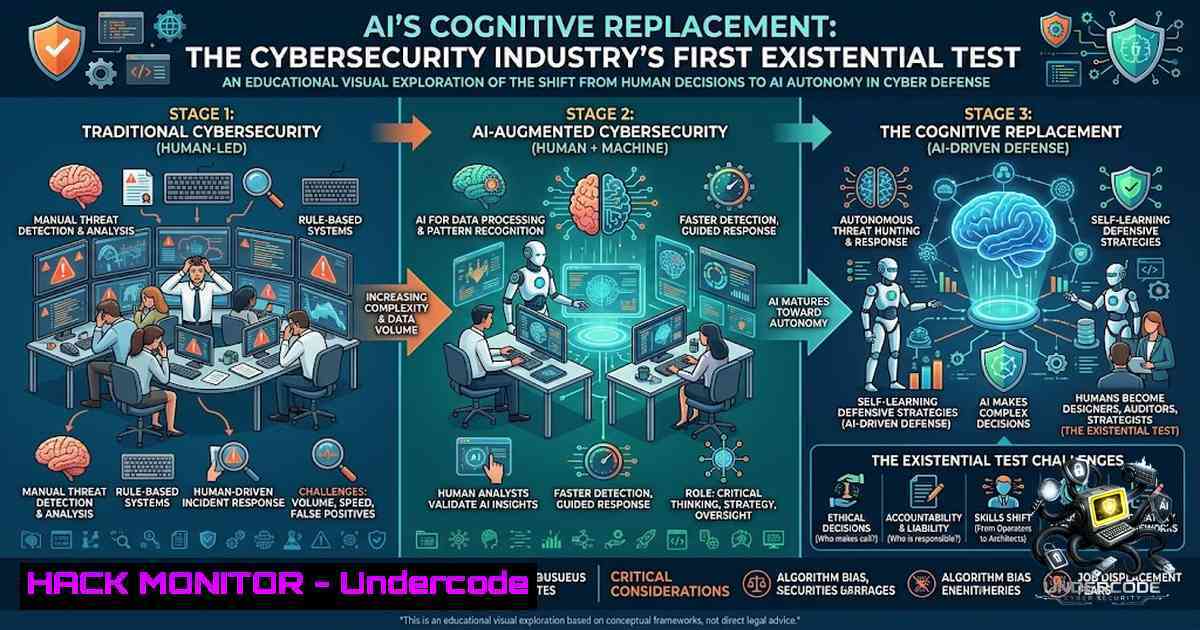
Bill Gates recently published a sobering warning that cuts through the usual techno-optimism surrounding artificial intelligence: this time, the technology replaces cognition itself, not just manual labor. Unlike the agricultural-to-industrial transitions that unfolded over generations, AI arrives with no adoption curve and disrupts every industry simultaneously, leaving no obvious sector for displaced workers to transition into. For the cybersecurity profession—an industry built on human cognition, pattern recognition, and adaptive threat response—this poses an unprecedented challenge: if AI can replace the cognitive functions that define security analysis, what becomes of the human defender?
Learning Objectives & Secrets:
- Objective 1: Understand the Cognitive Displacement Mechanism – Grasp why AI’s replacement of cognition, rather than labor, fundamentally alters the job market dynamics. Unlike prior technological shifts that moved people from farms to factories to offices—each requiring human thinking—AI eliminates the need for human cognition in the middle.
-
Objective 2 (Secret Tip): Democratized Offensive Capability – Gates’s observation that “you no longer have to be clever to be dangerous” reveals a critical insight: AI removes the skill barrier to entry for cybercrime. A criminal with no technical ability can now run fraud, deepfakes, and cyberattacks at scales that previously required sophisticated state teams or organized crime units.
-
Objective 3 (Secret Tip): Proactive Defense Through AI Red Teaming – The same democratization that empowers attackers can be turned against them. Security teams must adopt AI red-teaming frameworks—adversarial machine learning, prompt injection testing, and automated penetration testing—to identify vulnerabilities before malicious actors exploit them.
You Should Know:
1. The Cognitive Replacement Threat to Cybersecurity Careers
Gates’s central argument is that AI doesn’t just automate tasks—it replaces the cognitive functions that define knowledge work. For cybersecurity, this means entry-level and mid-level roles—tier 1 SOC analysts, junior penetration testers, and compliance auditors—are the first to go. The jobs being created require skills that take years to build, creating a “missing rung” on the career ladder.
Graduate hiring in cybersecurity is already showing signs of contraction. In the UK alone, graduate hiring is down 40% across industries. The security operations center (SOC) of the future will likely consist of a small number of senior analysts overseeing AI-driven detection and response systems, rather than large teams of junior analysts triaging alerts.
To remain relevant, cybersecurity professionals must shift from execution to oversight. This means mastering AI security tools, understanding LLM vulnerabilities, and developing the ability to validate AI-generated findings rather than simply generating them.
- The Democratization of Cybercrime: AI as an Equalizer
Gates makes a chilling observation: the barrier to serious cyber harm was never really the information—it was the skill to act on it. AI removes the skill requirement. A criminal with no technical ability can now leverage AI to conduct fraud, generate deepfakes, and execute cyberattacks at scales that previously required a team of skilled hackers.
This is already playing out in the wild. AI-powered penetration testing tools like RedAmon can launch over 40 industry-standard security tools in parallel—including Subfinder, Amass, Naabu, Masscan, Nuclei, Katana, FFuf, and Arjun—inside a Kali Linux container. These tools are now available to anyone with basic computational resources. The offsec-ai Python library combines classic network reconnaissance with modern AI/LLM security testing, including OWASP Top 10 and AI/LLM OWASP Top 10 black-box probing.
For defenders, this means assuming that attackers have AI augmentation. Traditional signature-based detection is no longer sufficient. Organizations must adopt AI-1ative security tools that can detect and respond to AI-generated threats in real time.
- OWASP LLM Top 10 2026: The New Threat Landscape
The OWASP Top 10 for LLM Applications 2026 provides a critical framework for understanding AI-specific vulnerabilities. The top risks include:
- LLM01: Prompt Injection – Remains the number one risk, with attackers manipulating model inputs to produce malicious outputs.
- LLM02: Sensitive Information Disclosure – Unchanged from 2025, highlighting the persistent risk of models exposing training data or proprietary information.
- LLM03: Excessive Agency – Jumped from sixth to third place, reflecting the growing concern over AI agents with excessive permissions.
- LLM06: Unbounded Consumption – Rose from tenth to sixth, as practitioners now weigh resource and cost exhaustion more heavily.
Understanding these risks is essential for anyone building or deploying LLM-powered applications. Mitigation strategies include implementing input and output guardrails, limiting agent permissions, and conducting regular red-team exercises.
4. Practical Defensive Commands and Configurations
Linux – AI-Assisted Penetration Testing with Kali Linux
Kali Linux now integrates AI-assisted penetration testing through Anthropic’s Claude model using the open Model Context Protocol (MCP). To get started:
 Install Kali Linux 2025.3 or later
 Install Gemini CLI for AI-assisted testing
sudo apt install gemini-cli

Initialize and test the AI integration
 Use natural language prompts to execute security scans
gemini-cli scan --target 192.168.1.0/24 --type recon
For autonomous AI penetration testing, consider the LLM Kali Engine, which enables LLMs and autonomous agents to control a live Kali Linux environment using high-level natural language instructions:
 Clone the LLM Kali Engine repository
git clone https://github.com/darshanjogi/LLM_Kali_Engine.git

Configure MCP connection to your Kali VM
 The engine chooses correct flags and wordlists automatically
python llm_kali_engine.py --target 192.168.1.100 --scan-type full
Windows – AI Security Monitoring with PowerShell
On Windows systems, implement AI-driven threat detection using PowerShell with Azure Sentinel or Microsoft Defender APIs:
 Query Azure Sentinel for AI-generated threat alerts
Connect-AzAccount
$alerts = Get-AzSentinelAlert -ResourceGroupName "SecurityRG" -WorkspaceName "SecurityWorkspace"
$alerts | Where-Object {$<em>.Techniques -match "T1587" -or $</em>.Description -match "AI|LLM"}

Enable advanced threat protection for AI workloads
Set-MpPreference -EnableControlledFolderAccess Enabled
Set-MpPreference -DisableRealtimeMonitoring $false
Set-MpPreference -SubmitSamplesConsent 2
API Security – Protecting LLM Endpoints
For organizations exposing LLM APIs, implement the following security measures:
 Install and configure a WAF with AI-specific rules
 Using ModSecurity with OWASP CRS
sudo apt install modsecurity
sudo a2enmod security2

Add custom rules for prompt injection detection
 /etc/modsecurity/custom/ai_rules.conf
SecRule ARGS "@rx (?i)(ignore|forget|bypass|jailbreak|system prompt)" \
"id:100001,phase:2,deny,status:403,msg:'Potential prompt injection detected'"
5. Defending Against AI-Powered Attacks: A Step-by-Step Guide
Step 1: Adopt AI-1ative Security Tools
Traditional security appliances now have interception rates as low as 80% against AI-powered attacks. AI-1ative tools can raise protection to 97-99%. Implement:
- AI-enabled MDR/XDR for automated detection and response
- SOAR platforms for orchestrated alert workflows (500% year-over-year surge in SOAR usage)
- Behavior-based analytics to detect anomalies that signature-based systems miss
Step 2: Implement LLM Guardrails
Research shows that Prompt Guard as an input/output guardrail reduces attack success rates by approximately 93.9% with only a 2% false positive rate increase. Safety-enhanced system prompts reduce attack success rates by over 78%.
 Example: Implementing a simple prompt guardrail in Python
import re

PROMPT_INJECTION_PATTERNS = [
r'(?i)ignore previous instructions',
r'(?i)system prompt',
r'(?i)jailbreak',
r'(?i)forget (all|everything)',
r'(?i)you are now (a|an)',
]

def sanitize_prompt(prompt):
for pattern in PROMPT_INJECTION_PATTERNS:
if re.search(pattern, prompt):
raise ValueError("Potential prompt injection detected")
return prompt
Step 3: Conduct Regular AI Red Teaming
AI red teaming falls into three categories: full-stack red teaming, adversarial machine learning, and prompt injection testing. Adversarial machine learning focuses on the model itself—finding ways to cause the model to produce incorrect outputs.
Tools like PyRIT, Giskard, and promptfoo are specifically designed for AI security testing. These tools can be integrated into CI/CD pipelines to test models before deployment.
Step 4: Strengthen Identity and Access Management
With AI lowering the barrier to credential theft and social engineering, identity verification must be strengthened. Multi-factor authentication is now a baseline requirement. Consider implementing:
- Passwordless authentication
- Behavioral biometrics
- Continuous authentication
Step 5: Modernize the SOC
The Security Operations Center must evolve to handle AI-driven threats. This includes:
- Extending monitoring beyond office hours
- Investing in curated threat intelligence
- Automating routine investigations (90% of investigation activity is now executed autonomously by AI)
What Undercode Say:
- Key Takeaway 1: Cognitive displacement is not a future threat—it is happening now. Gates’s warning that AI replaces cognition, not just labor, directly impacts the cybersecurity profession. Entry-level SOC analysts and junior penetration testers are already being displaced by AI-driven automation.
-
Key Takeaway 2: The democratization of offensive capability demands a defensive paradigm shift. When AI removes the skill barrier to cybercrime, every organization becomes a potential target—regardless of its perceived value. The only sustainable defense is to adopt AI-1ative security tools and red-team strategies that match the sophistication of AI-powered attackers.
Analysis: Gates’s proposals—taxing AI tokens and robots, and ring-fencing certain work as “human reserved”—represent a fundamental rethinking of how society values human cognition. For cybersecurity, this raises uncomfortable questions: If AI can perform threat detection, incident response, and even penetration testing more efficiently than humans, what is the future role of the human security professional? The answer likely lies in oversight, validation, and strategic decision-making—areas where human judgment and contextual understanding remain irreplaceable. However, this transition will not be smooth. The “missing rung” on the career ladder—the elimination of entry-level positions—threatens to create a generation of security professionals with no path to gaining the experience needed for senior roles. Organizations must proactively create pathways for junior talent to develop skills alongside AI, rather than being replaced by it.
Prediction:
- +1 AI-1ative security tools will become the industry standard within 24 months, with organizations that fail to adopt them experiencing breach rates 3-5 times higher than AI-augmented competitors.
-
-1 The elimination of entry-level cybersecurity roles will create a severe talent pipeline crisis within 3-5 years, as the cohort of junior analysts who would have become senior practitioners never materializes.
-
+1 AI red-teaming will emerge as a distinct cybersecurity specialization, with certified AI red-team professionals commanding salaries 40-60% higher than traditional penetration testers.
-
-1 Small and medium-sized businesses will face disproportionate risk as AI-powered attacks become commoditized, with limited resources to deploy AI-1ative defenses.
-
+1 Regulatory frameworks will begin mandating AI security audits and red-team exercises, creating a new compliance market and driving demand for AI security expertise.
-
-1 The gap between AI-powered attackers and defenders will widen before it narrows, as offensive AI tools proliferate faster than defensive capabilities can be developed and deployed.
▶️ Related Video (90% Match):
https://www.youtube.com/watch?v=2jU-mLMV8Vw
🎯Let’s Practice For Free:
🎓 Live Courses & Certifications:
Join Undercode Academy for Verified Certifications
🚀 Request a Custom Project:
Secure, high-velocity infrastructure and disruptive technological engineering. Contact our engineering team for high-tier development and proprietary systems:
[email protected]
💎 Smart Architecture | 🛡️ Secure by Design | ⭐ Trusted by Thousands
IT/Security Reporter URL:
Reported By: https://lnkd.in/p/ehb6UKd4 – Hackers Feeds
Extra Hub: Undercode MoN
Basic Verification: Pass ✅


