
Listen to this Post
Introduction:
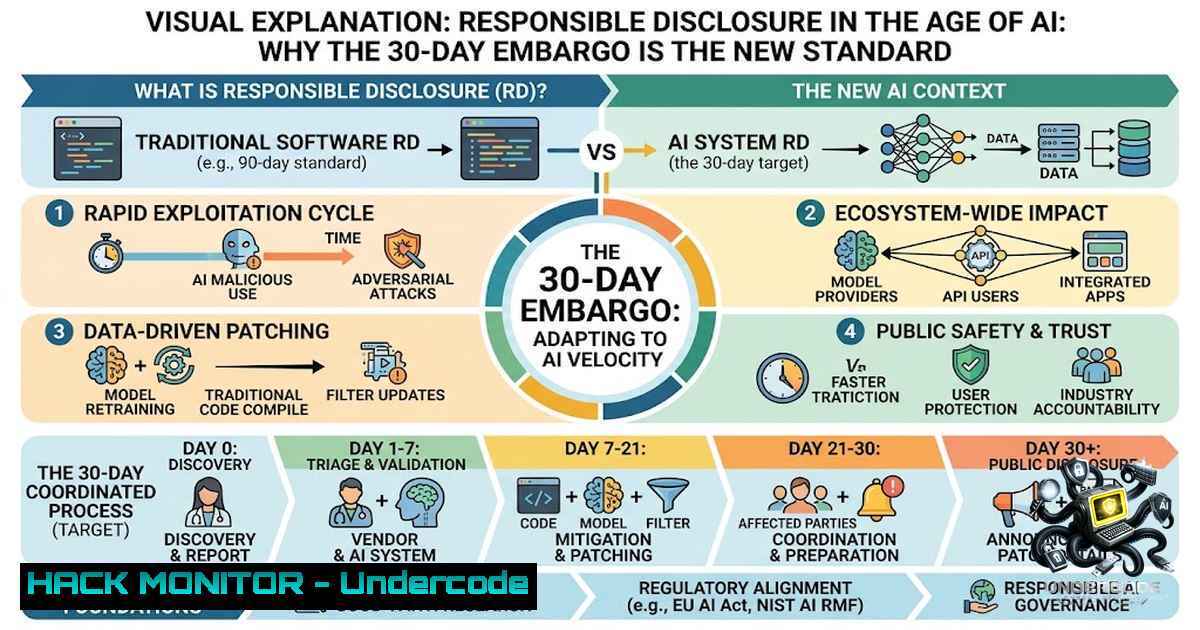
The traditional responsible disclosure model—where security researchers privately report vulnerabilities and vendors are given an indefinite timeline to respond—is breaking under the weight of AI-accelerated vulnerability discovery. Artiphishell, a cybersecurity research firm born from the DARPA AI Cyber Challenge (AIxCC), has announced a new policy: every 0-day disclosure will now be subject to a 30-day embargo, after which unaddressed vulnerabilities will be published with full write-up and proof-of-concept (PoC). This shift reflects a fundamental reality: AI systems can now discover vulnerabilities in hours that once required months of manual research, rendering “security through obscurity” an obsolete defense strategy.
Learning Objectives & Secrets:
- Objective 1: Understand the 30-Day Embargo Framework – Learn how Artiphishell’s new policy balances vendor remediation time with public disclosure rights, and why 30 days represents a meaningful window for investigation and patching.
-
Objective 2 Secret Tip: Bypass AI Triage Bottlenecks – When reporting through bug bounty programs, supplement your submission with direct outreach to security teams via social media and email. AI triage bots often misclassify or deprioritize valid reports; human-to-human contact increases the chance your vulnerability reaches the right person.
-
Objective 3 Secret Tip: Leverage AI for Faster Discovery – Use AI-augmented reconnaissance pipelines that integrate tools like Nmap, Nuclei, FFUF, and SQLMap with locally hosted language models to reason over findings and prioritize high-value targets. Practitioners report finding 30–40% more vulnerabilities in the same time window using LLM-assisted workflows.
You Should Know:
1. The AI Vulnerability Discovery Revolution
AI is fundamentally changing the economics of vulnerability research. In 2026 alone, Palo Alto Networks’ autonomous AI system identified over 14,000 previously unknown software vulnerabilities. TitanCA, an LLM-agent orchestration system, discovered 203 confirmed zero-day vulnerabilities and yielded 118 CVEs. Anthropic’s Mythos and OpenAI’s GPT-5.5-Cyber represent a transformation from human-led research to machine-scale operations.
What does this mean for defenders? A vulnerability that may be difficult to find today could become trivial to discover tomorrow with a new model or automated technique. Relying on a vulnerability remaining undiscovered is no longer a reasonable security strategy.
Step-by-Step Guide: Setting Up an AI-Augmented Vulnerability Discovery Pipeline
This pipeline combines open-source reconnaissance tools with an LLM to automate target discovery and vulnerability triage.
Step 1: Install Core Tools
 On Kali Linux / Debian-based systems
sudo apt update && sudo apt install -y nmap ffuf sqlmap
 Install Nuclei
go install -v github.com/projectdiscovery/nuclei/v3/cmd/nuclei@latest
 Install Subfinder
go install -v github.com/projectdiscovery/subfinder/v2/cmd/subfinder@latest
Step 2: Run Initial Reconnaissance
 Subdomain enumeration
subfinder -d target.com -o subdomains.txt
 Port scanning with Naabu
naabu -list subdomains.txt -top-ports 1000 -o ports.txt
 HTTP probing
httpx -list subdomains.txt -o live_hosts.txt
Step 3: AI-Powered Vulnerability Scanning
 Run Nuclei with AI-enhanced template selection
nuclei -list live_hosts.txt -t ~/nuclei-templates/ -severity critical,high -o findings.txt
 Use FFUF for directory fuzzing with wordlist
ffuf -u https://target.com/FUZZ -w /usr/share/wordlists/dirb/common.txt -o fuzz_results.json
Step 4: LLM-Assisted Analysis
Feed your findings into a locally hosted LLM (e.g., Llama 3 8B) to prioritize vulnerabilities based on exploitability and business impact. The LLM can reason over reconnaissance data and dispatch targeted follow-up probes.
2. The Broken State of Bug Bounty Programs
Artiphishell’s frustration with “clogged bug bounty programs, questionable AI triage bots, and unresponsive vendors” reflects a growing industry crisis. AI-assisted submissions have dramatically increased the volume of bug reports, overwhelming triage teams. Elastic Security Labs built an AI triage agent that matches human decisions only 85% of the time—meaning 15% of reports are still misclassified. VOID.Bounty and similar platforms use ML-based severity classification, but these systems remain unreliable for nuanced vulnerabilities.
Step-by-Step Guide: Reporting Vulnerabilities Effectively
Step 1: Document Thoroughly
- Include a clear description, affected versions, CVSS score, and step-by-step reproduction instructions.
- Provide a minimal PoC (code or script) that demonstrates the vulnerability.
Step 2: Submit Through Official Channels
- Use the vendor’s bug bounty platform (HackerOne, Bugcrowd, or proprietary).
- Retain submission confirmation and tracking numbers.
Step 3: Escalate Through Direct Outreach
- If no response within 7 days, find security team contacts via LinkedIn, company security.txt files, or email patterns (security@, psirt@).
- Send a follow-up with your ticket number and a professional reminder.
Step 4: Track the 30-Day Clock
- Document every contact attempt (date, channel, response).
- If no meaningful contact or remediation effort after 30 days, prepare for public disclosure.
3. Vendor Unresponsiveness: A Systemic Problem
The most dangerous vulnerabilities are not the ones being exploited—they are the ones nobody knows about. Artiphishell argues that “responsible disclosure should not mean that vulnerabilities can remain indefinitely hidden from the public simply because a vendor does not respond”. This is particularly critical when AI can rediscover the same vulnerability independently. Leaving vulnerabilities unaddressed and unknown to the public indefinitely is, in their view, irresponsible.
Step-by-Step Guide: What to Do When Vendors Don’t Respond
Step 1: Exhaust All Contact Methods
- Email primary and secondary contacts.
- Reach out via LinkedIn, Twitter/X, and other social platforms.
- Check for security.txt files at `https://domain/.well-known/security.txt`.
Step 2: Escalate Within the Organization
- Contact legal or executive teams if security teams are unresponsive.
- Use public relations pressure as a last resort before disclosure.
Step 3: Prepare for Public Disclosure
- Write a comprehensive technical write-up.
- Prepare a sanitized PoC that demonstrates the vulnerability without enabling exploitation.
- Publish on your disclosure ledger or security blog.
Step 4: Coordinate with CERT/CC
- If the vulnerability is critical, consider reporting to CERT/CC, which uses a 45-day default disclosure timeline.
- Comparing Disclosure Timelines: 30 vs. 45 vs. 90 Days
The 30-day embargo is not arbitrary—it aligns with industry best practices while being more aggressive than traditional models. Google Project Zero enforces a strict 90-day deadline with a 30-day grace period after patching. CERT/CC uses a 45-day default. Many organizations require at least 30 days for remediation.
Artiphishell’s 30-day window provides a reasonable balance: vendors receive a meaningful opportunity to respond, while the public is ultimately warned about vulnerabilities that remain exposed. For critical in-the-wild vulnerabilities, some policies shorten this to 7 days.
5. AI-Powered Defense: Hardening Against Automated Discovery
If AI can find vulnerabilities faster, defenders must adopt AI to patch them faster. Artiphishell’s Cyber Reasoning System (CRS) combines traditional analyses with LLMs to improve automated analysis of large open-source applications. The system discovered 28 synthetic vulnerabilities and successfully patched 11, including a Java zero-day.
Step-by-Step Guide: Implementing AI-Assisted Patching
Step 1: Deploy an AI-Powered Vulnerability Scanner
- Use tools like PentesterFlow, which automates the entire workflow from information gathering to report generation.
- Consider PhantomRed, which integrates Nmap, Nuclei, FFUF, and SQLMap with a locally hosted Llama 3 8B model.
Step 2: Integrate with CI/CD
- Automate scanning in your development pipeline.
- Use AI to suggest patches for identified vulnerabilities.
Step 3: Validate and Test Patches
- Reproduce the vulnerability in a sandbox environment.
- Test the patch thoroughly before deployment.
Step 4: Monitor for Regression
- Continuously scan for reintroduced vulnerabilities.
- Use AI agents to perform continuous, human-supervised testing at machine speed.
- Cloud and API Security in the AI Era
APIs are a prime target for AI-assisted vulnerability discovery. PortSwigger demonstrated that AI can generate attack vectors from RFCs and automatically validate attack techniques, uncovering HTTP request smuggling vulnerabilities.
Linux Command: API Security Testing with AI
 Install Arjun for parameter discovery
pip3 install arjun
 Run parameter discovery
arjun -u https://api.target.com/endpoint -o params.txt
 Use ffuf for fuzzing discovered parameters
ffuf -u https://api.target.com/endpoint?FUZZ=test -w params.txt -fc 404,403
Windows Command: API Endpoint Discovery
 Use PowerSploit for API reconnaissance
Import-Module .\PowerSploit.psm1
Invoke-WebRequest -Uri "https://api.target.com/v1/" -Method Options
Cloud Hardening Checklist:
- Implement strict IAM policies with least-privilege access.
- Enable comprehensive logging and monitoring (CloudTrail, Azure Monitor).
- Use WAF and API gateways with rate limiting.
- Regularly audit API endpoints for exposed sensitive data.
7. The Future of Responsible Disclosure
Artiphishell’s manifesto signals a broader shift: the era of indefinite private disclosure is ending. As AI makes vulnerability discovery cheaper and faster, the only sustainable defense is rapid remediation—not secrecy. The 30-day embargo creates urgency, forcing vendors to prioritize security responses. Organizations that fail to adapt will find their unpatched vulnerabilities published publicly, with full PoCs, exposing their users to unnecessary risk.
What Undercode Say:
- Key Takeaway 1: The 30-day embargo is not an abandonment of responsible disclosure—it is an evolution. It forces vendors to engage meaningfully while protecting the public from indefinitely hidden vulnerabilities.
-
Key Takeaway 2: AI is democratizing vulnerability discovery. What was once the domain of elite researchers is now accessible through automated pipelines and LLM agents. Defenders must adopt AI defensively or risk being outpaced.
Analysis: Artiphishell’s policy shift reflects a maturing understanding of AI’s impact on cybersecurity. The traditional model assumed that vulnerabilities would remain hidden if researchers kept them private. That assumption is now invalid. AI systems can independently rediscover the same vulnerabilities, often faster than human researchers. The 30-day embargo creates a forcing function: vendors must respond quickly or face public disclosure. This is not hostile—it is practical. The public deserves to know when serious vulnerabilities remain unaddressed, especially when AI makes rediscovery increasingly likely. Artiphishell’s approach, combining direct outreach with a hard deadline, represents the most balanced model yet for the AI era.
Prediction:
- +1 The 30-day embargo will become the industry standard within 18 months, as more researchers adopt similar policies and vendors recognize the inevitability of AI-driven rediscovery.
-
+1 AI-powered vulnerability discovery tools will commoditize 0-day research, shifting the advantage toward defenders who can patch faster rather than attackers who can find more bugs.
-
-1 Organizations with slow security response times will face a wave of public disclosures, leading to increased regulatory scrutiny and class-action lawsuits.
-
-1 Bug bounty programs will struggle to adapt, as AI-generated reports overwhelm human triage teams, forcing platforms to implement stricter submission guidelines and automated filtering.
-
+1 The cybersecurity industry will see a surge in AI-assisted patching tools, creating a new market for automated remediation and reducing the average time-to-patch from months to days.
-
-1 Smaller vendors without dedicated security teams will be disproportionately affected, unable to respond within 30 days and facing public exposure of vulnerabilities they cannot quickly fix.
-
+1 Responsible disclosure will become more transparent and accountable, with public disclosure ledgers serving as a check on vendor inaction.
-
-1 The volume of publicly disclosed vulnerabilities will increase significantly, potentially overwhelming security teams and creating alert fatigue.
-
+1 AI will enable more proactive security postures, with continuous automated testing identifying and patching vulnerabilities before they can be exploited at scale.
-
+1 The 30-day embargo will ultimately improve software security across the ecosystem, as the fear of public disclosure incentivizes faster, more thorough vulnerability management.
▶️ Related Video (78% Match):
https://www.youtube.com/watch?v=-mrz5sxYopQ
🎯Let’s Practice For Free:
🎓 Live Courses & Certifications:
Join Undercode Academy for Verified Certifications
🚀 Request a Custom Project:
Secure, high-velocity infrastructure and disruptive technological engineering. Contact our engineering team for high-tier development and proprietary systems:
[email protected]
💎 Smart Architecture | 🛡️ Secure by Design | ⭐ Trusted by Thousands
IT/Security Reporter URL:
Reported By: https://lnkd.in/p/em7Dq4ZS – Hackers Feeds
Extra Hub: Undercode MoN
Basic Verification: Pass ✅


