
Listen to this Post
Introduction:
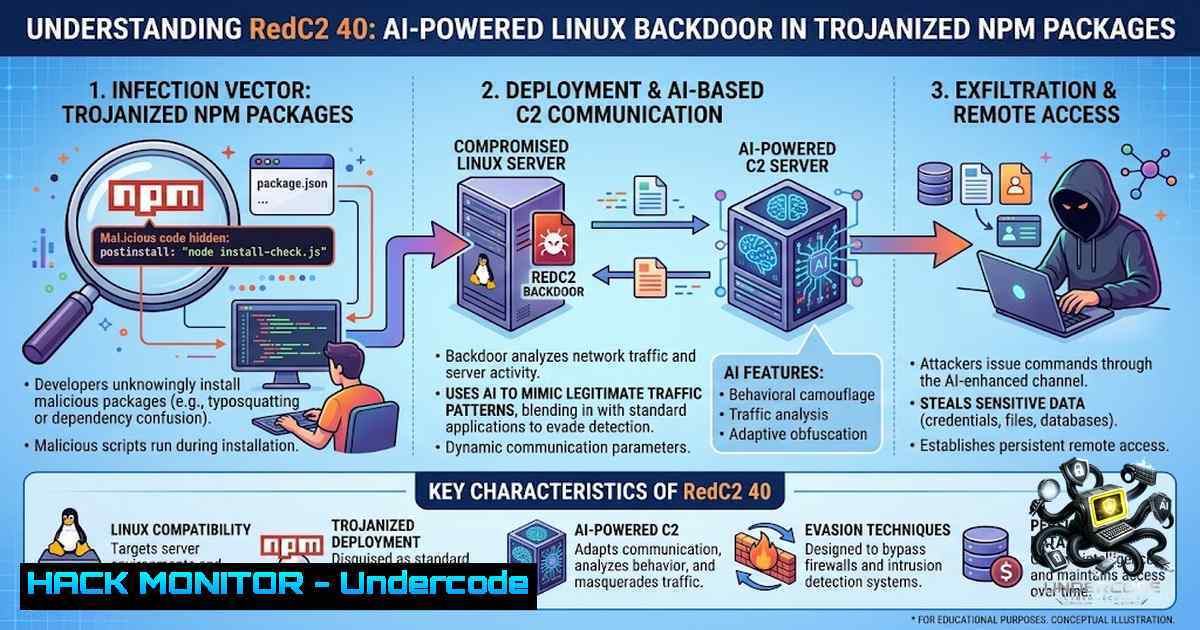
The npm ecosystem—the backbone of modern JavaScript development—has once again become the vector for a sophisticated supply chain attack. Cybersecurity researchers at TrendAI (Trend Micro’s enterprise security arm) have uncovered 14 trojanized npm packages masquerading as harmless calendar and streak-tracking utilities. These packages silently deliver RedC2 4.0, an AI-powered Linux implant that grants attackers full remote control, credential theft capabilities, and a foothold for lateral movement across corporate networks. What makes this attack particularly alarming is that the malicious payload executes immediately upon module import—no install hook or exported function call is required—meaning even a transitive dependency can trigger the backdoor.
Learning Objectives & Secrets:
- Objective 1: Understand the RedC2 4.0 Attack Chain – Learn how trojanized npm packages deliver the RedShell Linux beacon through a single import statement, bypassing traditional install-hook detection mechanisms.
-
Objective 2 Secret Tip: Detect Hidden Binary Payloads – Malicious binaries are disguised as math accelerator files (e.g.,
math-core.bin,calc.bin,calc-mapping.bin) stored within `dist/` or `dist/internal/` directories. Audit these locations for unexpected ELF executables. -
Objective 3 Secret Tip: Monitor for LLM-Assisted C2 Activity – RedC2 4.0 includes “Red Agent,” an LLM-backed layer accessible via `/ra` that translates natural-language commands into beacon instructions. Look for unusual outbound traffic patterns to C2 servers that may indicate AI-driven post-exploitation.
You Should Know:
- The Attack Mechanism: How a Single Import Compromises Your System
The trojanized npm packages—including [email protected]/1.0.1, [email protected], [email protected], and 11 others—are fully functional utilities that perform legitimate date-math and streak-tracking operations. This functionality lowers suspicion while hiding malicious code beneath the surface.
The attack triggers through the package’s entry file, dist/index.mjs, which acts as a trojan loader. When any application imports the package—even transitively—the loader:
- Locates the bundled binary payload (e.g.,
math-core.bin,calc.bin)
2. Marks it executable using `chmod`
- Launches it as a detached background process via a double-fork daemonization technique
- Continues re-exporting legitimate date-helper functions to maintain the illusion of normal operation
Detection Command (Linux):
 Search for suspicious binary files in node_modules
find node_modules -type f -1ame ".bin" -o -1ame ".dat" | grep -E "(math|calc|cache)" | xargs file

Check for ELF executables hidden in npm package directories
find node_modules -type f -exec file {} \; | grep ELF | grep -v ".node"

Monitor for unexpected processes spawned from node_modules
ps aux | grep -E "node_modules..bin"
Windows Detection (PowerShell):
 Find suspicious binaries in node_modules
Get-ChildItem -Path .\node_modules -Recurse -Include .bin,.dat | Where-Object { $_.Name -match "math|calc|cache" }

Check for ELF or PE executables
Get-ChildItem -Path .\node_modules -Recurse | ForEach-Object { if ((Get-Content $<em>.FullName -Encoding Byte -TotalCount 4) -eq <a href="0x7F,0x45,0x4C,0x46">byte[]</a>) { $</em>.FullName } }
2. RedShell Beacon: The Linux Implant Capabilities
Once deployed, the RedShell beacon establishes communication with a remote C2 server over TLS-encrypted TCP, further obfuscated with a custom three-round XOR and ROR1 routine. The beacon provides attackers with an interactive shell through `/bin/sh` and exposes a comprehensive set of post-exploitation capabilities:
- System Reconnaissance: Host discovery, network mapping, process enumeration
- Credential Theft: SSH key extraction, browser credential harvesting, database credential dumping
- File Operations: Upload, download, and bulk exfiltration (using plaintext HTTP and third-party services like
litterbox.catbox.moe) - Persistence Mechanisms: Cron jobs, `~/.bashrc` modifications, user-level systemd services, and XDG autostart entries
- Network Pivoting: SOCKS5 proxying and TCP port forwarding for lateral movement
- In-Memory Execution: Beacon Object Files (BOFs), .NET assemblies, and shellcode execution
RedShell Communication Flow:
Victim Host -> TLS TCP (XOR+ROR1 obfuscated) -> C2 Server
Victim Host -> Plaintext HTTP (bulk exfiltration) -> C2 Server
Victim Host -> Third-party service (file transfers) -> litterbox.catbox.moe
Network Monitoring Commands:
 Monitor outbound connections from Node.js processes
sudo netstat -tunap | grep node

Capture suspicious TLS traffic (requires tcpdump)
sudo tcpdump -i any -1n 'tcp port 443' -vv

Check for connections to known malicious domains (example)
grep -r "catbox.moe" /etc/hosts /var/log/
3. Red Agent: The AI-Driven Command Layer
RedC2 4.0’s most distinctive feature is Red Agent, an LLM-backed component that lowers the skill barrier for conducting sophisticated cyber operations. Operators can issue natural-language commands such as “dump all SSH keys from this host” or “find files containing the word ‘password’ and exfiltrate them,” and Red Agent translates these into ordered sequences of beacon commands.
This AI integration has several implications:
- Lowered Entry Barrier: Even novice attackers can execute complex post-exploitation tasks without deep knowledge of command syntax
- Faster Attack Execution: Natural-language intent reduces the time between initial compromise and data exfiltration
- Evasion Enhancement: AI can potentially adapt command sequences to avoid detection patterns
Threat Hunting Query (SIEM/Splunk):
index=network sourcetype=firewall
| search dest_ip IN (C2_IP_LIST) OR dest_domain IN (C2_DOMAIN_LIST)
| stats count by src_ip, dest_ip, dest_port
| where count > 10
4. Impact on Development Environments and CI/CD Pipelines
The RedC2 attack poses a severe risk to development environments where npm packages are frequently installed and updated. A single compromised dependency can:
- Compromise Developer Workstations: Expose source code, SSH keys, and access tokens
- Infect CI/CD Build Servers: Inject malicious code into production builds
- Enable Lateral Movement: Pivot from development environments to internal production infrastructure
- Persist Through Updates: Persistence mechanisms survive system reboots and package updates
CI/CD Pipeline Hardening Checklist:
- [ ] Implement egress filtering on build servers to block connections to unauthorized external IPs
- [ ] Use npm lockfiles (
package-lock.json) to pin dependency versions - [ ] Perform integrity checks using `npm audit` and `npm ci` instead of `npm install`
– [ ] Scan `node_modules` for unexpected binary files during build stages - [ ] Monitor build logs for suspicious process creation
npm Audit Command:
 Audit dependencies for known vulnerabilities
npm audit --production

Generate a detailed report
npm audit --json > audit-report.json

Check for specific malicious packages
npm list | grep -E "streak-metrics-math|kit-map-vim|streak-map-cache|streak-map-kit|map-streak-kit|streak-cache-map|streak-calc-metrics|streak-calc-math|streak-math-abz|streak-metricsaz|streak-math-metrics|streak-metricazbd|streak-metricsazb|streak-kit-map"
5. Mitigation and Remediation Strategies
Organizations should take immediate action to identify and remediate RedC2 infections:
Immediate Actions (0-24 hours):
- Audit Dependencies: Scan all projects for the 14 malicious package names
- Remove Malicious Packages: Uninstall any identified packages and check for persistence mechanisms
- Rotate Credentials: Reset all SSH keys, API tokens, and passwords that may have been exposed
- Isolate Compromised Hosts: Disconnect infected systems from the network to prevent lateral movement
Detection Rules (EDR/SIEM):
 Sample YARA rule for RedShell beacon detection
rule RedShell_Beacon {
meta:
description = "Detects RedShell Linux beacon binary"
author = "Security Team"
date = "2026-08-22"
strings:
$redshell = "RedShell" ascii wide
$redc2 = "RedC2" ascii wide
$agent = "Red Agent" ascii wide
condition:
uint16(0) == 0x457F and ($redshell or $redc2 or $agent)
}
Linux Persistence Check:
 Check for suspicious cron jobs
crontab -l | grep -v "^"

Check for bashrc modifications
grep -E "(curl|wget|nc|bash|sh|python)" ~/.bashrc ~/.profile

Check for systemd user services
ls -la ~/.config/systemd/user/

Check for XDG autostart entries
ls -la ~/.config/autostart/
Windows Persistence Check (PowerShell):
 Check scheduled tasks
Get-ScheduledTask | Where-Object { $_.State -1e "Disabled" }

Check startup folder
Get-ChildItem "$env:APPDATA\Microsoft\Windows\Start Menu\Programs\Startup"

Check registry run keys
Get-ChildItem "HKLM:\SOFTWARE\Microsoft\Windows\CurrentVersion\Run"
Get-ChildItem "HKCU:\SOFTWARE\Microsoft\Windows\CurrentVersion\Run"
What Undercode Say:
- Key Takeaway 1: The RedC2 campaign demonstrates that supply chain attacks have evolved beyond simple typosquatting and install-hook exploitation. By triggering payloads on module import—not installation—attackers have bypassed one of the primary detection vectors used by security teams. The functional nature of the packages (they actually work as advertised) makes them even harder to identify through static analysis alone.
-
Key Takeaway 2: The integration of AI (Red Agent) into commodity malware represents a paradigm shift in offensive cyber capabilities. Attackers no longer need deep technical expertise to execute complex post-exploitation tasks—they can simply describe their intent in natural language. This democratization of hacking tools will likely accelerate the frequency and sophistication of supply chain attacks in the coming years.
Analysis: The RedC2 4.0 campaign is not an isolated incident but part of a broader trend in npm-targeted malware. Sonatype’s 2026 supply chain research places the cumulative count of known malicious open-source packages above 1.2 million—a 75 percent year-over-year increase. The RedC2 framework itself has been under active development for over a year, with versions 2.0 (August 2025), 3.0 (January 2026), and 4.0 (June 2026). This suggests a professionalized malware development operation with sustained investment. The threat actor “MarlboroMan” markets RedC2 on Hack Forums as a “built for evasion” cross-platform toolkit, selling it for approximately $99.99. At this price point, the barrier to entry for would-be attackers is remarkably low, and the AI integration only compounds the risk.
Prediction:
- +1 The RedC2 campaign will accelerate adoption of software composition analysis (SCA) tools and runtime application self-protection (RASP) solutions in enterprise DevSecOps pipelines. Organizations that invest in proactive supply chain security will gain a competitive advantage in resilience.
-
-1 AI-assisted malware like RedC2 will become the new normal in commodity cybercrime, dramatically increasing the volume and velocity of successful supply chain attacks. The 75% year-over-year growth in malicious packages suggests this trend will accelerate, not decelerate.
-
-1 The npm ecosystem’s structural vulnerability—where a single package can impact thousands of downstream applications—makes comprehensive remediation nearly impossible. Even after the 14 packages are removed, copycat campaigns using similar techniques will emerge within weeks.
-
+1 Community-driven initiatives like npm’s `–ignore-scripts` flag and enhanced audit capabilities will evolve to detect import-time payloads, forcing attackers to innovate further. However, this cat-and-mouse game will continue indefinitely.
-
-1 Organizations that fail to implement egress filtering, dependency pinning, and integrity checking on build servers will experience successful breaches within the next 6-12 months. The operational complexity of securing modern supply chains remains a significant challenge for most IT teams.
▶️ Related Video (88% Match):
https://www.youtube.com/watch?v=2a7ovmQG6Dw
🎯Let’s Practice For Free:
🎓 Live Courses & Certifications:
Join Undercode Academy for Verified Certifications
🚀 Request a Custom Project:
Secure, high-velocity infrastructure and disruptive technological engineering. Contact our engineering team for high-tier development and proprietary systems:
[email protected]
💎 Smart Architecture | 🛡️ Secure by Design | ⭐ Trusted by Thousands
IT/Security Reporter URL:
Reported By: https://lnkd.in/p/eKvcs4kh – Hackers Feeds
Extra Hub: Undercode MoN
Basic Verification: Pass ✅


