
Listen to this Post
Introduction
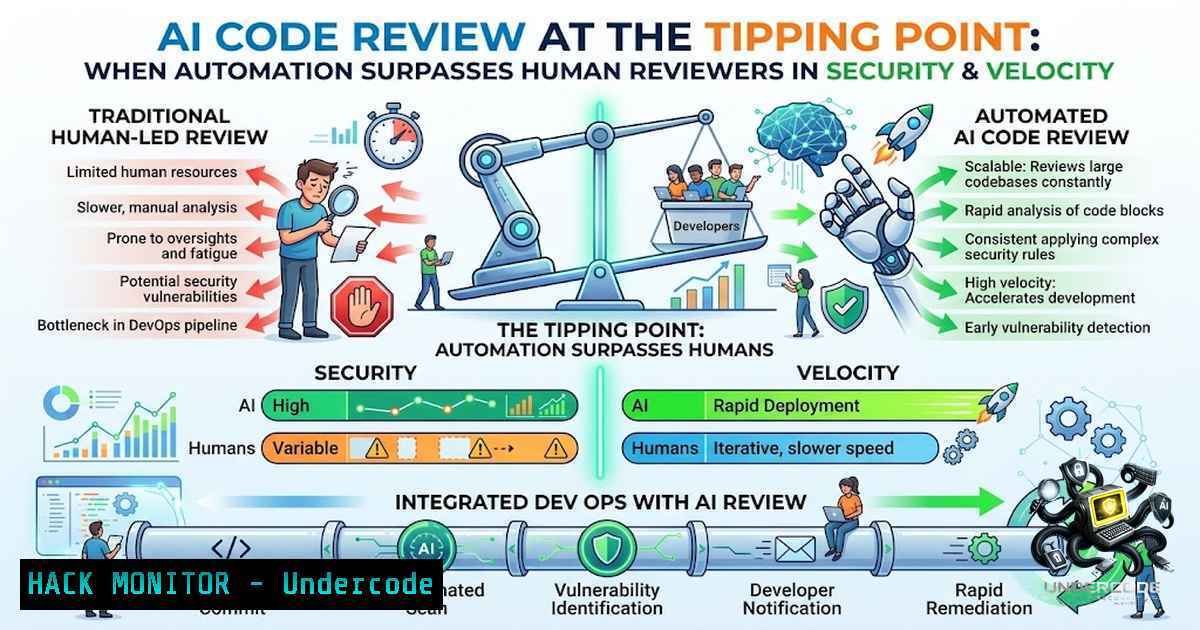
The software development lifecycle is undergoing a fundamental transformation as AI coding agents now generate over 40% of new code in many organizations, creating a bottleneck that human reviewers simply cannot overcome. This has reignited a critical debate among security leaders: should traditional pull request (PR) security reviews be automated, augmented, or even replaced entirely by AI systems? Industry experts like Daghan Altas from Semgrep and Gergely Orosz have weighed in, with many comparing the trajectory to autonomous vehicles—where automated systems don’t need to be perfect, merely better than human performance. As Julie Davila, a security and engineering executive, notes, most code-level flaws that lead to incidents are on code paths that security teams already reviewed, suggesting that current human-centric processes have fundamental limitations that automation may address more effectively.
Learning Objectives & Secrets
- Objective 1: Master AI-Powered Code Review Automation – Learn to implement and configure AI-driven code review systems that integrate with existing CI/CD pipelines, reducing review bottlenecks while maintaining security standards.
-
Objective 2 Secret Tip: Leverage Multi-Agent Review Architectures – Deploy parallel AI agents that specialize in different review tasks—logic verification, security analysis, and false positive filtering—to achieve comprehensive coverage with sub-1% false positive rates.
-
Objective 3 Secret Tip: Implement Supply Chain Hardening – Focus security investments on stable infrastructure and dependency management, which will become primary targets for AI-powered attacks as application code becomes too ephemeral for traditional scanning.
You Should Know
1. AI Code Review Architecture and Implementation
The modern AI code review ecosystem has evolved rapidly, with several production-ready tools now available. Semgrep’s Autofix feature, now in public beta, uses AI to generate proposed code changes for security findings and automatically opens draft pull requests. The system creates a branch, applies the changes, and opens a draft PR—all within 2 to 10 minutes. For supply chain vulnerabilities, Upgrade Guidance identifies which dependency upgrades are safe and flags line-level breaking changes.
Installation and Configuration (Linux/macOS):
 Install Semgrep via pip (Linux/Windows/macOS)
pip install semgrep

macOS users can also use Homebrew
brew install semgrep

Verify installation
semgrep --version

Run a basic scan on your repository
semgrep scan --config auto /path/to/your/repo
GitHub Actions Integration:
 .github/workflows/semgrep.yml
name: Semgrep Security Scan
on:
pull_request:
branches: [ main, develop ]
push:
branches: [ main ]
jobs:
semgrep:
runs-on: ubuntu-latest
steps:
- uses: actions/checkout@v4
- name: Semgrep Scan
uses: returntocorp/semgrep-action@v1
with:
config: auto
publishToken: ${{ secrets.SEMGREP_APP_TOKEN }}
Windows PowerShell Configuration:
 Install Python if not present
winget install Python.Python.3.11

Install Semgrep
pip install semgrep

Run scan
semgrep scan --config auto C:\path\to\your\repo
For organizations seeking deeper integration, SonarQube Agentic Analysis connects AI coding tools to systematic analysis engines, enabling agents to “ask” SonarQube to check their work in real-time as code is generated. This service automatically applies existing SonarQube quality profiles, eliminating the need to manually teach agents company-specific rules.
2. Multi-Agent Review Systems and Parallel Processing
Anthropic’s Code Review system represents a paradigm shift in automated review architecture. When a pull request is opened, multiple AI agents work in parallel on different tasks—some specifically look for logical errors, while others verify findings to filter out false positives. A final agent aggregates results, removes duplicates, and prioritizes identified issues by severity. The system scales with PR size: for over a thousand changed lines, it deploys more agents and analyzes the entire codebase context.
Implementation Example: Multi-Agent Review with LangGraph
 multi_agent_reviewer.py
from langgraph.graph import StateGraph
from typing import TypedDict, List
import semgrep

class ReviewState(TypedDict):
pr_files: List[bash]
security_findings: List[bash]
logic_errors: List[bash]
verified_findings: List[bash]

Agent 1: Security Analysis
def security_agent(state: ReviewState):
results = semgrep.scan_files(state['pr_files'])
return {"security_findings": results}

Agent 2: Logic Verification
def logic_agent(state: ReviewState):
 Custom logic validation
return {"logic_errors": detect_logic_issues(state['pr_files'])}

Agent 3: False Positive Filter
def verification_agent(state: ReviewState):
verified = [f for f in state['security_findings']
if not is_false_positive(f)]
return {"verified_findings": verified}

Build the multi-agent workflow
workflow = StateGraph(ReviewState)
workflow.add_node("security", security_agent)
workflow.add_node("logic", logic_agent)
workflow.add_node("verify", verification_agent)
Cost Considerations: Anthropic estimates an average review costs between $15 and $25 in token-based billing. Open-source alternatives like the multi-agent code reviewer on GitHub cost roughly $0.06–$0.17 per review for typical small PRs.
3. CI/CD Pipeline Security Integration
Security gates must be strategically placed throughout the CI/CD pipeline to maximize effectiveness without creating bottlenecks. The first gate should run in the IDE or as a local pre-commit/pre-push hook, catching issues before they enter the repository. CI build-stage gates should run full-depth scanners including SAST with source-to-sink taint tracing.
Pre-commit Hook Configuration:
!/bin/bash
 .git/hooks/pre-commit

Run Semgrep on staged files
echo "Running security pre-commit checks..."
STAGED_FILES=$(git diff --cached --1ame-only --diff-filter=ACM | grep -E '.(py|js|ts|java|go)$')

if [ -1 "$STAGED_FILES" ]; then
semgrep scan --config auto $STAGED_FILES
if [ $? -1e 0 ]; then
echo "❌ Security issues found. Commit blocked."
exit 1
fi
fi
echo "✅ Pre-commit checks passed."
Zero Trust CI/CD Pipeline Implementation:
 .gitlab-ci.yml with Zero Trust principles
stages:
- security-scan
- build
- deploy

security-scan:
stage: security-scan
script:
 SAST with taint analysis
- semgrep scan --config auto --sarif > semgrep.sarif
 Dependency scanning
- trivy fs --severity HIGH,CRITICAL .
 Secrets detection
- trufflehog git file://.
rules:
- if: $CI_MERGE_REQUEST_ID
- if: $CI_COMMIT_BRANCH == "main"
Organizations should enforce least-privilege access for build and deployment permissions, isolate CI/CD runners from production environments, and restrict network access from CI/CD to production servers.
4. Supply Chain Security in the AI Era
As Julie Davila astutely observed, supply chain and infrastructure will likely emerge as the more stable elements within an organization’s software ecosystem, making them primary targets for AI-powered attacks. This prediction is already materializing through attack vectors like “slopsquatting”—a new class of software supply chain attack that exploits LLM tendencies to fabricate package names. When developers install these hallucinated packages, or when AI coding agents resolve them autonomously, they may receive attacker-controlled payloads instead.
Dependency Verification and Hardening:
 Verify package integrity using checksums
 Create a lockfile with verified hashes
pip freeze > requirements.txt
pip hash requirements.txt

Use npm's integrity verification
npm install --package-lock-only
npm audit

Verify signatures for container images
cosign verify-blob --key cosign.pub dependency.tar.gz
Best Practices for AI Supply Chain Security:
- Sign all artifacts and record their provenance; refuse to load unsigned dependencies
- Maintain comprehensive software bills of materials (SBOMs) for all dependencies
- Implement policy-as-code to enforce security constraints
- Conduct regular tabletop exercises for AI-specific incident response
- Treat code, containers, and models as first-class artifacts with continuous runtime drift checking
Dependency Scanning Automation:
 .github/workflows/dependency-scan.yml
name: Dependency Security Scan
on:
pull_request:
paths:
- 'package.json'
- 'requirements.txt'
- 'go.mod'

jobs:
scan:
runs-on: ubuntu-latest
steps:
- uses: actions/checkout@v4
- name: Scan dependencies
run: |
 OWASP Dependency Check
dependency-check --scan . --format HTML
 Semgrep Supply Chain
semgrep scan --config supply-chain
5. API Security and Cloud Hardening
With AI agents increasingly interacting through APIs, securing these interfaces becomes paramount. OWASP’s Q1 2026 report indicates that prompt injection has evolved into a practical attack vector for enterprise data leakage. Organizations must implement comprehensive API security measures.
API Security Hardening Commands:
 API gateway configuration with rate limiting (NGINX example)
rate_limit: 100r/s
burst: 50
nodelay: true

Validate JWT tokens
jwt:
secret: ${JWT_SECRET}
algorithms: ["RS256", "ES256"]

Implement circuit breakers for API calls
 5 failures in 60s opens circuit for 30s
circuit_breaker:
failure_threshold: 5
timeout: 30000ms
retry_timeout: 30000ms
Cloud Security Policy as Code:
 Terraform security policy with OPA
data "opa_policy" "security_policy" {
policy = <<EOF
package kubernetes.admission
deny[bash] {
input.kind == "Deployment"
not input.spec.template.spec.securityContext.runAsNonRoot
msg = "Containers must not run as root"
}
deny[bash] {
input.kind == "Service"
not input.spec.type == "ClusterIP"
msg = "Services should not be exposed externally"
}
EOF
}
6. False Positive Management and Human Exception Handling
The most effective automation systems use humans as exception handlers rather than primary reviewers. Anthropic’s internal metrics demonstrate this approach works: before AI review, only 16% of PRs received substantial review comments; with AI, that rate increased to 54%. For large PRs, the rate reached 84%, with an average of 7.5 issues found per review.
False Positive Filtering Configuration:
 custom_filters.py
class FalsePositiveFilter:
def <strong>init</strong>(self):
self.ignored_patterns = [
r'test_',  Ignore test files
r'.md$',  Ignore documentation
r'node_modules/',  Ignore dependencies
]
self.allowed_findings = ['HIGH', 'CRITICAL']

def should_include(self, finding):
if finding['severity'] not in self.allowed_findings:
return False
for pattern in self.ignored_patterns:
if re.match(pattern, finding['file']):
return False
return True

Integration with Semgrep
filter = FalsePositiveFilter()
findings = semgrep.scan('src/')
filtered = [f for f in findings if filter.should_include(f)]
What Undercode Say:
- Key Takeaway 1: The Automation Threshold Has Been Crossed – AI code review systems now demonstrate superior performance to human reviewers in many contexts, with sub-1% false positive rates and the ability to catch issues that human reviewers miss. The question is no longer whether automation can match human performance, but how to optimize the human-machine collaboration for maximum security and velocity.
-
Key Takeaway 2: Supply Chain is the New Battlefield – As application code becomes increasingly ephemeral and AI-generated, attackers will pivot to more stable targets—dependencies, infrastructure, and the AI supply chain itself. Organizations must prioritize hardening these areas with signed artifacts, provenance verification, and continuous monitoring.
The convergence of AI coding agents and automated review systems represents both an unprecedented opportunity and a significant risk. Organizations that successfully navigate this transition will achieve substantial competitive advantages in development velocity without compromising security. However, this requires a fundamental shift in mindset—moving from human-centric review processes to systems where humans serve as exception handlers for complex, critical changes while automation handles the vast majority of routine reviews.
The emergence of attack vectors like slopsquatting, where AI hallucinations become deterministic supply chain attacks with up to 85% consistency across models, underscores the urgency of this transition. Organizations must implement comprehensive security measures including signed artifacts, SBOMs, policy-as-code, and continuous runtime drift checking. The future belongs to teams that can balance the productivity gains of AI-generated code with robust, automated security controls that scale with development velocity.
Prediction:
- +1 AI code review adoption will reach 80%+ penetration among enterprise development teams within 24 months, driven by the unsustainable gap between AI coding velocity and human review capacity.
-
+1 The cost of AI code review will decrease by 60-70% as open-source multi-agent systems mature and competition intensifies, making automated review accessible to startups and SMBs.
-
-1 Supply chain attacks leveraging AI hallucinations (slopsquatting) will increase 5-10x over the next 18 months as attackers automate the discovery and exploitation of hallucinated package names.
-
-1 Organizations that fail to implement automated security gates in their CI/CD pipelines will experience 3-4x higher breach rates compared to those with comprehensive automation.
-
+1 The role of security engineers will shift from code reviewers to system architects and exception handlers, creating new, higher-value career trajectories.
-
-1 Legacy security tools that cannot keep pace with AI-generated code velocity will become obsolete, creating a significant migration burden for enterprises.
-
+1 Standards-based review systems where criteria live in versioned repositories will emerge as the dominant model, enabling portability and team ownership of review standards.
-
-1 The first major enterprise breach caused by an AI-generated vulnerability that passed human review but was caught by automated systems will accelerate regulatory scrutiny of AI development practices.
▶️ Related Video (76% Match):
https://www.youtube.com/watch?v=0-YCleDw-Po
🎯Let’s Practice For Free:
🎓 Live Courses & Certifications:
Join Undercode Academy for Verified Certifications
🚀 Request a Custom Project:
Secure, high-velocity infrastructure and disruptive technological engineering. Contact our engineering team for high-tier development and proprietary systems:
[email protected]
💎 Smart Architecture | 🛡️ Secure by Design | ⭐ Trusted by Thousands
IT/Security Reporter URL:
Reported By: https://lnkd.in/p/eFyxZFhm – Hackers Feeds
Extra Hub: Undercode MoN
Basic Verification: Pass ✅


