Listen to this Post
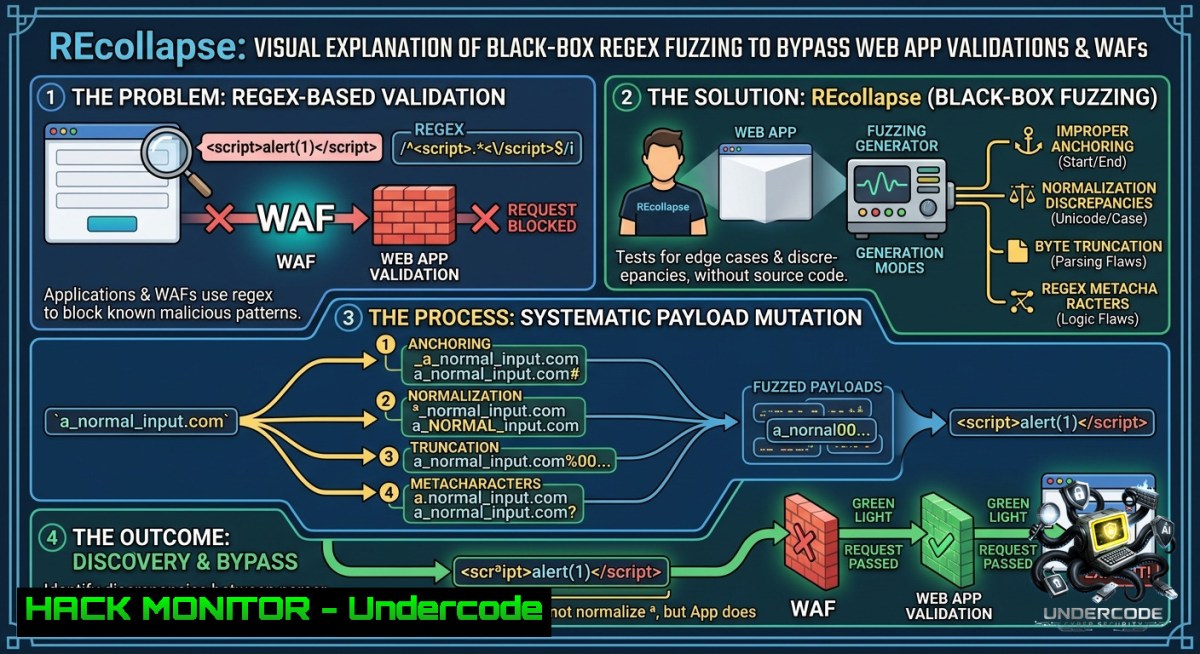
Introduction:
Regular expressions are the silent gatekeepers of modern web applications, controlling everything from input validation to WAF rules. However, developers often overlook subtle disparities in regex engine behaviors, normalization processes, and edge-case handling, creating blind spots for security testing. REcollapse is a specialized tool that leverages black-box regex fuzzing to uncover these blind spots, helping penetration testers systematically discover bypasses and weak vulnerability mitigations.
Learning Objectives:
– Understand the core concept of regex fuzzing and how REcollapse identifies normalization discrepancies in web applications.
– Master the installation process for REcollapse across Linux, Windows (WSL), and Docker environments.
– Execute practical fuzzing campaigns using REcollapse’s seven distinct mutation modes to bypass client-side and server-side validations.
– Apply discovered bypass techniques to test WAF rules, input filters, and authentication logic.
– Develop mitigation strategies to harden regex-based security controls against automated fuzzing attacks.
You Should Know:
1. Understanding Regex Fuzzing & Normalization Disparities
REcollapse moves beyond traditional payload-based fuzzing by targeting how applications parse input at the character normalization level. The core insight is that what a regex engine considers a match can vary drastically based on case folding, Unicode normalization forms (NFD, NFC, NFKD, NFKC), and encoding interpretations. For example, the characters ‘ſ’ (Latin small letter long s) and ‘s’ are considered the same under certain normalization rules, a fact that can bypass case-sensitive blacklists.
Below is the complete list of REcollapse’s seven fuzzing modes, each addressing a different type of validation logic:
| Mode | Name | Description |
|||-|
| 1 | Prefix Fuzzing | Inserts fuzzed bytes before the input |
| 2 | Separator Fuzzing | Injects bytes before and after special characters |
| 3 | Normalization Fuzzing | Replaces bytes with their normalized equivalents |
| 4 | Suffix Fuzzing | Appends fuzzed bytes after the input |
| 5 | Regex Metacharacter Fuzzing | Tests how regex engines handle control characters |
| 6 | Case Folding Fuzzing | Permutes uppercase/lowercase variations |
| 7 | Byte Truncation Fuzzing | Cuts input at various boundaries |
Step‑by‑Step Guide to Using REcollapse:
Installation on Linux/macOS:
 Using pip (recommended)
pip3 install recollapse

 Or using Docker
docker pull 0xacb/recollapse
docker run --rm -it 0xacb/recollapse -h
Installation on Windows (WSL):
 First install WSL2 and a Linux distribution (e.g., Ubuntu)
 Then within the WSL terminal:
sudo apt update && sudo apt install python3-pip -y
pip3 install recollapse
Basic Usage: The fundamental command structure is `recollapse
 "your_input_string"`. For example, to fuzz the input `<script>alert(1)</script>` using all default modes:
[bash]
recollapse "<script>alert(1)</script>"
This generates a list of mutated payloads that can be piped directly into a fuzzer like ffuf or Burp Suite Intruder.
Advanced Fuzzing Campaign:
 Focus on normalization and case-folding for a specific endpoint
recollapse -m 3,6 -e 1 -s 2 "admin" > payloads.txt

 Double URL-encode to bypass WAF decoding layers
recollapse -m 1,2,4 -e 4 -r 0x00,0xff "union select" > waf_payloads.txt

 Generate HTML report of normalization tables
recollapse --1ormtable --html > normalization_report.html
Integration with ffuf: After generating payloads, use them as input in ffuf:
ffuf -u https://target.com/api/search?q=FUZZ -w payloads.txt -fc 403,404
2. Exploiting WAF Bypasses with REcollapse
Modern WAFs rely heavily on regex-based signature matching to block malicious requests. REcollapse systematically maps how an application’s regex engine behaves at the byte level, uncovering discrepancies between expected and actual parsing logic. Common successful bypasses involve injecting non-printable characters, utilizing alternative Unicode representations, or exploiting backtracking limits in poorly optimized regex patterns.
Step‑by‑Step Guide for WAF Bypass Testing:
Step 1: Identify the target validation rule. Start by determining what the application is filtering—this could be SQL keywords, HTML tags, or path traversal sequences.
Step 2: Generate a comprehensive mutation set. Use REcollapse’s mode 5 (regex metacharacters) mixed with your injection vector:
 Generate SQL injection bypass variations
recollapse -m 5,6,7 -s 3 "' or '1'='1" > sqli_evasion.txt
Step 3: Probe the WAF’s decoding chain. Many WAFs decode URL-encoded input before applying regex rules. Test this by using double encoding:
recollapse -m 2,5 -e 4 "SELECT" > double_encoded.txt
Step 4: Analyze response codes for anomalies. Compare responses between baseline requests and mutated ones. A sudden change in HTTP status codes (e.g., from 403 Forbidden to 200 OK) indicates a successful bypass.
3. Mitigating ReDoS Attacks Through Robust Regex Design
Regular Expression Denial of Service (ReDoS) attacks exploit catastrophic backtracking in poorly constructed regex patterns, consuming CPU resources and crashing services. Attackers can trigger ReDoS by crafting inputs that force the regex engine into exponential matching attempts. REcollapse can be used defensively to identify vulnerable patterns in your own codebase before attackers do.
Step‑by‑Step Guide for ReDoS Mitigation:
Step 1: Identify dangerous regex constructs. Look for nested quantifiers like `(a+)+`, overlapping alternations with common prefixes like `(a|a)+`, or ambiguous quantifiers such as `.a.`.
Step 2: Test your regex patterns with REcollapse. While REcollapse is designed for black-box fuzzing, you can adapt it to test backend validation rules:
 Create a custom test harness
echo "aaaaaaaaaaaaaaaaaaaaaaaaaaaaaaaaaa!" > malicious_input.txt
recollapse -f malicious_input.txt -m 1,4 -s 5
Step 3: Apply defensive regex practices. Implement input length limits before regex evaluation, use atomic groups `(?>pattern)` to prevent backtracking, and prefer simpler string functions over complex regexes when possible.
Step 4: Monitor production regex performance. Use timeouts on regex operations—most modern languages allow setting a match timeout (e.g., Python’s `regex` library with `timeout` parameter, or Node.js `–regexp-timeout` flag).
4. Advanced Technical Implementation for Bug Bounty Hunting
For bug bounty hunters, REcollapse serves as an initial discovery tool to identify fuzzable parameters and normalization quirks. The real value emerges when combining its output with custom scripts for large-scale testing. Below is a Python wrapper script that integrates REcollapse with aiohttp for async fuzzing:
!/usr/bin/env python3
import subprocess
import aiohttp
import asyncio
import sys

async def test_payload(session, url, param, payload):
try:
async with session.get(url, params={param: payload}, timeout=5) as resp:
if resp.status != 403:  WAF bypass indicator
print(f"[+] Potential bypass: {payload} -> Status {resp.status}")
except:
pass

async def main(target_url, param, input_string):
 Generate REcollapse mutations
result = subprocess.run(
["recollapse", "-m", "1,2,3,4,5,6,7", "-e", "1", input_string],
capture_output=True, text=True
)
payloads = result.stdout.strip().split('\n')

async with aiohttp.ClientSession() as session:
tasks = [test_payload(session, target_url, param, p) for p in payloads]
await asyncio.gather(tasks)

if __name__ == "__main__":
asyncio.run(main(sys.argv[bash], sys.argv[bash], sys.argv[bash]))
Step‑by‑Step Guide for Continuous Integration Fuzzing:
Integrate REcollapse into your CI/CD pipeline to automatically test new endpoints:
 Jenkins pipeline stage example
stage('Regex Fuzzing') {
steps {
sh """
docker run --rm 0xacb/recollapse -m 1,2,3 -e 1 "$PAYLOAD" > ci_payloads.txt
ffuf -u https://staging.target.com/search?q=FUZZ -w ci_payloads.txt -of csv -o ci_results.csv
"""
}
post {
always {
archiveArtifacts artifacts: 'ci_results.csv', fingerprint: true
}
}
}
5. Cloud and API Security Hardening Against Regex Attacks
In cloud environments and API gateways (AWS WAF, Cloudflare, Azure Front Door), regex rules are frequently used to filter malicious requests. However, managed rule sets are often over-permissive or contain logic flaws. REcollapse can be used to audit these cloud WAF rules before deployment. For API security, focus on JSON and XML parsers that decode input before regex evaluation—these often introduce normalization steps that can be exploited.
Step‑by‑Step Guide for Cloud WAF Auditing:
Step 1: Extract the WAF’s regex rule. For open-source WAFs like ModSecurity, this means examining the CRS ruleset. For cloud WAFs, infer behavior through black-box testing.
Step 2: Test edge-case inputs. Use REcollapse with the `–1ormtable` flag to understand the exact normalization patterns your input undergoes:
recollapse --1ormtable | grep -i "s"
This shows how characters like ‘s’, ‘ſ’, and ‘ś’ are normalized.
Step 3: Compare bypass rates across rule versions. Maintain a regression suite of REcollapse-generated payloads to track when a new WAF version inadvertently opens a bypass.
Step 4: Implement defense-in-depth. Never rely solely on regex-based validation. Combine it with allowlist validation, parameterized queries for SQL, and Content Security Policy (CSP) headers.
What Undercode Say:
– RegEx as a first-class security control is fundamentally broken when implemented alone. REcollapse demonstrates that systematic mutation can defeat most common regex filters, yet many developers still treat regex as a silver bullet for input validation. The tool is not about breaking security; it’s about revealing hard truths about our assumptions.
– Normalization disparities are the new injection frontier. Just as we learned to treat SQL concatenation as dangerous, we must now treat regex-based filtering with the same skepticism. Every application stack has its own Unicode normalization quirks, and REcollapse provides a methodology to map those quirks at scale, turning what was once an esoteric research area into a practical, automated testing process.
Prediction:
– -1 As AI-generated code becomes more prevalent, the proliferation of naive regex-based sanitizers will increase, creating a larger attack surface for automated fuzzing tools like REcollapse. Without mandatory security training for AI code assistants, we will see a wave of easily bypassable filters in production systems.
– +1 Security testing will shift toward “normalization-aware” fuzzing as a standard practice. Expect to see REcollapse’s techniques integrated into mainstream DAST scanners and CI/CD pipelines within 18 months, reducing the barrier to entry for uncovering complex validation bypasses.
– -1 Bug bounty platforms will experience a surge in regex bypass reports, leading to fatigue and potential de-prioritization of these issues. However, when combined with other weaknesses (e.g., XSS or SQLi), regex bypasses can still be critical, and organizations will need to adapt their remediation workflows to handle this nuance.
– +1 The release of REcollapse as an open-source tool democratizes advanced web application testing. Smaller security teams without dedicated research budgets can now perform sophisticated fuzzing campaigns that were previously only possible with custom-built tooling, leveling the playing field against determined attackers.
▶️ Related Video (84% Match):
🎯Let’s Practice For Free:
🎓 Live Courses & Certifications:
[Join Undercode Academy for Verified Certifications](https://undercode.co.uk/certifications/)
🚀 Request a Custom Project:
Secure, high-velocity infrastructure and disruptive technological engineering. Contact our engineering team for high-tier development and proprietary systems:
[[email protected]](mailto:[email protected])
💎 Smart Architecture | 🛡️ Secure by Design | ⭐ Trusted by Thousands
IT/Security Reporter URL:
Reported By: [0xfrost Recollapse](https://www.linkedin.com/posts/0xfrost_recollapse-recollapse-is-a-helper-tool-share-7466850616527560704-aXH_/) – Hackers Feeds
Extra Hub: Undercode MoN
Basic Verification: Pass ✅
🔐JOIN OUR CYBER WORLD [ CVE News • HackMonitor • UndercodeNews ]
[💬 Whatsapp](https://undercode.help/whatsapp) | [💬 Telegram](https://t.me/UndercodeCommunity)
📢 Follow UndercodeTesting & Stay Tuned:
[𝕏 formerly Twitter 🐦](https://x.com/undercodeupdate) | [@ Threads](https://www.threads.net/@undercodetesting) | [🔗 Linkedin](https://www.linkedin.com/company/undercodetesting/) | [🦋BlueSky](https://bsky.app/profile/undercode.bsky.social)


