Listen to this Post
Introduction:
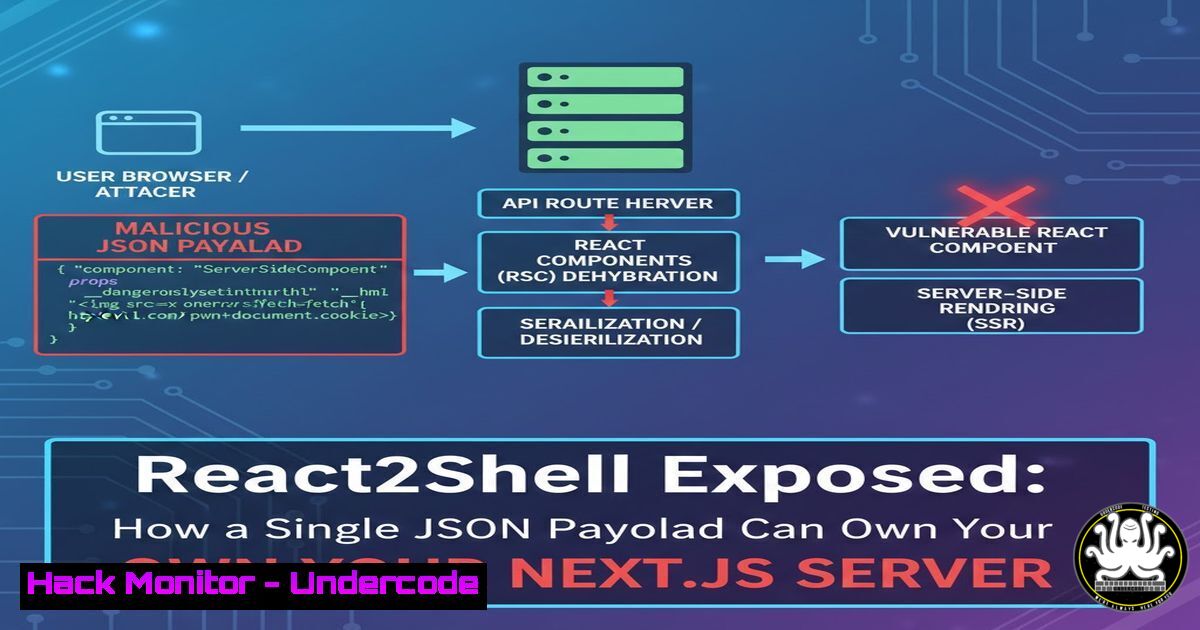
A critical remote code execution vulnerability, CVE-2025-55182 dubbed “React2Shell,” has shaken the React ecosystem, specifically targeting React Server Components (RSC) and, by extension, Next.js applications. This flaw stems from server-side prototype pollution within React’s serialization logic, allowing attackers to inject malicious payloads through seemingly benign JSON data. The exploitation attempts observed in the wild demonstrate that threat actors are actively weaponizing this to achieve full server compromise, turning your frontend framework into a backdoor.
Learning Objectives:
- Understand the mechanism of server-side prototype pollution leading to remote code execution in React Server Components.
- Learn to identify vulnerable applications and test for CVE-2025-55182 using safe, proof-of-concept methods.
- Implement immediate mitigation strategies, including patching, runtime hardening, and secure coding practices to protect your applications.
You Should Know:
1. The Anatomy of the React2Shell Exploit
The core vulnerability lies in how React Server Components handle serialized data. By sending a specially crafted JSON payload, an attacker can pollute the prototype chain of objects on the server. This pollution modifies the behavior of fundamental JavaScript objects (like Object.prototype), which can then be leveraged to bypass security controls and ultimately execute arbitrary system commands on the host.
Step‑by‑step guide explaining what this does and how to use it.
Step 1: Understand the Payload Structure. The exploit involves a JSON payload that sets a property on Object.prototype. A simplified malicious pattern looks like {"__proto__": {"polluted": "controlledValue"}}. In React’s flawed deserialization, this assigns the property to the base object prototype.
Step 2: Trigger Gadget Execution. Post-pollution, React’s server-side code utilizes objects that now have the polluted prototype. If the polluted property influences a function call or path resolution, it can lead to code execution. Real-world payloads chain this to manipulate `NODE_OPTIONS` or similar environment variables, leading to command injection.
Step 3: Example Proof-of-Concept (For Authorized Testing Only). A safe test to check vulnerability patterns (not actual exploitation) involves sending a diagnostic payload and observing the application’s object state.
 Using curl to send a test payload to an RSC endpoint (replace URL)
curl -X POST https://your-test-app.com/rsc-endpoint \
-H "Content-Type: application/json" \
-H "RSC-Prefix: 1" \
-d '{"<strong>proto</strong>":{"testPollution":"true"}}'
Monitoring server logs for unexpected property access or using a debugger would be needed to confirm the pollution’s effect.
- How to Test Your Next.js Application for Vulnerability
Before patching, you must ascertain your exposure. This involves checking versions and conducting controlled environmental tests.
Step‑by‑step guide explaining what this does and how to use it.
Step 1: Version Audit. The vulnerability affects React versions `>=18.3.0-canary-…` and `19.0.0-beta.0` up to the patched versions. For Next.js, it impacts versions `15.1.0` through 15.1.5. Run the following in your project root:
 Linux/macOS (in project directory)
npm list react react-dom next
 OR
yarn list react react-dom next
 Windows (PowerShell in project directory)
npm list react react-dom next
Step 2: Static Analysis with Security Tools. Integrate vulnerability scanning into your CI/CD pipeline. Use `npm audit` or `yarn audit` after updating your package manager’s advisory database.
npm audit --audit-level=critical
 Or use specialized SCA tools like Snyk or OWASP Dependency-Check
npx snyk test
3. Immediate Patching and Dependency Management
The primary mitigation is to upgrade to patched versions immediately. React `19.0.0-beta.6` and Next.js `15.1.6` contain the fixes. Do not rely on version ranges; enforce exact versions.
Step‑by‑step guide explaining what this does and how to use it.
Step 1: Update Package Definitions. Manually specify the patched versions in your package.json:
{
"dependencies": {
"react": "19.0.0-beta.6",
"react-dom": "19.0.0-beta.6",
"next": "15.1.6"
}
}
Step 2: Clean Install and Verify. Remove existing `node_modules` and lockfile to ensure a clean upgrade and avoid dependency confusion.
 Linux/macOS/Windows
rm -rf node_modules package-lock.json  or yarn.lock
npm install
npm list react react-dom next  Verify versions
4. Implementing Runtime Hardening Measures
Patching is crucial, but defense-in-depth is key. Harden your Node.js runtime environment to limit the impact of potential future prototype pollution flaws.
Step‑by‑step guide explaining what this does and how to use it.
Step 1: Use `–disable-proto` Node.js Flag. This runtime flag effectively blocks modifications to the `__proto__` property, neutralizing many prototype pollution vectors. Launch your Next.js application with:
node --disable-proto=delete ./node_modules/.bin/next start
(Incorporate this flag into your `start` script in `package.json` or your process manager (PM2, systemd) configuration).
Step 2: Apply Principle of Least Privilege. Run your Next.js application as a non-root user with minimal filesystem permissions. In a Docker container, this is essential:
FROM node:20-alpine
RUN addgroup -g 1001 -S nodejs && adduser -S nextjs -u 1001
USER nextjs
 ... rest of your Dockerfile
5. Adopting Secure Serialization and Input Validation
The root cause involves unsafe object creation during deserialization. Implement rigorous input validation and consider safer serialization alternatives for RSC payloads.
Step‑by‑step guide explaining what this does and how to use it.
Step 1: Validate and Sanitize RSC Inputs. While the framework should handle this, adding middleware to inspect and clean incoming RSC request bodies can be an extra layer. Use libraries like `validator` or joi.
// Example middleware sketch for Next.js (app router)
import { NextResponse } from 'next/server';
export function middleware(request) {
if (request.headers.get('RSC-Prefix')) {
// Implement logic to reject requests with suspicious <strong>proto</strong> keys
const body = await request.clone().json();
if (JSON.stringify(body).includes('"<strong>proto</strong>"')) {
return new NextResponse('Bad Request', { status: 400 });
}
}
return NextResponse.next();
}
Step 2: Explore Safer Serialization. For custom RSC-like implementations, consider serialization libraries that are immune to prototype pollution by design, such as `structuredClone` for pure data or libraries that explicitly reject prototype modifiers.
What Undercode Say:
- The Blurred Line Between Client and Server is a New Attack Frontier. React Server Components, designed for performance, inadvertently expanded the attack surface. Client-originating data now directly influences server-side JavaScript execution in a novel way, making classic client-side prototype pollution a server-side RCE threat.
- Supply Chain Security is Non-Negotiable. This vulnerability existed in core framework dependencies used by millions. It underscores the necessity of robust Software Composition Analysis (SCA), the ability to patch instantly, and runtime hardening to survive the “patch gap” between disclosure and implementation.
Analysis:
The React2Shell vulnerability is a paradigm shift for modern web application security. It demonstrates that the architectural trends favoring seamless server-client integration (like RSCs) introduce complex and non-obvious security risks. The exploit’s emergence within weeks of the vulnerable versions highlights the speed of the adversary. Organizations can no longer treat frontend frameworks as inherently safe from server takeover. This event will likely accelerate the adoption of stricter runtime hardening (like --disable-proto) as a standard deployment practice and will push frameworks to implement more robust, security-focused serialization layers. Future attacks will continue to target the interaction points between client-supplied data and server-side rendering engines, making secure-by-design principles in meta-frameworks more critical than ever.
Prediction:
The success of CVE-2025-55182 will catalyze a wave of offensive security research focused on server-side rendering (SSR) and isomorphic frameworks (Next.js, Nuxt, SvelteKit). We anticipate a short-term surge in similar prototype pollution gadget discoveries within these ecosystems. In response, framework developers will be forced to implement more aggressive isolation mechanisms, potentially moving RSC “work” into more sandboxed environments (Web Workers, isolates, or even micro-VMs). In the next 12-18 months, expect runtime flags like `–disable-proto` to become a baseline requirement in cloud-native application security benchmarks, and the role of Application Security in evaluating frontend framework choices will become significantly more prominent.
🎯Let’s Practice For Free:
IT/Security Reporter URL:
Reported By: Christophetafanidereeper So – Hackers Feeds
Extra Hub: Undercode MoN
Basic Verification: Pass ✅


