Listen to this Post
Introduction:
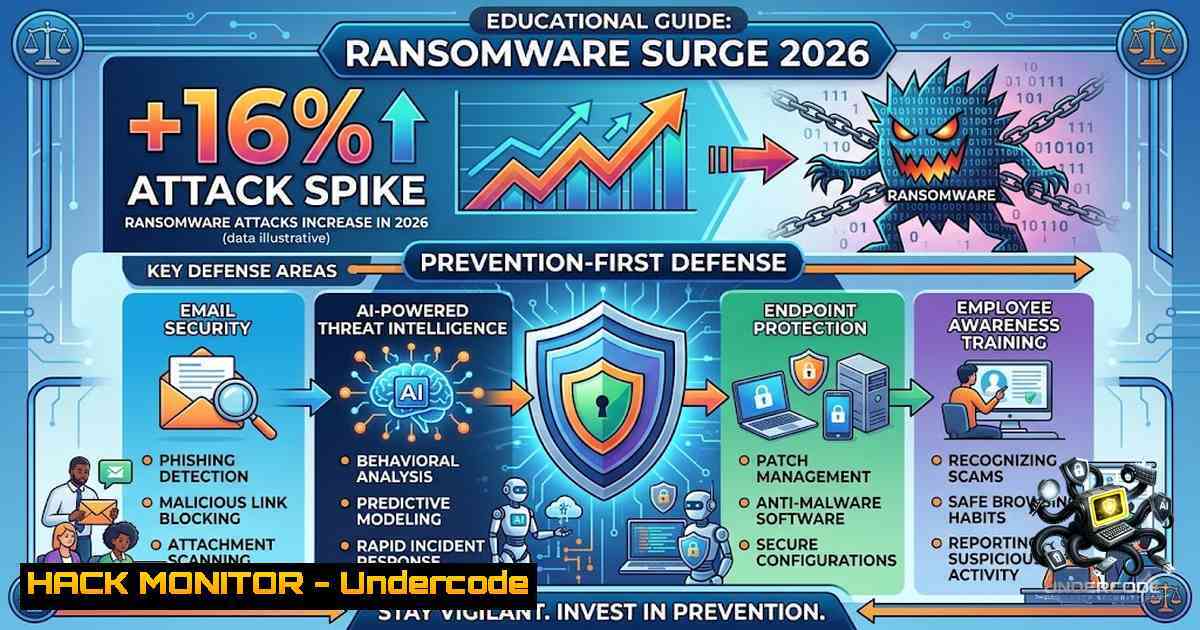
Global cyber attacks surged 16% year-over-year in July 2026, with ransomware victims climbing 49% from June alone—a sharp deviation from the steadier patterns observed in the first half of the year. Check Point Research data reveals organizations now face an average of 2,336 weekly attacks, while generative AI has introduced a new exposure vector: one in every 36 enterprise prompts carries high risk of sensitive data leakage. This multi-front threat landscape demands a prevention-first, AI-driven security architecture that protects networks, users, data, and AI workflows before attacks can cause impact.
Learning Objectives:
- Understand the July 2026 threat landscape, including regional and sector-specific attack patterns
- Implement ransomware mitigation strategies across email, endpoint, and network layers
- Secure generative AI workflows against sensitive data leakage through prompts
- Deploy practical Linux and Windows commands for ransomware detection and defense
- Apply cloud hardening and API security best practices aligned with 2026 threat intelligence
- Ransomware Surge Analysis: The Numbers Behind the Threat
July 2026 marked a tipping point. Reported ransomware victims reached 964—up 49% from June and 87% from July 2025. Latin America remained the most targeted region with 3,561 weekly attacks per organization, followed by Asia-Pacific at 3,316. Europe posted one of the fastest growth rates, climbing 18% year-over-year to 2,051 weekly attacks.
Sector pressure tells a revealing story. Education remained the most targeted industry at 4,848 weekly attacks per organization, with Government following at 3,044. Energy and Utilities rose 20% to 2,759 attacks, while Hospitality, Travel and Recreation entered the top five with 2,614 attacks—up 28%.
Ransomware groups followed a distinct pattern from overall attacks. Business Services accounted for 32.5% of reported victims, followed by Industrial Manufacturing at 14.4%. North America represented 45% of ransomware incidents, with the United States alone accounting for 39.4%. The most prevalent groups in July were The Gentlemen and Qilin, each linked to 14% of published attacks, while DeadLock ranked third with 10%.
2. Email Security: The Primary Attack Vector
One in every 128 emails—0.78%—was classified as phishing, with another 20% falling into unwanted or risky categories such as graymail, spam, and suspicious messages. Africa had the highest phishing rate at one in every 106 emails, followed by North America at one in 117.
Step-by-Step Guide: Hardening Email Security with Check Point Harmony
- Integrate with Office 365: Navigate to Security Settings > SaaS Applications > Office 365 Mail > Configure. Bind your Office 365 environment to Harmony Email & Collaboration.
-
Enforce Inline Protection: Keep Harmony Email & Collaboration policies in Prevent (Inline) mode to ensure phishing emails sent to on-premises mailboxes are quarantined.
-
Configure Anti-Malware Block Lists: Navigate to Security Settings > Exceptions > Anti-Malware > Block List. Create a new block list and select “Block all file types except” to specify allowed file types.
-
Require TLS Encryption: Under Encryption settings, select “Require TLS encryption” to secure email in transit.
-
Configure Quarantine Settings: Set up a unified end-user portal for quarantined emails, defining user permissions for restore actions.
Linux Command: Email Log Analysis for Phishing Detection
 Search for suspicious email patterns in mail logs
sudo grep -i "spam|phish|suspicious" /var/log/mail.log | tail -100

Extract sending IPs from suspicious emails
sudo grep "status=sent" /var/log/mail.log | awk '{print $NF}' | sort | uniq -c | sort -1r

Monitor for unusual outbound email volume (potential compromised account)
sudo tail -f /var/log/mail.log | grep -E "from=<.>.to=<.>"
3. Generative AI: The New Data Leakage Frontier
Generative AI use has emerged as a critical concern. Organizations used an average of eight GenAI tools, with users generating 95 prompts on average. Personal data was the most common type of sensitive information exposed, appearing in 70% of organizations measured, while financial data and network/IT infrastructure each appeared in 68%. Some 22% of prompts contained potentially sensitive information, and 88% of organizations with regular GenAI use were affected by high-risk prompt activity.
Step-by-Step Guide: Securing GenAI Workflows
- Deploy GenAI-Aware DLP: Implement Data Loss Prevention that applies real-time inspection to AI prompt flows, treating them with the same scrutiny as email or file transfers.
-
Block Sensitive Data in Prompts: Configure policies to block regulated data from entering AI prompts and flag outputs containing reconstructed sensitive content.
-
Enable Endpoint DLP Policies: Block or warn when users paste sensitive data into third-party AI applications.
-
Monitor Prompt Activity: Track sensitive data from its source through every copy and log all AI interactions for audit.
-
Implement Prompt Filtering: Use frameworks like PromptShield that prevent sensitive data exposure before prompts are submitted to LLMs.
Windows Command: Monitoring AI Application Network Activity
 Monitor network connections from AI applications
Get-1etTCPConnection | Where-Object {$_.OwningProcess -in (Get-Process -1ame "chrome","edge","python","node" | Select-Object -ExpandProperty Id)} | Format-Table

Enable advanced audit logging for AI tool usage
auditpol /set /subcategory:"Detailed Tracking" /success:enable /failure:enable

Monitor for suspicious file access by AI tools
Get-WinEvent -LogName "Security" -MaxEvents 50 | Where-Object {$<em>.Id -eq 4663 -and $</em>.Message -like "AI"}
4. Endpoint Defense: Linux and Windows Ransomware Protection
With Qilin and other ransomware groups actively targeting endpoints, proactive defense is essential. Qilin has been observed using vulnerable drivers to disable EDR tools, requiring organizations to tighten driver governance.
Step-by-Step Guide: Linux Ransomware Detection
1. Install YARA for Malware Detection:
sudo apt-get update && sudo apt-get install yara -y
2. Deploy YARA Ransomware Detection Rules:
 Hunt for ransomware indicators across critical system paths
yara -r rules/ransomware/ /var/log /usr/bin /home
3. Install ClamAV for Malware Scanning:
sudo apt install clamav clamav-daemon
sudo freshclam  Update virus definitions
sudo systemctl start clamav-daemon
4. Deploy File Integrity Monitoring:
 Monitor for unauthorized file changes using AIDE
sudo apt install aide
sudo aideinit
sudo aide --check
Step-by-Step Guide: Windows Defender Ransomware Protection
- Enable Controlled Folder Access: Open Windows Security > Virus & threat protection > Manage ransomware protection. Enable Controlled folder access to block unauthorized applications from modifying protected folders.
2. Configure Attack Surface Reduction (ASR) Rules:
 Enable ASR rules for ransomware protection
Set-MpPreference -AttackSurfaceReductionRules_Actions 1
- Enable Real-Time Protection: Ensure real-time protection is active in Windows Security settings.
-
Configure Cloud-Delivered Protection: Enable cloud-delivered protection for faster threat response.
5. Cloud Hardening and API Security
As ransomware groups increasingly target cloud infrastructure and APIs, organizations must implement comprehensive hardening measures. NIST has released updated guidelines for API protection in cloud-1ative systems, covering pre-runtime and runtime controls.
Step-by-Step Guide: Cloud Security Hardening Checklist
- Implement Zero Trust Architecture: Enforce conditional access MFA for all admin roles and block legacy authentication.
-
Harden Network Security: Restrict inbound access—no 0.0.0.0/0 inbound on ports 22 or 3389. Disable default network creation and configure Private Google Access.
-
Secure Storage: Set `allowBlobPublicAccess` to false and disable public network access.
-
Enable Key Vault Protection: Configure soft-delete and purge protection for key vaults.
-
Deploy Continuous Monitoring: Enable VPC flow logs, automated patch management, and AI-driven threat detection.
API Security Commands and Configurations
 Validate JWT tokens strictly - pin algorithm and verify signature
 Example JWT validation with jq
echo "YOUR_JWT_TOKEN" | jq -R 'split(".") | .[bash] | @base64d | fromjson'

Monitor API endpoints for unusual traffic patterns
sudo tcpdump -i any -1 'port 443 and (tcp[((tcp[12:1] & 0xf0) >> 2):4] = 0x47455420 or tcp[((tcp[12:1] & 0xf0) >> 2):4] = 0x504f5354)'
Windows Command: API Traffic Analysis
 Monitor API traffic using Windows netsh
netsh trace start capture=yes tracefile=C:\api_traffic.etl maxsize=100

Analyze API authentication failures
Get-WinEvent -LogName "Security" | Where-Object {$_.Id -in 4625,4648} | Select-Object TimeCreated, Message
6. Qilin-Specific Mitigation Strategies
Qilin ransomware, one of July’s most prevalent groups, requires targeted defenses.
Step-by-Step Guide: Qilin Ransomware Defense
- Shrink Attack Surface: Monitor the dark web for stolen credentials and enforce phishing-resistant MFA.
-
Patch Exposed Systems: Implement continuous patch management with special attention to internet-facing systems and edge devices.
-
Deploy EDR Across All Assets: Ensure Endpoint Detection and Response is deployed and monitored 24×7.
-
Segment Networks: Isolate IT and OT networks to protect industrial control systems.
-
Monitor for Data Exfiltration: Watch for unusual outbound transfers—Qilin often steals data before encryption.
-
Tighten Driver Governance: Only allow signed drivers from explicitly trusted publishers and review vulnerable drivers.
What Undercode Say:
-
Key Takeaway 1: The 16% attack surge and 49% ransomware spike in July represent a fundamental shift—not a seasonal fluctuation. Organizations must move beyond reactive patching to prevention-first architectures that block attacks before they execute.
-
Key Takeaway 2: GenAI exposure is no longer theoretical. With 88% of organizations affected by high-risk prompt activity and 70% exposing personal data through AI tools, security teams must treat AI prompts as a critical data leakage vector requiring DLP controls, real-time monitoring, and employee training.
-
Key Takeaway 3: Regional and sector disparities demand tailored defenses. Education and government sectors face the highest attack volumes, while business services bear the brunt of ransomware. Organizations in Latin America and Asia-Pacific need elevated threat hunting capabilities given their elevated attack rates.
-
Key Takeaway 4: The rise of Qilin and other groups using kernel-level EDR-killing techniques signals an escalation in ransomware sophistication. Traditional endpoint protection is insufficient—organizations need layered defenses including driver governance, network segmentation, and continuous behavioral monitoring.
-
Key Takeaway 5: Email remains the primary entry point with a 0.78% phishing rate. Combined with GenAI risks, security awareness training must evolve to cover both traditional phishing and AI-specific risks like prompt injection and sensitive data exposure through AI tools.
Prediction:
+1 Organizations that adopt prevention-first, AI-driven security architectures will demonstrate 40-60% lower breach costs by 2027 compared to those relying on reactive detection models.
+1 Regulatory bodies will introduce GenAI-specific data protection frameworks by 2027, mandating prompt filtering, audit logging, and DLP controls for enterprise AI usage.
-1 Ransomware-as-a-Service operations will increasingly adopt kernel-level EDR evasion techniques, rendering traditional endpoint protection ineffective without driver governance and behavioral monitoring.
-1 The education sector, already the most targeted at 4,848 weekly attacks, faces a critical resource gap that will lead to increased ransomware payments and data breaches unless government funding for cybersecurity is substantially increased.
-1 Organizations with unmanaged GenAI usage will experience data leakage incidents at 3x the rate of those with formal AI governance, with personal and financial data being the most frequently exposed categories.
▶️ Related Video (78% Match):
🎯Let’s Practice For Free:
🎓 Live Courses & Certifications:
Join Undercode Academy for Verified Certifications
🚀 Request a Custom Project:
Secure, high-velocity infrastructure and disruptive technological engineering. Contact our engineering team for high-tier development and proprietary systems:
[email protected]
💎 Smart Architecture | 🛡️ Secure by Design | ⭐ Trusted by Thousands
IT/Security Reporter URL:
Reported By: https://lnkd.in/p/eusgaaqf – Hackers Feeds
Extra Hub: Undercode MoN
Basic Verification: Pass ✅


