Listen to this Post
Introduction
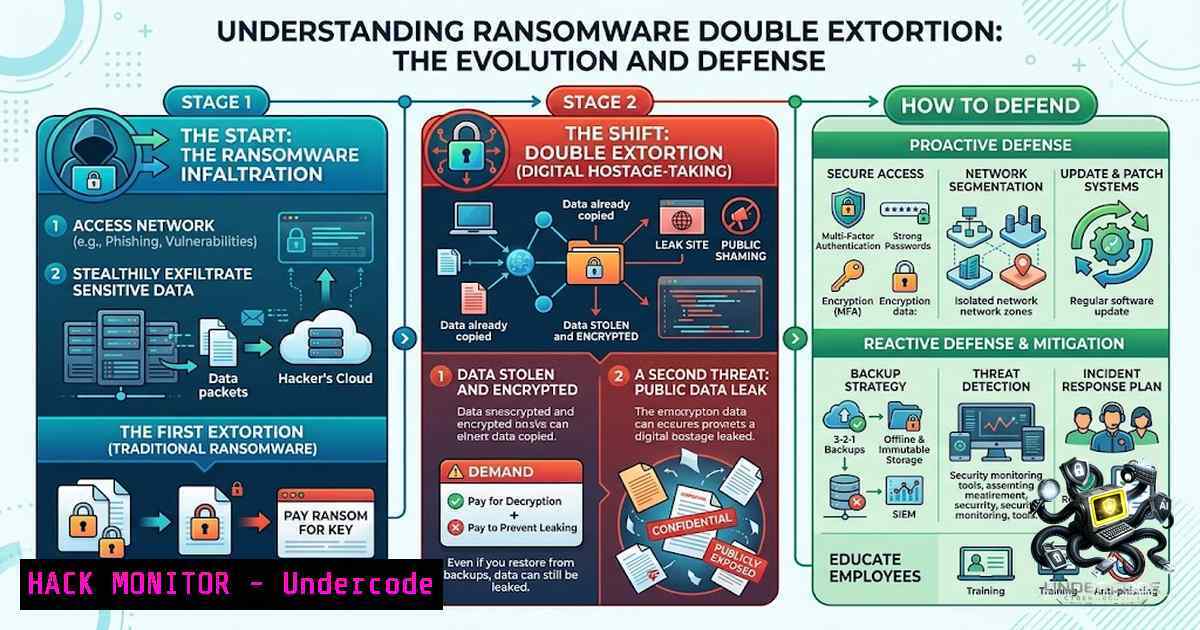
Modern ransomware has fundamentally transformed from a nuisance encryption attack into a sophisticated, multi-phase extortion campaign that weaponizes an organization’s own sensitive data against it. Today’s adversaries don’t just lock your systems – they exfiltrate your crown jewels first, then threaten to publish them unless a ransom is paid, creating dual pressure through operational disruption and catastrophic reputational damage. With ransomware groups like INC, Qilin, and Akira accounting for hundreds of incidents per quarter and projections indicating 2026 will surpass 2025 in overall victim count, understanding the double extortion threat landscape and implementing layered defenses has become mission-critical for every enterprise.
Learning Objectives
- Understand the complete double extortion attack lifecycle – from initial access to data exfiltration, encryption, and ransom negotiation
- Master practical detection techniques for identifying data exfiltration and encryption behaviors across Windows and Linux environments
- Implement proactive defense strategies including immutable backups, least privilege access, network segmentation, and AI-assisted threat detection
- Develop incident response capabilities specifically tailored to double extortion scenarios
You Should Know
- The Double Extortion Attack Lifecycle – What Happens Before the Ransom Note Arrives
The double extortion attack chain follows a predictable yet devastating pattern. Attackers typically gain initial access through spear-phishing campaigns, exploitation of public-facing applications (such as CVE-2024-55591), or RDP brute-force attacks. Once inside, they establish persistence and begin reconnaissance – often using Living Off the Land (LOL) techniques to blend in with legitimate administrative activity.
The critical distinction between traditional ransomware and double extortion is the exfiltration phase. Before deploying the encryptor, attackers identify, compress, and transfer sensitive data to external storage – frequently using cloud services like MEGA or custom command-and-control infrastructure. This stolen data becomes the leverage that pressures victims into paying, regardless of whether they can restore from backups.
The encryption phase often targets critical systems with surgical precision. On Windows endpoints, attackers disable security tools and delete Volume Shadow Copies to prevent recovery. On Linux and ESXi environments, ransomware families frequently terminate virtual machine processes to encrypt VMware-related files including .vmdk and .vmx files. The entire attack – from initial compromise to full encryption – can occur within a 75-minute window, as demonstrated in recent incidents where over 280,000 files were locked across multiple sites simultaneously.
How to detect early indicators:
On Windows, monitor for suspicious process creation patterns using PowerShell:
 Monitor for suspicious process creation events
Get-WinEvent -FilterHashtable @{LogName='Security'; ID=4688} |
Where-Object { $<em>.Properties[bash].Value -match "reg.exe|vssadmin.exe|bcdedit.exe" } |
Select-Object TimeCreated, @{N='Process';E={$</em>.Properties[bash].Value}},
@{N='CommandLine';E={$_.Properties[bash].Value}}
On Linux, use `auditd` to monitor for bulk file operations and encryption behavior:
 Monitor for mass file modifications indicative of encryption
sudo auditctl -w /var -p wa -k ransomware_activity
sudo auditctl -w /etc -p wa -k ransomware_activity
sudo auditctl -w /home -p wa -k ransomware_activity

Check for suspicious OpenSSL usage (commonly used by Linux ransomware)
sudo ausearch -k ransomware_activity --format raw | grep -E "openssl|gpg|rename"
- Data Exfiltration Detection – Catching the Theft Before the Lock
The exfiltration phase is your best opportunity to detect and stop a double extortion attack before encryption occurs. Attackers must move large volumes of data out of your network, creating observable network and system anomalies.
Key indicators of active exfiltration:
- Unusual outbound traffic volumes to unexpected destinations
- Compression or archiving activities on sensitive file shares
- Use of legitimate remote access tools (AnyDesk, TeamViewer) for data transfer
- Abnormal database export or backup operations
- Large file transfers during off-hours from privileged accounts
Detection commands and configurations:
Monitor outbound network connections on Windows using built-in tools:
 Monitor established outbound connections with high data volume
netstat -ano | findstr ESTABLISHED

Track processes with high network I/O (requires Sysmon or EDR)
Get-Process | Where-Object { $_.NetworkUsage -gt 1000000 } |
Select-Object ProcessName, Id, NetworkUsage
On Linux, monitor for suspicious outbound connections and data transfers:
 Monitor active outbound connections
sudo ss -tunap | grep ESTAB

Track network I/O by process
sudo nethogs -t

Detect large file transfers using rsync, scp, or curl
sudo ausearch -k network_activity --format raw | grep -E "rsync|scp|curl|wget"

Monitor for data compression activities on sensitive directories
sudo inotifywait -m -r /sensitive_data -e create,modify,move |
while read path action file; do
if [[ "$file" =~ .(zip|rar|7z|tar|gz)$ ]]; then
echo "ALERT: Archive created in sensitive location: $path$file"
fi
done
SIEM correlation rule example (pseudo-code):
IF (UserAccount == PrivilegedAccount)
AND (SourceIP == InternalServer)
AND (DestinationIP NOT IN AllowedEgressList)
AND (DataTransferred > 100MB)
AND (Time BETWEEN 22:00 AND 06:00)
THEN TriggerHighAlert("Potential Data Exfiltration")
- Encryption Behavior Monitoring – Identifying the Kill Chain
Ransomware encryption behavior creates distinct patterns that can be detected before widespread damage occurs. Early signals include sudden bursts of file renames, rapid file modifications, creation of ransom notes, and attempts to delete shadow copies or system restore points.
Windows-specific detection:
Monitor for Volume Shadow Copy deletion – a near-universal ransomware tactic:
 Detect shadow copy deletion attempts
Get-WinEvent -FilterHashtable @{LogName='System'; ID=7036} |
Where-Object { $_.Message -match "Volume Shadow Copy" }

Monitor for suspicious registry modifications (disabling Windows Defender)
Get-WinEvent -FilterHashtable @{LogName='Security'; ID=4657} |
Where-Object { $<em>.Message -match "EnableDefender" -or $</em>.Message -match "DisableRealtimeMonitoring" }

File integrity monitoring for sensitive directories
 Using Sysmon or native PowerShell:
$watcher = New-Object System.IO.FileSystemWatcher
$watcher.Path = "C:\CriticalData"
$watcher.IncludeSubdirectories = $true
$watcher.EnableRaisingEvents = $true
$watcher.Filter = "."
Register-ObjectEvent $watcher "Changed" -Action {
$path = $Event.SourceArgs[bash].FullPath
$changeType = $Event.SourceArgs[bash].ChangeType
$timestamp = Get-Date -Format "yyyy-MM-dd HH:mm:ss"
Write-Host "$timestamp - $changeType - $path"
}
Linux-specific detection:
Monitor for mass file modifications and entropy changes (encrypted files typically show high entropy):
 Monitor file modification rates per directory
!/bin/bash
while true; do
find /sensitive_data -type f -mmin -1 | wc -l > /tmp/file_change_rate
if [ $(cat /tmp/file_change_rate) -gt 100 ]; then
echo "ALERT: High file modification rate detected - possible encryption"
fi
sleep 60
done

Detect high-entropy files (potential encryption artifacts)
for file in $(find /sensitive_data -type f -size +1M -mmin -5); do
entropy=$(ent -t $file 2>/dev/null | awk '{print $1}')
if (( $(echo "$entropy > 7.5" | bc -l) )); then
echo "ALERT: High entropy file detected: $file"
fi
done

Monitor for ransom note creation
sudo inotifywait -m -r / --include "README|RECOVER|DECRYPT" -e create |
while read path action file; do
echo "ALERT: Potential ransom note created: $path$file"
done
4. Proactive Defense Architecture – Building Resilient Systems
Defense-in-depth strategy against double extortion:
Offline and Immutable Backups:
Maintain backups that cannot be modified or deleted by attackers. Implement the 3-2-1 backup rule (3 copies, 2 different media, 1 offsite) with immutable storage that enforces write-once-read-many (WORM) policies. Test restoration procedures regularly – not just the backup process itself.
Principle of Least Privilege:
Restrict user and service accounts to only the permissions they require. Implement Just-In-Time (JIT) and Just-Enough-Access (JEA) for privileged operations. Regularly audit and remove unused accounts and excessive permissions.
Multi-Factor Authentication (MFA):
Enforce MFA for all privileged access, including administrative accounts, remote access, and cloud consoles. Use phishing-resistant MFA methods (FIDO2/WebAuthn) where possible.
Network Segmentation:
Segment critical systems and sensitive data repositories from general user networks. Implement micro-segmentation to limit lateral movement. Use Zero Trust Network Access (ZTNA) principles for all internal and external access.
Vulnerability Management:
Prioritize patching of known exploited vulnerabilities. Establish a formal vulnerability management program with SLAs for remediation based on risk severity.
Example network segmentation configuration using Windows Firewall:
 Block SMB traffic from non-authorized subnets
New-1etFirewallRule -DisplayName "Block SMB from Untrusted" `
-Direction Inbound -Protocol TCP -LocalPort 445 `
-RemoteAddress "192.168.0.0/24" -Action Block

Restrict RDP access to specific jump hosts
New-1etFirewallRule -DisplayName "Restrict RDP to Jump Hosts" `
-Direction Inbound -Protocol TCP -LocalPort 3389 `
-RemoteAddress "10.0.1.0/24" -Action Allow
Linux iptables segmentation example:
 Allow only specific subnets to access sensitive services
sudo iptables -A INPUT -p tcp --dport 22 -s 10.0.1.0/24 -j ACCEPT
sudo iptables -A INPUT -p tcp --dport 22 -j DROP

Limit outbound connections to prevent data exfiltration
sudo iptables -A OUTPUT -d 0.0.0.0/0 -p tcp --dport 443 -m state --state NEW -j ACCEPT
sudo iptables -A OUTPUT -d 0.0.0.0/0 -p tcp --dport 80 -m state --state NEW -j ACCEPT
sudo iptables -A OUTPUT -d 0.0.0.0/0 -j DROP
- AI-Powered Threat Detection – Moving from Reactive to Proactive
Artificial Intelligence transforms ransomware defense from reactive response to proactive detection. AI systems excel at identifying subtle behavioral anomalies that traditional signature-based detection misses.
How AI strengthens ransomware defense:
Behavioral Analysis: AI models establish baseline patterns of normal user and system behavior, then flag deviations that may indicate compromise – including unusual file access patterns, abnormal authentication attempts, and atypical data movement.
Correlation Across Telemetry: Modern AI systems correlate data from endpoints, identity providers, cloud environments, email gateways, and network sensors to identify attack patterns that would be invisible when examining any single data source in isolation.
Early Indicator Detection: AI can identify ransomware activity before widespread encryption occurs by recognizing precursor behaviors – including discovery activities, privilege escalation attempts, and initial data staging operations.
Automated Response: AI generates incident timelines, recommends containment actions, and prioritizes high-risk alerts to accelerate SOC investigations.
Implementation approach:
 Example anomaly detection logic (pseudo-code)
import pandas as pd
from sklearn.ensemble import IsolationForest

def detect_exfiltration_anomaly(network_logs):
 Features: bytes_out, connection_count, destination_uniqueness
model = IsolationForest(contamination=0.01)
predictions = model.fit_predict(network_logs[['bytes_out', 'connections', 'unique_dest']])
anomalies = network_logs[predictions == -1]
return anomalies
6. Incident Response for Double Extortion Scenarios
When a double extortion attack is detected, time is critical. A well-rehearsed incident response plan can mean the difference between contained damage and catastrophic breach.
Immediate containment steps:
- Isolate affected systems – Disconnect compromised endpoints from the network without shutting them down (to preserve evidence)
- Identify the scope – Determine which systems and data have been compromised
- Preserve evidence – Capture memory dumps, network logs, and forensic images
- Engage legal counsel – Address regulatory notification requirements and legal considerations
- Contact law enforcement – Report the incident to appropriate authorities
- Prepare communication – Develop internal and external communication strategies
Critical consideration: Paying the ransom does not guarantee data recovery or prevent data leakage. Many victims who pay never receive decryption keys, and attackers may leak data regardless of payment.
Post-incident recovery:
- Restore from verified, offline backups
- Patch the initial entry vector
- Reset all credentials and rotate secrets
- Implement additional monitoring for residual threats
- Conduct a thorough post-mortem analysis
What Undercode Say
Key Takeaway 1: Double extortion ransomware is fundamentally an identity, data protection, and business continuity challenge – not just a malware problem. Organizations that treat ransomware solely as an endpoint security issue will fail against modern attacks that exploit identity weaknesses, data accessibility, and inadequate backup strategies.
Key Takeaway 2: Detection before encryption is your best defense. The exfiltration phase provides the clearest opportunity to stop attacks. Organizations must implement egress monitoring, behavioral analytics, and AI-powered threat detection to identify data theft before the encryptor executes.
Analysis: The ransomware ecosystem has matured into a sophisticated criminal industry with Ransomware-as-a-Service (RaaS) models, affiliate programs, and professional extortion operations. Groups like INC, Qilin, and Akira demonstrate that attackers are professionalizing – with standardized attack chains, dedicated negotiation teams, and data leak sites designed to maximize pressure. The barrier to entry for attackers has lowered dramatically, while the potential impact on victims has increased exponentially.
True cyber resilience requires a paradigm shift from “if we’re attacked” to “when we’re attacked” – and preparation must extend beyond technical controls to include incident response planning, legal preparedness, and crisis communication strategies. Organizations that invest in proactive detection, immutable backups, and Zero Trust architecture will be positioned to withstand attacks without paying ransoms, while those relying on reactive measures will continue to be pressured into costly and ineffective ransom payments.
Prediction
+1 The adoption of AI-powered threat detection will become standard practice within 18-24 months, with organizations deploying machine learning models that can identify ransomware behavior 30-60 minutes before encryption begins – effectively neutralizing the element of surprise that attackers currently rely upon.
+1 Regulatory frameworks will increasingly mandate ransomware preparedness requirements, including immutable backup policies, mandatory breach reporting timelines, and prohibition of ransom payments for critical infrastructure operators – fundamentally changing the economics of ransomware attacks.
-1 The ransomware ecosystem will continue to consolidate around a smaller number of highly sophisticated RaaS operations, with groups like Qilin and INC expanding their victim counts and developing more evasive techniques that bypass traditional security controls.
-1 Triple extortion tactics – where attackers threaten not just the primary victim but also customers, partners, and suppliers – will become the new normal, exponentially increasing the pressure on victim organizations and complicating incident response.
-1 As AI defenses improve, attackers will increasingly target backup systems and identity infrastructure directly, seeking to destroy recovery options and compromise the very foundations of organizational resilience before deploying ransomware.
▶️ Related Video (76% Match):
🎯Let’s Practice For Free:
🎓 Live Courses & Certifications:
Join Undercode Academy for Verified Certifications
🚀 Request a Custom Project:
Secure, high-velocity infrastructure and disruptive technological engineering. Contact our engineering team for high-tier development and proprietary systems:
[email protected]
💎 Smart Architecture | 🛡️ Secure by Design | ⭐ Trusted by Thousands
IT/Security Reporter URL:
Reported By: Imdebasis Cyberbattlefield – Hackers Feeds
Extra Hub: Undercode MoN
Basic Verification: Pass ✅


