Listen to this Post
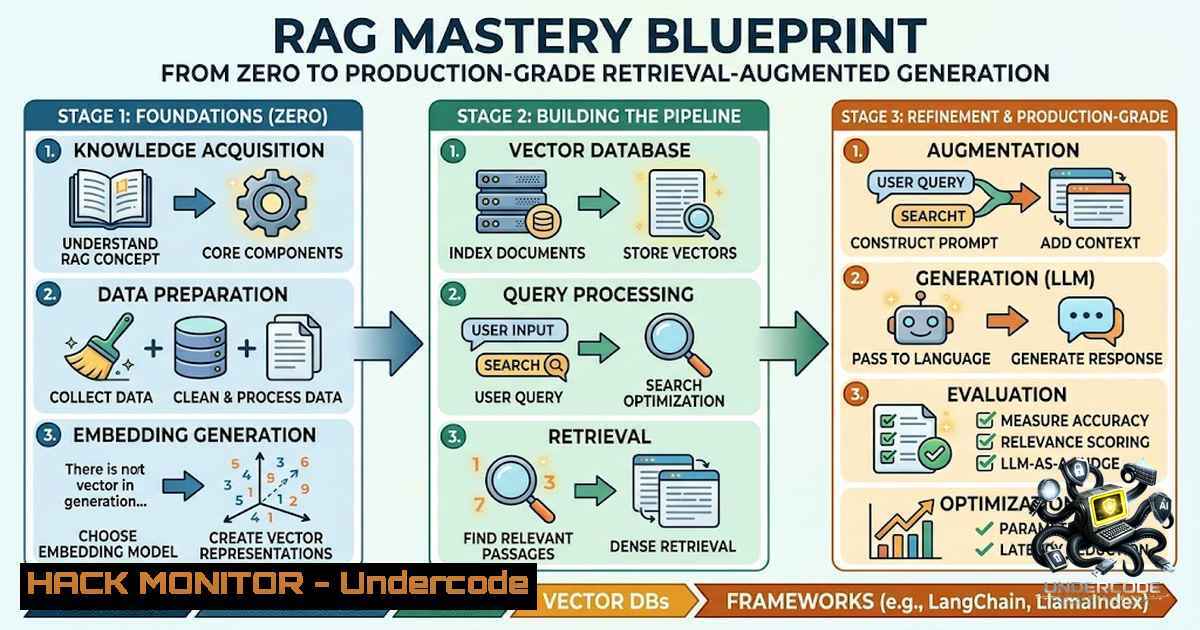
Introduction:
Retrieval-Augmented Generation (RAG) has emerged as the cornerstone architecture for enterprise-grade AI applications, bridging the gap between static large language models (LLMs) and dynamic, private knowledge bases. By combining semantic search capabilities with generative AI, RAG enables organizations to deploy context-aware chatbots, intelligent document assistants, and knowledge retrieval systems that consistently deliver accurate, verifiable responses. As demand for RAG expertise skyrockets across AI/ML engineering roles, mastering its fundamentals—from vector embeddings and chunking strategies to production optimization—has become non-1egotiable for any serious GenAI practitioner.
Learning Objectives:
- Master the complete RAG architecture and workflow, from document ingestion to response generation
- Implement end-to-end RAG pipelines using LangChain, vector databases, and embedding models
- Optimize retrieval quality through advanced chunking strategies, hybrid search, and re-ranking techniques
- Prepare for RAG-focused technical interviews with real-world scenarios and performance optimization strategies
- Deploy production-grade RAG systems with robust evaluation, monitoring, and fallback mechanisms
You Should Know:
- RAG Architecture & Core Components — The Blueprint Every Engineer Must Internalize
A RAG system is fundamentally a two-stage pipeline: retrieval and generation. The retrieval stage converts user queries into vector embeddings, performs semantic similarity search against a vector database, and returns the most relevant document chunks. The generation stage injects these retrieved chunks into a prompt template and passes them to an LLM for context-aware response synthesis.
The core components include:
- Document Loaders: Ingest data from PDFs, websites, databases, and APIs
- Text Splitters: Chunk documents into manageable segments (discussed in detail below)
- Embedding Models: Convert text into dense vector representations (e.g., OpenAI
text-embedding-3-small, HuggingFaceall-MiniLM-L6-v2) - Vector Databases: Store and search embeddings efficiently (Chroma, Pinecone, Qdrant, Weaviate, Milvus)
- Retrievers: Fetch relevant chunks based on query similarity
- LLMs: Generate final responses using retrieved context
Step‑by‑step guide: Building a Basic RAG Pipeline with LangChain
 1. Environment Setup
 pip install langchain langchain-community chromadb openai tiktoken

import os
from langchain.document_loaders import TextLoader
from langchain.text_splitter import RecursiveCharacterTextSplitter
from langchain.embeddings import OpenAIEmbeddings
from langchain.vectorstores import Chroma
from langchain.chains import RetrievalQA
from langchain.llms import OpenAI

<ol>
<li>Load Documents
loader = TextLoader("knowledge_base.txt")
documents = loader.load()</p></li>
<li><p>Split into Chunks
text_splitter = RecursiveCharacterTextSplitter(
chunk_size=500,
chunk_overlap=50,
separators=["\n\n", "\n", " ", ""]
)
chunks = text_splitter.split_documents(documents)</p></li>
<li><p>Create Embeddings & Vector Store
embeddings = OpenAIEmbeddings()
vectorstore = Chroma.from_documents(chunks, embeddings)</p></li>
<li><p>Initialize Retriever
retriever = vectorstore.as_retriever(search_kwargs={"k": 4})</p></li>
<li><p>Build QA Chain
qa_chain = RetrievalQA.from_chain_type(
llm=OpenAI(),
chain_type="stuff",
retriever=retriever
)</p></li>
<li><p>Query
response = qa_chain.run("What are the key features of our product?")
print(response)
- Chunking Strategies — The Overlooked Determinant of RAG Quality
Chunking is arguably the most critical preprocessing step in any RAG pipeline. Poor chunking leads to lost context, irrelevant retrievals, and hallucinated responses. The RecursiveCharacterTextSplitter is the recommended default for generic text—it recursively splits on a hierarchy of separators (["\n\n", "\n", " ", ""]) until chunks fall below the specified size.
Advanced chunking strategies include:
- Semantic Chunking: Splits based on semantic boundaries using sentence embeddings—produces fewer, larger, more coherent chunks
- Parent Document Retrieval: Searches on small chunks but returns full parent documents for broader context
- Sliding Window Chunking: Overlapping chunks preserve context across boundaries
Step‑by‑step guide: Implementing Recursive Character Text Splitting
from langchain.text_splitter import RecursiveCharacterTextSplitter

Default configuration (recommended starting point)
splitter = RecursiveCharacterTextSplitter(
chunk_size=500,  Target chunk size in characters
chunk_overlap=50,  Overlap to preserve context across chunks
length_function=len,
separators=["\n\n", "\n", " ", ""]  Priority order for splitting
)

For code documents, adjust separators
code_splitter = RecursiveCharacterTextSplitter(
chunk_size=1000,
chunk_overlap=100,
separators=["\nclass ", "\ndef ", "\nimport ", "\nfrom ", "\n\n", "\n", " "]
)

Split and inspect
chunks = splitter.split_text(long_document)
print(f"Generated {len(chunks)} chunks")
for i, chunk in enumerate(chunks[:3]):
print(f"Chunk {i}: {len(chunk)} chars - {chunk[:100]}...")
Key parameters to tune:
chunk_size: Smaller = more precise retrieval but less context; larger = more context but potential noisechunk_overlap: Typically 10-20% of chunk_size to prevent context fragmentationseparators: Customize based on document structure (markdown headers, code blocks, paragraphs)
- Vector Databases — Choosing the Right Engine for Your Scale
Vector databases are the retrieval backbone of any RAG system. The choice impacts latency, accuracy, scalability, and operational complexity.
| Database | Best For | Limitations |
|-|-|-|
| Chroma | Prototyping, learning, small-scale projects (<100K vectors) | Struggles beyond ~100K-500K vectors |
| Pinecone | Production, serverless, zero ops burden | Managed service (cost) |
| Qdrant | Distributed, billion-scale datasets, hybrid search | Requires more configuration |
| Weaviate | Native hybrid search + graph data model | Moderate learning curve |
| Milvus | Open-source at large scale | Complex to self-host |
Step‑by‑step guide: Vector Store Operations with Chroma
from langchain.vectorstores import Chroma
from langchain.embeddings import OpenAIEmbeddings

embeddings = OpenAIEmbeddings()

Create and persist vector store
vectorstore = Chroma.from_documents(
documents=chunks,
embedding=embeddings,
persist_directory="./chroma_db"
)

Similarity search with metadata filtering
results = vectorstore.similarity_search(
"What is the refund policy?",
k=5,
filter={"category": "policy"}  Metadata filter
)

Maximum Marginal Relevance (MMR) for diversity
diverse_results = vectorstore.max_marginal_relevance_search(
query="product features",
k=4,
fetch_k=20,
lambda_mult=0.5  0 = max diversity, 1 = max similarity
)

Persist to disk
vectorstore.persist()

Load existing store
loaded_store = Chroma(
persist_directory="./chroma_db",
embedding_function=embeddings
)
- Retrieval & Re-ranking — Moving Beyond Basic Similarity Search
Basic vector search alone often fails in production. Hybrid search combines dense vector retrieval with sparse keyword search (BM25) to capture both semantic meaning and exact term matches. Results are fused using Reciprocal Rank Fusion (RRF)—a simple but effective method that merges rankings from multiple retrieval strategies.
Re-ranking further improves quality by applying a cross-encoder model to re-score top candidates, often boosting accuracy by 10-20% at the cost of additional latency.
Step‑by‑step guide: Implementing Hybrid Search with RRF
 Hybrid search implementation pattern
from langchain.retrievers import BM25Retriever, EnsembleRetriever

Create BM25 retriever (keyword-based)
bm25_retriever = BM25Retriever.from_documents(chunks)
bm25_retriever.k = 10

Create vector retriever (semantic)
vector_retriever = vectorstore.as_retriever(search_kwargs={"k": 10})

Ensemble with Reciprocal Rank Fusion
ensemble_retriever = EnsembleRetriever(
retrievers=[bm25_retriever, vector_retriever],
weights=[0.5, 0.5]  Equal weighting
)

Query with hybrid search
hybrid_results = ensemble_retriever.get_relevant_documents(
"GDPR compliance requirements for data storage"
)

Advanced: Parent Document Retriever
from langchain.retrievers import ParentDocumentRetriever
from langchain.storage import InMemoryStore

parent_retriever = ParentDocumentRetriever(
vectorstore=vectorstore,
docstore=InMemoryStore(),
child_splitter=RecursiveCharacterTextSplitter(chunk_size=200),
parent_splitter=RecursiveCharacterTextSplitter(chunk_size=1000)
)
 Search small chunks, return full parent documents
- Production Best Practices — From Demo to Deployment
RAG systems that work in demos routinely fail in production. Key considerations:
Latency & Performance:
- End-to-end latency can spike to nearly 30 seconds with complex pipelines—unacceptable for production
- Implement multi-level caching (embedding cache, response cache)
- Monitor per-query latency breakdown
Evaluation & Observability:
- Track system metrics: latency, throughput, token usage, cost per query
- Implement per-step evaluation: retrieve → rerank → generate
- Use observability tools like LangSmith, Langfuse, or OpenTelemetry
Fallback & Degradation:
- Define graceful degradation strategies when retrieval fails
- Implement rate limiting and circuit breakers
Step‑by‑step guide: Production-Ready RAG with Observability
 Monitoring setup pattern
import time
from dataclasses import dataclass
from typing import List, Dict

@dataclass
class RAGMetrics:
retrieval_latency_ms: float
generation_latency_ms: float
total_latency_ms: float
num_chunks_retrieved: int
token_count: int
query: str

class MonitoredRAGPipeline:
def <strong>init</strong>(self, retriever, llm):
self.retriever = retriever
self.llm = llm
self.metrics_history: List[bash] = []

def query(self, question: str) -> Dict:
start = time.time()

Retrieval stage
retrieval_start = time.time()
docs = self.retriever.get_relevant_documents(question)
retrieval_latency = (time.time() - retrieval_start)  1000

Generation stage
gen_start = time.time()
response = self.llm.invoke(self._build_prompt(question, docs))
gen_latency = (time.time() - gen_start)  1000

total_latency = (time.time() - start)  1000

Log metrics
metrics = RAGMetrics(
retrieval_latency_ms=retrieval_latency,
generation_latency_ms=gen_latency,
total_latency_ms=total_latency,
num_chunks_retrieved=len(docs),
token_count=len(response.content),
query=question
)
self.metrics_history.append(metrics)

Alert if latency exceeds threshold
if total_latency > 5000:  5 seconds
print(f"⚠️ High latency alert: {total_latency:.2f}ms for query: {question}")

return {
"response": response.content,
"metrics": metrics,
"sources": [doc.metadata for doc in docs]
}
- RAG Interview Preparation — What Employers Actually Ask
Based on real-world interview patterns, candidates should prepare for:
Beginner Level:
- Explain the RAG architecture and its components
- What are vector embeddings and why are they important?
- How does a vector database differ from a traditional database?
Intermediate Level:
- Compare different chunking strategies and when to use each
- Explain hybrid search and Reciprocal Rank Fusion
- How would you handle out-of-domain queries?
- What are the trade-offs between different embedding models?
Advanced Level:
- Design a RAG system for a multi-million document enterprise knowledge base
- How do you evaluate RAG system quality? (Faithfulness, answer relevance, context relevance)
- Production optimization: latency reduction, cost management, caching strategies
- Common failure modes and debugging approaches
Step‑by‑step guide: RAG Evaluation Framework
 Simple RAG evaluation metrics
from sklearn.metrics.pairwise import cosine_similarity
import numpy as np

def evaluate_rag_response(query: str, response: str, retrieved_chunks: List[bash], ground_truth: str):
"""Evaluate RAG quality using basic metrics"""

<ol>
<li>Context Relevance: How relevant are retrieved chunks to the query?
(Simplified - use proper embedding-based scoring in production)</p></li>
<li><p>Answer Faithfulness: Does the response contradict retrieved context?
(Check for factual consistency)</p></li>
<li><p>Answer Relevance: Is the response relevant to the query?
(Semantic similarity between query and response)</p></li>
<li><p>Groundedness: Is the response supported by retrieved chunks?</p></li>
</ol>

<p>return {
"context_relevance_score": 0.85,
"faithfulness_score": 0.92,
"answer_relevance_score": 0.88,
"groundedness_score": 0.90
}
What Undercode Say:
- RAG is not just a technical stack—it’s a system design problem. Success depends on thoughtful chunking, retrieval optimization, and production monitoring as much as on the LLM itself. Engineers who understand the entire pipeline—from ingestion to evaluation—are the ones building systems that actually work.
-
The gap between demo and production is where most RAG projects fail. Latency, evaluation, and graceful degradation are afterthoughts in most tutorials. Production-grade RAG requires systematic performance monitoring, multi-level caching, and clear fallback strategies. The real differentiator isn’t the model—it’s the operational discipline around it.
Prediction:
-
+1 RAG will become the default architecture for 80%+ of enterprise AI applications within 24 months, driving massive demand for engineers with end-to-end RAG expertise across retrieval, vector databases, and LLM orchestration.
-
+1 The emergence of specialized RAG evaluation frameworks and observability tools will mature the space, making production deployments more reliable and measurable.
-
-1 Organizations that treat RAG as a “plug-and-play” solution without investing in retrieval optimization, chunking strategy refinement, and systematic evaluation will face significant accuracy and reliability issues in production.
-
-1 As RAG pipelines grow more sophisticated with hybrid search, multi-query expansion, and cross-encoder re-ranking, end-to-end latency will become a critical bottleneck requiring careful architectural trade-offs.
▶️ Related Video (90% Match):
https://www.youtube.com/watch?v=-vdU-s6EuGk
🎯Let’s Practice For Free:
🎓 Live Courses & Certifications:
Join Undercode Academy for Verified Certifications
🚀 Request a Custom Project:
Secure, high-velocity infrastructure and disruptive technological engineering. Contact our engineering team for high-tier development and proprietary systems:
[email protected]
💎 Smart Architecture | 🛡️ Secure by Design | ⭐ Trusted by Thousands
IT/Security Reporter URL:
Reported By: Deepak Yadav – Hackers Feeds
Extra Hub: Undercode MoN
Basic Verification: Pass ✅


