Listen to this Post
Introduction:
Retrieval-Augmented Generation (RAG) has emerged as the cornerstone architecture for grounding Large Language Models in external, verifiable knowledge—transforming generic chatbots into domain-specific reasoning engines. By retrieving relevant document chunks at query time and injecting them into the LLM’s context window, RAG effectively eliminates hallucinations and unlocks private data for AI-powered applications. As the AI landscape evolves beyond simple prompt engineering, mastering the end-to-end RAG pipeline—from chunking strategies and embedding models to vector databases and advanced RAG variants like Graph RAG and Agentic RAG—has become an essential competency for AI/ML engineers and data scientists preparing for roles in Generative AI and LLM development.
Learning Objectives:
- Understand the complete end-to-end RAG pipeline architecture and its core components.
- Master chunking techniques, embedding models, and vector database selection for optimal retrieval performance.
- Implement advanced RAG patterns including Hybrid RAG, Graph RAG, Agentic RAG, Self-RAG, and CRAG.
- Learn evaluation methodologies using RAGAS and other frameworks to diagnose retrieval vs. generation failures.
- Acquire hands-on skills with LangChain, LlamaIndex, ChromaDB, and production-grade RAG deployment.
You Should Know:
1. The End-to-End RAG Pipeline: A Step-by-Step Implementation
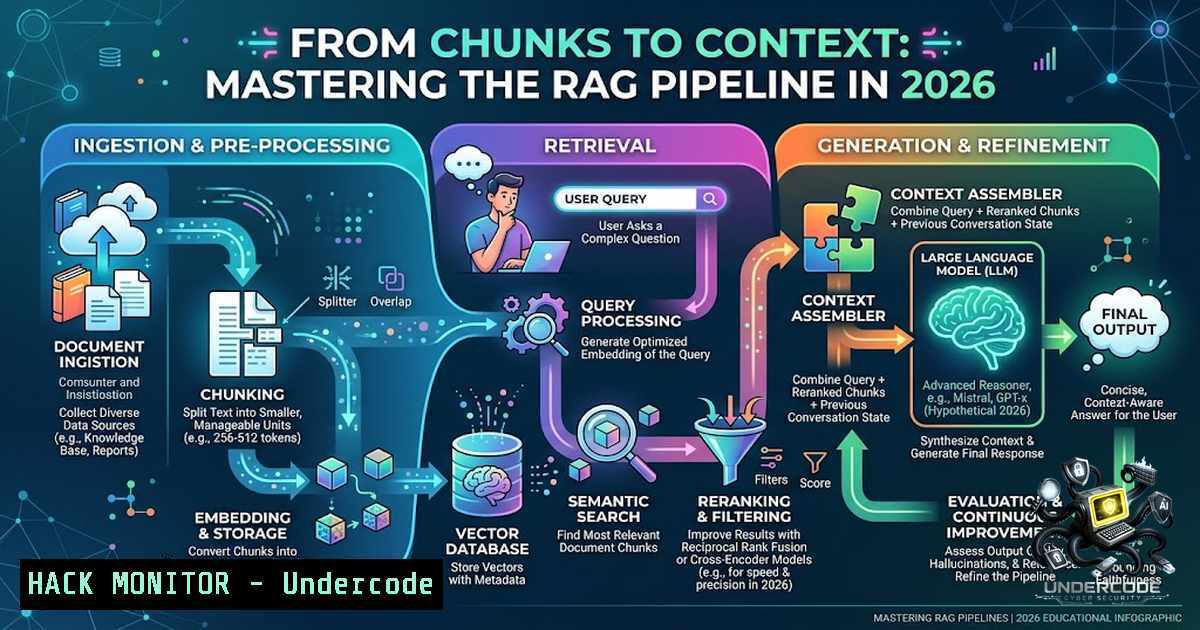
The RAG pipeline transforms raw documents into context-aware LLM responses through a systematic workflow. At its core, RAG grounds an LLM’s answer in your own documents by embedding a corpus of text into vectors, storing those vectors, retrieving the closest matches to a user’s query, and passing the retrieved text into a chat completion as context.
Step-by-step guide to building a RAG pipeline from scratch:
Step 1: Document Ingestion and Chunking
- Load documents from various sources (PDFs, Markdown, JSON, web pages).
- Split documents into manageable chunks. Recursive 512-token splitting with overlap is common, but semantic chunking may be better for prose.
- Example using LangChain’s RecursiveCharacterTextSplitter:
from langchain.text_splitter import RecursiveCharacterTextSplitter
text_splitter = RecursiveCharacterTextSplitter(
chunk_size=512,
chunk_overlap=50,
length_function=len,
)
chunks = text_splitter.split_documents(documents)
Step 2: Generate Embeddings
- Convert each text chunk into a vector embedding using an embedding model (e.g., OpenAI’s text-embedding-ada-002, or open-source models like intfloat/multilingual-e5-large-instruct).
- Embeddings capture the semantic meaning of text in a high-dimensional space.
Step 3: Index in a Vector Database
- Store embeddings in a vector database such as ChromaDB (lightweight, in-memory), Pinecone (production-grade), or Weaviate (hybrid search).
- ChromaDB runs in memory locally with no extra account required.
- Example with ChromaDB:
from langchain.vectorstores import Chroma
vectorstore = Chroma.from_documents(
documents=chunks,
embedding=embeddings,
persist_directory="./chroma_db"
)
Step 4: Query Processing and Retrieval
- Convert the user’s query into an embedding using the same model.
- Perform similarity search (cosine similarity) to find the top-k most relevant chunks.
- Implement hybrid search combining dense retrieval with BM25 sparse search for better recall.
Step 5: Context Augmentation and Generation
- Inject retrieved chunks into the LLM’s context window with a carefully crafted system prompt.
- The system prompt should instruct the LLM to answer using only the provided context.
- Generate the final response using an LLM (OpenAI, Anthropic, Mistral, or local models via Ollama).
Step 6: Evaluation
- Measure retrieval quality (context precision, context recall) and generation quality (faithfulness, answer relevancy) using frameworks like RAGAS.
2. Chunking Strategies: The Foundation of Retrieval Quality
Chunking is arguably the most critical yet underappreciated decision in RAG pipeline design. The chunking strategy determines what units of information are retrievable—and once the chunk boundary is baked into the index at ingest time, every downstream lever is constrained by what ingestion produced.
Step-by-step guide to selecting the right chunking strategy:
Fixed-size chunking (e.g., 512 tokens with 50-token overlap): Works well for uniform short-paragraph blog corpora, FAQs, and marketing copy. However, it fails on legal and medical documents because it cuts clauses and clinical sections.
Semantic chunking: Splits at topic boundaries using sentence embeddings. Wins on long-form prose, research papers, transcripts, and books where topic boundaries beat markup.
Clause/section-level chunking: Essential for contracts, regulations, clinical notes, and SOPs where the legal or procedural unit is the chunk.
Late-interaction (ColBERT): Uses token-level scoring that preserves identifiers. Ideal for code, code with comments, mixed languages, and multilingual corpora.
Domain Decision Matrix:
| Domain | Winning Strategy |
|–||
| Contracts, regulations, SOPs | Clause / section-level |
| Research papers, long prose | Semantic |
| Marketing copy, FAQs | Fixed-512 with overlap |
| Code, mixed languages | Late-interaction (ColBERT) |
| Multilingual | Late-interaction (Jina-ColBERT-v2) |
Linux/Windows command for document preprocessing:
 Linux - Extract text from PDFs for RAG ingestion
pip install pypdf2
python -c "import PyPDF2; pdf = PyPDF2.PdfReader('document.pdf'); print(''.join([page.extract_text() for page in pdf.pages]))" > extracted.txt

Windows (PowerShell) - Batch process Markdown files
Get-ChildItem -Path .\docs\ -Filter .md | ForEach-Object { Get-Content $_.FullName -Raw } | Out-File -FilePath .\all_docs.txt
- Vector Databases and Embedding Models: The Retrieval Engine
Choosing the right vector database and embedding model directly impacts retrieval accuracy, latency, and scalability.
Step-by-step guide to vector database selection:
ChromaDB: Lightweight, in-memory, ideal for prototyping and local development. No API keys required.
Pinecone: Production-grade, fully managed, supports massive-scale vector search with low latency.
Weaviate: Supports hybrid search combining vector and keyword search with built-in GraphQL API.
pgvector: PostgreSQL extension, ideal for teams already using Postgres who want vector capabilities without adding new infrastructure.
FAISS: Facebook’s library for efficient similarity search, useful for custom implementations.
Embedding Model Considerations:
- OpenAI
text-embedding-ada-002: High quality, paid API. intfloat/multilingual-e5-large-instruct: Open-source, multilingual support.- Sentence Transformers: Open-source, can run locally.
Code example for vector similarity search from scratch (no framework):
import math
from together import Together

client = Together()
EMBEDDING_MODEL = "intfloat/multilingual-e5-large-instruct"
CHAT_MODEL = "MiniMaxAI/MiniMax-M3"

def cosine(a, b):
dot = sum(x  y for x, y in zip(a, b))
na = math.sqrt(sum(x  x for x in a))
nb = math.sqrt(sum(x  x for x in b))
return dot / (na  nb) if na and nb else 0.0

Embed corpus and store
doc_embeddings = client.embeddings.create(model=EMBEDDING_MODEL, input=corpus).data
index = list(zip(corpus, [d.embedding for d in doc_embeddings]))

def rag(query: str, top_k: int = 3) -> str:
q_emb = client.embeddings.create(model=EMBEDDING_MODEL, input=query).data[bash].embedding
ranked = sorted(index, key=lambda d: cosine(q_emb, d[bash]), reverse=True)
context = "\n\n".join(text for text, _ in ranked[:top_k])
response = client.chat.completions.create(
model=CHAT_MODEL,
messages=[{"role": "system", "content": f"Answer using only the context below.\n\nContext:\n{context}"},
{"role": "user", "content": query}]
)
return response.choices[bash].message.content
- Prompt Engineering for RAG: Crafting the System Prompt
The system prompt is the critical interface between retrieved context and the LLM’s generation. Poor prompting can nullify even perfect retrieval.
Step-by-step guide to RAG prompt engineering:
Essential System Prompt Components:
- Role definition: “You are a helpful assistant that answers questions based strictly on the provided context.”
- Context integration: “Use ONLY the following context to answer the question.”
- Fallback handling: “If the context does not contain the answer, respond with ‘I don’t have enough information to answer this question.'”
- Citation encouragement: “Cite specific parts of the context that support your answer.”
- Conciseness: “Keep answers concise and directly relevant to the question.”
Example system prompt template:
You are a precise AI assistant. Answer the user's question using ONLY the context provided below.
If the answer cannot be found in the context, say "I cannot answer this based on the provided information."
Do not use external knowledge. Cite relevant portions of the context when appropriate.

Context:
{retrieved_chunks}

Question: {user_query}

Answer:
Key insight: The LLM should be instructed to “tell the user that you don’t know if the answer is not in the context” to prevent hallucination.
5. Advanced RAG Variants: Beyond Naive RAG
In 2026, “naive RAG” is just the starting line. The real work is choosing the right architecture for the failure mode you’re actually seeing.
Step-by-step guide to RAG variants:
Hybrid RAG: Combines dense vector retrieval with sparse keyword (BM25) search, then reranks results. Improves recall for queries with specific terminology.
Corrective RAG (CRAG): Adds a retrieval evaluator that grades retrieved context and triggers corrective actions (web search or query reformulation) when the grade is low. CRAG and Self-RAG represent approaches where “RAG learns to doubt”.
Self-RAG: The model self-reflects on retrieved information, deciding whether to retrieve, generate, or critique its own output.
Graph RAG: Structures knowledge as a graph, best for cross-document, relationship-heavy questions where connections between entities matter.
Agentic RAG: Treats retrieval like research—plan, use tools, iterate, verify, answer. Best for multi-step, complex queries requiring multiple retrieval passes.
Implementation considerations:
- LangChain excels at building complex multi-tool Agent workflows.
- LlamaIndex is optimized for pure RAG knowledge base scenarios with intuitive APIs focused on data retrieval.
- LangGraph enables stateful, multi-step agentic workflows.
6. Evaluation: Diagnosing RAG Failures with RAGAS
RAG errors usually hide behind fluent text. A retriever can miss the right policy, fetch stale chunks, or return passages that look plausible but don’t answer the question—yet the generator still writes a confident response.
Step-by-step guide to RAG evaluation:
RAGAS (RAG Assessment) is an open-source framework that provides four core metrics:
- Context Precision: Whether retrieved chunks are relevant to the expected answer.
- Context Recall: Whether the needed evidence was retrieved at all.
- Faithfulness: Whether the generated answer stays supported by the supplied context.
- Answer Relevancy: Whether the response addressed the user’s question instead of drifting.
Installation and usage:
pip install ragas
from ragas import evaluate
from ragas.metrics import faithfulness, answer_relevancy, context_precision, context_recall

result = evaluate(
dataset=your_dataset,
metrics=[faithfulness, answer_relevancy, context_precision, context_recall]
)
print(result)
Diagnostic framework:
- If Context Recall is low → expand or diversify search (hybrid search, multi-query, HyDE).
- If Context Precision is low → improve ranking (reranking, cross-encoders).
- If Faithfulness drops while retrieval scores stay flat → the prompt or model is turning good context into unsupported claims.
- If Answer Relevancy drops → the model may be misinterpreting the user’s intent.
What Undercode Say:
- Key Takeaway 1: RAG is no longer an experimental technique—it’s a production engineering discipline. The difference between a working RAG system and a failing one often comes down to data quality, chunking strategy, and evaluation rigor, not the choice of LLM.
- Key Takeaway 2: The evolution from naive RAG to advanced variants (Graph RAG, Agentic RAG, Self-RAG, CRAG) represents a shift from “retrieve once, generate once” to intelligent, adaptive retrieval strategies that can plan, reflect, and correct themselves.
Analysis: The handwritten notes approach to learning RAG—breaking down the entire pipeline visually—reflects a deeper truth about the complexity of modern AI systems. As one practitioner noted, “writing out system architectures by hand is still one of the best ways to internalize how data moves through a pipeline”. The RAG ecosystem in 2026 is characterized by a proliferation of frameworks (LangChain, LlamaIndex, Haystack), vector databases (Chroma, Pinecone, Weaviate, pgvector), and evaluation tools (RAGAS). However, the fundamental challenge remains consistent: grounding LLM outputs in verifiable, domain-specific knowledge. The real differentiator is no longer prompting models—it’s engineering AI systems that are reliable, governable, and deliver measurable business outcomes. Practitioners who master the entire pipeline—from ingestion and chunking to retrieval, generation, and evaluation—will be uniquely positioned to build production-grade AI applications that actually work.
Prediction:
- +1 RAG will become the de facto standard architecture for enterprise AI deployments by 2027, with every major cloud provider offering managed RAG services that abstract away infrastructure complexity.
- +1 Agentic RAG patterns (where LLMs plan and execute multi-step retrieval strategies) will replace simple single-pass retrieval for complex knowledge work, enabling AI systems that can research and synthesize information like junior analysts.
- -1 The fragmentation in the RAG ecosystem—competing frameworks, vector databases, and evaluation standards—will create significant technical debt for early adopters, with many organizations needing to rebuild their RAG pipelines within 12-18 months.
- -1 Organizations that neglect proper chunking strategies and evaluation will continue to suffer from “hallucination leakage”—confident-sounding wrong answers that erode user trust and create compliance risks.
- +1 The rise of Graph RAG will enable a new class of applications that leverage relationship-aware retrieval, making AI systems capable of answering complex, multi-hop questions that require connecting disparate pieces of information across document boundaries.
- +1 Open-source embedding models and local LLM deployment (via Ollama, vLLM) will increasingly challenge proprietary APIs, making RAG more accessible and cost-effective for privacy-sensitive enterprise applications.
- -1 The skill gap in RAG engineering will widen, with demand for practitioners who understand retrieval mechanics, evaluation, and production deployment far outstripping supply—creating a premium for specialized expertise.
- +1 RAG evaluation frameworks like RAGAS will evolve from offline assessment tools to production-grade release gates, enabling continuous monitoring and automated rollback of RAG pipelines based on quality metrics.
- -1 The complexity of advanced RAG variants (CRAG, Self-RAG, Agentic RAG) will lead to a “complexity tax” where simpler, well-tuned naive RAG systems outperform over-engineered solutions for 80% of use cases.
- +1 The convergence of RAG with traditional information retrieval (BM25, hybrid search, reranking) will create a new discipline of “AI-powered search” that combines the best of classical and neural approaches, fundamentally transforming how enterprises access their knowledge bases.
▶️ Related Video (88% Match):
🎯Let’s Practice For Free:
🎓 Live Courses & Certifications:
Join Undercode Academy for Verified Certifications
🚀 Request a Custom Project:
Secure, high-velocity infrastructure and disruptive technological engineering. Contact our engineering team for high-tier development and proprietary systems:
[email protected]
💎 Smart Architecture | 🛡️ Secure by Design | ⭐ Trusted by Thousands
IT/Security Reporter URL:
Reported By: Kmtfarhan Artificialintelligence – Hackers Feeds
Extra Hub: Undercode MoN
Basic Verification: Pass ✅


