Listen to this Post
Introduction:
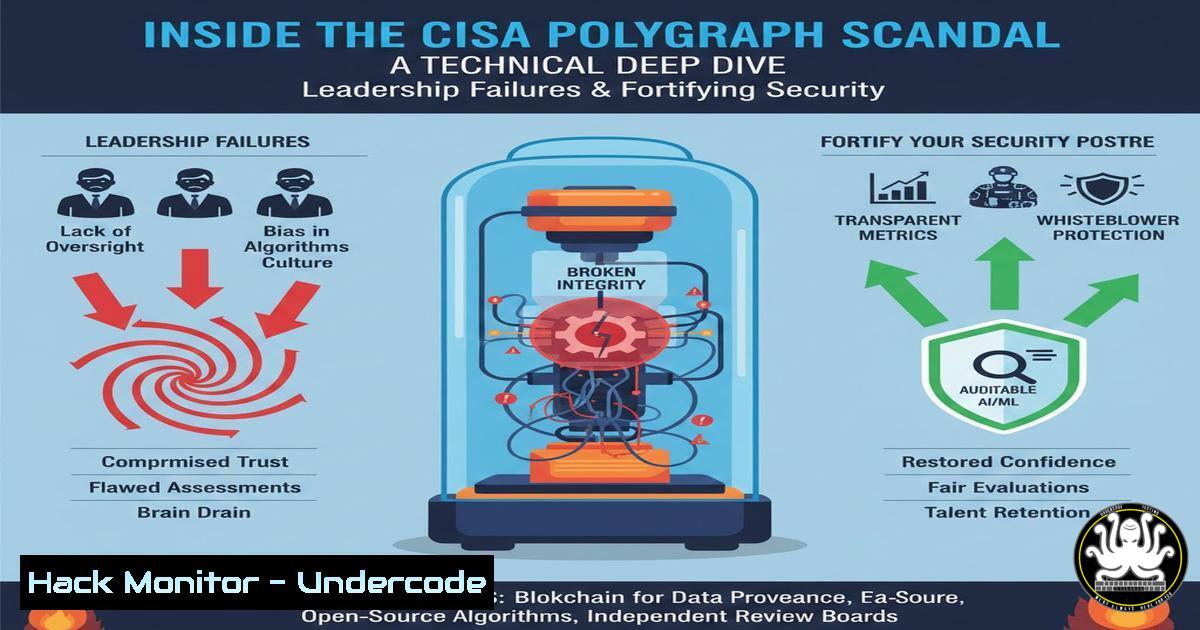
A failed polygraph test by the acting director of the Cybersecurity and Infrastructure Security Agency (CISA) has triggered an internal investigation and the suspension of six career staffers, exposing deep turmoil within America’s top civilian cyber defense agency. This incident highlights critical failures in leadership, judgment, and adherence to security protocols at the highest levels, raising alarming questions about the agency’s stability as it faces relentless cyber threats. The controversy underscores the fundamental importance of trust, accountability, and strict access control—principles that are equally vital for securing any enterprise network.
Learning Objectives:
- Understand the security and leadership failures revealed by the CISA polygraph incident and their implications for organizational trust.
- Learn to implement technical controls for enforcing the principle of least privilege and robust access management.
- Develop strategies to mitigate insider threats and ensure compliance with rigorous security frameworks.
- The Breach in Protocol: Understanding “Need-to-Know” and Access Control
The core of the CISA incident revolves around the acting director’s insistence on accessing a Controlled Access Program (CAP), a highly sensitive intelligence stream with tightly restricted circulation. Senior staff reportedly questioned the necessity, noting the previous deputy director did not have access and that less-classified versions of the intelligence were available. This directly violates the “need-to-know” principle, a cornerstone of information security that limits access to data strictly to what is necessary for an individual to perform their duties.
Step-by-Step Guide to Enforcing Least Privilege:
A technical implementation of “need-to-know” is the principle of least privilege (PoLP). Enforce it using the following commands and configurations:
On Linux Systems: Use `sudo` and user groups to granularly control privileges. Never grant unrestricted `sudo` access.
 Create a specific group for analysts needing access to a log directory
sudo groupadd log_analysts
 Give the group read-only access to the sensitive directory
sudo setfacl -R -m g:log_analysts:r /var/log/sensitive_app/
 Add a user to the group, granting them only the required access
sudo usermod -a -G log_analysts username
 To allow a specific, infrequent privileged command, configure sudoers carefully
 Run `sudo visudo` and add a line like:
 username ALL=(ALL) /usr/bin/systemctl restart application_service
On Windows Systems: Utilize Active Directory Groups and Local Security Policy.
1. Create Security Groups in Active Directory (e.g., Sensitive_Data_Readers).
2. On the file server, right-click the sensitive folder > Properties > Security > Advanced.
3. Remove inherited permissions and add only the required AD group with explicit permissions (e.g., Read & execute).
4. Use the Group Policy Editor (gpedit.msc) to deploy user rights assignments and restrict local logon rights.
Cloud Infrastructure (AWS IAM Example): Apply the PoLP with precise IAM policies.
{
"Version": "2012-10-17",
"Statement": [
{
"Effect": "Allow",
"Action": [
"s3:GetObject",
"s3:ListBucket"
],
"Resource": [
"arn:aws:s3:::secure-bucket-name",
"arn:aws:s3:::secure-bucket-name/"
],
"Condition": {
"IpAddress": {
"aws:SourceIp": "10.0.1.0/24"
}
}
}
]
}
This policy allows a user to only read objects from one specific S3 bucket, and only when connecting from the corporate office IP range.
- The Polygraph Problem: Technical Reliability vs. Security Theater
The acting director, Madhu Gottumukkala, failed the counter-intelligence polygraph required for accessing the CAP. While DHS claims the test was “unsanctioned,” officials note that principals typically approve their own polygraph requests. Polygraphs measure physiological stress, not deception, and results are inadmissible in most courts due to reliability issues. This makes them a potentially flawed gatekeeper for sensitive systems.
Step-by-Step Guide to Implementing Stronger, Technical Authentication:
Instead of relying on subjective measures, enforce access with multi-factor authentication (MFA) and context-aware logging.
Enforce MFA on All Critical Systems:
Linux (SSH): Use Google Authenticator PAM modules.
 Install the PAM module
sudo apt-get install libpam-google-authenticator
 Edit the PAM configuration for SSH
sudo nano /etc/pam.d/sshd
 Add the line: auth required pam_google_authenticator.so
 Edit SSH daemon config to enable challenge-response
sudo nano /etc/ssh/sshd_config
 Set: ChallengeResponseAuthentication yes
Windows / Enterprise: Integrate conditional access policies via Microsoft Entra ID (Azure AD). Require MFA and compliant devices for accessing sensitive applications.
Implement Session Recording for High-Privilege Access:
For root, Administrator, or privileged service account access, tools like `auditd` (Linux) or Third-Party Privileged Access Management (PAM) solutions can record all activity.
 Configure auditd to watch a specific user's command history
sudo nano /etc/audit/rules.d/audit.rules
 Add: -a always,exit -F arch=b64 -F euid=0 -S execve -k ROOT_CMDS
 Monitor the logs with: sudo ausearch -k ROOT_CMDS | aureport -f -i
- The Insider Threat and Blame-Shifting: A Case Study in Toxic Culture
Following the failed test, at least six career staffers were placed on paid administrative leave, accused of misleading leadership. An internal official described the acting director’s tenure as “a nightmare,” stating, “Instead of taking ownership… he gets other people blamed”. This retaliation against staffers enforcing security protocols creates a toxic culture that discourages adherence to strict rules and amplifies insider threat risks.
Step-by-Step Guide to Mitigating Insider Threats with Technical Controls:
Deploy User and Entity Behavior Analytics (UEBA): Use tools like Splunk UBA, Microsoft Defender for Identity, or open-source Elastic Stack to baseline normal behavior.
Alert on anomalies: Access at unusual hours, massive data downloads, access to unrelated systems (lateral movement).
Implement Robust Data Loss Prevention (DLP):
On Endpoints: Use tools like Microsoft Purview DLP to classify sensitive data and block unauthorized transfers via USB, email, or cloud uploads.
On Network Perimeters: Use Snort or Suricata IDS/IPS with custom rules to detect exfiltration.
 Example Suricata rule to alert on large HTTP POST uploads (potential data exfil)
alert http $HOME_NET any -> $EXTERNAL_NET any (msg:"LARGE POST Potential Data Exfil"; flow:established,to_server; http.method; content:"POST"; http.header; content:"Content-Length"; pcre:"/Content-Length:\s(9\d{5,}|[1-9]\d{6,})/i"; classtype:policy-violation; sid:1000001;)
Establish a Non-Punitive Incident Reporting Culture: Integrate anonymous reporting channels and ensure security tools are configured for detection, not solely for punitive measures.
- Compliance Under Scrutiny: When Leadership Undermines Security Frameworks
The incident occurs as CISA has faced sweeping cuts, losing nearly a third of its staff. Concurrently, the Department of Justice is aggressively pursuing the Civil Cyber-Fraud Initiative, holding contractors accountable for failing to meet cybersecurity standards like NIST SP 800-171 and the Cybersecurity Maturity Model Certification (CMMC). This creates a stark contrast: career staff are punished for following procedures, while leadership’s actions undermine the very security frameworks the government mandates.
Step-by-Step Guide to Automated Compliance Scanning:
Scan for NIST 800-171 Compliance: Use the open-source DISA SCAP Compliance Checker (SCC) or commercial tools.
 On a Linux system, you can use OpenSCAP for baseline scanning
sudo apt-get install openscap-scanner scap-security-guide
 Evaluate against a NIST-based profile
sudo oscap xccdf eval --profile xccdf_org.ssgproject.content_profile_cis_server_l1 --results scan-report.xml --report scan-report.html /usr/share/xml/scap/ssg/content/ssg-rhel8-ds.xml
Implement Continuous Compliance with Infrastructure as Code:
For AWS: Use AWS Config with managed rules like iam-password-policy, restricted-ssh, and cloud-trail-enabled.
For Azure: Use Azure Policy to enforce definitions like “Audit Windows VMs that do not have a specified Windows PowerShell execution policy.”
Document Everything: Use a SIEM (Security Information and Event Management) system to aggregate logs from all systems, providing an immutable audit trail for who accessed what, when, and from where—a crucial requirement for frameworks like CMMC.
5. Third-Party Risk and Supply Chain Vulnerabilities
The integrity of a security agency is paramount, but recent breaches highlight that risk often enters through third parties. The CISA incident itself involves a “third-party”—another spy agency providing the CAP. Simultaneously, major 2025 breaches, like those at Qantas and SimonMed Imaging, originated in vendor software. This parallels the risk of a compromised leadership chain introducing vulnerability at the very top.
Step-by-Step Guide to Hardening Your Supply Chain:
Software Composition Analysis (SCA): Integrate tools like OWASP Dependency-Check, Snyk, or GitHub Dependabot into your CI/CD pipeline to find vulnerable open-source libraries.
 Run a basic OWASP Dependency-Check scan
dependency-check.sh --project "MyApp" --scan ./path/to/your/code --out ./report
Vendor Risk Assessment Questionnaire (VRAQ): Automate the collection and scoring of vendor security posture. Require evidence like SOC 2 Type II reports.
Network Segmentation for Vendors: Do not grant vendors full network access. Use jump hosts and zero-trust network access (ZTNA) solutions.
 Example iptables rule restricting vendor IP to one specific application port
sudo iptables -A INPUT -p tcp --dport 443 -s [bash] -j ACCEPT
sudo iptables -A INPUT -p tcp --dport 443 -j DROP
- Building a Resilient Security Culture from the Ground Up
A resilient security culture requires clear communication from leadership that security protocols apply to everyone. The reported comments from CISA officials describe a culture of fear and blame, which is catastrophic for a security organization. Building the opposite requires deliberate technical and social engineering.
Step-by-Step Guide to Fostering a Positive Security Culture:
Implement Gamified Security Training: Use platforms that offer simulated phishing campaigns, with positive rewards for reporting phishing attempts rather than punishment for failing.
Enable Easy, Secure Alternatives: If security is seen as a hindrance, people will bypass it. Deploy user-friendly password managers and single sign-on (SSO) to make secure practices easier than insecure ones.
Leadership Visibility in Security Practices: Management should openly participate in training and discuss security priorities. Metrics should be shared transparently (e.g., “Our MFA adoption is at 95%, let’s get to 99%”).
What Undercode Say:
Security Protocols Are Meaningless Without Leadership Buy-In: The most sophisticated technical controls can be undone by a leader who insists on bypassing them, as allegedly seen in the push for unnecessary access. A culture of accountability must start at the top.
The Blame Game is a Critical Vulnerability: Retaliating against employees for enforcing security protocols is a definitive red flag. It incentivizes cutting corners, silences dissent, and creates a toxic environment where the largest insider threats can flourish unchecked.
The CISA polygraph scandal is not merely a political story; it is a masterclass in how to dismantle an organization’s security posture from within. The technical failures—disregarding need-to-know, questionable authentication methods—are severe, but they are symptoms of the deeper disease: a failure of leadership and culture. For technical professionals, the lesson is clear. We must build systems that enforce policy objectively, log actions immutably, and are resilient to both external attacks and internal pressure. The future of organizational security depends not just on the code we write, but on the culture we build and the leaders we hold accountable to the same stringent standards they mandate for others.
Prediction:
This incident will have a chilling effect on cybersecurity professionals within government agencies, potentially accelerating the “brain drain” as experienced staff leave. The resulting loss of institutional knowledge will degrade the government’s operational cybersecurity capability. In the short term, expect increased scrutiny from Congress and a possible tightening of oversight on security waivers for political appointees. Long-term, if not addressed, this erosion of trust and expertise will create tangible vulnerabilities in federal networks and critical infrastructure, making them more susceptible to sophisticated attacks from nation-state actors who are undoubtedly observing this weakness. The demand for robust, technically-enforced security controls that reduce reliance on subjective human judgment will become even more urgent.
▶️ Related Video (70% Match):
🎯Let’s Practice For Free:
IT/Security Reporter URL:
Reported By: Mrdigitalexhaust Acting – Hackers Feeds
Extra Hub: Undercode MoN
Basic Verification: Pass ✅


