Listen to this Post
Introduction:
In the competitive arena of bug bounty hunting, subtle and often overlooked vulnerabilities like race conditions are quietly yielding consistent payouts. As highlighted by security professionals, these flaws, while frequently rated as low-severity, represent a critical blind spot in modern application logic, spanning from local systems to complex web APIs and cloud infrastructures.
Learning Objectives:
- Understand the fundamental principle of Time-of-Check to Time-of-Use (TOCTOU) race conditions.
- Learn practical methods to identify and exploit race conditions in Linux, Windows, and web applications.
- Implement mitigation strategies and hardening techniques to secure code against concurrent execution attacks.
You Should Know:
1. The Fundamentals of a Race Condition
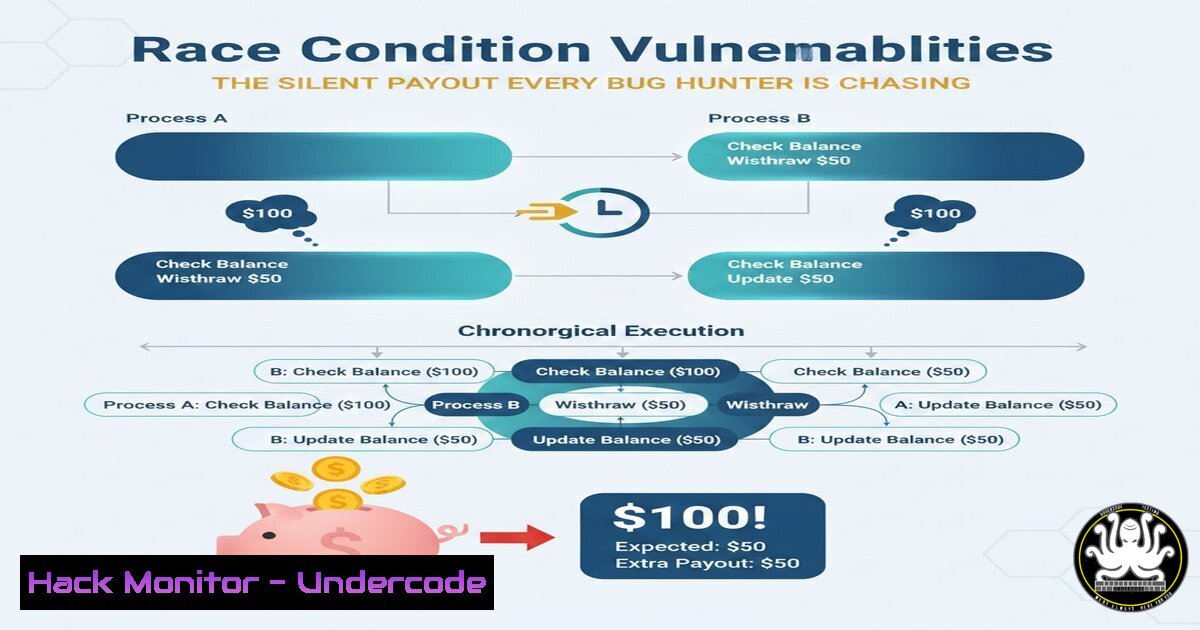
A race condition occurs when a system’s output becomes dependent on the sequence or timing of uncontrollable events, typically when multiple threads or processes access shared data concurrently without proper synchronization. The classic vulnerability pattern is Time-of-Check to Time-of-Use (TOCTOU), where a resource (e.g., a file, balance, or token) is checked for a property and then used, but an attacker can alter it between those two operations.
Step‑by‑step guide explaining what this does and how to use it.
Conceptual Walkthrough: Imagine an application that checks if a user has sufficient funds before processing a withdrawal. The vulnerable sequence is: 1) Check balance (e.g., if balance >= amount). 2) If true, deduct `amount` and disburse cash. An attacker could initiate two simultaneous withdrawal requests. Both checks might see sufficient funds before either deduction completes, allowing two withdrawals to proceed, effectively doubling the available balance.
Key Command for Testing Mindset: On Linux, use `strace` or `ltrace` to monitor the sequence of system/library calls, looking for gaps between check and use operations.
strace -f -e trace=file,open,close,read,write ./vulnerable_program
2. Exploiting Local File Race Conditions in Linux
Local race conditions often involve symbolic links (symlinks) and privileged operations (setuid binaries). The goal is to trick a privileged program into writing to or reading from an attacker-controlled location.
Step‑by‑step guide explaining what this does and how to use it.
1. Identify a target binary with SUID bit set that operates on files.
find / -type f -perm -4000 -user root 2>/dev/null
2. Use `strace` to analyze its file operations. Look for a pattern where it checks a file (e.g., with `access()` or stat()) and later uses it (e.g., with `open()` for writing).
3. Write a custom C program or script that rapidly switches a `symlink` between a legitimate target and a malicious one (e.g., /etc/passwd) in the gap between the check and the use.
// Simplified PoC loop
while true; do
ln -sf /tmp/attacker_file /tmp/target;
ln -sf /etc/passwd /tmp/target;
done
4. Run the vulnerable binary in parallel with this switcher. If successful, the privileged binary may write corrupted data or expose sensitive information.
3. Windows-based Race Condition Exploitation
Windows APIs are equally susceptible. A common scenario involves DLL planting, where an application searches for a DLL in writable directories before system folders.
Step‑by‑step guide explaining what this does and how to use it.
1. Use ProcMon from Sysinternals to monitor an application’s file system activity. Filter for `PATH NOT FOUND` errors on DLLs.
2. Identify a writable directory (like the current working directory or C:\Temp) that is searched before the secure `System32` folder.
3. Write a malicious DLL that performs privilege escalation or executes code.
4. Create a race condition script in PowerShell that rapidly creates the missing DLL file in the writable location at the precise moment the application is searching for it.
while($true) {
Copy-Item malicious.dll C:\Temp\target.dll -Force
Remove-Item C:\Temp\target.dll -Force
}
4. Web Application & API Race Condition Attacks
These are prime targets for bug bounty hunters. Classic examples include coupon code reuse, inventory oversell, limit bypass on OTPs, and profile email takeover.
Step‑by‑step guide explaining what this does and how to use it.
1. Identify an Endpoint: Look for endpoints that perform state-changing actions: wallet transfers, cart checkouts, coupon applications, email updates.
2. Craft Concurrent Requests: Use tools like `Turbo Intruder` (Burp Suite), racepwn, or custom Python scripts with async libraries to send a burst of identical requests.
import asyncio
import aiohttp

async def send_request(session, url):
async with session.post(url, json={"coupon": "FESTIVE50"}) as resp:
print(await resp.text())

async def main():
async with aiohttp.ClientSession() as session:
tasks = [send_request(session, target_url) for _ in range(20)]
await asyncio.gather(tasks)

asyncio.run(main())
3. Analyze Responses: Check if the application processed all requests as valid when it should have only allowed one. Did you get 20 successful discount applications? Did the inventory decrement by only 1 despite 20 purchase requests?
5. Cloud & Serverless Function Race Conditions
Stateless serverless functions accessing the same cloud resource (database, storage) can introduce race conditions if not designed for concurrency.
Step‑by‑step guide explaining what this does and how to use it.
1. Target a Lambda/Cloud Function that updates a DynamoDB item’s counter or an S3 object’s metadata.
2. The vulnerability arises when the function reads a value, modifies it locally, and writes it back (read-modify-write cycle).
3. Exploit by triggering the function massively and simultaneously using a load testing tool or AWS SDK.
4. Mitigation Command (AWS CLI): Use DynamoDB’s atomic counters or conditional writes.
aws dynamodb update-item --table-name MyTable --key '{"Id":{"N":"101"}}' --update-expression "ADD Balance :inc" --expression-attribute-values '{":inc":{"N":"1"}}'
6. Mitigation and Hardening Techniques
Preventing race conditions requires a defensive coding paradigm and proper infrastructure configuration.
Step‑by‑step guide explaining what this does and how to use it.
Use Atomic Operations: Leverage database transactions, atomic counters, and `O_EXCL` flag in Linux `open()` calls for exclusive creation.
fd = open("/tmp/file", O_CREAT | O_EXCL | O_RDWR, 0600);
Implement Proper Locking: Use file locks (flock()), mutexes in code, or distributed locks (Redis) for shared resources.
Adopt Immutable Infrastructure: In cloud, treat resources as immutable. Replace rather than modify.
Web-Specific Fixes: Use database row-level locking (SELECT FOR UPDATE), idempotency keys, and Redis-based rate limiting with atomic increments.
What Undercode Say:
- Low Severity ≠ Low Value: As the source post confirms, race conditions are consistently paid, even at lower bounty tiers, due to their persistence and the logic flaw they reveal. They represent a systematic failure in concurrency control.
- The Attacker’s Advantage: The non-deterministic nature of exploitation is a testing challenge, but automation (burst requests, symlink switchers) turns this into an attacker’s strength, allowing them to “roll the dice” thousands of times per second.
Analysis: The recurring payout for race conditions underscores a significant gap between academic security knowledge and production-ready resilient coding. Modern architectures—microservices, serverless, and async-heavy frameworks—amplify these risks. While automated SAST/DAST tools often miss them, a manual hunter thinking in concurrent flows can find gold. The mitigation is not about adding a single security check but about fundamentally designing for concurrency, which many development lifecycles still deprioritize. This ensures race conditions will remain a lucrative niche for skilled bug hunters for the foreseeable future.
Prediction:
As applications become more distributed and real-time, the attack surface for race conditions will expand dramatically, moving deeper into WebSockets, GraphQL subscriptions, and financial/gaming APIs where state consistency is paramount. We predict a rise in “logical race condition” findings in smart contracts and DeFi protocols, potentially leading to high-severity financial impacts. Consequently, bug bounty platforms will likely introduce more specific race condition categories, and severity ratings may increase as their business-critical implications become more demonstrably severe.
▶️ Related Video (86% Match):
🎯Let’s Practice For Free:
IT/Security Reporter URL:
Reported By: Rohit Joshi – Hackers Feeds
Extra Hub: Undercode MoN
Basic Verification: Pass ✅


