Listen to this Post
Introduction:
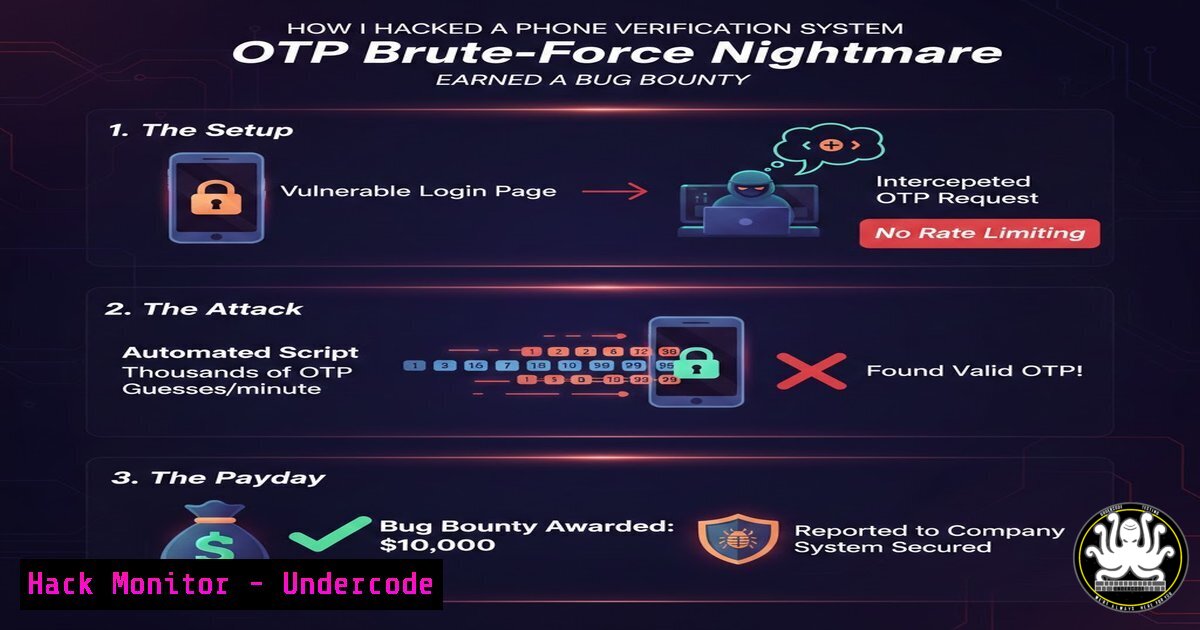
One-time password (OTP) systems are critical for securing authentication flows, but missing rate-limiting can turn them into a hacker’s playground. In a recent bug bounty report, a researcher exploited an OTP brute-force vulnerability in a phone verification flow, highlighting how regression flaws can resurface even after fixes. This incident underscores the persistent threats in application security and the need for robust defensive measures.
Learning Objectives:
- Understand the mechanics of OTP brute-force attacks and their impact on authentication systems.
- Learn practical steps to identify and exploit missing rate-limiting in phone verification APIs.
- Implement hardening techniques for OTP systems across Linux, Windows, and cloud environments.
You Should Know:
1. Decoding OTP Brute-Force Vulnerabilities
OTP brute-force attacks occur when an attacker can guess verification codes repeatedly due to absent or weak rate-limiting. This allows enumeration of valid OTPs, leading to account takeover or unauthorized access. Typically, OTPs are short numeric codes (e.g., 4-6 digits), making them susceptible to brute-forcing if not protected.
– Step-by-Step Guide: Start by analyzing the phone verification endpoint. Use browser developer tools or proxy software like Burp Suite to intercept the OTP submission request. Note parameters such as `phone_number` and otp_code. If the application lacks rate-limiting, you can send multiple requests with different OTP values. For a quick test, use a Linux command with `curl` in a loop:
`for i in {0000..9999}; do curl -X POST https://target.com/verify -d “phone=1234567890&otp=$i”; done`
This sends 10,000 requests to test all 4-digit combinations. Monitor responses for success indicators like redirects or JSON messages confirming verification.
2. Identifying Missing Rate-Limiting in API Endpoints
Missing rate-limiting is often a regression flaw, where previously patched vulnerabilities reappear after updates or deployments. To detect this, assess the request handling on authentication endpoints.
– Step-by-Step Guide: First, map the verification flow using tools like OWASP ZAP or Burp Suite. Configure Burp Suite to capture requests and use the Intruder module for automated testing. Set up a payload position on the OTP parameter and load a wordlist of OTPs (e.g., from 0000 to 9999). Start the attack and analyze responses for HTTP status codes (e.g., 200 OK for success) or content differences. On Windows, use PowerShell to simulate attacks:
`1..9999 | % { Invoke-WebRequest -Uri “https://target.com/verify” -Method POST -Body “phone=1234567890&otp=$_” }`
This script iterates through OTPs, but add delays to avoid detection. Check if the system blocks after multiple failures or allows unlimited attempts.
3. Tools for Automating OTP Exploitation
Automated tools streamline brute-force attacks by sending high-volume requests. Common tools include Hydra for Linux and custom Python scripts.
– Step-by-Step Guide: On Linux, install Hydra via sudo apt-get install hydra. For OTP brute-forcing, use a command targeting the POST endpoint:
`hydra -l 1234567890 -P /path/to/otp_wordlist.txt target.com http-post-form “/verify:phone=^USER^&otp=^PASS^:F=incorrect”`
Here, `-l` sets the phone number, `-P` specifies a wordlist file, and `:F=incorrect` defines a failure string in responses. On Windows, use THC-Hydra with similar syntax in Command Prompt. Alternatively, write a Python script with requests library:
import requests
for otp in range(10000):
response = requests.post('https://target.com/verify', data={'phone': '1234567890', 'otp': f'{otp:04d}'})
if 'verified' in response.text:
print(f'Valid OTP: {otp:04d}')
break
Run this with `python3 script.py` after installing requests via pip install requests.
4. Crafting a Proof-of-Concept for Bug Bounties
A successful bug report requires a clear proof-of-concept (PoC) demonstrating the vulnerability. This involves documenting steps, screenshots, and impact analysis.
– Step-by-Step Guide: Begin by setting up a testing environment with proxy tools. Capture the verification request in Burp Suite and save it to a file. Use Intruder to perform a brute-force attack with a limited payload set (e.g., 100 OTPs) to avoid harming the system. Record the process: note the endpoint, parameters, and absence of rate-limiting headers like X-RateLimit-Limit. For regression cases, reference past fixes—mention if the issue was previously resolved but reappeared. Submit the PoC on platforms like HackerOne with details on attack rate, success conditions, and potential impact (e.g., account takeover).
5. Implementing Rate-Limiting on Web Servers
Mitigating OTP brute-force requires enforcing rate-limiting at the server or application level. This restricts the number of requests from a single IP or user.
– Step-by-Step Guide: For Nginx on Linux, edit the configuration file (/etc/nginx/nginx.conf) and add rate-limiting zones:
`limit_req_zone $binary_remote_addr zone=otpzone:10m rate=5r/m;`
Then, apply it to the verification location:
`location /verify { limit_req zone=otpzone burst=10 nodelay; }`
This limits to 5 requests per minute per IP. For Apache, use `mod_evasive` and configure in httpd.conf:
`
On Windows IIS, install URL Rewrite Module and set rate-limiting rules via the IIS Manager. Test with `curl -I https://target.com/verify` to check for `429 Too Many Requests` responses.
6. Hardening API Security with Cloud Solutions
Cloud providers offer managed services to protect authentication endpoints. Use AWS WAF, Azure API Management, or Google Cloud Armor to implement rate-limiting.
– Step-by-Step Guide: In AWS, create a WAF rule for rate-based blocking. Navigate to AWS WAF console, define a rule with a rate limit (e.g., 100 requests per 5 minutes) for the `/verify` path. Attach it to an API Gateway or Application Load Balancer. For Azure, use API Management policies: in the Azure portal, select your API, add a policy with <rate-limit calls="5" renewal-period="60" />. In Google Cloud, configure Cloud Armor security policies with rate-limiting thresholds via `gcloud` commands:
`gcloud compute security-policies rules create 100 –action=rate-based-ban –rate-limit-threshold-count=100 –rate-limit-interval-sec=300 –target-service=backend-service`
Verify by sending excessive requests and monitoring logs for blocks.
7. Regression Testing for Vulnerability Management
Regression flaws, as seen in the reported bug, occur when fixes are undone during updates. Continuous testing ensures long-term security.
– Step-by-Step Guide: Integrate automated security tests into CI/CD pipelines. Use OWASP ZAP in Docker for dynamic scanning:
`docker run -v $(pwd):/zap/wrk -t owasp/zap2docker-stable zap-baseline.py -t https://target.com/verify -g gen.conf`
This scans for missing rate-limiting and other issues. On Windows, incorporate PowerShell scripts to test endpoints post-deployment:
`Test-NetConnection -ComputerName target.com -Port 443` followed by request flooding simulations. Schedule regular pentests with tools like Burp Suite Professional, focusing on authentication flows. Document findings and track remediation in a vulnerability management platform.
What Undercode Say:
- Key Takeaway 1: OTP brute-force vulnerabilities are low-hanging fruit that can lead to severe breaches, but they are easily preventable with proper rate-limiting and monitoring.
- Key Takeaway 2: Regression testing is critical in AppSec—organizations must adopt continuous security assessments to avoid reintroducing patched flaws.
Analysis: The reported bug highlights a common pitfall in development cycles: security fixes often lack robust regression tests, allowing vulnerabilities to resurface. This case underscores the importance of integrating security into DevOps (DevSecOps) and using automated tools for consistent checks. Bug bounty programs like HackerOne are vital for crowdsourced security, but organizations must complement them with internal hardening practices. The researcher’s success demonstrates how ethical hacking can drive improvements, yet reliance on external reports alone is risky—proactive defense is key.
Prediction: As authentication systems evolve with AI and multi-factor methods, OTP brute-force attacks may decline, but regression flaws will persist due to agile development and complex deployments. Future impacts could include increased automated exploitation via AI-driven bots, targeting cloud-native apps. Organizations will need to adopt zero-trust architectures and real-time threat detection to mitigate such risks, making rate-limiting a baseline requirement in API security frameworks.
▶️ Related Video (76% Match):
🎯Let’s Practice For Free:
IT/Security Reporter URL:
Reported By: Yahyaibr Bugbounty – Hackers Feeds
Extra Hub: Undercode MoN
Basic Verification: Pass ✅


