Listen to this Post
Introduction:
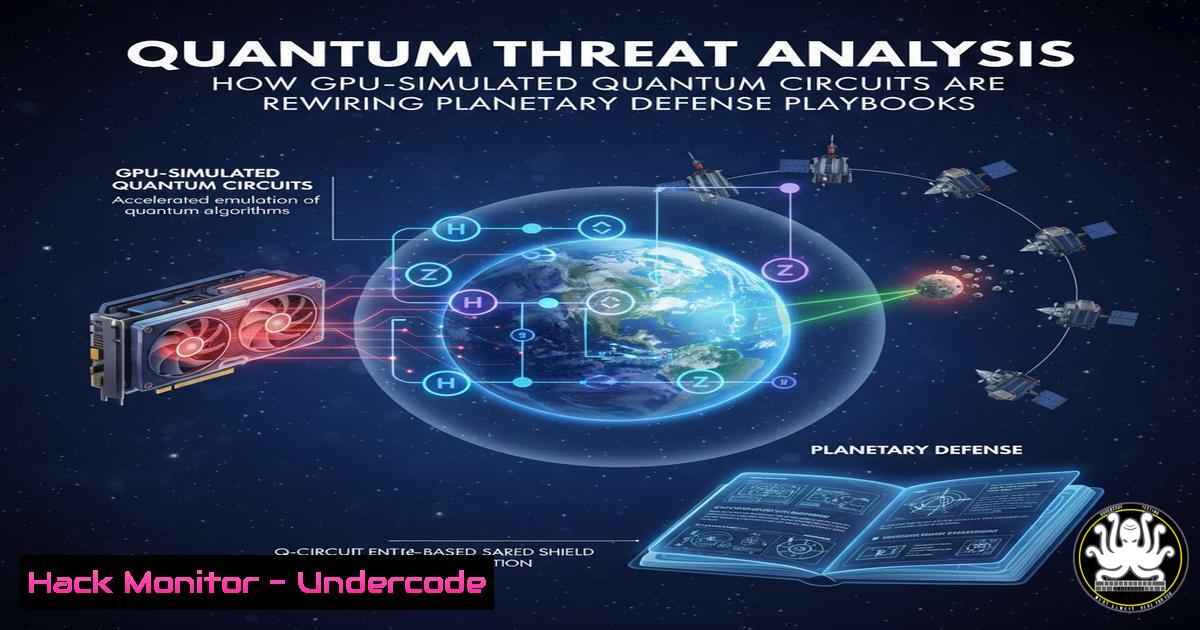
A groundbreaking open-source project is fusing NASA asteroid data with GPU-accelerated quantum circuit simulations to pioneer a new frontier in threat assessment. The “NEO Quantum” tool provides real-time 3D visualization of Near-Earth Objects while demonstrating how quantum algorithms like VQC and QAOA could theoretically revolutionize risk classification and mission planning. This educational platform serves as a critical bridge, allowing cybersecurity and IT professionals to explore post-quantum security concepts and the immense data processing paradigms of tomorrow, today.
Learning Objectives:
- Understand the practical application of four key quantum algorithms (VQC, VQE, QAE, QAOA) in a simulated cybersecurity-threat context.
- Learn to deploy and configure the full-stack NEO Quantum tool, integrating a FastAPI backend with a Three.js frontend and CUDA-Q.
- Analyze how quantum simulation projects create new data pipelines and API integrations that reshape IT infrastructure and security considerations.
You Should Know:
- Architecture and Deployment: The IT Backbone of a Quantum Demo
Deploying the NEO Quantum project is an exercise in modern full-stack development, cloud-ready APIs, and GPU-accelerated computing. Its architecture cleanly separates the real-time data ingestion layer from the quantum processing engine and 3D visualization client.
Step‑by‑step guide:
Prerequisites & Setup: The system requires Python 3.11+, Node.js 18+, and an NVIDIA GPU with CUDA support. Begin by cloning the repository and setting up the isolated Python environment.
git clone https://github.com/HxHippy/nasa-neo-cuda-quantum.git
cd nasa-neo-cuda-quantum
python -m venv venv
 On Linux/Mac:
source venv/bin/activate
 On Windows:
.\venv\Scripts\activate
Backend Configuration: The FastAPI backend handles NASA API communication and quantum processing. Install dependencies and configure environment variables with your NASA API key.
pip install -r requirements.txt
cp .env.example .env
 Edit .env with: NASA_API_KEY=your_key_here
Frontend & Execution: The frontend is a TypeScript application using Three.js. Install its dependencies and start both services.
cd ui
npm install
 In one terminal (backend):
uvicorn api.server:app --reload --port 8000
 In another terminal (frontend):
npm run dev
Access the tool at `http://localhost:3000`. This deployment model mirrors scalable microservices architecture, where the quantum engine operates as a specialized compute service.
- Quantum Algorithms in Action: From Theory to Simulated Practice
The core educational value lies in its implementation of four quantum algorithms using NVIDIA’s CUDA-Q SDK, simulated on classical GPUs. Each algorithm is mapped to a specific aspect of asteroid threat analysis.
Step‑by‑step guide:
Variational Quantum Classifier (VQC): Located in quantum_risk_classifier.py, this circuit classifies threat levels. It encodes asteroid features (size, velocity) into qubits using `RY` rotations, applies trainable parameterized layers, and uses entanglement (CNOT gates) before measurement. On a simulator, it’s slower than a classical Random Forest, demonstrating that quantum advantage requires actual quantum hardware.
Quantum Amplitude Estimation (QAE): Demonstrated in quantum_engine.py, QAE provides a quadratic speedup for probability estimation—crucial for calculating low-probability, high-impact collision risks. The circuit uses a Grover operator to mark “collision states” and phase estimation to amplify their probability amplitude, a technique with direct parallels in searching vulnerable states in encrypted data spaces.
3. API Integration and Real-Time Data Flow
The system’s realism stems from its live integration with NASA’s APIs, creating a continuous data pipeline. Understanding this flow is key for IT architects.
Step‑by‑step guide:
Data Ingestion: The `neo_fetcher.py` module programmatically calls NASA’s NeoWs (Near Earth Object Web Service) and Sentry (Impact Risk) APIs. Security best practice is to use environment variables for the API key, not hard-coded credentials.
WebSocket Communication: The backend (api/server.py) and frontend establish a persistent WebSocket connection (ws://localhost:8000/ws/neo-stream). This allows for streaming real-time classification updates. You can simulate a client request for analysis using a command-line tool like `websocat` or a Python script.
 Example Python WebSocket client message
import asyncio, websockets, json
async def request_analysis():
async with websockets.connect('ws://localhost:8000/ws/neo-stream') as ws:
msg = {"type": "start_analysis", "data": {"days_ahead": 7}}
await ws.send(json.dumps(msg))
response = await ws.recv()
print(json.loads(response))
4. The AI Analyst Module: Augmenting Quantum Output
Beyond quantum processing, the `ai_analyst.py` module uses a large language model (the suggested nvidia/nemotron-3-nano-30b-a3b) to generate contextual threat reports. This showcases AI’s role in explaining complex analytical outputs.
Step‑by‑step guide:
Configuration: To enable this feature, add an `OPENROUTER_API_KEY` to your `.env` file. The module structures quantum results and asteroid data into a prompt for the LLM.
Process: The AI synthesizes the numerical risk classification, orbital data, and historical context from the training set to generate a narrative assessment. This demonstrates an emerging MLOps pattern: using AI to interpret and communicate the results of another advanced computational model (quantum or classical).
5. Security and Operational Considerations for Demo Environments
While not a production system, the project’s structure highlights important IT and security practices for research and demo platforms that handle external data and API keys.
Step‑by‑step guide:
Environment Management: The use of `.env` files and `venv` is fundamental. The `.env.example` file provides a template without exposing secrets. Always ensure `.env` is listed in .gitignore.
API Rate Limiting & Caching: To avoid hitting NASA API rate limits and to improve performance, the backend implements caching. Examine `neo_fetcher.py` to see how it can cache responses, a critical pattern for building resilient integrations with third-party services.
Network Security: The application runs on `0.0.0.0` by default. For any external deployment, this must be secured behind a reverse proxy (like Nginx), with HTTPS enforced and WebSocket connections (wss://) properly configured.
What Undercode Say:
- Quantum-Ready Skills are Built on Classical Foundations: This project powerfully demonstrates that the path to quantum computing expertise is paved with classical IT skills: containerization, API design, GPU programming, and data visualization. Mastering these areas is the most practical step toward future-proofing a tech career.
- Simulation is the Sandbox for Tomorrow’s Security Threats: By simulating quantum processes on today’s hardware, we create a vital testing ground. Security professionals can use such environments to understand the data patterns and computational workflows that future quantum-accelerated attacks might employ, informing the development of next-generation defense mechanisms.
Prediction:
Within the next 3-5 years, quantum simulation projects like NEO Quantum will evolve from educational demos into essential “quantum sandboxes” for enterprise IT and cybersecurity teams. They will become standard training tools for developing quantum literacy and will be integrated into devsecops pipelines to test the resilience of encryption and data processing systems against simulated quantum attacks. The lines between high-performance computing (GPU clusters), AI inference, and quantum simulation will blur, creating a new hybrid infrastructure specialty focused on preparing organizations for the post-quantum era. The open-source nature of such projects will accelerate this trend, making advanced quantum concepts accessible and actionable for a broad technical audience.
▶️ Related Video (84% Match):
🎯Let’s Practice For Free:
IT/Security Reporter URL:
Reported By: Briansgagne Built – Hackers Feeds
Extra Hub: Undercode MoN
Basic Verification: Pass ✅


