Listen to this Post
Introduction:
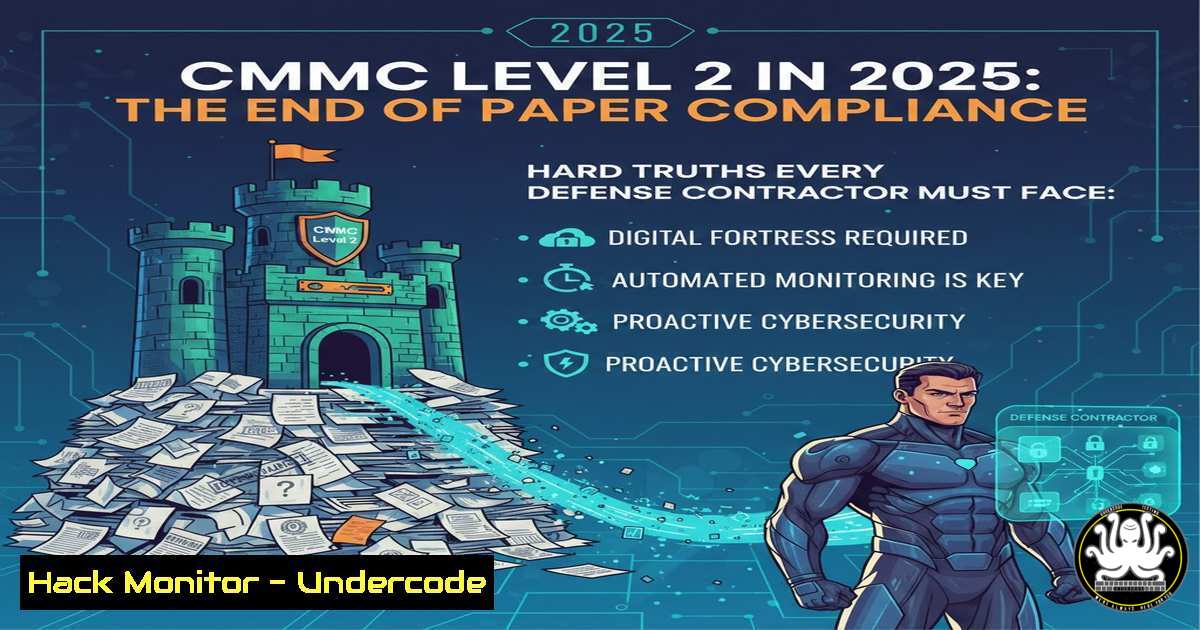
The Cybersecurity Maturity Model Certification (CMMC) Level 2 has transitioned from a theoretical framework to an enforceable reality, fundamentally altering the landscape for the Defense Industrial Base (DIB). This shift represents more than a compliance checkpoint; it is a survivability threshold where evidentiary scrutiny replaces attestation theater. Organizations that treat these 110 security practices as a checklist rather than a continuous operational discipline will face significant consequences as enforcement accelerates into 2026.
Learning Objectives:
- Understand why CMMC Level 2 is a minimum baseline, not a security achievement, and the technical evidence required to prove compliance.
- Learn the critical daily security habits and tool configurations that separate paper compliance from resilient security postures.
- Develop a strategic roadmap to move beyond compliance into genuine resilience, preparing for both audit and active defense.
You Should Know:
1. The Evidentiary Burden: From Saying to Showing
The core shift in formalized CMMC assessments is the demand for objective evidence. Auditors will no longer accept policy documents alone; they require proof of implementation through logs, configurations, and demonstrable processes.
Step-by-Step Guide: Generating Evidence for Access Control (AC.L2-3.1.2)
What it does: This control mandates limiting system access to authorized users, processes, and devices. Evidence must show this is actively enforced, not just documented.
How to use it:
- Linux Command Evidence: On a Linux server handling CUI, use `sudo cat /etc/ssh/sshd_config | grep -i “AllowUsers\|AllowGroups”` to demonstrate restricted SSH access. Follow with `sudo tail -20 /var/log/auth.log` to show authentication attempts and prove monitoring.
- Windows Command Evidence: On a Windows domain controller, open PowerShell and run `Get-ADGroupMember “CUI_Access_Group” | Select-Object Name` to list authorized users. Generate a log of recent logons with
Get-EventLog -LogName Security -InstanceId 4624 -Newest 10. - Tool Configuration: In your endpoint protection platform, create a screenshot of the policy that blocks removable media (addressing AC.L2-3.1.19) and export the incident log showing blocked attempts.
2. Security Habitualization: Building Daily IT Hygiene
Compliance fails when security is a periodic “audit prep” activity. Resilience is built through ingrained, daily habits that map directly to CMMC practices.
Step-by-Step Guide: Implementing Habitualized Vulnerability Management (SI.L2-3.14.1)
What it does: This requires regularly scanning for vulnerabilities and remediating them. The “habit” is the scheduled, automated scan and the mandated review process.
How to use it:
- Automated Scanning: Schedule a weekly credentialed scan using a tool like OpenVAS or Tenable Nessus. Automate the report generation and distribution to sysadmins.
- Linux Patching Command: For critical updates, demonstrate the process. First, check for updates: `sudo apt update && sudo apt list –upgradable` (Debian/Ubuntu) or `sudo yum check-update` (RHEL/CentOS). Apply security updates only with `sudo apt upgrade –only-upgrade security` or
sudo yum update --security. - Patch Verification: After patching, verify the new version of a critical library: `sudo dpkg -l | grep openssl` or
sudo rpm -qa | grep kernel. Log this output as evidence of remediation. -
Tool Configuration vs. Tool Purchase: The Implementation Gap
Merely purchasing a “compliant” toolset is a common and fatal mistake. The security value is derived from its correct, hardened configuration.
Step-by-Step Guide: Hardening a SIEM for Audit Logging (AU.L2-3.3.1 & 3.3.2)
What it does: System events must be captured, protected from tampering, and retained. A misconfigured SIEM creates a false sense of security.
How to use it:
- Ensure Log Collection: In your SIEM (e.g., Splunk, Elastic Stack), verify agents are installed on all CUI systems. Run a health check: In Splunk, search `index= | stats count by host` to confirm all expected hosts are reporting.
- Tamper Protection: Configure immutable logging. On a Linux log server, set append-only permissions on the audit log directory:
sudo chattr +a /var/log/secure. This prevents deletion by attackers or privileged users. - Retention Enforcement: In the SIEM, create a retention policy that aligns with CMMC requirements (often 3-7 years for audit logs). Document this policy and provide a screenshot of the configuration.
4. Leadership Accountability in Technical Controls
Governance failures manifest as technical gaps. Leadership must own the resources and authority granted to security teams to implement effective controls.
Step-by-Step Guide: Enforcing Least Privilege via Technical Policy (AC.L2-3.1.3-7)
What it does: The principle of least privilege is a leadership-driven policy that must be enforced technically. It requires regular review of accounts and privileges.
How to use it:
- Audit Privileged Accounts: Schedule a monthly PowerShell script on the Domain Controller: `Get-ADGroupMember “Domain Admins”` and
Get-ADGroupMember "Enterprise Admins". Export the list and have a signed leadership review attesting to the necessity of each member. - Implement Just-in-Time Access: Configure Privileged Access Management (PAM) tools to require approval for elevated access. Document the workflow and provide an audit trail from the PAM system showing a request, approval, and timed session.
- Demonstrate Removal: When an employee offboards, show the workflow: a ticket triggers a script that runs `Disable-ADAccount -Identity “jdoe”` and
Remove-ADGroupMember -Identity "CUI_Access_Group" -Members "jdoe" -Confirm:$false.
5. From CMMC Baseline to Proactive Threat Hunting
True resilience starts where CMMC Level 2 ends. The logged data and configured controls become the foundation for hunting adversaries, not just passing audits.
Step-by-Step Guide: Using CMMC Logs for Threat Hunting (IR.L2-3.13.1)
What it does: The incident response capability required by CMMC can be operationalized proactively by hunting for indicators of compromise within the very logs you’re now collecting.
How to use it:
- Leverage SIEM Searches: Hunt for lateral movement using Windows Event Code 4624 (logon) with a logon type of 3 (network) and a source IP from an unusual internal subnet.
- Analyze Linux Auditd Logs: Search for unusual process execution from web directories:
sudo ausearch -k web_root_exec | aureport -f -i. This could indicate a web shell. - Cross-Reference Intelligence: Use the MISP threat intelligence platform to ingest IOCs from the MS-ISAC. Automate a daily job to compare your SIEM’s DNS logs against domains of known malware C2 servers.
What Undercode Say:
- CMMC Level 2 is a Floor, Not a Ceiling. Treating it as the end goal leaves an organization compliant yet vulnerable. The controls are a minimum viable product for protecting CUI; advanced adversaries routinely exploit gaps in minimally configured environments.
- Governance is the Keystone. The most sophisticated tool will fail without the leadership accountability, trained personnel, and continuous monitoring processes that turn a static configuration into a living security posture. The comment that “CMMC L2 isn’t a security achievement, it’s a survivability threshold” underscores that this is about business continuity in a contested digital environment.
Analysis: The dialogue in the original post highlights a pivotal industry maturation. The transition from “attestation theater” to “evidentiary scrutiny” changes the game from writing checks to doing the work. The organizations at risk are those with a “checkbox mentality” who invested in silver-bullet tools without the operational discipline to wield them effectively. Success now belongs to those who integrated CMMC requirements into their SDLC, change management, and daily IT ops long before an assessor was scheduled. The consequence velocity—the speed at which a control failure leads to a breach or a failed assessment—has increased dramatically. In 2025, the illusion that paperwork equals security was removed. By 2026, excuses for not having implemented, evidence-ready technical controls will carry the tangible consequences of lost contracts and compromised networks.
Prediction:
As CMMC Level 2 assessments become routine through 2026, we will witness a stark bifurcation in the Defense Industrial Base. Organizations that embraced the framework as an operational discipline will leverage their mature, evidence-ready postures to move beyond compliance, investing in AI-driven anomaly detection and automated threat response. Conversely, those who rushed or checkboxed compliance will face a brutal reckoning: failed audits, costly emergency remediation projects, and an exponentially higher risk of becoming the victim of a breach due to shallow, unmaintained controls. This divide will ultimately reshape the competitive landscape, with contract awards increasingly favoring vendors who can demonstrably prove resilience, not just compliance. The foundational controls of CMMC Level 2 will become the assumed baseline, and the market will begin to demand CMMC Level 3-like behaviors—continuous security improvement and advanced protection—as a standard differentiator.
▶️ Related Video (70% Match):
🎯Let’s Practice For Free:
IT/Security Reporter URL:
Reported By: Johnchristly %F0%9D%97%96%F0%9D%97%A0%F0%9D%97%A0%F0%9D%97%96 – Hackers Feeds
Extra Hub: Undercode MoN
Basic Verification: Pass ✅


