Listen to this Post
Introduction:
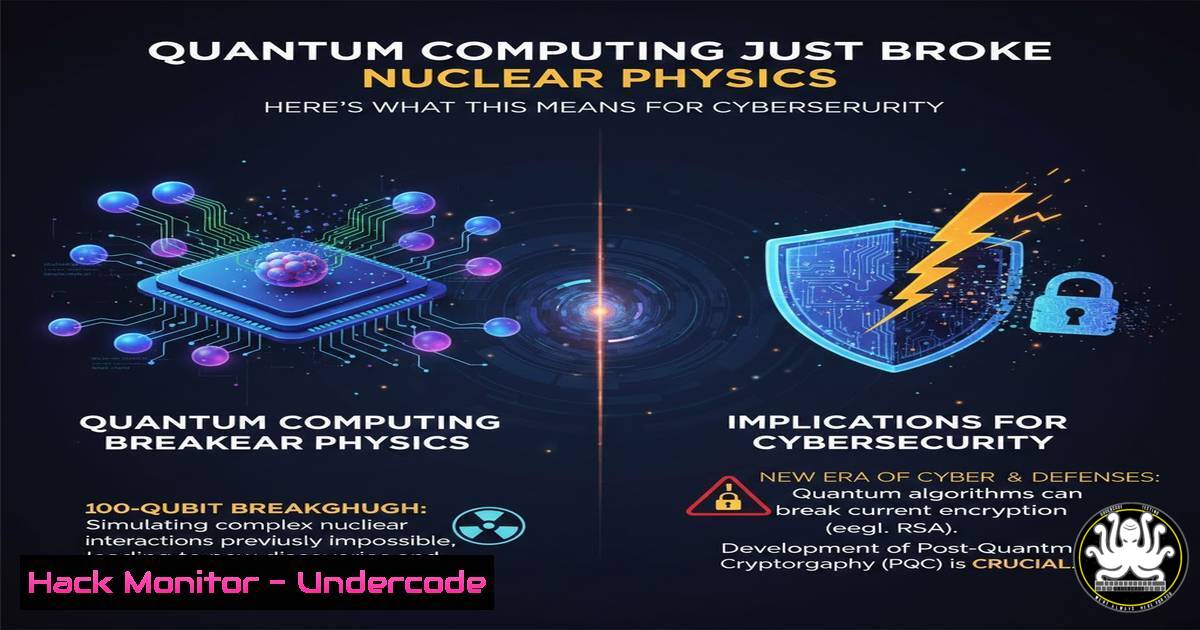
Researchers have successfully developed scalable quantum circuits capable of simulating fundamental nuclear physics using over 100 qubits, surpassing classical computational limits. This milestone enables modeling of particle interactions and exotic matter previously deemed unreachable, representing a paradigm shift in computational power. For cybersecurity professionals, this breakthrough signals the imminent arrival of quantum capabilities that will fundamentally transform encryption, threat modeling, and national security infrastructure.
Learning Objectives:
- Understand the technical significance of scalable quantum circuits exceeding 100 qubits
- Identify immediate cybersecurity implications of quantum-accelerated nuclear physics simulation
- Develop mitigation strategies for quantum-vulnerable cryptographic systems
You Should Know:
1. Quantum Circuit Architecture and State Preparation
The breakthrough involves quantum circuits specifically engineered to prepare complex nuclear initial states that classical supercomputers cannot efficiently compute. These circuits optimize for depth, error tolerance, and state preparation efficiency, creating a viable pathway for modeling nuclear interactions requiring exponential classical resources.
Step-by-step guide explaining what this does and how to use it:
– Circuit Design: Quantum circuits use optimized gate sequences to encode nuclear structure information
– State Preparation: Initial states are prepared using variational quantum eigensolver (VQE) algorithms
– Verification: Results are cross-verified against known classical simulations where possible
– Implementation: Researchers used custom quantum processing units (QPUs) with error mitigation techniques
Example quantum circuit initialization code:
from qiskit import QuantumCircuit, QuantumRegister
from qiskit.circuit.library import EfficientSU2

Initialize 100-qubit circuit for nuclear state preparation
qubits = 100
qc = QuantumCircuit(qubits)
ansatz = EfficientSU2(qubits, reps=3)
qc.compose(ansatz, inplace=True)
qc.measure_all()
2. Cryptographic Implications and Quantum Vulnerability Assessment
The ability to simulate nuclear physics at scale demonstrates quantum computers can solve complex optimization problems that underpin modern encryption. This directly threatens RSA, ECC, and other public-key cryptosystems reliant on factoring and discrete logarithm problems.
Step-by-step guide explaining what this does and how to use it:
– Inventory Assessment: Identify all systems using quantum-vulnerable cryptography
– Risk Prioritization: Classify assets by sensitivity and cryptographic vulnerability
– Migration Planning: Develop timeline for transitioning to post-quantum cryptography
– Implementation: Begin testing NIST-selected PQC algorithms in development environments
Linux command to identify SSL/TLS certificates using vulnerable algorithms:
openssl s_client -connect example.com:443 -servername example.com | openssl x509 -text -noout | grep -E "Signature Algorithm|Public Key Algorithm"
3. Quantum-Enhanced Threat Modeling for Critical Infrastructure
The nuclear physics simulation capability suggests quantum systems could soon model complex critical infrastructure networks, enabling sophisticated attack planning and vulnerability discovery at unprecedented scale.
Step-by-step guide explaining what this does and how to use it:
– Infrastructure Mapping: Document network architectures and dependencies
– Quantum Risk Assessment: Identify systems vulnerable to quantum-accelerated analysis
– Defense Planning: Implement quantum-resistant segmentation and monitoring
– Incident Response: Develop procedures for quantum-era threat containment
Windows PowerShell command for network segmentation analysis:
Get-NetFirewallRule | Where-Object {$_.Enabled -eq "True"} | Select-Object Name, DisplayName, Direction, Action | Export-CSV -Path "firewall_rules.csv"
4. Post-Quantum Cryptography Implementation Framework
As quantum computers advance toward practical cryptanalysis, organizations must begin migrating to quantum-resistant algorithms while maintaining compatibility with existing systems.
Step-by-step guide explaining what this does and how to use it:
– Algorithm Selection: Choose from NIST-standardized PQC algorithms (CRYSTALS-Kyber, CRYSTALS-Dilithium)
– Hybrid Implementation: Deploy classical and quantum-resistant algorithms simultaneously
– Performance Testing: Evaluate computational overhead and compatibility
– Gradual Migration: Phase out vulnerable algorithms as PQC maturity increases
Example OpenSSL configuration for hybrid certificates:
openssl req -new -newkey rsa:2048 -keyout traditional.key -out traditional.csr
openssl req -new -newkey dilithium2 -keyout pqc.key -out pqc.csr
5. Quantum Key Distribution (QKD) Network Design
For ultra-sensitive communications, QKD provides information-theoretically secure key exchange based on quantum mechanical principles rather than computational complexity.
Step-by-step guide explaining what this does and how to use it:
– Link Assessment: Evaluate fiber optic infrastructure for QKD compatibility
– Protocol Selection: Choose between BB84, E91, or other QKD protocols
– Network Architecture: Design trusted node placements and key management
– Security Validation: Implement quantum hacking detection and countermeasures
Network configuration for QKD integration:
 Example QKD network controller configuration
qkd_network = {
"nodes": ["primary_router", "backup_router"],
"key_refresh_rate": "1/second",
"authentication": "quantum_enhanced",
"monitoring": ["photon_detection", "eavesdropping_detection"]
}
- Quantum Random Number Generation (QRNG) for Cryptographic Security
True randomness is essential for cryptographic key generation, and quantum processes provide fundamentally unpredictable random number sources superior to classical pseudorandom generators.
Step-by-step guide explaining what this does and how to use it:
– Hardware Selection: Choose between optical, atomic, or other QRNG technologies
– Integration Testing: Validate QRNG output with existing cryptographic systems
– Entropy Validation: Verify randomness quality using NIST statistical tests
– Deployment Strategy: Implement QRNG for critical key generation processes
Linux entropy source configuration:
 Check available entropy sources
cat /proc/sys/kernel/random/entropy_avail
 Configure additional QRNG entropy source
echo "hwrandom" >> /etc/modules-load.d/qrng.conf
7. Quantum-Safe Blockchain and Distributed Ledger Technologies
The nuclear simulation breakthrough demonstrates quantum computers will soon break blockchain cryptographic foundations, requiring urgent migration to quantum-resistant distributed consensus mechanisms.
Step-by-step guide explaining what this does and how to use it:
– Ledger Assessment: Inventory blockchain implementations and their cryptographic bases
– Consensus Migration: Plan transition to quantum-safe signature schemes
– Smart Contract Updates: Modify contracts to use PQC algorithms
– Network Hardening: Implement quantum-era fork resolution procedures
Smart contract migration example:
// Traditional ECDSA signature verification
function verifySignature(bytes32 hash, uint8 v, bytes32 r, bytes32 s) public view returns (address) {
return ecrecover(hash, v, r, s);
}

// Quantum-resistant alternative using Dilithium
function verifyPQCSignature(bytes32 hash, bytes memory signature) public view returns (bool) {
return dilithium.verify(hash, signature, publicKey);
}
What Undercode Say:
- The 100-qubit threshold for practical nuclear physics simulation represents a Rubicon moment where quantum computing transitions from theoretical to applied science
- Organizations ignoring quantum risk assessment are accumulating technical debt that will become catastrophic within 3-5 years
- The national security implications extend beyond cryptography to intelligence gathering, weapons development, and strategic advantage
This breakthrough demonstrates that quantum advantage is no longer abstract—it’s achieving measurable results in domains directly relevant to national security. The nuclear physics simulations possible today will evolve into cryptanalytic capabilities tomorrow. Organizations must treat quantum readiness with the same urgency as Y2K preparations, recognizing that cryptographic migration requires years of careful planning and execution. The window for orderly transition is closing rapidly as quantum hardware continues its exponential improvement trajectory.
Prediction:
Within 24-36 months, we will see the first demonstration of quantum computers breaking widely-deployed cryptographic protocols, triggering global emergency patching cycles and potentially exposing years of encrypted communications. Critical infrastructure operators who haven’t begun quantum migration will face catastrophic security failures, while early adopters of PQC will maintain operational continuity. Nation-states will increasingly treat quantum capability as strategic military assets, leading to new forms of cyber warfare and intelligence operations exploiting quantum-derived advantages.
🎯Let’s Practice For Free:
IT/Security Reporter URL:
Reported By: Keith King – Hackers Feeds
Extra Hub: Undercode MoN
Basic Verification: Pass ✅


