
Listen to this Post
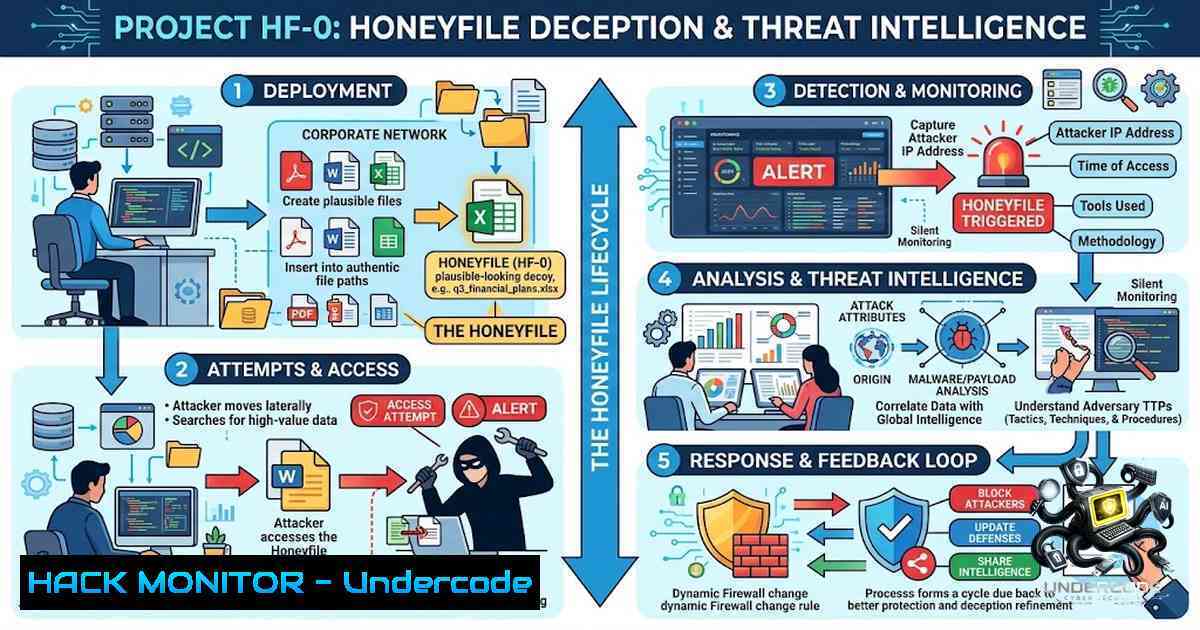
Introduction:
In the ever-evolving landscape of cybersecurity, passive defense is no longer sufficient. Active cyber deception, through the strategic deployment of honeypots and honeyfiles, has emerged as a powerful technique to detect, deflect, and analyze malicious activity in real-time. Honeyfiles are decoy files designed to appear legitimate to an intruder; their access triggers an alert, providing defenders with a critical early warning signal and valuable intelligence about an attacker’s methods and objectives. “Project HF-0” (Honey File – Zero) represents a practical, hands-on approach to implementing this deception technology in a controlled homelab environment, utilizing a mix of hardware including an MSI laptop as the target (“Hack Tank”), an HP laptop as the attack platform (“Mobile Attacker – 1”), and a Raspberry Pi running Kali Linux as a headless penetration testing node (“Headless RPK”). This article provides a comprehensive, step-by-step guide to building and executing a similar honeyfile deployment project, from initial setup to real-time alerting and analysis.
Learning Objectives & Secrets:
- Objective 1: Master the Art of Honeyfile Creation. Learn to generate realistic decoy files that are indistinguishable from legitimate documents, including backdating files to appear established and using plausible, yet fake, content.
- Objective 2 Secret Tip: Strategic Placement for Maximum Impact. Understand the attacker’s mindset. Place honeyfiles in high-value locations such as user desktops, document folders, and root directories of file shares, using naming conventions that sort first or last alphabetically to intercept ransomware that enumerates directories in order.
- Objective 3 Secret Tip: Multimodal Alerting is Key. Configure your monitoring system to send alerts through multiple channels—console, SIEM-ready JSON logs, SQLite database, and instant notifications like Discord or email—to ensure you never miss a detection event.
You Should Know:
- Setting Up the Honeyfile Monitor on the Target (Hack Tank)
The core of Project HF-0 is a robust monitoring system that watches the deployed honeyfiles for any access. The `honeyfile-watcher` tool is an excellent open-source solution built specifically for this purpose in homelab environments.
Step‑by‑step guide:
- Installation: On your target machine (the MSI laptop “Hack Tank”), clone the repository and install the tool.
git clone https://github.com/AlexPGAO/honeyfile-monitor.git
cd honeyfile-monitor
pip install .
This tool has one runtime dependency (
watchdog) and uses the standard library for Office file generation.
2. Initialization: Initialize the configuration and environment files.
honeyfile init
This creates `config.toml` and a `.env` file skeleton.
- Configuration: Edit the `config.toml` file to define your honeyfile paths. For example, to plant a decoy credit card file on the desktop and a fake password backup in documents:
[[bash]]
path = "~/Desktop/CreditCards_2026.xlsx"
type = "xlsx"</li>
</ol>

[[bash]]
path = "~/Documents/passwords_backup.docx"
type = "docx"
Next, configure your alerting by editing the `.env` file. To enable Discord alerts, add your webhook URL:
HONEYFILE_DISCORD_WEBHOOK_URL=https://discord.com/api/webhooks/your-webhook-id/your-webhook-token
4. Deploy the Decoys: Generate the actual honeyfiles. The tool builds real `.xlsx` and `.docx` files using the OOXML standard, backdating them 45–400 days to make them look established.
honeyfile deploy
To regenerate files, use the `–force` flag.
- Start Monitoring: Begin watching the files in real-time.
honeyfile watch
The monitor will now alert on the console, log to SQLite and a JSON-lines file (
events.jsonl), and send rich Discord embeds the moment any honeyfile is touched. -
Simulating the Attack from the Attacker Machine (MA-1 / Headless RPK)
To test the honeyfile detection, you must simulate an attacker’s actions from a separate machine. This is where the HP laptop (“MA-1”) and the Raspberry Pi running Kali Linux (“Headless RPK”) come into play.
Step‑by‑step guide:
- Setting up Headless RPK (Raspberry Pi/Kali): Flash a Kali Linux image onto a microSD card using the Raspberry Pi Imager. Boot the Pi and enable SSH for headless operation.
- Network Reconnaissance: From the attacker machine, perform a basic network scan to discover the target’s IP address. On Kali Linux, you can use `netdiscover` or
nmap.sudo netdiscover -r 192.168.1.0/24
Or, a more targeted scan:
sudo nmap -sn 192.168.1.0/24
3. Accessing the Honeyfile: Once the target’s IP is identified, simulate an attacker gaining access (e.g., via a compromised account or SMB share) and attempting to read the decoy file. For a simple test, you can use `smbclient` or `ssh` if the file is accessible. A basic test from the target machine itself can also be performed to validate the alerting pipeline.
echo tamper >> ~/Desktop/CreditCards_2026.xlsx
This command appends text to the honeyfile, simulating a modification event.
4. Triggering and Verifying Alerts: The `honeyfile watch` process on the target machine will detect this change. You should immediately see a console alert, a new entry inevents.jsonl, and a rich Discord embed with details of the access.- Extending Deception with Canary Tokens and SSH Honeypots
While file-based honeyfiles are powerful, a comprehensive deception strategy includes other types of lures. Canary tokens and SSH honeypots like Cowrie can provide additional layers of detection.
Step‑by‑step guide:
- Deploying Canary Tokens: Canary tokens are unique identifiers (URLs, DNS names, or files) that trigger an alert when accessed. You can generate a free token at
canarytokens.org. For a practical test, create a Microsoft Excel token, download it, and place it alongside your honeyfiles. - Setting Up Cowrie SSH Honeypot: On a separate machine or VM (or even your Raspberry Pi), set up Cowrie to simulate a vulnerable SSH server.
git clone https://github.com/cowrie/cowrie
cd cowrie
cp cowrie.cfg.dist cowrie.cfg
Edit cowrie.cfg to change the listen port (e.g., 2222) and other settings.
bin/cowrie start
Cowrie logs all attacker interactions, including login attempts and commands, providing valuable threat intelligence.
- Integrating Alerts: While Cowrie logs to files, you can integrate its logs with a SIEM or use a tool like `fail2ban` to automate responses. The `honeyfile-watcher` can also be extended to monitor these log files for specific patterns, creating a unified alerting dashboard.
4. Analyzing and Visualizing the Data
Collecting alerts is only half the battle; the real value lies in analysis. The `honeyfile-watcher` tool includes a built-in dashboard for visualizing events.
Step‑by‑step guide:
- Generate the Dashboard: From the `honeyfile-monitor` directory, generate an HTML dashboard.
honeyfile dashboard -o dash.html
- Serve the Dashboard: You can serve this dashboard locally for live viewing.
honeyfile dashboard --serve
This will host the dashboard at `http://127.0.0.1:8777`.
- Query Events: Use the CLI to query recent events from the SQLite database.
honeyfile events -1 20
This command prints the 20 most recent events.
- SIEM Integration: The `events.jsonl` file is formatted for easy ingestion into SIEM tools like Splunk or Wazuh. Point your log forwarder (e.g., Filebeat) at this file to centralize your deception data.
5. Advanced: Active Directory Honeyfiles
For enterprise environments, deception can be extended to Active Directory. Tools like `Deceptive-Auditing` allow you to deploy honeypot objects and automatically enable auditing on them.
Step‑by‑step guide:
- Import the PowerShell Module: On a domain controller or management workstation, import the `Deceptive-Auditing` module.
Import-Module Deceptive-Auditing
- Set an Audit Rule on a File: To audit read access to a specific file by any user (WorldSid), use the following command:
Set-AuditRule -FilePath "C:\Path\To\Honeyfile.txt" -WellKnownSidType WorldSid -Rights Read -InheritanceFlags None -PropagationFlags None -AuditFlags Success
This will generate a Windows Security Event (4663) whenever the file is read.
- Deploy Deception Objects: The tool can create entire deceptive AD environments, planting fake users, groups, and computers to misdirect and detect attackers.
What Undercode Say:
- Key Takeaway 1: Active cyber deception, through honeyfiles and honeypots, is a highly effective, proactive defense strategy that provides early warning and valuable threat intelligence. It shifts the advantage from the attacker to the defender.
- Key Takeaway 2: Building a honeyfile lab is an accessible and invaluable project for cybersecurity students and professionals. It provides hands-on experience with Linux, Windows, network monitoring, and threat detection, bridging the gap between theory and practice.
- The “Project HF-0” concept is a perfect example of a “living lab” that teaches core security principles. The combination of an MSI laptop as a target and a Raspberry Pi/Kali as an attack platform mirrors real-world attack scenarios, making the learning experience highly relevant. The inclusion of a “Headless RPK” adds a layer of complexity, simulating an autonomous, low-footprint attacker.
- The use of `honeyfile-watcher` demonstrates the power of open-source tools in building sophisticated security solutions with minimal overhead. Its ability to generate real Office documents, backdate them, and send multi-channel alerts makes it a professional-grade tool for any homelab.
- This project highlights the importance of not just detecting attacks, but also analyzing them. The integration with SIEM tools and the built-in dashboard ensures that the data collected is actionable.
- For those preparing for certifications like CompTIA CySA+, this project provides a tangible demonstration of core exam objectives, including threat detection, vulnerability management, and incident response.
- The evolution of honeyfiles from simple text files to complex, realistic documents (like `.xlsx` and
.docx) shows the sophistication of modern deception technologies. This realism is key to their effectiveness, as it increases the likelihood that an attacker will take the bait. - In a world of sophisticated APTs and ransomware, deception provides a critical layer of defense that can catch threats that evade traditional signature-based tools. Ransomware, in particular, can be detected early by strategically placing honeyfiles that it will inevitably encrypt.
- The hands-on nature of this project also builds essential Linux and Windows administration skills, from configuring firewalls and SSH to managing file permissions and auditing.
- Ultimately, “Project HF-0” is more than just a lab exercise; it’s a mindset. It encourages a proactive, hunter-killer approach to cybersecurity, where defenders actively set traps and gather intelligence on their adversaries.
Prediction:
- +1 The adoption of cyber deception technologies like honeyfiles and honeypots will become a standard component of enterprise security architectures, moving from a niche tactic to a mainstream defense-in-depth strategy.
- +1 The integration of AI and machine learning will automate the generation of highly realistic and context-aware honeyfiles, making them even more effective at luring and detecting sophisticated attackers.
- -1 As deception becomes more prevalent, attackers will develop countermeasures to detect and avoid honeyfiles, leading to an ongoing “arms race” in the deception domain.
- +1 Open-source projects like `honeyfile-watcher` will continue to lower the barrier to entry for implementing advanced security measures, empowering smaller organizations and security enthusiasts to build robust defenses.
- -1 The effectiveness of honeyfiles is contingent on proper placement and realistic content. Poorly implemented deception can be easily identified and ignored by attackers, wasting resources and providing a false sense of security.
- +1 The hands-on experience gained from projects like “Project HF-0” will be highly valued in the cybersecurity job market, as employers increasingly seek candidates with practical, demonstrable skills in active defense and threat hunting.
- +1 The use of low-cost hardware like the Raspberry Pi for security labs will continue to grow, making advanced security training more accessible and fostering a new generation of skilled cybersecurity professionals.
- -1 The proliferation of homelab-created honeyfiles could lead to an increase in “false positive” alerts if not properly configured and tuned, potentially leading to alert fatigue.
- +1 The data collected from honeypots and honeyfiles will become a crucial source of threat intelligence, providing defenders with real-time insights into attacker TTPs (Tactics, Techniques, and Procedures) and helping to predict and prevent future attacks.
- +1 The principles of active defense and deception will become a core part of cybersecurity curricula, ensuring that future professionals are equipped with the skills to think like both attackers and defenders.
▶️ Related Video (86% Match):
🎯Let’s Practice For Free:
🎓 Live Courses & Certifications:
Join Undercode Academy for Verified Certifications
🚀 Request a Custom Project:
Secure, high-velocity infrastructure and disruptive technological engineering. Contact our engineering team for high-tier development and proprietary systems:
[email protected]
💎 Smart Architecture | 🛡️ Secure by Design | ⭐ Trusted by ThousandsIT/Security Reporter URL:
Reported By: https://lnkd.in/p/eihbwKtw – Hackers Feeds
Extra Hub: Undercode MoN
Basic Verification: Pass ✅🔐JOIN OUR CYBER WORLD [ CVE News • HackMonitor • UndercodeNews ]
📢 Follow UndercodeTesting & Stay Tuned:
- Start Monitoring: Begin watching the files in real-time.


