Listen to this Post
Introduction:
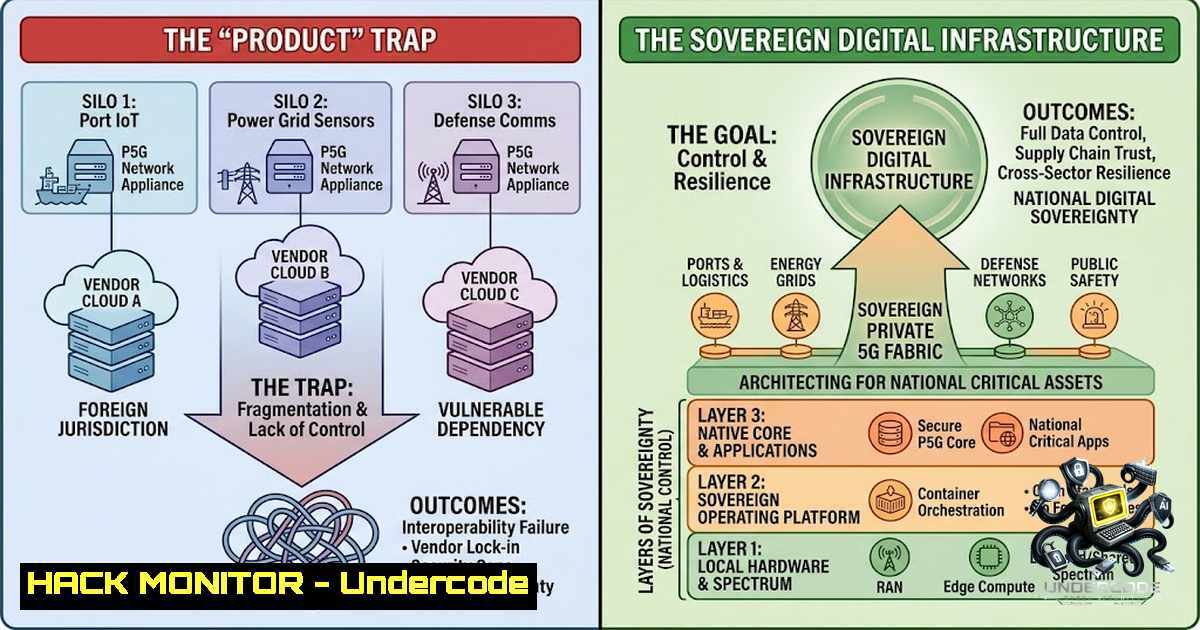
The telecommunications industry is at an inflection point where the traditional business model of selling connectivity, bandwidth, and SIM cards is no longer sufficient to address the emerging demands of national security and critical infrastructure resilience. As nation-states increasingly recognize 5G as a matter of digital sovereignty and national security, the convergence of Private 5G, Edge computing, Artificial Intelligence, Digital Twins, and cybersecurity is reshaping how we protect assets that nations cannot afford to lose—nuclear power plants, ports, airports, defense installations, and energy grids. The fundamental question is no longer about network speed but about who controls the network when the country needs it most.
Learning Objectives:
- Understand the strategic shift from selling connectivity to architecting sovereign digital infrastructure for national critical assets
- Master the technical convergence of Private 5G, Edge AI, Digital Twins, and Zero Trust security architectures
- Learn practical implementation strategies, including Linux hardening, network isolation, and AI-driven anomaly detection for OT/IT environments
You Should Know:
- The Sovereign Digital Infrastructure Architecture: From Connectivity to Control
The next-generation Telco must evolve from a connectivity provider to a trusted technology partner that architects, secures, and operates the digital nervous system around critical infrastructure. South Korea’s Korea Hydro & Nuclear Power (KHNP) exemplifies this transformation, having reported 1,463 hacking attempts over a decade before deploying a fully isolated Private 5G network at the Hanul Nuclear Power Plant in December 2022. The network enables rapid disaster response while maintaining complete isolation from commercial communication networks.
Similarly, Europe has demonstrated this model at the Temelín Nuclear Power Plant in Czechia, where ČEZ Group and Vodafone deployed what is recognized as Europe’s first 5G Mobile Private Network (MPN) at a nuclear facility. The deployment ensures that all user data and infrastructure are securely managed within the power plant’s own systems, maintaining strict security and operational standards required in nuclear environments.
Step-by-Step Guide: Implementing Network Isolation for Critical Infrastructure
- Deploy a fully isolated private 5G core – Ensure the network functions (AMF, SMF, UPF) are hosted on-premises with no routing to public networks
- Implement network slicing with Linux iptables – Use `iptables -A FORWARD -s
-d -j DROP` to enforce strict isolation between different network slices - Enable user plane encryption at the gNB – Pass command line arguments to srsRAN_Project gNB: `cu_cp security –1ea_pref_list=nea2,nea1,nea3,nea0`
4. Configure TLS certificates for network functions – Generate certificates using `sudo openssl req -x509 -1ewkey rsa:4096 -keyout nf-key.pem -out nf-cert.pem -days 365`
5. Audit firewall rules regularly – Use `iptables -L -v` to verify isolation policies are enforced
2. AI-Driven Anomaly Detection and Predictive Maintenance
Artificial intelligence transforms Private 5G networks from passive connectivity into proactive security and operational intelligence platforms. AI can detect anomalies, predict degradation, and simulate failure scenarios before they impact critical operations. Research demonstrates that AI-based anomaly detection in 5G infrastructure achieves detection accuracy of 94.6% with a median prediction time of 120 seconds.
Network Digital Twins enable security deduction modeling, where virtual representations of the physical network allow for attack simulation and defense optimization without risking operational disruption. The digital twin layer utilizes graph-based representations to employ attack detection and mitigation modules. This approach enables organizations to run “what-if” scenarios—simulating cyberattacks, equipment failures, or natural disasters—and validate response strategies in a safe environment.
Step-by-Step Guide: Deploying AI-Driven Anomaly Detection
- Collect time-series telemetry data from 5G network functions (AMF, SMF, UPF, gNB) using standardized metrics
- Deploy a digital twin framework with a modular three-layered architecture: data collection layer, digital twin layer, and visualization/response layer
- Implement machine learning models for anomaly detection using deep learning algorithms trained on baseline network behavior
- Configure predictive maintenance alerts that trigger before real issues occur, enabling teams to resolve issues proactively
- Integrate with SIEM platforms for centralized monitoring and incident response
3. Edge Computing and OT/IT Security Convergence
The convergence of IT and OT environments in critical infrastructure creates significant security challenges. Research from Palo Alto Networks reveals that more than 70% of operational technology (OT) breaches originate in the IT environment. Private 5G networks must bridge this gap while maintaining strict isolation between corporate IT systems and critical OT networks.
Edge computing addresses this by keeping critical intelligence close to operations. Ataya Edge, for example, converges private 5G connectivity, edge AI compute orchestration, and Zero Trust security into a unified architecture deployed at the site edge. Each data stream is individually encrypted and obfuscated, completely isolating critical OT systems from the corporate IT network and preventing lateral threat movement.
Step-by-Step Guide: Securing OT/IT Convergence
- Deploy Multi-Access Edge Computing (MEC) at the facility to process data locally, reducing latency and attack surface
- Implement Zero Trust architecture with SIM-based identity and access control (standard 3GPP-based)
- Segment OT and IT networks using VLANs and firewall rules: `iptables -A FORWARD -i
-o -j DROP`
4. Deploy OT-specific security monitoring – Embed security tools like Nozomi Networks Guardian on industrial edge platforms to gain visibility into critical processes - Harden the Linux kernel on edge nodes using sysctl parameters: `sysctl -w net.ipv4.tcp_syncookies=1` and other kernel-level anti-attack parameters
4. Network Hardening and Infrastructure Security
Securing Private 5G infrastructure requires a defense-in-depth approach spanning the entire stack—from physical layer to application layer. Linux hardening techniques are essential for maintaining a robust security posture in 5G infrastructure.
Step-by-Step Guide: Linux Hardening for 5G Infrastructure
- Disable unnecessary services – Use `netstat -tulpn` or `ss -tulpn` to identify running services and disable those not required
- Implement file integrity monitoring – Deploy tools like AIDE (Advanced Intrusion Detection Environment) to detect unauthorized changes
- Regularly scan container images for vulnerabilities using tools like Clair or Trivy
- Apply kernel hardening – Disable IPv6 at kernel level if not required: add `net.ipv6.conf.all.disable_ipv6=1` to `/etc/sysctl.conf`
5. Implement network lockdown scripts – Use root-only network lockdown scripts that restrict access based on security policies
Windows-Specific Hardening (for hybrid environments):
- Enable Windows Defender Credential Guard to protect against credential theft
- Configure Windows Firewall with advanced security rules for 5G core network functions
- Implement AppLocker or Windows Defender Application Control to restrict unauthorized executables
- Enable BitLocker Drive Encryption for storage devices containing sensitive network configurations
5. Lifecycle Assurance and Continuous Monitoring
The value proposition for next-generation Telcos extends beyond initial deployment to lifecycle assurance—the continuous monitoring, updating, and optimization of critical infrastructure networks. This includes regular security audits, vulnerability assessments, and compliance verification against frameworks like IEC 62443 for industrial cybersecurity.
Step-by-Step Guide: Implementing Lifecycle Assurance
- Establish baseline security configurations for all network functions and document deviations
- Implement continuous vulnerability scanning using automated tools that integrate with CI/CD pipelines
- Conduct regular penetration testing using frameworks like ATT&CK to validate security controls
- Maintain incident response playbooks specific to OT/IT convergence scenarios
- Perform regular disaster recovery drills simulating network outages, cyberattacks, and equipment failures
What Undercode Say:
- Key Takeaway 1: The telecommunications industry must transition from selling connectivity to architecting sovereign digital infrastructure—the value lies in becoming the trusted partner behind assets a nation cannot afford to lose, not in selling another connection.
-
Key Takeaway 2: The convergence of Private 5G, Edge AI, Digital Twins, and Zero Trust security represents not just a technology stack but a fundamental shift in how we protect national critical infrastructure. Telcos that fail to make this transition risk being commoditized as mere connectivity providers.
Analysis: The strategic framing of Private 5G as “sovereign digital infrastructure” rather than a product is particularly insightful. This perspective elevates the discussion from technical specifications to national security and economic resilience. The KHNP case—1,463 hacking attempts over a decade—demonstrates that the threat is real and persistent. The Temelín deployment shows that European utilities are actively embracing this model. However, the observation that India has 24 commercial NPCIL reactors with no publicly announced Private 5G deployment highlights a significant gap—and opportunity. This is not a technology problem but a leadership challenge. The commercial model must evolve from selling SIMs to providing lifecycle assurance, security, and AI-driven intelligence. The integration of Digital Twins for attack simulation and AI for predictive maintenance transforms reactive security into proactive resilience. The role of edge computing in keeping critical intelligence local while maintaining strict OT/IT isolation is non-1egotiable for nuclear and defense applications.
Prediction:
- +1 The Private 5G sovereign infrastructure market will become a primary growth vector for telecommunications companies over the next 5–7 years, with annual growth rates exceeding 25% as nations prioritize digital sovereignty.
-
+1 AI-driven Digital Twins will become mandatory for critical infrastructure cybersecurity compliance, enabling real-time attack simulation and defense optimization without operational disruption.
-
-1 Organizations that fail to adopt isolated Private 5G architectures will face increasing cyberattack risks, as demonstrated by KHNP’s 1,463 hacking attempts over a decade.
-
+1 Edge computing and Zero Trust architectures will converge into standardized frameworks for OT/IT security, with more than 70% of new critical infrastructure deployments incorporating private 5G by 2030.
-
-1 The gap between early adopters (South Korea, Europe) and laggards (as exemplified by India’s 24 reactors without Private 5G) will widen, creating security disparities that adversaries will exploit.
-
+1 Telcos that successfully transition to sovereign digital infrastructure providers will command premium margins, while those remaining connectivity-only vendors will face commoditization and margin compression.
▶️ Related Video (80% Match):
https://www.youtube.com/watch?v=3dhKIsWcn4I
🎯Let’s Practice For Free:
🎓 Live Courses & Certifications:
Join Undercode Academy for Verified Certifications
🚀 Request a Custom Project:
Secure, high-velocity infrastructure and disruptive technological engineering. Contact our engineering team for high-tier development and proprietary systems:
[email protected]
💎 Smart Architecture | 🛡️ Secure by Design | ⭐ Trusted by Thousands
IT/Security Reporter URL:
Reported By: https://lnkd.in/p/egEbam8T – Hackers Feeds
Extra Hub: Undercode MoN
Basic Verification: Pass ✅


