Listen to this Post
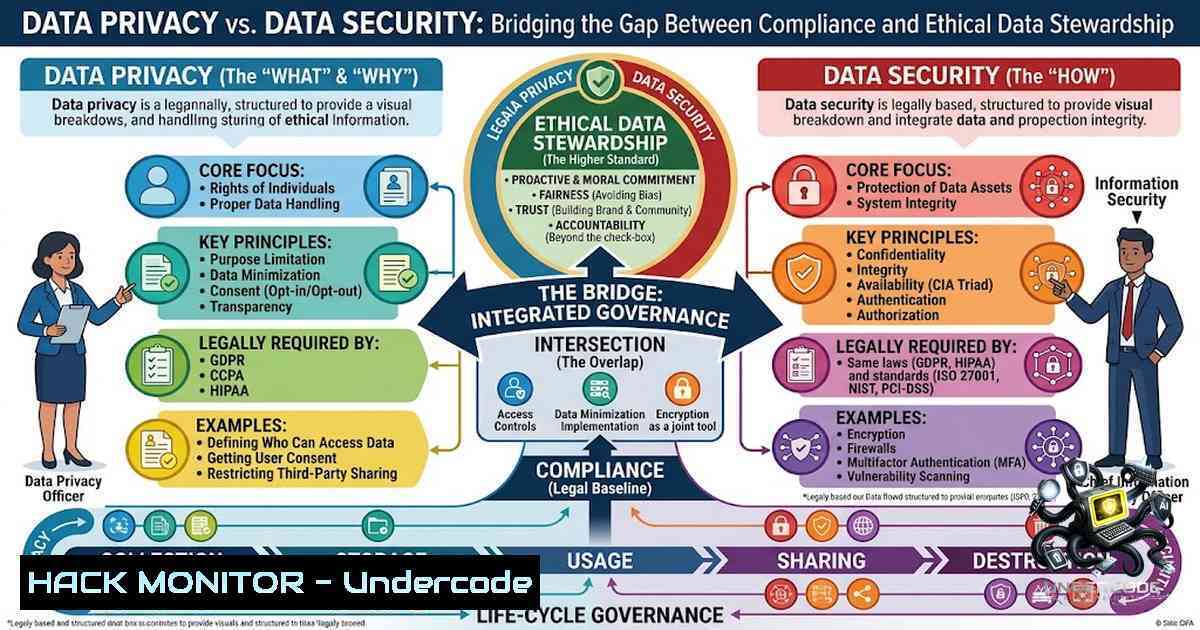
Introduction:
The contemporary digital ecosystem often conflates data privacy with cybersecurity, yet privacy extends far beyond the fortress walls of firewalls and intrusion detection systems. Data privacy is a multidisciplinary governance framework that dictates the lifecycle of personal information—from collection and utilization to storage and eventual destruction—while balancing individual rights against organizational utility. As artificial intelligence and big data analytics accelerate the velocity of data processing, the technical implementation of privacy-enhancing technologies (PETs) and compliance mechanisms has become a critical engineering challenge, requiring a synthesis of legal mandates like GDPR and DPDPA with cryptographic controls and access management architecture.
Learning Objectives:
- Understand the distinction between data privacy as a governance framework and data security as a technical control layer.
- Identify the core technical controls required for data lifecycle management, including encryption, access controls, and secure deletion.
- Gain hands-on proficiency in executing Linux, Windows, and API security commands to enforce data minimization and retention policies.
You Should Know:
- The Data Lifecycle: Mapping the Flow of Information
Data privacy is fundamentally about the journey of data. Before an engineer can enforce policies, they must map the data flow through the system. This involves identifying where personally identifiable information (PII) is ingested, transformed, stored, and eventually purged. Technical teams often rely on data discovery tools and manual directory enumeration to create a “data map.”
Step‑by‑step guide for Linux: Discovering and Auditing Files Containing Sensitive Data
To locate potential PII stored on a Linux file system, system administrators can utilize `grep` and `find` commands to search for patterns like email addresses or credit card numbers. This is a foundational step for compliance audits.
Command List:
 Search for email patterns in a directory recursively
grep -rE "[a-zA-Z0-9._%+-]+@[a-zA-Z0-9.-]+.[a-zA-Z]{2,4}" /path/to/data/
 Find files modified in the last 30 days that could contain sensitive data
find /data/ -type f -mtime -30 -exec ls -la {} \;
 Calculate file sizes to estimate storage usage of PII before deletion
du -sh /home/user/datasets/
- Access Control and the Principle of Least Privilege
One of the core tenets of privacy is ensuring that only personnel with a legitimate business need can access sensitive data. Technically, this is enforced via Role-Based Access Control (RBAC) and Identity and Access Management (IAM). For cloud environments, this means scrutinizing API keys and IAM roles to prevent over-privileged accounts. The “break-glass” procedure should be logged and monitored.
Step‑by‑step guide for Windows: Managing File Permissions and Auditing Access
In Windows environments, administrative commands allow privacy officers to review who has access to a specific folder housing HR or financial records. Using `icacls` is essential for checking permissions.
Command List:
 Display current permissions on a directory
icacls "C:\Sensitive_Data"
 Grant read-only access to a specific user
icacls "C:\Sensitive_Data" /grant "DOMAIN\User:(R)"
 Remove inherit permissions to enforce strict folder isolation
icacls "C:\Sensitive_Data" /inheritance:r
3. Data Minimization: Collection, Retention, and Secure Deletion
Data minimization is not just a policy but a technical requirement. Systems should be configured to automatically delete logs or customer data after the retention period expires. This often involves configuring logrotate, database TTL (Time To Live) indices, or permanent data erasure tools. Failure to implement this leads to data hoarding, which increases the attack surface.
Step‑by‑step guide for Linux/Unix: Configuring Log Rotation and Secure Deletion
To ensure logs containing IP addresses or user agents are purged automatically, configure logrotate. For secure file deletion that prevents forensic recovery, tools like `shred` or `wipe` are recommended.
Command List:
 Secure deletion of a file (overwrites 3 times by default)
shred -vfz -1 10 secret_data.csv
 Configure logrotate to rotate logs daily and keep 7 days
sudo nano /etc/logrotate.d/app-logs
 Inside the file:
 /var/log/app/.log {
 daily
 rotate 7
 compress
 missingok
 notifempty
 }
4. Encryption at Rest and In Transit
While cybersecurity focuses on preventing intrusions, privacy focuses on rendering the data useless to an intruder. Implementing encryption is a technical safeguard mandated by GDPR and DPDPA. This includes configuring TLS 1.3 for data in transit and utilizing LUKS or BitLocker for data at rest. Additionally, application-level encryption (field-level encryption) ensures that even database administrators cannot view plaintext PII.
Step‑by‑step guide for Linux: Encrypting a Directory with eCryptfs
eCryptfs provides a stackable cryptographic file system for Linux. This ensures that if a server’s physical storage is compromised, the data remains confidential.
Command List:
 Install eCryptfs utils
sudo apt-get install ecryptfs-utils
 Mount a directory with encryption
sudo mount -t ecryptfs /data/private /data/private
 Choose options: AES, key bytes, no plaintext passthrough
5. API Security and Privacy: Preventing Data Leakage
In modern microservices architectures, data privacy is often breached at the API layer. APIs that return too much user data (e.g., returning the user’s email or phone number in a response where it isn’t needed) violate data minimization. This requires implementing strict JSON/XML schema validation and filtering at the controller level.
Step‑by‑step guide for API Hardening: Rate Limiting and Response Filtering
To prevent scraping and exposure, implement rate limiting at the reverse proxy level (Nginx) and ensure server-side code filters out sensitive fields before serialization.
Nginx Configuration Snippet for Rate Limiting:
http {
limit_req_zone $binary_remote_addr zone=mylimit:10m rate=10r/s;
server {
location /api/ {
limit_req zone=mylimit burst=20 nodelay;
proxy_pass http://backend;
}
}
}
Best Practice: In Node.js/Python, explicitly use `.select()` or `.exclude()` in ORMs to avoid returning full database models.
- The Intersection of AI and Privacy: Model Inversion and Data Poisoning
With the rise of AI, privacy is at risk of “inference attacks.” Developers must consider privacy risks related to machine learning models. Techniques like Differential Privacy (adding noise to datasets) and Federated Learning are becoming essential. Furthermore, training data used for AI must be scrutinized to ensure it doesn’t contain proprietary or private information that can be extracted via prompt injection.
Step‑by‑step guide for AI Engineers: Sanitizing Training Data
Before feeding data into an ML pipeline, run a preprocessing script to redact PII.
Python Snippet for PII Redaction using Presidio:
from presidio_analyzer import AnalyzerEngine
from presidio_anonymizer import AnonymizerEngine

analyzer = AnalyzerEngine()
anonymizer = AnonymizerEngine()

text = "User email is [email protected]"
analyzer_results = analyzer.analyze(text=text, language='en')
anonymized = anonymizer.anonymize(text=text, analyzer_results=analyzer_results)
print(anonymized.text)  Output: User email is <EMAIL>
What Undercode Say:
- Privacy is a System Design Issue, Not Just a Legal Checkbox: Organizations must shift from viewing privacy as a compliance overhead to integrating it into the SDLC (Secure Development Lifecycle). This requires “Privacy by Design,” where engineers actively design schemas that omit unnecessary fields.
- The Cost of Ignorance is High: Data breaches leading to privacy violations often result in significant fines under GDPR/DPDPA and catastrophic brand damage. The technical implementation of these protections is the only defense against both external hackers and internal negligence.
Analysis: The conversation around privacy has matured from simple password management to complex data governance. Technical professionals must now wield both administrative commands (like `icacls` or shred) and cryptographic tools to enforce data rights. The modern data stack is messy; therefore, data mapping and inventory are prerequisites to any security strategy. As AI continues to ingest vast datasets, the privacy engineer’s role will increasingly overlap with the data scientist’s role to ensure that innovation does not come at the cost of individual rights. The ability to automate retention policies and audit trails is no longer optional but a business enabler.
Prediction:
- +1 A surge in demand for “Privacy Engineers” who possess coding skills (Python/Go) alongside compliance knowledge will reshape the cybersecurity job market, placing privacy on equal footing with network security.
- +1 Open-source tools for Differential Privacy and Synthetic Data generation will become standard in the AI development pipeline, allowing companies to train models without violating user consent.
- -1 The rise of state-sponsored cyber-espionage targeting corporate data lakes will force organizations to prioritize fragmented encryption (per row/per cell), increasing operational complexity and cost.
- +1 The DPDPA (India) and GDPR will harmonize into a global de facto standard, leading to the standardization of API security headers and data deletion protocols across international borders.
- -1 Legacy systems that cannot support data minimization (e.g., systems that require historical data to function) will become liability magnets, leading to expensive migrations or breaches as attackers exploit stagnant data lakes.
▶️ Related Video (80% Match):
🎯Let’s Practice For Free:
🎓 Live Courses & Certifications:
Join Undercode Academy for Verified Certifications
🚀 Request a Custom Project:
Secure, high-velocity infrastructure and disruptive technological engineering. Contact our engineering team for high-tier development and proprietary systems:
[email protected]
💎 Smart Architecture | 🛡️ Secure by Design | ⭐ Trusted by Thousands
IT/Security Reporter URL:
Reported By: https://lnkd.in/p/eu3D8J8r – Hackers Feeds
Extra Hub: Undercode MoN
Basic Verification: Pass ✅


