Listen to this Post
Introduction:
In the volatile landscape of social media, a deletion is not an erasure but often a significant data point. For cybersecurity professionals and OSINT practitioners, the ability to track and archive deleted content from high-profile accounts is a critical component of digital forensics and narrative analysis. By leveraging specialized archival tools, investigators can reconstruct timelines, verify past statements, and hold entities accountable by analyzing the digital debris left behind after a post is removed from public view.
Learning Objectives:
- Understand the mechanics of a dedicated tool for archiving deleted tweets from U.S. political figures.
- Learn how to apply OSINT techniques to analyze deleted content for narrative and timeline reconstruction.
- Identify alternative methods and commands for capturing web content before it is removed.
You Should Know:
1. Understanding the Polar Toolkit
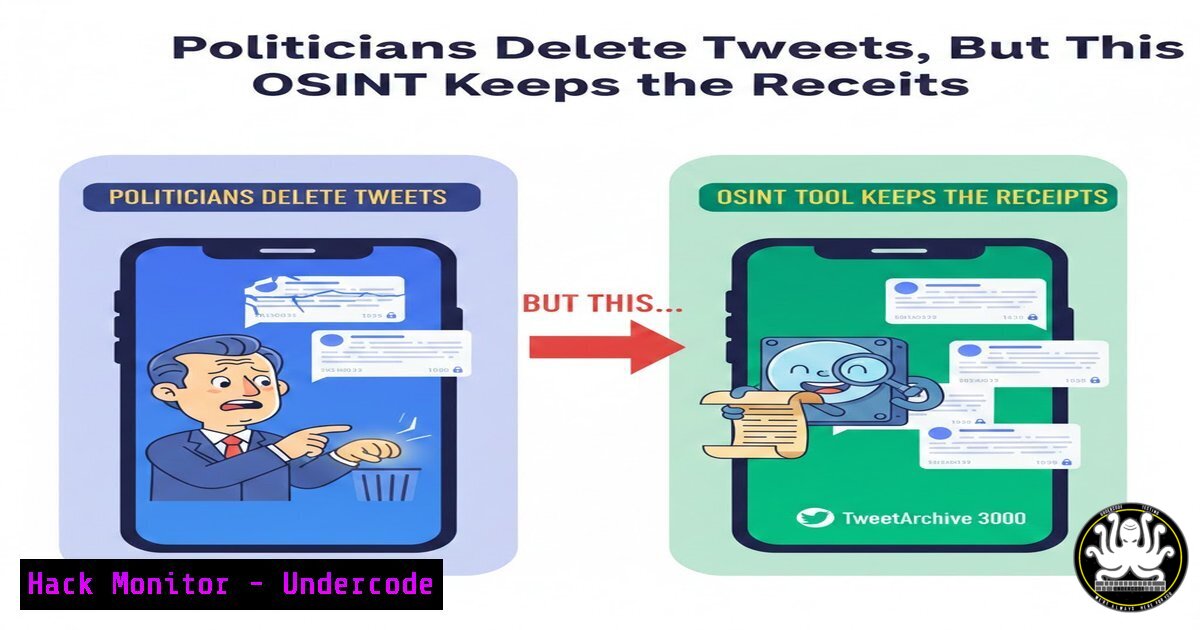
The tool referenced in the post (hosted at polar.io, though the specific link is shortened) is a specialized web application designed to monitor and archive the Twitter/X accounts of U.S. politicians, cabinet members, and candidates. When these accounts delete a tweet—often to walk back a controversial statement or correct a gaffe—the tool captures the original text, media, and metadata before it disappears from the public API.
What it does:
It acts as a watchdog. By polling the Twitter API (or using front-end scraping when API access is restricted), it compares the current timeline of a politician against its previous snapshot. Any tweet present in the old snapshot but missing in the new one is flagged, scraped, and stored in a public database.
How to use it conceptually:
1. Navigate to the tool’s main dashboard.
2. Browse by politician name, state, or office.
- View the “Deleted” feed to see recent removals.
- Analyze the content of the deleted tweet for context—why was it removed? Was it a factual error, a policy shift, or a public relations misstep?
-
Manual OSINT: Simulating the Archive with the Wayback Machine
While the Polar tool is automated, OSINT practitioners must know how to manually verify deletions using public archives.
Step-by-step guide for manual verification:
- Identify the Target: Find the Twitter handle of the official you are investigating (e.g., @POTUS or @SenatorX).
2. Access the Wayback Machine: Go to `archive.org`.
- Enter the URL: Paste the target’s Twitter profile URL into the Wayback Machine’s search bar.
- Select a Snapshot: Look for snapshots taken before the suspected deletion date. Twitter is notoriously difficult to archive fully, but profile pages and specific tweet links are often saved.
- Analyze the Capture: If the snapshot captured a now-deleted tweet, you will see the original post in its archived state.
3. Reconstructing Timelines via Command Line (Linux)
For technical OSINT analysts, relying on web interfaces is inefficient. Using Linux command-line tools, you can automate the monitoring of changes on a politician’s page.
Using `curl` and `diff` for change detection:
This is a simplified simulation of how the core logic of an archival tool works.
!/bin/bash
 Simple webpage change detector

URL="https://twitter.com/TargetPolitician"
OLD_FILE="previous_snapshot.html"
NEW_FILE="current_snapshot.html"

Download the current page (respect robots.txt and rate limiting)
curl -s -L -A "Mozilla/5.0 (Windows NT 10.0; Win64; x64) AppleWebKit/537.36 (KHTML, like Gecko) Chrome/91.0.4472.124 Safari/537.36" $URL -o $NEW_FILE

Check if the old file exists
if [ -f "$OLD_FILE" ]; then
 Compare the files
DIFF=$(diff $OLD_FILE $NEW_FILE)
if [ "$DIFF" != "" ]; then
echo "Change detected on $URL"
 Log the differences or trigger an alert
echo "$DIFF" > "change_log_$(date +%Y%m%d).txt"
else
echo "No changes detected."
fi
else
echo "First run. Creating baseline snapshot."
cp $NEW_FILE $OLD_FILE
fi
Note: Twitter’s front-end is heavily JavaScript-reliant, so `curl` alone will not capture dynamically loaded tweets. This script demonstrates the principle; advanced tools use headless browsers (like Selenium or Puppeteer) to render the JavaScript before taking a snapshot.
4. API Security: Why Restrictions Drive Innovation
The post mentions the tool shifted focus when Twitter’s API was restricted. This highlights a crucial intersection of API security and OSINT.
Understanding the shift:
- Before API Restrictions: Tools could use official API keys to directly query for deleted tweets via stream listeners.
- After API Restrictions (The “Walled Garden”): When APIs are paywalled or shut down, OSINT tools must adapt. They often resort to:
- Web Scraping: Using headless browsers to mimic human interaction.
- First-Party Data Collection: Relying on user reports or browser extensions to send data to a central server.
- Alternative Data Sources: Shifting focus to platforms with more open APIs (e.g., Telegram, Reddit) or to archival modes, as seen with Polar.
5. Windows OSINT: Using PowerShell for Web Requests
On a Windows machine, an OSINT analyst can use PowerShell to perform similar checks, focusing on the HTTP headers and status codes to see if a specific deleted tweet URL is now a “404 Not Found.”
PowerShell command to check a deleted tweet URL:
 Define the URL of the suspected deleted tweet
$tweetURL = "https://twitter.com/User/status/1234567890123456789"

Perform a web request and capture the response
try {
$response = Invoke-WebRequest -Uri $tweetURL -Method Head -ErrorAction Stop
if ($response.StatusCode -eq 200) {
Write-Host "Tweet is still public." -ForegroundColor Green
}
} catch {
if ($<em>.Exception.Response.StatusCode.value__ -eq 404) {
Write-Host "Tweet is deleted (404 Not Found)." -ForegroundColor Red
 Optionally, check the Wayback Machine automatically
$waybackURL = "https://web.archive.org/web//$tweetURL"
Start-Process $waybackURL
} else {
Write-Host "Error: $($</em>.Exception.Message)" -ForegroundColor Yellow
}
}
6. Mitigation and OpSec for Public Figures
From a defensive cybersecurity standpoint, understanding these tools is vital for the security teams protecting public figures. If a statement must be deleted, the deletion alone is insufficient.
Hardening against archival:
- The 24-Hour Rule: Controversial content rarely survives. If a statement is made in error, security teams must assume it was captured immediately by RSS feeds, scrapers, or screenshot tools.
- Narrative Control: Instead of quietly deleting a tweet (which invites speculation and archival), the official account should post a correction or retraction, acknowledging the change publicly. This frames the narrative rather than leaving the “deleted tweet” tool to do it.
- Content Moderation: Implementing a strict pre-approval workflow for social media posts to prevent embarrassing content from being published in the first place.
What Undercode Say:
- Deletions are Data: In cybersecurity forensics, the absence of data (a deleted tweet) is as informative as its presence. It signals a change in strategy, an error, or an attempt at damage control.
- The Arms Race: The cat-and-mouse game between OSINT tool developers and platform API restrictions is a microcosm of the larger cybersecurity landscape. When one data source closes, another opens or adapts.
This tool serves as a critical reminder that the internet does not forget. For the OSINT analyst, it provides a direct line to the unspoken revisions of public discourse. For the security professional, it is a stark warning that all digital actions, even deleted ones, are potential liabilities. The shift from live API tracking to historical archiving represents a maturation of the OSINT field, moving from real-time surveillance to deep-dive historical accountability.
Prediction:
As large language models (LLMs) become integrated into social media management, we will see a rise in “AI-hallucinated” tweets that are rapidly deleted. Future OSINT tools will need to evolve from simply tracking deletions to analyzing the semantic differences between a deleted AI-generated draft and its human-corrected follow-up, adding a new layer of complexity to narrative analysis.
▶️ Related Video (88% Match):
🎯Let’s Practice For Free:
IT/Security Reporter URL:
Reported By: Saadsarraj Osint – Hackers Feeds
Extra Hub: Undercode MoN
Basic Verification: Pass ✅


