Listen to this Post
Introduction:
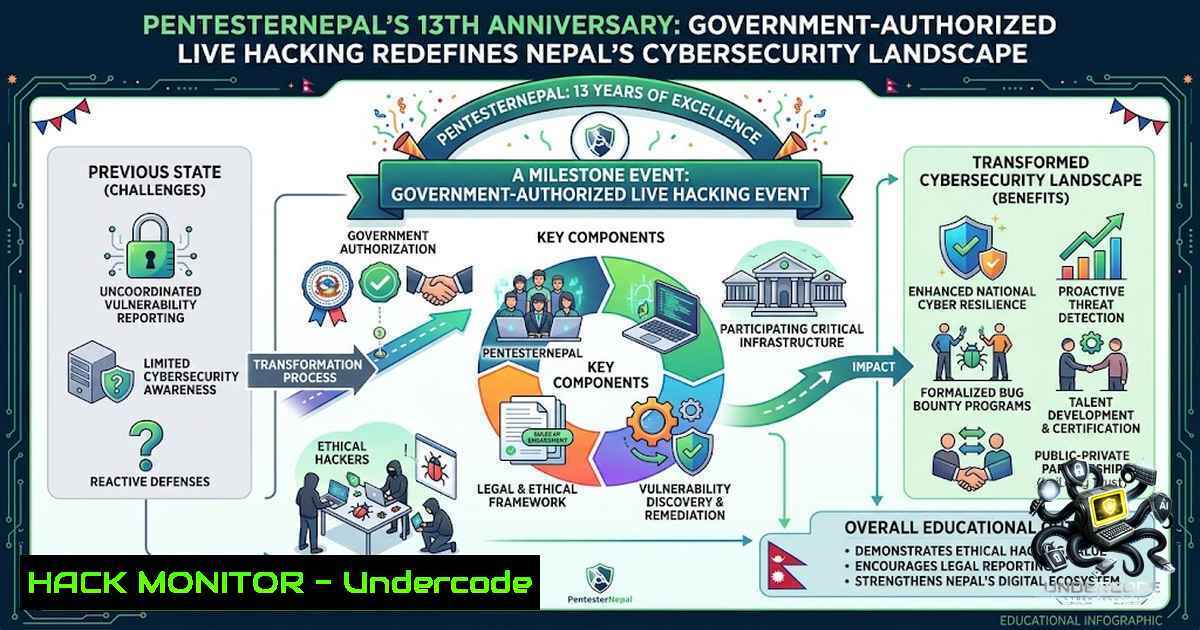
On August 15, 2026, PentesterNepal, in collaboration with OWASP Kathmandu, hosted its 13th Anniversary Celebration at Herald College Kathmandu, drawing over 450 security researchers, industry experts, students, and community leaders. The event’s centerpiece—a government-authorized live hacking exercise targeting an upcoming digital system from the Office of the Prime Minister and Council of Ministers (OPMCM)—marked a historic shift in Nepal’s cybersecurity posture. This milestone demonstrates how crowdsourced security, when institutionalized, can transform national digital infrastructure from reactive compliance into proactive, community-driven defense.
Learning Objectives:
- Understand the operational mechanics of government-authorized Vulnerability Disclosure Programs (VDPs) and live penetration testing.
- Master practical exploitation and mitigation techniques for modern attack vectors, including AI-driven exploits, Active Directory privilege escalation, and cloud misconfigurations.
- Apply hands-on Linux and Windows commands, tool configurations, and CTF-style problem-solving to real-world scenarios.
You Should Know:
- Government-Authorized Live Hacking: Anatomy of a National VDP
Nepal’s decision to authorize live ethical hacking of government systems represents a fundamental departure from traditional vendor-locked, compliance-based audits. In this model, vetted local security researchers conduct real-time vulnerability assessments on pre-release government software, identifying logic flaws, authentication bypasses, and misconfigurations before malicious actors can exploit them. The initiative, coordinated with the OPMCM, produced 54 reports with 12 accepted findings, 41 rejected, and 13 duplicates—demonstrating the rigor and scale of community-driven testing.
Step-by-Step Guide: Setting Up a Basic VDP Pipeline
For organizations looking to emulate this model, a structured VDP requires:
- Define Scope: Clearly document in-scope domains, IP ranges, and excluded systems. Use a `scope.txt` file:
cat > scope.txt << EOF
.gov.np
192.168.1.0/24
!192.168.1.10
EOF
-
Deploy a Reporting Portal: Use open-source platforms like DefectDojo or OWASP Bug Logging Framework to centralize submissions.
Deploy DefectDojo via Docker
docker run -d -p 8080:8080 --1ame defectdojo defectdojo/defectdojo-docker
-
Establish Triage Workflow: Assign severity ratings (Critical, High, Medium, Low) using CVSS v3.1 calculator:
Example: Calculate CVSS for a remote code execution
cvss-calculator --vector "CVSS:3.1/AV:N/AC:L/PR:N/UI:N/S:U/C:H/I:H/A:H"
-
Implement Safe Harbor: Draft legal agreements protecting researchers from prosecution when operating within scope.
-
Build a Hall of Fame: Publicly acknowledge contributors to incentivize ethical disclosure, as demonstrated by PentesterNepal’s recognition of Sandip Oli as Most Valuable Hacker (MVH) with 55 points.
-
Slop2Shell: Offensive Security in the Era of AI
Ananda Dhakal’s talk “Slop2Shell” addressed the emerging threat of AI-generated exploit code flooding internet-facing servers. The term “slop” refers to low-quality, AI-generated attack scripts that, while often crude, can be chained into effective exploits when combined with human ingenuity. Recent events like React2Shell (CVE-2025-55182) and WordPress WP2Shell demonstrate how AI models can generate working exploit chains from public vulnerability disclosures within hours.
Step-by-Step Guide: Detecting and Mitigating AI-Generated Exploit Traffic
- Monitor for Anomalous Request Patterns: Use ModSecurity with custom rules to detect AI-generated payloads:
ModSecurity rule to detect common AI-generated payload patterns
SecRule REQUEST_URI "@rx (?i)(eval|exec|system|passthru|shell_exec)" \
"id:10001,phase:2,deny,status:403,msg:'AI-generated payload detected'"
-
Deploy Web Application Firewall (WAF) with ML Capabilities: Use AWS WAF or Cloudflare with machine learning-based threat detection:
AWS CLI to enable ML-based WAF rules aws wafv2 update-web-acl --1ame MyWAF --scope REGIONAL \ --default-action Allow={} \ --rules file://ml-rules.json -
Implement Rate Limiting: AI-generated attacks often rely on brute-force scanning:
iptables rate limiting for suspicious IPs
iptables -A INPUT -p tcp --dport 80 -m hashlimit \
--hashlimit-1ame http --hashlimit-mode srcip \
--hashlimit-above 60/minute -j DROP
-
Honeypot Deployment: Deploy fake endpoints to bait and analyze AI-generated attacks:
Deploy T-Pot honeypot
docker run -d -p 64295:64295 -p 80:80 -p 443:443 --1ame tpot tpotce/t-pot
-
Patch Management Automation: AI exploits target unpatched systems; automate patching with Ansible:
</p></li>
</ol>

<p>- name: Apply critical security patches
hosts: webservers
tasks:
- name: Update all packages
apt:
upgrade: dist
update_cache: yes
when: ansible_os_family == "Debian"
3. Autonomous Remediation & Risk Visualization
Bipul G.’s presentation on autonomous remediation introduced AI-driven systems that not only detect threats but also automatically implement fixes without human intervention. This approach integrates SOAR (Security Orchestration, Automation, and Response) with SIEM (Security Information and Event Management) to create closed-loop security.
Step-by-Step Guide: Building an Autonomous Remediation Pipeline
- Integrate SIEM with SOAR: Use Elastic Stack (ELK) with TheHive for orchestration:
Install Elasticsearch, Logstash, Kibana
wget -qO - https://artifacts.elastic.co/GPG-KEY-elasticsearch | sudo apt-key add -
sudo apt-get install elasticsearch logstash kibana
-
Create Automated Playbooks: Use Cortex or Shuffle for playbook automation:
Example Shuffle playbook for IP blocking</p></li> </ol> <p>- name: Block Malicious IP trigger: SIEM_Alert actions: - name: Block IP in Firewall type: firewall-block parameters: ip: "{{ alert.source_ip }}" duration: 3600- Risk Visualization Dashboard: Build a Grafana dashboard to visualize risk scores:
-- Prometheus query for risk score aggregation avg(risk_score{severity="critical"}) by (service) -
Continuous Compliance Scanning: Use OpenSCAP to automate compliance checks:
Run OpenSCAP scan
oscap xccdf eval --profile xccdf_org.ssgproject.content_profile_standard \
--results scan_results.xml /usr/share/xml/scap/ssg/content/ssg-centos7-ds.xml
-
Yantra: Smarter Cybersecurity Through AI and Quantum Computing
Bibek Dhakal’s “Yantra” session explored AI- and quantum-powered Unified Security Posture Management (USPM) platforms. These platforms correlate real-time data with built-in SOAR and SIEM intelligence, enabling predictive threat detection.
Step-by-Step Guide: Deploying AI-Powered Threat Detection
- Install AI Detection Engine: Use TensorFlow for anomaly detection:
import tensorflow as tf
from sklearn.ensemble import IsolationForest

Load network traffic data
X_train = load_network_data()
model = IsolationForest(contamination=0.01)
model.fit(X_train)
predictions = model.predict(X_test)
-
Integrate with SIEM: Forward AI-detected anomalies to SIEM:
Send alerts to Elasticsearch curl -X POST "localhost:9200/alerts/_doc" -H 'Content-Type: application/json' -d' { "timestamp": "2026-08-17T10:00:00Z", "severity": "high", "description": "Anomalous network traffic detected", "source_ip": "192.168.1.100" }' -
Automated Response with Quantum-Inspired Optimization: Use simulated annealing for optimal response selection:
import numpy as np
from scipy.optimize import dual_annealing</p></li>
</ol>

<p>def objective(x):
return x[bash]2 + x[bash]2

result = dual_annealing(objective, bounds=[(-10, 10), (-10, 10)])
print("Optimal response parameters:", result.x)
5. Shadow Credentials & Active Directory Trust
Aaryan G.’s talk on “Shadow Credentials & AD Trust” addressed a sophisticated attack technique where adversaries modify the `msDS-KeyCredentialLink` attribute in Active Directory to implant unauthorized credentials. This allows attackers to authenticate using PKINIT (Public Key Cryptography for Initial Authentication) without requiring password-based attacks.
Step-by-Step Guide: Detecting and Mitigating Shadow Credentials
- Monitor for Attribute Modifications: Enable Windows Security Event Logging for Event ID 5136 (Directory Service Changes):
Enable auditing for AD attribute changes
auditpol /set /subcategory:"Directory Service Changes" /success:enable /failure:enable
-
Deploy Custom Detection Script: Use PowerShell to monitor
msDS-KeyCredentialLink:Monitor msDS-KeyCredentialLink modifications Get-WinEvent -FilterHashtable @{LogName='Security'; ID=5136} | Where-Object {$_.Message -match "msDS-KeyCredentialLink"} | Format-Table TimeCreated, Message -AutoSize
3. Implement Protective Measures:
- Enforce LDAP signing and channel binding on all Domain Controllers.
- Apply Deny ACE (Access Control Entry) on `msDS-KeyCredentialLink` for all Domain/Enterprise Admins.
Set Deny ACE for Domain Admins
$acl = Get-Acl "AD:CN=Domain Admins,CN=Users,DC=domain,DC=com"
$rule = New-Object System.DirectoryServices.ActiveDirectoryAccessRule(
"DOMAIN\Domain Admins",
"WriteProperty",
"Deny",
"msDS-KeyCredentialLink"
)
$acl.AddAccessRule($rule)
Set-Acl "AD:CN=Domain Admins,CN=Users,DC=domain,DC=com" $acl
- Regular Audits: Use Impacket’s `shadowcred` module for testing:
Test for Shadow Credentials vulnerability
python3 shadowcred.py domain/user:[email protected]
6. CVE Playground: Hands-On Vulnerability Learning
The CTF competition was hosted on CVE Playground, a platform offering hands-on labs based on real publicly disclosed CVEs. Participants solved 14 challenges covering web exploitation, cryptography, digital forensics, reverse engineering, and OSINT.
Step-by-Step Guide: Using CVE Playground for Practical Learning
- Access the Platform: Visit cveplayground.com and create an account.
-
Select a Lab: Choose from available CVEs including Linux kernel, cPanel, GitHub, Sequelize, and pac4j-jwt vulnerabilities.
3. Reproduce the Vulnerability:
- Read the vulnerable code and the original fix commit.
- Spin up a browser-based target environment.
- Trace the exploitation flow and understand the patch.
4. Exploit and Capture the Flag:
Example: Exploit a Sequelize injection vulnerability curl -X POST http://target.com/api/users \ -H "Content-Type: application/json" \ -d '{"username": "admin", "password": {"$ne": null}}'- Complete Guided Questions: Answer questions along the way to earn certificates.
What Undercode Say:
- Key Takeaway 1: Government-authorized VDPs represent the future of national cybersecurity—moving from reactive compliance to proactive, community-driven defense. Nepal’s initiative sets a precedent for other developing nations.
- Key Takeaway 2: The convergence of AI-generated exploits (Slop2Shell) and AI-powered defense (Yantra, autonomous remediation) creates an asymmetric arms race where speed of detection and response becomes the critical differentiator.
Analysis: The PentesterNepal 13th anniversary event was not merely a celebration but a strategic inflection point for Nepal’s cybersecurity ecosystem. By authorizing live hacking of government systems, Nepal has legitimized ethical hacking as a national security function. The 54 reports generated during the live hacking exercise underscore the effectiveness of crowdsourced security over traditional audits. Meanwhile, the technical talks—ranging from AI-driven exploitation to Active Directory privilege escalation—highlight the sophistication required of modern defenders. The CTF competition on CVE Playground further demonstrates the importance of hands-on, practical training in building a skilled workforce. As AI tools lower the barrier to entry for attackers, the defensive community must equally leverage AI for autonomous remediation and risk visualization. Nepal’s collaborative model—uniting government, academia, and the private sector—offers a blueprint for other nations seeking to build resilient digital infrastructure.
Prediction:
- +1 Government-authorized VDPs will become a global standard within 3–5 years, with developing nations adopting Nepal’s model to secure public infrastructure.
- +1 AI-powered autonomous remediation systems will reduce mean time to remediation (MTTR) by 60–70%, transforming SOC operations from reactive to predictive.
- -1 The proliferation of AI-generated exploit code (Slop2Shell) will increase the attack surface, requiring organizations to invest heavily in AI-driven defense mechanisms.
- -1 Shadow Credentials and similar AD-based attacks will become the primary vector for privilege escalation, necessitating continuous monitoring and zero-trust architecture.
- +1 Platforms like CVE Playground will democratize cybersecurity education, producing a new generation of practitioners who think like attackers.
▶️ Related Video (88% Match):
🎯Let’s Practice For Free:
🎓 Live Courses & Certifications:
Join Undercode Academy for Verified Certifications
🚀 Request a Custom Project:
Secure, high-velocity infrastructure and disruptive technological engineering. Contact our engineering team for high-tier development and proprietary systems:
[email protected]
💎 Smart Architecture | 🛡️ Secure by Design | ⭐ Trusted by ThousandsIT/Security Reporter URL:
Reported By: https://lnkd.in/p/erNdtA4n – Hackers Feeds
Extra Hub: Undercode MoN
Basic Verification: Pass ✅🔐JOIN OUR CYBER WORLD [ CVE News • HackMonitor • UndercodeNews ]
📢 Follow UndercodeTesting & Stay Tuned:
- Monitor for Attribute Modifications: Enable Windows Security Event Logging for Event ID 5136 (Directory Service Changes):
- Risk Visualization Dashboard: Build a Grafana dashboard to visualize risk scores:
- Integrate SIEM with SOAR: Use Elastic Stack (ELK) with TheHive for orchestration:


