Listen to this Post
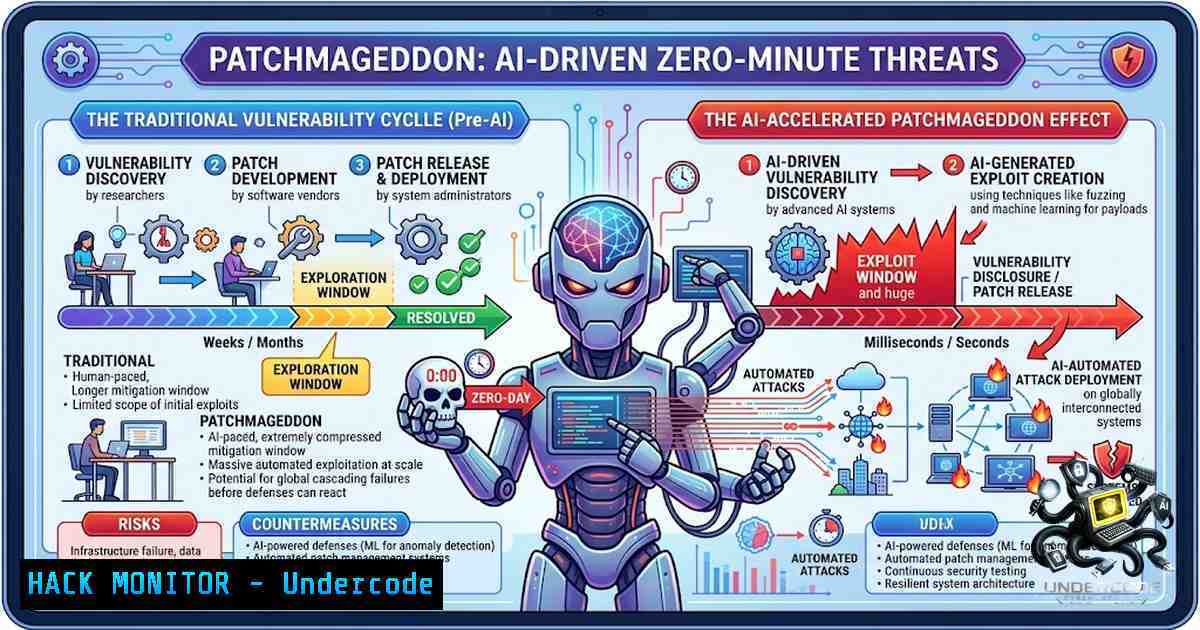
Introduction:
The cybersecurity industry is facing an unprecedented structural crisis as frontier AI models like Anthropic’s Claude Mythos and OpenAI’s GPT-5.5-Cyber have crossed a critical capability threshold—they now identify vulnerabilities in production software at a speed, scale, and cost efficiency that no human team can match. The average time between vulnerability disclosure and confirmed exploitation has collapsed from nearly a year in 2021 to just over a day in 2026, with projections toward one hour, then one minute. In May 2026 alone, Anthropic reported that of 530 high and critical vulnerabilities reported to maintainers, only 75 had been patched. JPMorgan’s Michael Cembalest warns that we have entered “Patchmageddon”—a world where state-grade cyber capabilities are increasingly accessible to ransomware operators, terrorists, and hacktivists.
Learning Objectives:
- Understand how frontier AI models are fundamentally altering the vulnerability discovery-to-exploitation lifecycle
- Master the technical commands and configurations needed to implement zero-day defense-in-depth strategies
- Learn to deploy AI-powered defensive tools and automate patch management at machine speed
- Develop breach-ready architecture patterns that assume compromise and prioritize rapid detection
You Should Know:
- The Collapse of the Patch Window: From Days to Negative Time
The traditional vulnerability management model assumed a positive gap between disclosure and exploitation—time to identify, prioritize, test, and deploy patches. That assumption is now obsolete. Mandiant’s M-Trends 2026 report puts estimated mean time to exploit at negative seven days, meaning exploitation is now routinely occurring before a patch is available. In 2018, that window was 63 days.
The numbers are staggering:
- Zero Day Clock reports that nearly 80% of attacks now occur on or before the day of vulnerability disclosure
- The median time-to-exploit fell from approximately one year in 2021 to one day in 2026
- Vulnerabilities that remain unexploited past six weeks have fallen to effectively zero
- Every vulnerability that will eventually be exploited is now attacked within 50 days of disclosure
What This Means for Defenders: Traditional patch cycles measured in weeks are no longer viable. Organizations must shift from prevention-heavy budgets to detection-dominant strategies. The decisive control becomes time to detection, not time to patch.
2. AI-Powered Vulnerability Discovery: The New Reality
Frontier AI models have demonstrated genuine capability in vulnerability discovery that far exceeds human or traditional automated scanning. Anthropic’s Claude Mythos Preview achieved 93.9% on SWE-bench and 73% on expert-level cybersecurity tasks where every prior LLM scored zero. It completed the UK AI Security Institute’s 32-step network-takeover range end-to-end.
Key discoveries from Mythos include:
- 271 zero-day bugs in the Firefox web browser
- A 27-year-old integer overflow in OpenBSD that survived decades of human review
- Bugs in TLS, SSH, and AES-GCM cryptographic libraries
- Chains allowing root access on smartphones via firmware vulnerabilities
The Defensive Countermeasure: Organizations must deploy AI-powered defensive tools to match offensive capabilities. Microsoft’s MDASH (Multi-Model Agentic Scanning Harness) uses over 100 specialized AI agents to automate vulnerability discovery, verification, and proof-of-exploit workflows. Open-source options like Vigolium ship with 235+ scanner modules combining deterministic scanning with AI-driven auditing.
3. Linux Hardening Commands for Zero-Day Resilience
Given that attackers now exploit vulnerabilities before patches exist, system hardening becomes the first line of defense. Below are essential Linux commands to implement defense-in-depth:
Kernel Hardening:
 Enable kernel address space layout randomization (KASLR)
echo 2 > /proc/sys/kernel/randomize_va_space

Restrict kernel pointer access
echo 2 > /proc/sys/kernel/kptr_restrict

Disable core dumps (prevents memory exposure)
echo " hard core 0" >> /etc/security/limits.conf
Filesystem Protections:
 Mount /tmp with noexec,nosuid,nodev
mount -o remount,noexec,nosuid,nodev /tmp

Enable SELinux enforcing mode
setenforce 1

Set immutable bit on critical files (prevents unauthorized modification)
chattr +i /etc/passwd /etc/shadow /etc/sudoers
Network Attack Surface Reduction:
 Block all unnecessary ports using iptables
iptables -A INPUT -p tcp --dport 22 -m conntrack --ctstate NEW -m recent --set
iptables -A INPUT -p tcp --dport 22 -m conntrack --ctstate NEW -m recent --update --seconds 300 --hitcount 3 -j DROP

Enable TCP SYN cookies (mitigates SYN flood attacks)
echo 1 > /proc/sys/net/ipv4/tcp_syncookies

Disable IPv6 if not required
echo "net.ipv6.conf.all.disable_ipv6 = 1" >> /etc/sysctl.conf
Automated Patch Management at Machine Speed:
 Configure unattended-upgrades for critical security patches
apt-get install unattended-upgrades
dpkg-reconfigure --priority=low unattended-upgrades

For RHEL/CentOS - automatic security updates
yum install yum-cron
systemctl enable yum-cron
systemctl start yum-cron
4. Windows Security Hardening and PowerShell Automation
Windows environments are equally vulnerable to AI-accelerated zero-day exploitation. Implement these configurations:
PowerShell Security Hardening:
 Enable PowerShell script block logging for threat detection
Set-ItemProperty -Path "HKLM:\SOFTWARE\Policies\Microsoft\Windows\PowerShell\ScriptBlockLogging" -1ame "EnableScriptBlockLogging" -Value 1

Disable PowerShell v2 (known insecure)
Disable-WindowsOptionalFeature -Online -FeatureName MicrosoftWindowsPowerShellV2

Set execution policy to restricted (prevents untrusted scripts)
Set-ExecutionPolicy -ExecutionPolicy Restricted -Scope LocalMachine
Windows Defender Advanced Threat Protection:
 Enable cloud-delivered protection
Set-MpPreference -CloudBlockLevel High

Enable network protection (prevents connections to malicious IPs)
Set-MpPreference -EnableNetworkProtection Enabled

Configure attack surface reduction rules
Add-MpPreference -AttackSurfaceReductionRules_Ids 3B576869-A4EC-41E9-A4C8-4D0C4921C8E6 -AttackSurfaceReductionRules_Actions Enabled
Automated Patching:
 Configure Windows Update for automatic security patches
Set-WUSettings -AutomaticUpdateOption 4 -ScheduledInstallDay 0 -ScheduledInstallTime 3

Force immediate update check and installation
Install-WindowsUpdate -AcceptAll -AutoReboot
5. Open Source Code Security: The Underappreciated Risk
JPMorgan’s report highlights the “underappreciated breadth and risks from open source code”. With AI models ingesting vast amounts of open-source code, vulnerabilities in these repositories are being discovered and weaponized at scale. Trend Micro’s scan of 19,000 MCP servers found that 4.1% of AI-identified vulnerabilities are genuinely exploitable, with SQL injection, remote code execution, and path traversal accounting for the majority. Critically, 42.6% of manually classified vulnerable repositories showed signs of AI code generation.
Open Source Security Commands:
 Scan for known vulnerabilities in dependencies (Python)
pip install safety
safety check --json

JavaScript/Node.js vulnerability scanning
npm audit --production --json

Comprehensive SCA with OWASP Dependency-Check
dependency-check --scan ./ --format JSON --out report.json

Detect AI-generated code in repositories
 Install aialib pipeline for AI-generated code detection
pip install aialib
aialib scan --repo ./project --output sarif
6. Critical Infrastructure Protection: Beyond IT Security
The threat extends beyond traditional IT systems. Physical infrastructure—power grids, water treatment, transportation, and AI data centers—is now in the crosshairs. AI has lowered the level of expertise previously required to attack critical infrastructure, making power systems more vulnerable. Data centers, long targets of cyberattacks, now face physical attacks as well—a phenomenon unique to 2026.
SCADA/ICS Security Checklist:
- Implement network segmentation isolating OT networks from IT networks
- Deploy industrial IDS/IPS with AI-powered anomaly detection
- Conduct regular AI-assisted penetration testing of control systems
- Establish incident response playbooks specific to infrastructure attacks
- Implement NIST SP 800-82 and IEC 62443 frameworks
7. Building Cyber Resilience for the AI Era
The World Economic Forum emphasizes that prevention alone is insufficient—organizations need the ability to detect, contain, and continue operating when incidents occur. Two priorities guide this shift:
First, defense must operate at machine speed. Detection, triage, and initial response increasingly need to happen without waiting for human intervention. The role of analysts is evolving toward supervising systems, investigating edge cases, and making higher-impact decisions.
Second, plan for breach scenarios. Threats can originate from compromised endpoints, suppliers, or development tools, making containment-focused architecture essential.
Deploying AI-Powered Defensive Tools:
 GhostPatch - local AI vulnerability scanner (zero infrastructure cost)
npx ghostpatch scan --target ./src --format sarif

Offsec-ai - full-stack AI security testing
pip install offsec-ai
offsec-ai scan --target https://api.example.com --llm-endpoint local

Vigolium - open-source AI-driven vulnerability scanner
git clone https://github.com/vigolium/vigolium
vigolium scan --target 192.168.1.0/24 --ai-audit enabled
What Undercode Say:
Key Takeaway 1: The patch window is dead. Organizations must abandon the assumption that they have days or weeks to respond to vulnerabilities. With mean time to exploit now negative, the focus must shift from prevention to rapid detection and containment. Security budgets should reallocate from preventive controls to detection and response capabilities.
Key Takeaway 2: AI is both the problem and the solution. While frontier AI models are democratizing offensive capabilities, the same technology can be deployed defensively. Organizations that fail to adopt AI-powered security tools will be outmatched by attackers who do. The gap between AI-enabled attackers and human-speed defenders will only widen.
Analysis: The Patchmageddon report represents a watershed moment in cybersecurity. The structural shift from episodic to continuous vulnerability discovery fundamentally breaks the traditional risk management model. Organizations can no longer measure, prioritize, and reduce exposure over time—the backlog expands rather than contracts. The most striking finding is that Mythos discovered vulnerabilities that had survived 27 years of human review, demonstrating that human expertise alone is no longer sufficient. The implication is clear: cybersecurity must transform from a human-led discipline with automated tools to an AI-led discipline with human supervision. The organizations that survive the next decade will be those that embrace this transformation now, not those that wait for regulatory mandates or catastrophic breaches to force change. The economic implications are equally profound—the cost of breaches will skyrocket as attack speeds increase, and cyber insurance may become unattainable for organizations without AI-powered defenses.
Expected Output:
Introduction:
The cybersecurity industry is facing an unprecedented structural crisis as frontier AI models like Anthropic’s Claude Mythos and OpenAI’s GPT-5.5-Cyber have crossed a critical capability threshold—they now identify vulnerabilities in production software at a speed, scale, and cost efficiency that no human team can match. The average time between vulnerability disclosure and confirmed exploitation has collapsed from nearly a year in 2021 to just over a day in 2026, with projections toward one hour, then one minute. In May 2026 alone, Anthropic reported that of 530 high and critical vulnerabilities reported to maintainers, only 75 had been patched. JPMorgan’s Michael Cembalest warns that we have entered “Patchmageddon”—a world where state-grade cyber capabilities are increasingly accessible to ransomware operators, terrorists, and hacktivists.
What Undercode Say:
- Key Takeaway 1: The patch window is dead. Organizations must abandon the assumption that they have days or weeks to respond to vulnerabilities. With mean time to exploit now negative, the focus must shift from prevention to rapid detection and containment. Security budgets should reallocate from preventive controls to detection and response capabilities.
- Key Takeaway 2: AI is both the problem and the solution. While frontier AI models are democratizing offensive capabilities, the same technology can be deployed defensively. Organizations that fail to adopt AI-powered security tools will be outmatched by attackers who do. The gap between AI-enabled attackers and human-speed defenders will only widen.
Expected Output:
Introduction:
[2–3 sentence cybersecurity‑angle introduction]
What Undercode Say:
- Key Takeaway 1
- Key Takeaway 2
Expected Output:
Prediction:
- +1 AI-powered defensive tools will become as essential as firewalls and antivirus within 24 months, creating a new multi-billion-dollar cybersecurity market segment.
- -1 The democratization of state-grade cyber capabilities will lead to a surge in ransomware attacks on critical infrastructure, potentially causing physical harm and loss of life within the next 12-18 months.
- +1 Organizations that successfully implement machine-speed detection and response will gain significant competitive advantage, as cyber resilience becomes a key differentiator in customer trust and regulatory compliance.
- -1 The cybersecurity skills gap will widen dramatically as AI offensive capabilities outpace the human workforce’s ability to respond, leading to a crisis in talent availability.
- +1 Regulatory bodies like CISA will mandate AI-powered vulnerability scanning and sub-24-hour patch windows, driving widespread adoption of defensive AI technologies.
- -1 Small and medium businesses without access to AI-powered defenses will become prime targets for ransomware operators, potentially leading to a wave of business failures.
- +1 The development of AI models specifically designed for defensive security will accelerate, creating a new category of “cyber AI” that can operate autonomously at machine speed.
- -1 The physical security of AI data centers will become a critical national security concern, with potential for kinetic attacks on these facilities as seen in the US-Iran conflict.
- +1 Open-source security frameworks like Akrites will emerge to protect open-source projects from AI-generated attacks, creating a new ecosystem of community-driven security.
- -1 The average enterprise will continue to take 60 days to close critical vulnerabilities, ensuring that attackers maintain a significant advantage for the foreseeable future.
▶️ Related Video (88% Match):
🎯Let’s Practice For Free:
🎓 Live Courses & Certifications:
Join Undercode Academy for Verified Certifications
🚀 Request a Custom Project:
Secure, high-velocity infrastructure and disruptive technological engineering. Contact our engineering team for high-tier development and proprietary systems:
[email protected]
💎 Smart Architecture | 🛡️ Secure by Design | ⭐ Trusted by Thousands
IT/Security Reporter URL:
Reported By: Todd Teal – Hackers Feeds
Extra Hub: Undercode MoN
Basic Verification: Pass ✅


