Listen to this Post
Introduction:
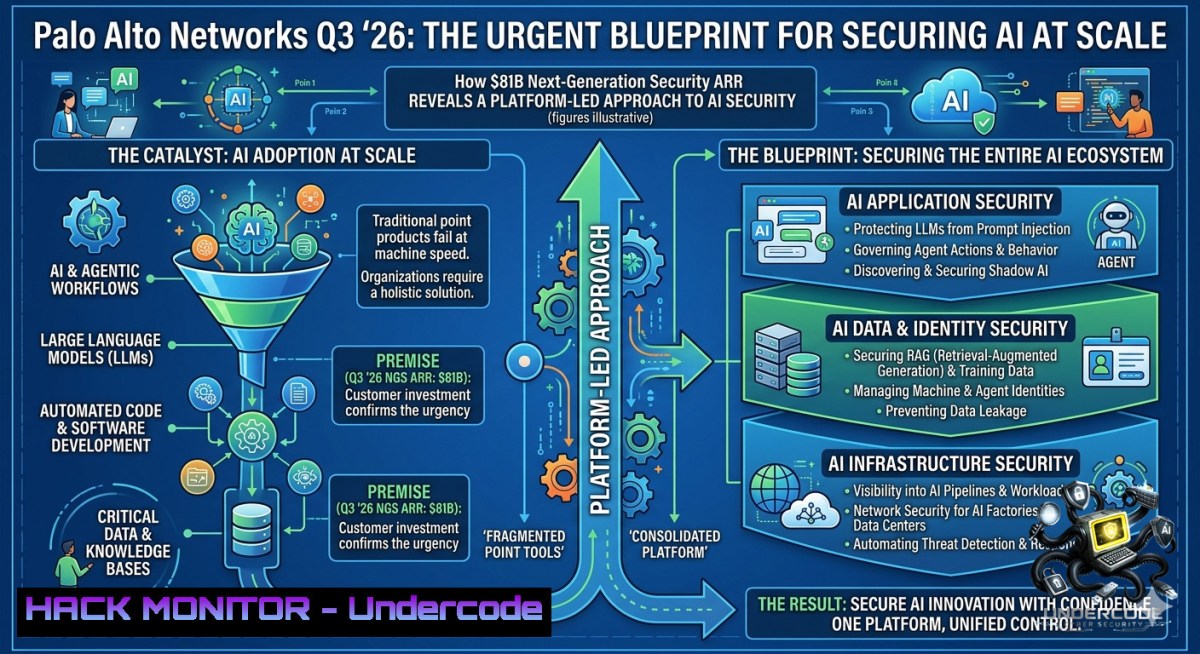
Palo Alto Networks’ stellar Q3’26 results—highlighting 60% YoY NGS ARR growth to $8.1B and 36% RPO growth to $18.4B—underscore a massive enterprise shift toward “platformization” for AI security. As organizations rush to deploy AI at scale, integrating best-in-class solutions like CyberArk (privileged access) and Chronosphere (observability) into a unified security fabric is no longer optional; it’s the new imperative for defending against AI-driven threats and compliance blind spots.
Learning Objectives:
– Implement a platformization strategy that reduces tool sprawl and accelerates AI deployment security.
– Harden AI workloads using container-level controls, privileged access management (PAM), and real-time observability.
– Apply NGS ARR and RPO metrics as leading indicators for security program maturity and ROI.
You Should Know:
1. Platformization: Consolidating Your Security Stack for AI Scale
Platformization means moving from point products to an integrated ecosystem where data, policies, and responses unify. Palo Alto’s success with CyberArk and Chronosphere integration proves that eliminating silos improves detection and reduces operational friction.
Step‑by‑step guide to assess and migrate to a platform model:
1. Inventory all security tools and identify overlaps (e.g., three vendors for PAM).
2. Map your AI data pipeline (training data → inference endpoints) to required controls: secrets management, workload scanning, and anomaly detection.
3. Select an anchor platform (e.g., Palo Alto Prisma Cloud) that natively integrates with CyberArk for privileged sessions and Chronosphere for metrics.
4. Pilot on a non‑critical AI application, measure latency and alert accuracy.
Commands to test API integration with Palo Alto’s platform (Linux/macOS):
 Authenticate to PAN-OS API (replace with your API key and firewall IP)
curl -X GET 'https://<firewall-ip>/api/?type=keygen&user=<admin>&password=<pass>' -k

 Query NGS ARR-like metrics from Prisma Cloud (requires API token)
curl -X GET 'https://api.prismacloud.io/v2/alert' -H 'x-redlock-auth: <your-token>'
Windows (PowerShell) equivalent for CyberArk REST API:
$headers = @{ Authorization = "Basic $([bash]::ToBase64String([Text.Encoding]::ASCII.GetBytes('user:pass')))" }
Invoke-RestMethod -Uri "https://cyberark-server/PasswordVault/api/Accounts" -Method Get -Headers $headers
2. Hardening AI Workloads: Container and Model Integrity
AI models and their serving infrastructure (e.g., KServe, TensorFlow Serving) are prime targets for model poisoning and backdoor injection. Use runtime security and immutable image scanning.
Step‑by‑step container hardening for AI models:
1. Scan base images with `trivy` or `grype` before deployment.
2. Enforce eBPF-based runtime monitoring using Falco or Palo Alto’s Prisma Cloud Defender.
3. Apply seccomp profiles to limit syscalls from Python inference engines.
4. Mount model volumes as read-only and verify checksums at startup.
Linux commands for image scanning and runtime policies:
 Scan a local docker image for CVEs (install trivy first)
trivy image tensorflow/serving:latest --severity HIGH,CRITICAL

 Run Falco with custom rules for AI model directory writes
sudo falco -r /etc/falco/falco_rules.yaml -r /path/to/ai-rules.yaml
 Example ai-rule: detect writes to /models/.h5
- rule: AI_Model_Write
desc: Detect unauthorized modification of AI model files
condition: open_write and fd.name contains "/models/"
output: "Model file write detected (user=%user.name file=%fd.name)"
priority: CRITICAL
3. Privileged Access Management (PAM) with CyberArk for AI Pipelines
AI data engineers and MLOps platforms require privileged access to GPUs, training datasets, and model registries. CyberArk’s PSM and PSMP help isolate sessions and rotate credentials.
Step‑by‑step to configure a just-in-time (JIT) access for an AI training VM:
1. In CyberArk Vault, create a platform for “AI Ubuntu 22.04” with SSH connection component.
2. Define time‑based access policy (e.g., 2-hour window for model retraining).
3. Deploy CyberArk PSMP on a jump host: `sudo dpkg -i cyberark-psmp.deb`.
4. Enforce session recording for all `kubectl exec` commands into AI pods.
Linux commands to verify JIT access flow:
 On target AI host, list active CyberArk-managed users (plugin)
sudo cyberark-get-credentials --username aiexpert --duration 120

 Rotate SSH key using CyberArk AIM CLI (after session ends)
./aim_cli.sh -p "AI_KeyPair" -a Rotate
Windows command for CyberArk PVWA credential retrieval:
powershell -Command "Invoke-RestMethod -Uri 'https://cyberark/AIMWebService/api/Accounts?AppID=MLOps&Safe=AI' -UseDefaultCredentials"
4. Observability‑Driven Security Using Chronosphere Metrics
Chronosphere (now integrated into Palo Alto’s stack) provides high‑cardinality observability to detect anomalous API calls to LLM endpoints or sudden GPU memory spikes indicative of model extraction attacks.
Step‑by‑step to set up Chronosphere alerts for AI inference anomalies:
1. Deploy the Chronosphere collector as a sidecar to your model serving pod.
2. Tag metrics with `model_version`, `user_id`, and `input_tokens`.
3. Create a PromQL query to flag request rates exceeding 3σ of baseline.
4. Feed alerts into Palo Alto XSOAR for automated response (rate‑limit the API gateway).
Example PromQL for anomalous token usage (Linux/Chronosphere CLI):
 Detect spike in tokens per second (5m rolling average)
avg_over_time(model_tokens_per_second[bash]) > (stddev_over_time(model_tokens_per_second[bash])  3 + avg_over_time(model_tokens_per_second[bash]))

 Simulate metric query using curl against Chronosphere API
curl -X POST 'https://api.chronosphere.io/v1/query' -H 'Authorization: Bearer <token>' -d 'query=sum(rate(container_cpu_usage_seconds_total{pod=~"ai-inference-."}[bash]))'
5. Measuring Security ROI with NGS ARR and RPO
NGS ARR (Next‑Gen Security Annual Recurring Revenue) and RPO (Remaining Performance Obligations) are financial proxies for platform adoption. Security leaders can mirror these internally by tracking “platform coverage percentage” and “contracted security backlog.”
Step‑by‑step to calculate your organization’s security platform metric:
1. Identify which assets (cloud workloads, user endpoints, AI models) are covered by your primary platform (e.g., Prisma Cloud).
2. Compute Platform Coverage Ratio = (Assets under platform management) / (Total assets).
3. Track Security RPO as the sum of committed multi‑year contracts for integrated modules (PAM + observability + CNAPP).
Python script to simulate RPO trend analysis (run on Linux/Windows with Python 3):
import pandas as pd
import matplotlib.pyplot as plt

 Sample quarterly security contract data
data = {'Quarter': ['Q3\'25', 'Q4\'25', 'Q1\'26', 'Q2\'26', 'Q3\'26'],
'RPO_Million': [14200, 15800, 16700, 17900, 18400]}
df = pd.DataFrame(data)
df['YoY_Growth'] = df['RPO_Million'].pct_change(periods=4)  100
print("RPO YoY Growth:", df['YoY_Growth'].iloc[-1], "%")
 Plot
plt.plot(df['Quarter'], df['RPO_Million'], marker='o')
plt.title('Security RPO (Remaining Performance Obligations)')
plt.show()
6. Zero‑Trust for AI Deployments: Micro‑segmentation and API Security
AI models often expose REST/gRPC APIs that become attack surfaces. Combine network micro‑segmentation (e.g., with Calico or Palo Alto VM‑Series) and API security gateways to validate input sanitization.
Step‑by‑step micro‑segmentation for an AI inference namespace in Kubernetes:
1. Install Calico or Cilium and enable network policies.
2. Deny all ingress except from authorized API gateway pod.
3. Create a policy that blocks egress to untrusted external IPs (prevents model exfiltration).
4. Use `tcpdump` to verify no lateral movement from the AI pod.
Linux commands to test segmentation (inside AI pod):
 Attempt to reach an unauthorized service (should fail)
curl -m 2 http://internal-db.prod.svc:5432
 Expected: Connection timeout or reset

 Verify allowed egress only to API gateway
ip route get $(getent hosts api-gateway | awk '{print $1}')
Windows command to check connectivity to AI endpoint after applying policy:
Test-1etConnection -ComputerName ai-model.prod.local -Port 443 -InformationLevel Detailed
7. Migrating from Legacy to Platform‑Based Security: A Tactical Plan
Vendors like Palo Alto have shown that integrated platforms reduce TCO by 30‑40% while increasing threat response speed. Use a phased cutover to avoid operational disruption.
Step‑by‑step migration for a hybrid environment:
1. Phase 1 (Weeks 1–4): Run the new platform (e.g., Palo Alto NGS) in monitor‑only mode alongside legacy tools. Use `syslog` forwarding to compare alerts.
2. Phase 2 (Weeks 5–8): Migrate critical detection rules (e.g., for AI data poisoning) into the new platform’s XDR engine.
3. Phase 3 (Weeks 9–12): Decommission redundant point products, update firewall rules to proxy through the new platform’s IPS.
4. Post‑migration: Measure NGS ARR‑like metric (percentage of workloads protected by platform) weekly.
Example log forwarding from legacy SIEM to new platform (Linux rsyslog):
 In /etc/rsyslog.conf, forward all local logs to Palo Alto Log Forwarder
. @192.168.1.100:514
sudo systemctl restart rsyslog
Windows Event Forwarding command for native platform ingestion:
wecutil qc
New-EventLogSubscription -Source "LegacySecurityLogs" -Destination "https://pan-log-collector:8443"
What Undercode Say:
– Key Takeaway 1: Platformization is not a marketing buzzword—it’s a measurable driver of security efficiency. Palo Alto’s 60% NGS ARR growth proves that customers are willing to consolidate when integration (e.g., CyberArk + Chronosphere) delivers tangible reductions in alert fatigue and breach risk.
– Key Takeaway 2: AI security demands a shift from siloed point controls to a unified stack combining PAM, observability, and workload hardening. The rapid adoption of AI deployments is forcing CFOs and CISOs to co-own metrics like RPO as leading indicators of resilience.
Analysis (approx. 10 lines): The Q3’26 results reveal that enterprises are treating AI security as a strategic board-level priority, not an afterthought. The integration of Chronosphere (observability) with Palo Alto’s core allows real-time anomaly detection on LLM token usage—crucial for spotting prompt injection or data exfiltration. Meanwhile, CyberArk’s privileged access modules lock down MLOps pipelines where credentials often sprawl across Jupyter notebooks. The 36% RPO growth suggests buyers are locking in multi-year platform commitments, signaling confidence that “platformizing” reduces future incident response costs. However, this also raises a challenge: vendor lock-in risk. Organizations must demand open APIs and standardized data schemas (e.g., OpenTelemetry, STIX) to avoid becoming captive to a single ecosystem. The most successful adopters will treat platformization as an enabler for Zero Trust, where every AI component—from training data to inference endpoint—is continuously verified rather than implicitly trusted.
Prediction:
– +1 By Q4’27, over 60% of Fortune 500 companies will have adopted a single security platform for AI workloads, driving a 45% reduction in mean time to contain (MTTC) AI-related breaches.
– -1 Vendor‑specific security APIs will fragment the market, causing 15‑20% of enterprises to face costly re‑platforming within 3 years due to integration dead ends.
– +1 Open standards for AI security telemetry (e.g., OWASP AI Exchange, MITRE ATLAS) will emerge as compulsory procurement requirements, mitigating lock‑in risk.
– -1 The complexity of migrating legacy PAM and observability tools will temporarily increase operational overhead, leading to a 10% spike in security staffing costs for mid‑size firms in 2026–2027.
🎯Let’s Practice For Free:
🎓 Live Courses & Certifications:
[Join Undercode Academy for Verified Certifications](https://undercode.co.uk/certifications/)
🚀 Request a Custom Project:
Secure, high-velocity infrastructure and disruptive technological engineering. Contact our engineering team for high-tier development and proprietary systems:
[[email protected]](mailto:[email protected])
💎 Smart Architecture | 🛡️ Secure by Design | ⭐ Trusted by Thousands
IT/Security Reporter URL:
Reported By: [Dipak Golechha](https://www.linkedin.com/posts/dipak-golechha-8b9a209_very-pleased-to-announce-the-results-of-palo-share-7467691442438696960-QeMO/) – Hackers Feeds
Extra Hub: Undercode MoN
Basic Verification: Pass ✅
🔐JOIN OUR CYBER WORLD [ CVE News • HackMonitor • UndercodeNews ]
[💬 Whatsapp](https://undercode.help/whatsapp) | [💬 Telegram](https://t.me/UndercodeCommunity)
📢 Follow UndercodeTesting & Stay Tuned:
[𝕏 formerly Twitter 🐦](https://x.com/undercodeupdate) | [@ Threads](https://www.threads.net/@undercodetesting) | [🔗 Linkedin](https://www.linkedin.com/company/undercodetesting/) | [🦋BlueSky](https://bsky.app/profile/undercode.bsky.social)


