
Listen to this Post
Introduction:
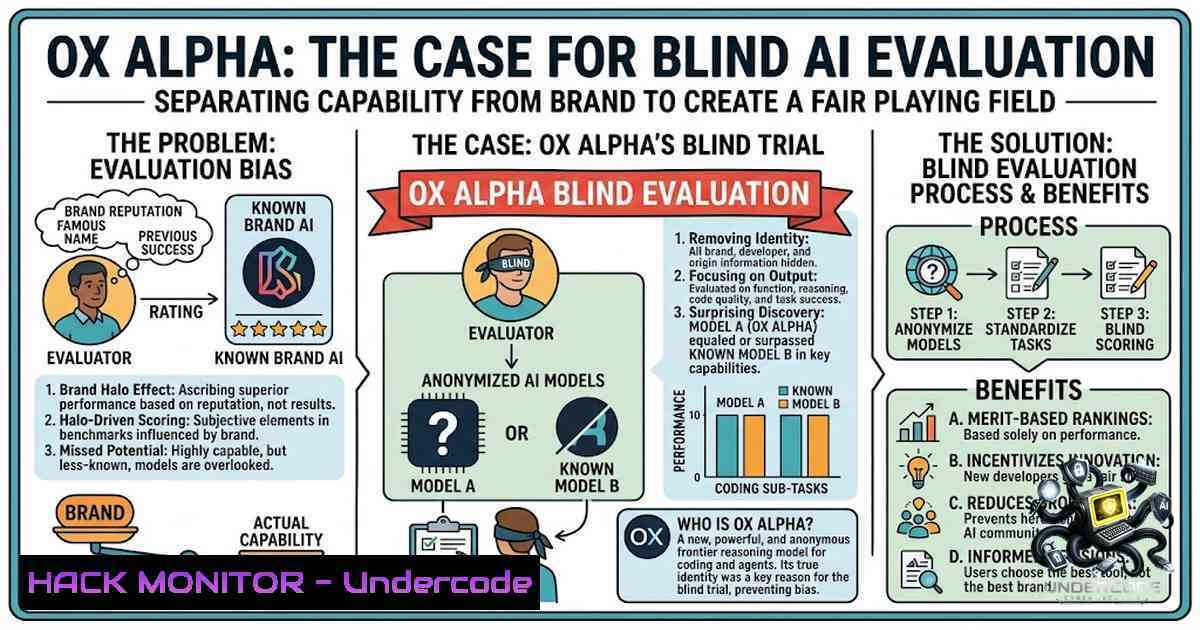
The AI industry witnessed an unprecedented experiment in August 2026 when an anonymous model called Ox Alpha appeared on OpenRouter and OpenCode, quickly becoming the most-used model of the week before its creator, Z.ai, revealed it as GLM-5.3-Flash. This stealth launch deliberately removed brand signals—reputation, country of origin, and vendor relationships—from the initial evaluation process, allowing developers to assess the model purely on performance. The experiment raises a fundamental question for cybersecurity and AI procurement: when organizations evaluate AI models, are they assessing capability or merely responding to brand cues?
Learning Objectives & Secrets:
- Objective 1: Understand the Stealth Model Launch Pattern – Learn how anonymous deployment on platforms like OpenRouter and OpenCode enables real-world performance testing at scale, free from brand bias. Z.ai’s test generated 23.2 trillion tokens of usage in one week—double that of DeepSeek’s V4 Flash.
-
Objective 2 Secret Tip: Fingerprint Anonymous Models Using Tokenizer Analysis – Model families inherit distinct tokenizer behaviors that are nearly impossible to disguise. By feeding models unusual strings, emoji sequences, or mixed scripts, you can match tokenization patterns to known families. The community identified Ox Alpha as a GLM model within 48 hours using this technique.
-
Objective 3 Secret Tip: Combine Behavioral Signals for Provenance Attribution – Beyond tokenizers, analyze refusal formatting, multilingual behavior (especially Chinese vs. English prompt responses), benchmark performance profiles, and serving characteristics (latency patterns, error codes). Ox Alpha’s 1210 error code on reasoning_effort parameters and Chinese-language error messages strongly pointed to Zhipu AI.
You Should Know:
1. Anonymous AI Model Fingerprinting: A Step-by-Step Guide
When an anonymous model appears, security teams and researchers need systematic methods to identify its origin before committing to integration. Here’s how the community identified Ox Alpha:
Step 1: Tokenizer Fingerprinting
Different AI labs use distinct tokenizers inherited across model releases. To compare:
 Using tokwhois - a zero-1etwork tokenizer fertility fingerprinting tool
git clone https://github.com/fasuizu-br/tokwhois
cd tokwhois
pip install -e .
python3 -m tokwhois demo --model stealth/ox-alpha
The tool generates a 14-integer fertility vector that uniquely identifies tokenizer families.
Step 2: Behavioral Probing
Send test prompts designed to elicit family-specific responses:
import requests

Test multilingual behavior - Chinese prompts often reveal origin
test_prompts = [
"Explain the concept of attention mechanism",  English
"解释注意力机制的概念",  Chinese
"Explain the concept of attention mechanism in Chinese"  Code-switching
]

for prompt in test_prompts:
response = requests.post(
"https://openrouter.ai/api/v1/chat/completions",
headers={"Authorization": f"Bearer {api_key}"},
json={"model": "stealth/ox-alpha", "messages": [{"role": "user", "content": prompt}]}
)
 Analyze response patterns, refusal styles, and formatting
Step 3: Error Code Analysis
When the model encounters unsupported parameters, observe error messages. Ox Alpha’s `reasoning_effort` parameter returned error code 1210—a known Zhipu signature.
Step 4: Benchmark Profile Comparison
Run a standard evaluation battery and compare the relative strengths and weaknesses against known models:
 Using llm-fingerprint-detector
export OPENAI_API_KEY="your-api-key"
npx llm-fingerprint-detector fingerprint --endpoint https://openrouter.ai/api/v1 --model stealth/ox-alpha
This performs single-token behavioral fingerprinting to verify which LLM an API endpoint actually serves.
2. Deploying GLM-5.3-Flash: API Integration and Self-Hosting
Following Z.ai’s reveal, GLM-5.3-Flash became available as an open-weights model under the MIT license. Here’s how to integrate it:
API Access via OpenRouter:
curl https://openrouter.ai/api/v1/chat/completions \
-H "Authorization: Bearer $OPENROUTER_API_KEY" \
-H "Content-Type: application/json" \
-d '{
"model": "z-ai/glm-5.3-flash",
"messages": [{"role": "user", "content": "Write a Python function to validate an API token"}],
"max_tokens": 4096
}'
Self-Hosting from Hugging Face:
 Install huggingface hub CLI
pip install -U "huggingface_hub[bash]"

Download the model weights (320B total, 18B active parameters)
hf download zai-org/GLM-5.3-Flash --local-dir ./glm-5.3-flash

Using llama.cpp for GGUF quantized version
git clone https://github.com/ggerganov/llama.cpp
cd llama.cpp
make
./llama-cli -m ./GLM-5.3-Flash-IQ4_XS-00001-of-000NN.gguf -p "Your prompt here"
The model features a Mixture-of-Experts architecture with 320 billion total parameters but activates only 18 billion per token, making it cost-efficient at $0.15 per million input tokens.
3. Security Considerations for Anonymous and Stealth Models
The Ox Alpha case exposed critical governance gaps that security teams must address:
Data Governance Risks:
OpenRouter’s Ox Alpha model page stated prompts would not be used for training, but the Stealth Program’s general terms permitted training use—a dangerous inconsistency. Before using any anonymous model:
 Audit data retention policies - check model provider documentation
curl https://openrouter.ai/terms/stealth | grep -i "training|retention"
curl https://openrouter.ai/stealth/ox-alpha | grep -i "training|retention"
Jurisdictional Unknowns:
Z.ai acknowledged that Ox Alpha’s inference ran on Chinese AI chips but did not disclose the physical location of computing clusters. For sensitive workloads:
- Verify data sovereignty compliance before deployment
- Implement data masking and tokenization for sensitive inputs
- Use local or on-premise deployment when possible
API Security Hardening:
 Example: Secure API integration with audit logging
import hashlib
import json
import logging
from datetime import datetime

def secure_model_call(prompt, model="z-ai/glm-5.3-flash"):
 Hash sensitive data before sending (if unavoidable)
sensitive_patterns = ["api_key", "password", "token", "secret"]
sanitized_prompt = prompt
for pattern in sensitive_patterns:
 Implement redaction logic here

Log all requests for audit
audit_entry = {
"timestamp": datetime.utcnow().isoformat(),
"model": model,
"prompt_hash": hashlib.sha256(prompt.encode()).hexdigest(),
"prompt_length": len(prompt)
}
logging.info(json.dumps(audit_entry))

Make the API call with proper authentication
response = requests.post(
"https://openrouter.ai/api/v1/chat/completions",
headers={"Authorization": f"Bearer {api_key}"},
json={"model": model, "messages": [{"role": "user", "content": sanitized_prompt}]}
)
return response
- Building an AI Evaluation Pipeline Without Brand Bias
Organizations can adopt Z.ai’s methodology to improve their own model selection processes:
Step 1: Blind Benchmarking
Create an evaluation framework that strips model identities:
 Evaluation harness with blinded model names
models_to_test = [
"z-ai/glm-5.3-flash",
"anthropic/claude-opus-4.8",
"openai/gpt-5.6-terra",
"deepseek/deepseek-v4-flash"
]

Assign random codes to models for blinded testing
import random
model_codes = {model: f"Model-{random.randint(1000,9999)}" for model in models_to_test}

def blinded_evaluation(model, test_suite):
 Run standard benchmarks: DeepSWE, Terminal-Bench, HLE
results = {}
 Terminal-Bench 2.1: GLM-5.3-Flash scored 84.3 vs Claude Opus 4.8 at 85.0
 DeepSWE: scored 63.4
return results
Step 2: Real-World Workload Testing
Deploy candidate models against actual production tasks for a defined period—as Z.ai did with Ox Alpha’s week-long free access. This surfaces edge cases that benchmark suites miss.
Step 3: Delayed Provenance Introduction
Only after performance evaluation should organizations introduce cost, governance, jurisdiction, and vendor risk considerations.
5. Cost-Performance Optimization with GLM-5.3-Flash
The model’s value proposition centers on cost efficiency—10x cheaper than its predecessor and priced at roughly one-tenth of comparable frontier models:
| Metric | GLM-5.3-Flash | Claude Opus 4.8 |
|–||–|
| Intelligence Index | 57 | ~55 |
| Cost per task | $0.045 | ~$0.45 |
| Output tokens/sec | 48.7 | ~60 |
Performance Testing:
 Test time-to-first-token (TTFT) performance
time curl -X POST https://openrouter.ai/api/v1/chat/completions \
-H "Authorization: Bearer $OPENROUTER_API_KEY" \
-H "Content-Type: application/json" \
-d '{"model":"z-ai/glm-5.3-flash","messages":[{"role":"user","content":"Explain quantum computing in three paragraphs"}],"max_tokens":500}'
GLM-5.3-Flash achieves a p50 TTFT of approximately 1.50 seconds.
What Undercode Say:
- Key Takeaway 1: Performance must precede provenance in AI evaluation. Z.ai’s Ox Alpha experiment demonstrates that removing brand signals—reputation, country of origin, and market position—enables more objective capability assessment. Organizations should adopt blind evaluation methodologies to avoid brand bias in model selection.
-
Key Takeaway 2: Stealth deployment is a legitimate and powerful testing strategy. By exposing Ox Alpha to real-world usage at scale—generating 23.2 trillion tokens in one week—Z.ai gathered feedback that internal testing could never replicate. This approach surfaces edge cases and long-tail usage patterns that benchmarks miss.
-
Key Takeaway 3: Governance gaps in anonymous model deployment demand immediate attention. The contradiction between Ox Alpha’s model page (“no training use”) and the Stealth Program’s general terms (“training permitted”) highlights critical transparency failures. Security teams must audit data usage policies, jurisdiction, and retention practices before engaging with any anonymous or stealth model.
-
Key Takeaway 4: Tokenizer fingerprinting and behavioral analysis are essential security skills. The community identified Ox Alpha as a GLM model within 48 hours using publicly available techniques—tokenizer analysis, error code patterns, and multilingual behavior. Organizations should build these capabilities into their AI security toolkits.
-
Key Takeaway 5: The economics of open-weight models are reshaping the AI landscape. GLM-5.3-Flash delivers Claude Opus 4.8-level performance at one-tenth the cost, running entirely on Chinese AI chips. This cost-performance disruption will accelerate enterprise AI adoption while introducing new supply chain and geopolitical considerations.
Prediction:
-
+1 Anonymous “stealth model” launches will become a standard industry practice for pre-release validation, enabling vendors to gather real-world usage data without brand bias. Expect 10–15 major stealth launches in 2027.
-
+1 Open-weight, cost-efficient models like GLM-5.3-Flash will accelerate enterprise AI adoption, with per-task costs dropping below $0.01 for frontier-level capabilities within 18 months.
-
-1 The governance gap exposed by Ox Alpha—where terms of service contradict model-specific promises—will lead to regulatory scrutiny and potential sanctions against platforms hosting anonymous models without clear data usage disclosures.
-
-1 Organizations that fail to implement blind evaluation frameworks will continue overpaying for branded models while missing cost-effective alternatives that match or exceed performance.
-
+1 Tokenizer fingerprinting and model provenance tools will mature into enterprise-grade security products, becoming standard components of AI security stacks alongside API gateways and DLP solutions.
▶️ Related Video (82% Match):
https://www.youtube.com/watch?v=4Dtp8WYAZkA
🎯Let’s Practice For Free:
🎓 Live Courses & Certifications:
Join Undercode Academy for Verified Certifications
🚀 Request a Custom Project:
Secure, high-velocity infrastructure and disruptive technological engineering. Contact our engineering team for high-tier development and proprietary systems:
[email protected]
💎 Smart Architecture | 🛡️ Secure by Design | ⭐ Trusted by Thousands
IT/Security Reporter URL:
Reported By: https://lnkd.in/p/eYtGPYrg – Hackers Feeds
Extra Hub: Undercode MoN
Basic Verification: Pass ✅


