Listen to this Post
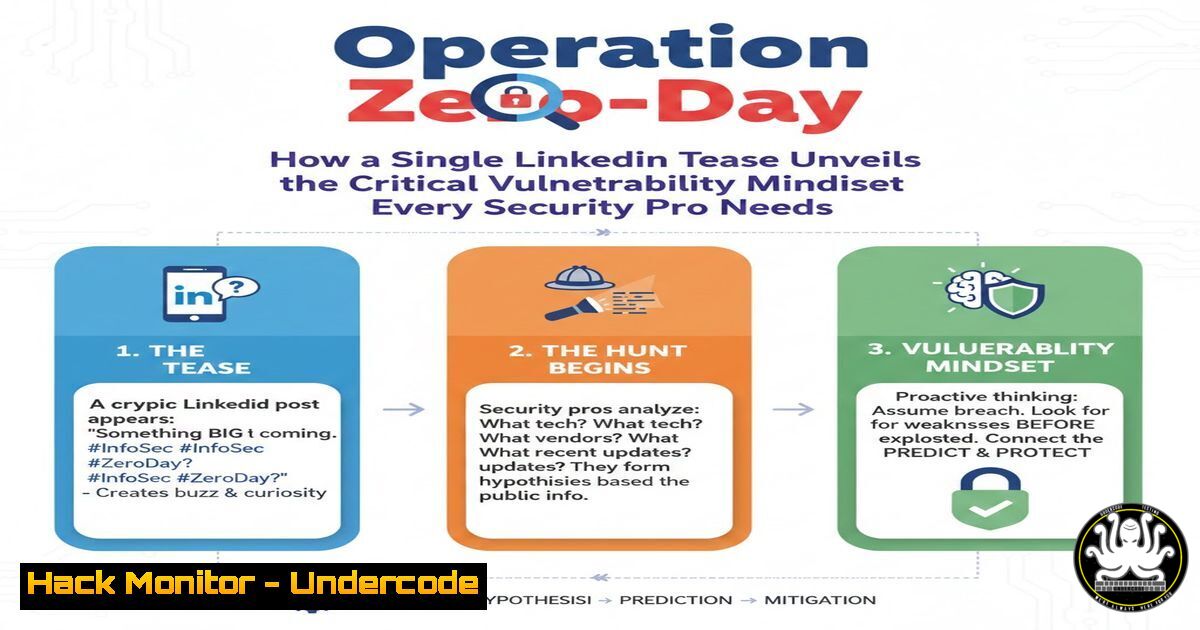
Introduction:
In the cybersecurity world, a single, cryptic post from a respected professional can signal the discovery of a critical flaw before its public disclosure. This article deconstructs the mindset and methodology required to move from seeing a vague announcement to understanding, testing, and defending against a novel vulnerability. We’ll translate the social media tease into a actionable red and blue team playbook.
Learning Objectives:
- Decode the indicators of a nascent vulnerability disclosure from informal sources.
- Apply a systematic approach to research, proof-of-concept development, and validation for unknown threats.
- Implement immediate hardening measures for Linux and Windows systems against a hypothetical critical local privilege escalation (LPE) vulnerability.
You Should Know:
- From Social Tease to CVE: The Hunter’s Research Methodology
When a trusted source like an offensive security specialist hints at a “new vulnerability,” it triggers a reconnaissance phase. The goal is to gather crumbs of data before formal publication.
Step‑by‑step guide:
Step 1: Source Analysis. Examine the poster’s history, connections, and comments. A comment asking for a “bug reference” hints at a pending CVE. Use professional networks and platforms like GitHub, X, and dedicated Discord channels often frequented by researchers.
Step 2: Contextual Clues. The poster’s specializations (Red Team, Offensive Security) suggest a vulnerability likely in scope for penetration testing—think privilege escalation, remote code execution, or authentication bypass.
Step 3: Aggregated Intelligence Searching. Don’t just search the CVE database. Use broad technical queries on search engines and code repositories. For a hypothetical “KernelLPE” flaw, search for recent commits in OS kernel repositories, security mailing lists (e.g., oss-security, kernel mailing list), and bug trackers using keywords from the post’s context.
Step 4: Environment Replication. If clues point to a specific software or OS, prepare a isolated lab environment (using VMware or VirtualBox) with vulnerable versions for testing.
- Building a Hypothesis: Assuming a Critical Local Privilege Escalation Flaw
Let’s hypothesize the vulnerability is a kernel-level LPE in Linux, similar to historical flaws like Dirty Pipe or Dirty Cow.
Step‑by‑step guide:
Step 1: Understand the Attack Surface. LPE often involves flawed interaction with kernel objects (files, pipes, memory). Research recent kernel subsystem changes.
Step 2: Craft a Theoretical Exploit Path. Assume a flaw where a non-privileged process can write to read-only kernel memory pages. The conceptual exploit flow: 1) Trigger a race condition, 2) Gain a temporary write window, 3) Overwrite critical data (e.g., SUID binary memory or credential structures).
Step 3: Verify with Static Analysis. If a potential patch is identified, use `diff` to analyze the fix.
 Example of analyzing a kernel patch for hints
curl -s https://kernel.org/patch-fix.diff | diffstat
 Look for changed functions in security/ or kernel/ directories
3. Proof-of-Concept (PoC) Development & Safe Testing
Developing a PoC validates the hypothesis and understands exploitation prerequisites.
Step‑by‑step guide:
Step 1: Setup Isolated Lab. Use a snapshotable VM.
 On Linux host for managing VMs
VBoxManage snapshot "VulnLinuxLab" take "CleanState"
Step 2: Write a Minimalist PoC. Based on our hypothesis, a PoC might attempt to trigger the race condition.
// hypothethic_poc.c - Simplified conceptual code
include <stdio.h>
include <unistd.h>
int main() {
printf("[] Attempting to trigger race condition...\n");
// Hypothetical syscall or /proc interaction
if (trigger_flaw()) {
setuid(0); // Attempt to gain root
execl("/bin/bash", "bash", NULL);
}
return 0;
}
Step 3: Compile & Test. `gcc -o hypothethic_poc hypothethic_poc.c`
Step 4: Critical – Contingency Plan. Have kernel debugging (KGDB) enabled and a quick revert snapshot ready.
4. Blue Team Response: Immediate Hardening & Detection
Before patches are released, defenders must implement compensatory controls.
Step‑by‑step guide for Linux:
Step 1: Restrict Kernel Module Loading. This can prevent injection of malicious kernel code.
echo 1 > /proc/sys/kernel/modules_disabled
sysctl -w kernel.modules_disabled=1
Step 2: Harden /proc and /sys Filesystems. Restrict access to kernel memory interfaces.
 Mount /proc with hidepid option
mount -o remount,rw,hidepid=2 /proc
 Restrict access to /sys/kernel/debug
chmod 750 /sys/kernel/debug
Step 3: Implement Syscall Auditing. Monitor for anomalous sequences.
 Use auditd to watch key syscalls (hypothetical example)
auditctl -a always,exit -S openat -S keyctl -S mmap -k kernel_exploit_attempt
Step‑by‑step guide for Windows (analogous LPE scenario):
Step 1: Enable Attack Surface Reduction (ASR) Rules. Via PowerShell:
Set-MpPreference -AttackSurfaceReductionRules_Ids <Rule_ID> -AttackSurfaceReductionRules_Actions Enabled
 Specifically consider rules blocking process injection and LSASS access.
Step 2: Harden LSASS & Kernel. Use Credential Guard and enforce Code Integrity.
 Verify Credential Guard is enabled
Get-ComputerInfo -Property DeviceGuard
 Enforce Kernel-mode Code Integrity (KMCI) policy
Step 3: Aggressive Logging. Enable detailed Process Creation and Kernel auditing via Advanced Audit Policy.
- The Formal Disclosure: From PoC to Patch Management
Once the CVE is published (e.g., CVE-2023-XXXXX), shift to systematic defense.
Step‑by‑step guide:
Step 1: Vulnerability Assessment. Map the CVE to your assets using a vulnerability scanner.
Step 2: Patch Testing. In your lab, test the official patch. For a Linux kernel update:
sudo apt update && sudo apt upgrade linux-image-$(uname -r) -y
 Or compile from source if a backport is needed
Step 3: Deploy Mitigations. If patching isn’t immediate, deploy community or vendor-recommended workarounds, which may involve disabling features or applying specific firewall rules.
6. Post-Incident: Building a Proactive Threat Intelligence Cycle
Step‑by‑step guide:
Step 1: Automate Intelligence Gathering. Use RSS feeds, Twitter APIs (for researchers), and scripts to monitor sources.
 Simple curl to monitor a CVE feed
curl -s "https://cvefeed.io/api/latest" | jq '.items[] | select(.title | contains("Linux Kernel"))'
Step 2: Conduct Tabletop Exercises. Regularly simulate scenarios based on such vague threats to improve team response time.
Step 3: Share Knowledge. Write internal reports detailing the research path from tease to mitigation, enhancing organizational learning.
What Undercode Say:
- The Silence Speaks Volumes. The most critical vulnerabilities are often preceded by hushed conversations and vague posts. Building a network of trusted sources and honing your investigative skills is as vital as any technical tool.
- Hypothesis-Driven Defense is Key. Without concrete details, you must build and test defensive hypotheses. This proactive, threat-modeling approach is what separates reactive IT from strategic security operations.
Analysis: The original post is a microcosm of modern vulnerability discovery—opaque, socially-driven, and highly impactful. It underscores that cybersecurity is not just about running tools but about interpreting human signals and connecting disparate data points. The professional’s reluctance to share details before coordinated disclosure is ethical but creates a window of risk for defenders who are not proactively hunting. The ensuing comments reveal a community eager for details, highlighting the collective hunger for knowledge that drives the security ecosystem forward. This cycle—tease, research, exploit, patch, analyze—is the relentless heartbeat of information security.
Prediction:
The future of vulnerability disclosure will become increasingly fragmented, with more initial signals emerging from encrypted messaging apps and private forums before hitting mainstream platforms like LinkedIn. This will force defenders to rely more on AI-powered threat intelligence aggregators that can correlate vague social mentions with code commits, dark web chatter, and nascent exploit attempts. Furthermore, the rise of AI-assisted code auditing will shorten the window between a vulnerability’s hint and its weaponization, making the “tease-to-exploit” lifecycle increasingly compressed. Organizations that fail to invest in proactive hunting and intelligence-gathering capabilities will find themselves consistently behind the attack curve, responding to breaches rather than preventing them.
🎯Let’s Practice For Free:
IT/Security Reporter URL:
Reported By: Mostafa Shaban99 – Hackers Feeds
Extra Hub: Undercode MoN
Basic Verification: Pass ✅


