Listen to this Post
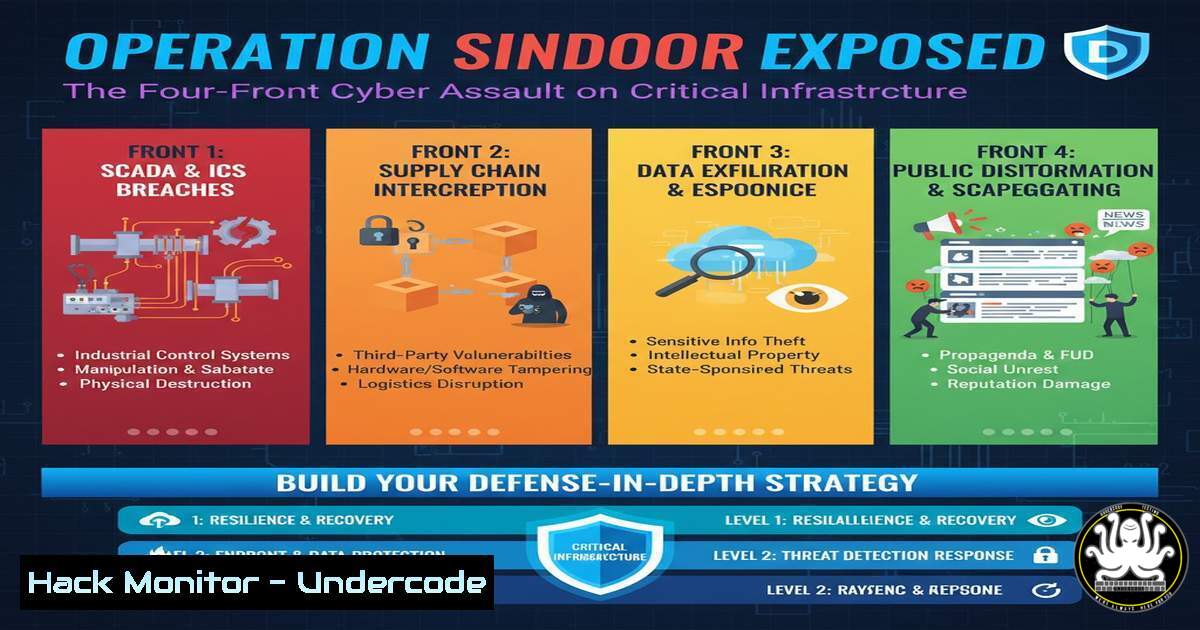
Introduction:
The operational technology (OT) landscape is under siege by sophisticated, multi-vector cyber attacks targeting industrial control systems (ICS). Recent revelations from the ISA Bangalore OT Cybersecurity Summit 2025 detail “Operation Sindoor,” a coordinated cyber assault launched simultaneously from four nations against critical infrastructure. This event underscores the urgent necessity for a robust, multi-layered defense-in-depth strategy to protect the vital systems that manage our power grids, water supplies, and industrial manufacturing.
Learning Objectives:
- Understand the mechanics and implications of multi-front cyber attacks like Operation Sindoor.
- Learn the core principles of building a Defence-in-Depth strategy for Industrial Control Systems.
- Acquire practical, actionable skills for implementing network segmentation, asset visibility, and endpoint hardening in an OT environment.
You Should Know:
- The Anatomy of Operation Sindoor: A Multi-Front Assault
The “Sindoor Operation” represents a paradigm shift in cyber warfare against critical infrastructure. Intelligence indicates that four distinct threat actor groups from Pakistan, Indonesia, Bangladesh, and North Korea launched synchronized attacks. This multi-front strategy is designed to overwhelm traditional, perimeter-based security defenses by attacking from multiple vectors simultaneously. One group may focus on spear-phishing to gain initial access, while another conducts network reconnaissance, a third exploits vulnerabilities in human-machine interfaces (HMIs), and the fourth plants persistent malware within the control network. This coordinated effort makes attribution difficult and mitigation incredibly complex, as defending teams are forced to fight on several fronts at once.
Step‑by‑step guide explaining what this does and how to use it.
Step 1: Threat Intelligence Integration. Subscribe to OT-specific threat intelligence feeds (e.g., CISA’s ICS-CERT, vendor advisories). Correlate IOCs (Indicators of Compromise) like malicious IPs and file hashes associated with the involved regions.
Step 2: Network Traffic Analysis. Use tools like Wireshark or Zeek (formerly Bro) to monitor for anomalous traffic patterns. Look for unexpected connections to external IPs in the mentioned countries.
Example Wireshark Filter: `ip.addr ==
Step 3: Deploy Deception Technology. Place honeypots configured as PLCs or HMIs within your OT network. Any interaction with these systems is a high-fidelity alert of unauthorized reconnaissance.
2. Pillar 1: Achieving Complete OT Asset Visibility
You cannot protect what you cannot see. A foundational element of Defence-in-Depth is having a real-time, accurate inventory of every device on your OT network. This includes not just controllers and HMIs, but also engineering workstations, routers, switches, and any IIoT devices. Unified Asset Intelligence platforms, as highlighted at the summit, are critical for this. They passively monitor network traffic to identify, classify, and profile every asset, detecting unauthorized or rogue devices that could serve as an entry point for attacks.
Step‑by‑step guide explaining what this does and how to use it.
Step 1: Passive Network Monitoring. Connect a SPAN port from a core OT network switch to a dedicated asset discovery appliance or server.
Step 2: Protocol Analysis. Configure the discovery tool to decode common industrial protocols (Modbus TCP, DNP3, OPC UA, PROFINET) to identify device types, models, and firmware versions.
Step 3: Active Scanning (Use with Caution). In resilient environments, conduct careful, low-impact active scans to supplement passive data.
Example Nmap Command for OT: `nmap -sS -T4 -p 1-1000 –script banner
3. Pillar 2: Implementing Robust Network Segmentation
Network segmentation is the cornerstone of Defence-in-Depth, acting as digital firewalls that contain the spread of an attack. The goal is to create security zones and conduits, as defined by the ISA/IEC 62443 standard, to isolate critical process networks from the corporate IT network and the internet. This ensures that a breach in one zone, like the enterprise network, does not automatically lead to a compromise of the control system zone.
Step‑by‑step guide explaining what this does and how to use it.
Step 1: Architectural Review. Map your OT network into zones (e.g., Level 3 – Site Operations, Level 2 – Area Supervision, Level 1 – Basic Control, Level 0 – Process) and conduits for data flow between them.
Step 2: Configure Firewall Rules. Deploy an industrial next-generation firewall (NGFW) between zones. Rules should be based on the principle of least privilege.
Example Rule: `ALLOW SOURCE: HMI_Zone (IP: 10.10.2.10) DESTINATION: PLC_Zone (IP: 10.10.1.50) PROTOCOL: TCP PORT: 502`
Implicit Rule: `DENY ANY ANY`
Step 3: Implement VLANs. Use Virtual LANs on your OT switches to logically separate traffic at Layer 2.
Example Cisco Switch Command: `switchport access vlan 20` (Assigns a port to the DMZ VLAN).
4. Pillar 3: Hardening Endpoints and Controllers
OT endpoints, like engineering workstations and HMIs, are high-value targets. Similarly, PLCs and RTUs are often vulnerable due to outdated firmware or weak configuration. Hardening these devices involves applying security patches, removing unnecessary services, and enforcing application whitelisting to prevent the execution of unauthorized malware.
Step‑by‑step guide explaining what this does and how to use it.
Step 1: Vulnerability Management. Use an OT-specific vulnerability scanner to identify missing patches and common misconfigurations on Windows-based OT hosts.
Step 2: Application Whitelisting. On Windows 10/11 IoT Enterprise workstations, configure Windows Defender Application Control (WDAC) in whitelisting mode.
PowerShell Command (to audit mode first): `Set-RuleOption -FilePath .\Policy.xml -Option 3` (Audit Mode). This allows you to build a policy based on allowed applications without blocking anything initially.
Step 3: PLC Configuration Hardening. Change default passwords on PLCs, disable unused communication services (e.g., HTTP if HTTPS is used), and set the controller to “Run” mode to prevent unauthorized program changes.
5. Pillar 4: Continuous Monitoring and Incident Response
A Defence-in-Depth strategy is not a “set it and forget it” solution. Continuous monitoring for anomalous behavior is essential for early detection. Furthermore, having a tested incident response (IR) plan tailored to the OT environment is critical. The plan must balance containment with operational safety, as abruptly taking a critical industrial process offline can be dangerous.
Step‑by‑step guide explaining what this does and how to use it.
Step 1: Deploy an OT SIEM. Ingest logs from firewalls, HMIs, and asset management platforms into a Security Information and Event Management (SIEM) system. Create alerts for suspicious activity, like a programming command sent to a PLC from a non-engineering workstation.
Step 2: Develop OT-Specific IR Playbooks. Create step-by-step procedures for different incident types (e.g., Ransomware on HMI, Malicious Logic on PLC). The playbook must include steps for engaging operations personnel and safety engineers.
Step 3: Conduct Tabletop Exercises. Regularly simulate attacks like Operation Sindoor with your IT, OT, and safety teams to test communication and the effectiveness of your IR plan.
What Undercode Say:
- The Perimeter is Dead. The four-front attack model proves that relying on a single, strong perimeter defense is a fatal flaw. Security must be layered throughout the entire OT architecture, from the network down to the individual controller.
- Resilience Trumps All. The ultimate goal is not just to prevent breaches but to ensure operational resilience. A robust Defence-in-Depth strategy allows an organization to detect, contain, and recover from an incident without catastrophic disruption to the physical process.
The revelations from the ISA summit paint a clear picture: the threat landscape has evolved from targeted, single-point attacks to coordinated, multi-national campaigns designed to cripple national critical infrastructure. Operation Sindoor is not an anomaly; it is a blueprint for future attacks. The complexity and scale demand a proportional response. The industry’s shift towards unified asset intelligence and a principled, standards-based approach to Defence-in-Depth is no longer a best practice but a survival imperative. Organizations that fail to adopt this layered security posture are effectively leaving their digital doors unlocked for a syndicate of threat actors.
Prediction:
The success and publicity of multi-vector campaigns like Operation Sindoor will catalyze a new era of “Cyber Swarm” attacks. We will see an increase in AI-driven, fully automated botnets capable of simultaneously exploiting IT, OT, and cloud vulnerabilities within a single target organization. This will force a convergence of IT and OT security tools and teams, leading to the rise of integrated security platforms that provide a single pane of glass for defending the entire enterprise. Furthermore, nation-states will increasingly use these swarm attacks as a form of low-level, deniable warfare, continuously testing and probing the resilience of a rival’s critical infrastructure without triggering a full-scale military response.
🎯Let’s Practice For Free:
IT/Security Reporter URL:
Reported By: Mukeshkumarojha1234 Otsecurity – Hackers Feeds
Extra Hub: Undercode MoN
Basic Verification: Pass ✅


