Listen to this Post
Introduction:
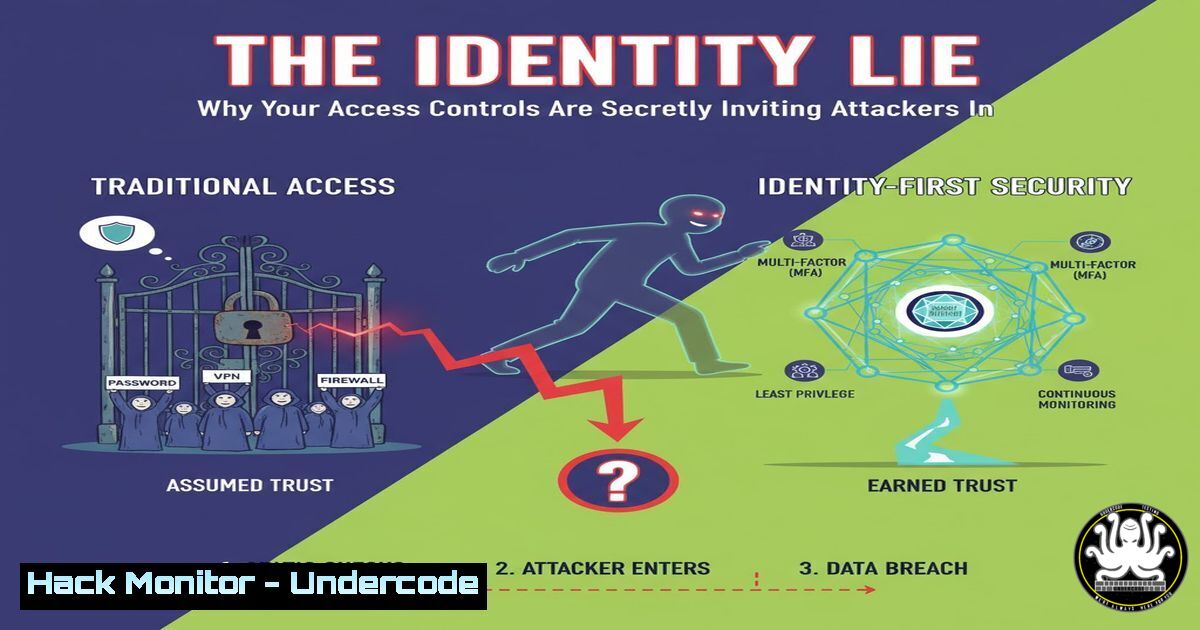
In today’s perimeter-less digital environments, identity has become the new battlefield. Traditional security models that rely on static credentials are collapsing under sophisticated social engineering and supply chain attacks, allowing threat actors to operate freely with stolen legitimate access. This paradigm shift demands a fundamental rethinking of how we verify and continuously trust digital identities.
Learning Objectives:
- Understand the critical vulnerabilities in legacy identity and access management (IAM) systems
- Implement behavioral analytics and Zero Trust principles to detect compromised credentials
- Deploy practical technical controls across cloud, on-premise, and hybrid environments
You Should Know:
1. The Anatomy of Modern Identity-Based Attacks
Modern attackers don’t break down walls—they walk through front doors using stolen credentials. The SolarWinds and Colonial Pipeline incidents demonstrated how supply chain compromises and credential theft enable persistent access. Attackers typically follow this pattern: initial credential harvesting through phishing, lateral movement using privilege escalation, and then establishing persistence through service accounts.
Key technical vectors include:
- Golden SAML attacks forging authentication tokens
- Pass-the-Hash techniques moving laterally across systems
- OAuth token hijacking in cloud environments
- Service principal credential theft in Azure AD
2. Implementing Behavioral-Based Access Controls
Step-by-step guide explaining what this does and how to use it:
Behavioral analytics transform authentication from binary decisions to risk-based evaluations. Instead of simply checking credentials, systems analyze hundreds of behavioral signals including login time, location, device fingerprint, and typical access patterns.
For Windows environments, implement conditional access through PowerShell:
 Configure conditional access policy via Graph API
Connect-MgGraph -Scopes "Policy.ReadWrite.ConditionalAccess"
New-MgIdentityConditionalAccessPolicy -DisplayName "High-Risk Login Block" -State "enabled" -Conditions @{
Applications = @{IncludeApplications = "All"}
Users = @{IncludeUsers = "All"}
Locations = @{IncludeLocations = "All"; ExcludeLocations = "TrustedIPs"}
} -GrantControls @{
BuiltInControls = "block"
Operator = "OR"
}
For Linux systems, implement real-time monitoring with auditd:
 Configure advanced audit rules for suspicious authentication
auditctl -a always,exit -F arch=b64 -S execve -k user_auth_commands
auditctl -w /etc/passwd -p wa -k identity_modification
auditctl -w /etc/shadow -p r -k shadow_access
3. Hardening Cloud Identity Providers
Step-by-step guide explaining what this does and how to use it:
Cloud identity providers like Azure AD and AWS IAM represent critical attack surfaces. Implement these hardening measures:
Azure AD hardening:
 Enforce privileged identity management
Enable-AzureADPrivilegedIdentityManagement
New-AzureADMSPrivilegedResource -ProviderId aadroles -ResourceId (Get-AzureADDirectorySetting).Id

Configure emergency access break-glass accounts
New-AzureADUser -DisplayName "Break Glass Admin" -PasswordProfile $PasswordProfile -UserPrincipalName "[email protected]" -AccountEnabled $true
AWS IAM security:
 Enable and analyze IAM Access Analyzer
aws accessanalyzer create-analyzer --analyzer-name "organization-analyzer" --type ORGANIZATION

Implement SCPs to restrict dangerous actions
{
"Version": "2012-10-17",
"Statement": [
{
"Effect": "Deny",
"Action": [
"iam:CreateAccessKey",
"iam:UpdateAccessKey",
"iam:DeleteAccessKey"
],
"Resource": ""
}
]
}
4. API Security and Machine Identity Protection
Step-by-step guide explaining what this does and how to use it:
Machine identities now outnumber human identities in most organizations, making API security critical. Implement these controls:
JWT validation and hardening:
import jwt
from cryptography.hazmat.primitives import hashes
from cryptography.hazmat.primitives.kdf.hkdf import HKDF

Implement proper JWT validation
def validate_jwt_token(token, secret_key):
try:
payload = jwt.decode(token, secret_key, algorithms=['HS256'], options={'verify_aud': True})
 Additional validation for issuer, expiration
if payload['iss'] != 'trusted-issuer':
return None
return payload
except jwt.InvalidTokenError:
return None

Implement key rotation for API secrets
def rotate_api_keys():
new_secret = HKDF(algorithm=hashes.SHA256(), length=32, salt=None, info=b'api-key-rotation').derive(os.urandom(32))
update_secret_store(new_secret)
5. Active Directory Certificate Services Exploitation Mitigation
Step-by-step guide explaining what this does and how to use it:
AD CS vulnerabilities have become a primary attack vector for domain escalation:
Detect vulnerable certificate templates with PowerShell:
Get-CATemplate | Where-Object {$<em>.EnrollmentFlags -like "ENABLE_KEY_REUSE" -or $</em>.AuthenticationType -eq "None" -or $_.ExtendedKeyUsage -like "1.3.6.1.5.5.7.3.1"} | Format-List Name, Permissions
Harden certificate templates by:
- Removing ENROLLEE_SUPPLIES_SUBJECT from enrollment flags
- Requiring manager approval for sensitive templates
- Implementing certificate transparency logging
- Removing vulnerable extended key usages
6. Implementing Zero Trust Network Access (ZTNA)
Step-by-step guide explaining what this does and how to use it:
Replace VPNs with granular application-level access controls:
Linux ZTNA client configuration:
 Configure network namespace isolation
ip netns add ztna-namespace
iptables -A FORWARD -i ztna0 -o eth0 -j DROP
 Only allow specific application traffic
iptables -A OUTPUT -p tcp --dport 443 -j ACCEPT
iptables -A OUTPUT -p tcp --dport 80 -j DROP
Windows application control policies:
New-CIPolicy -FilePath "ztna_policy.xml" -Level FilePublisher -Fallback Hash -UserPEs -Audit
Set-RuleOption -FilePath "ztna_policy.xml" -Option 0 -Delete
ConvertFrom-CIPolicy -XmlFilePath "ztna_policy.xml" -BinaryFilePath "ztna_policy.bin"
7. Continuous Threat Exposure Management for Identities
Step-by-step guide explaining what this does and how to use it:
Implement automated scanning for exposed credentials and misconfigurations:
Cloud security posture management:
 Scan for publicly accessible storage with sensitive identity data
aws s3api list-buckets --query "Buckets[].Name" | while read bucket; do
if aws s3api get-bucket-acl --bucket "$bucket" | grep -q "http://acs.amazonaws.com/groups/global/AllUsers"; then
echo "Public bucket: $bucket"
fi
done
Azure AD continuous monitoring:
 Monitor for risky sign-ins and configuration changes
Get-MgIdentityRiskDetection -Top 100 | Where-Object {$_.RiskLevel -eq "high"} | Format-Table Activity, RiskDetail, UserPrincipalName
What Undercode Say:
- Identity has become the primary attack vector, surpassing technical vulnerabilities in frequency and impact
- Behavioral analytics and continuous authentication must replace binary access decisions
- The convergence of human and machine identities requires unified security frameworks
The traditional castle-and-moat security model is fundamentally broken in a world where identities regularly cross organizational boundaries. Organizations that continue relying on perimeter-based defenses while neglecting identity-centric security are essentially handing attackers master keys to their digital kingdoms. The technical controls outlined represent minimum viable security in today’s threat landscape, where identity protection isn’t just another layer—it’s the foundation.
Prediction:
Within two years, we’ll see identity-focused attacks evolve from credential theft to complete identity fabric manipulation, where attackers systematically poison behavioral analytics and machine learning models to make malicious activity appear normal. The emergence of AI-generated behavioral patterns will create an arms race between defensive AI systems and adaptive attackers, forcing the industry toward blockchain-verified identity attestations and mandatory hardware-backed security keys for all privileged access. Organizations that fail to implement behavioral-based Zero Trust architectures will experience breach rates 300% higher than those that do, making identity security the primary differentiator in cyber insurance premiums and regulatory compliance.
🎯Let’s Practice For Free:
IT/Security Reporter URL:
Reported By: Bradleyschagrin Attacksurfacemanagement – Hackers Feeds
Extra Hub: Undercode MoN
Basic Verification: Pass ✅


