Listen to this Post
Introduction
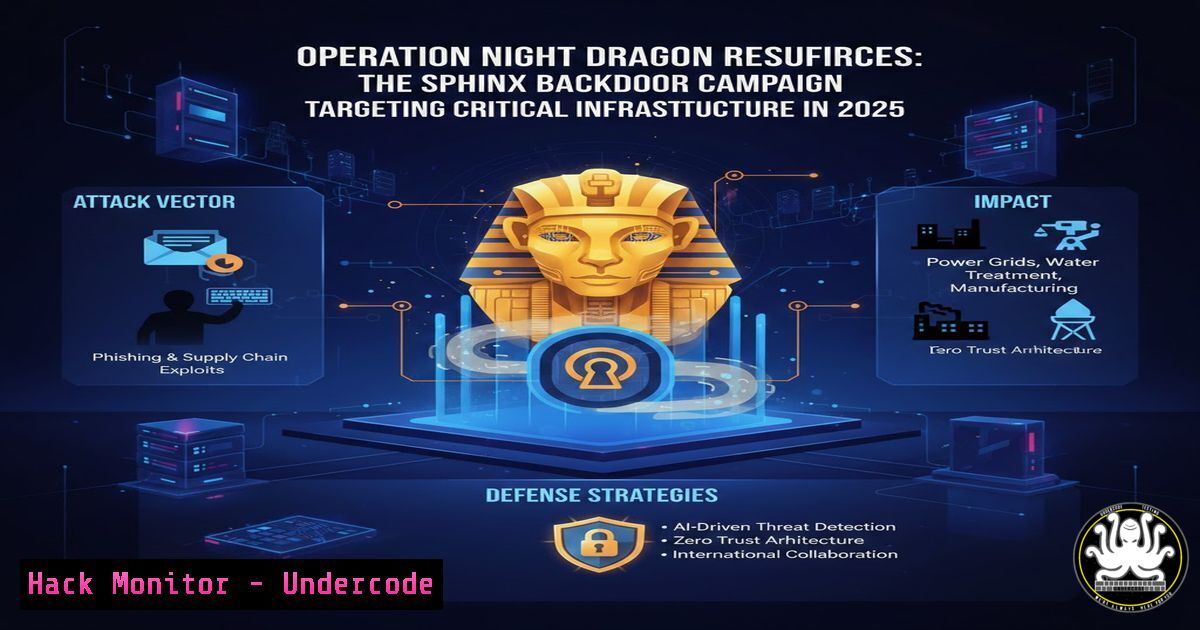
In a sophisticated resurgence of state-sponsored cyber espionage, security researchers have identified a new iteration of the infamous “Operation Night Dragon” campaign, now leveraging an advanced modular backdoor codenamed “Sphinx.” This campaign specifically targets energy sector organizations and telecommunications providers across Southeast Asia and Eastern Europe, utilizing previously unseen evasion techniques that bypass modern EDR solutions. The attackers combine custom-developed malware with living-off-the-land binaries to establish persistent access while maintaining a low forensic footprint that challenges conventional detection methodologies.
Learning Objectives
- Analyze the Sphinx backdoor’s modular architecture and command execution framework
- Identify indicators of compromise across Windows and Linux enterprise environments
- Implement network-level detection rules for C2 communication patterns
- Deploy YARA rules for memory-resident malware variant identification
- Configure endpoint hardening measures against living-off-the-land attacks
You Should Know
1. Sphinx Backdoor Analysis and Persistence Mechanisms
The Sphinx backdoor represents a significant evolution in modular malware design, incorporating both DLL side-loading techniques on Windows and LD_PRELOAD rootkit capabilities on Linux systems. The malware establishes persistence through WMI event subscriptions on Windows and systemd timers on Linux, making traditional persistence detection challenging.
Windows Persistence Detection:
 List all WMI event filters and consumers
Get-WmiObject -Namespace root\subscription -Class __EventFilter
Get-WmiObject -Namespace root\subscription -Class CommandLineEventConsumer
Get-WmiObject -Namespace root\subscription -Class __FilterToConsumerBinding

Check for suspicious scheduled tasks
schtasks /query /fo LIST /v | findstr /i "sphinx update maintenance"

Examine startup registry modifications
reg query HKLM\SOFTWARE\Microsoft\Windows\CurrentVersion\Run
reg query HKCU\SOFTWARE\Microsoft\Windows\CurrentVersion\Run
Linux Persistence Detection:
 List all systemd timers
systemctl list-timers --all | grep -E "(update|maintenance|backup)"

Check LD_PRELOAD persistence
grep -r "LD_PRELOAD" /etc/environment /etc/profile /etc/profile.d/

Examine cron jobs for anomalies
for user in $(cut -f1 -d: /etc/passwd); do crontab -u $user -l 2>/dev/null; done

Check systemd service modifications
find /etc/systemd/system -type f -exec grep -l "ExecStart=.(python|perl|bash|wget|curl)" {} \;
2. C2 Communication Protocol Analysis
The Sphinx backdoor employs a sophisticated domain generation algorithm (DGA) combined with DNS over HTTPS (DoH) to establish resilient command and control channels. Communication occurs over legitimate cloud services including Discord CDN, GitHub Gists, and Telegram bots, making traffic analysis particularly difficult.
Network Detection Rules (Zeek/Bro):
 Detect potential DoH traffic on non-standard ports
cat dns-over-https.sig
signature dns-over-https {
ip-proto == tcp
dst-port == 443
payload /.\x00\x00\x00\x00\x00\x01\x00\x00.application\/dns-message/
event "Potential DoH traffic detected"
}

Identify GitHub Gist C2 patterns
cat github-gist-c2.sig
signature github-gist-c2 {
ip-proto == tcp
dst-port == 443
http-request-header /Host: gist.github.com/
http-request-uri /.\/raw\/.[a-fA-F0-9]{32}/
event "Possible GitHub Gist C2 beacon"
}
PCAP Analysis Commands:
 Extract all HTTPS certificates for suspicious domain analysis
tshark -r capture.pcap -Y "ssl.handshake.certificate" -T fields -e x509sat.uTF8String -e x509sat.printableString

Identify potential DGA domains using entropy calculation
tshark -r capture.pcap -Y "dns.qry.name" -T fields -e dns.qry.name | while read domain; do
echo -n "$domain "
echo "$domain" | grep -o '[a-z0-9]' | sort | uniq -c | awk '{sum+=$1} END {print sum/NR}'
done | awk '$2 > 3.5 {print "High entropy domain: "$1}'
3. Memory-Only Payload Extraction and Analysis
The Sphinx loader employs process hollowing and reflective DLL injection to execute payloads entirely in memory, leaving minimal disk artifacts. Understanding these techniques is crucial for incident response and malware analysis.
Memory Analysis with Volatility:
 Identify suspicious processes with no parent or abnormal parent-child relationships
volatility -f memory.dump windows.psscan | awk '{if ($3 == "0" && $4 != "System") print "Orphan process: "$2}'

Dump injected code regions
volatility -f memory.dump windows.malfind --pid 1234 --dump

Extract and analyze hollowed processes
volatility -f memory.dump windows.hollowfind

Examine process environment variables for anomalies
volatility -f memory.dump windows.envars --pid 1234
Live Memory Acquisition on Linux:
 Capture process memory for analysis
gdb --pid 1234 -ex "dump memory /tmp/process_memory.dump 0x$(cat /proc/1234/maps | head -1 | cut -d'-' -f1) 0x$(cat /proc/1234/maps | tail -1 | cut -d'-' -f2)"

Check for LD_PRELOAD injection
lsof -p 1234 | grep mem | grep -vE "^(anon_inode|/usr/lib)"

Examine loaded shared libraries for anomalies
cat /proc/1234/maps | grep "r-xp" | awk '{print $6}' | sort -u | while read lib; do
if [ ! -f "$lib" ]; then
echo "Suspicious library loaded: $lib"
fi
done
4. Privilege Escalation Techniques Employed
The attackers utilize a combination of known vulnerabilities and zero-day exploits targeting print spooler services on Windows and polkit on Linux. Understanding these escalation paths enables proper hardening.
Windows Privilege Escalation Mitigation:
 Disable Print Spooler if not required
Stop-Service Spooler -Force
Set-Service Spooler -StartupType Disabled

Check for vulnerable drivers
Get-WindowsDriver -Online | Where-Object {$_.Driver -like "print"}

Audit token privileges
whoami /priv

Implement LSA protection
New-ItemProperty -Path "HKLM:\SYSTEM\CurrentControlSet\Control\Lsa" -Name "RunAsPPL" -Value 1 -PropertyType DWORD
Linux Privilege Escalation Hardening:
 Update polkit to latest version
apt-get update && apt-get install --only-upgrade policykit-1

Audit sudoers for dangerous configurations
grep -r "NOPASSWD" /etc/sudoers /etc/sudoers.d/

Check for SUID binaries with known vulnerabilities
find / -perm -4000 -type f 2>/dev/null | while read binary; do
if dpkg -S "$binary" 2>/dev/null | grep -q "unowned"; then
echo "Unowned SUID binary: $binary"
fi
done

Implement kernel hardening
sysctl -w kernel.unprivileged_bpf_disabled=1
sysctl -w kernel.kexec_load_disabled=1
5. Network Segmentation and Micro-segmentation Strategies
The Sphinx operators rely heavily on east-west movement once initial access is achieved. Implementing proper network segmentation is critical for containment.
Implementing Micro-segmentation with iptables:
 Isolate critical servers from general network
iptables -A FORWARD -i eth0 -o eth1 -m state --state NEW -j LOG --log-prefix "EAST-WEST: "
iptables -A FORWARD -i eth0 -o eth1 -j DROP

Create application-specific zones
iptables -N WEB_ZONE
iptables -N DB_ZONE
iptables -A WEB_ZONE -p tcp --dport 443 -j ACCEPT
iptables -A DB_ZONE -p tcp --dport 3306 -j ACCEPT

Limit lateral movement between zones
iptables -A FORWARD -i WEB_ZONE -o DB_ZONE -m state --state ESTABLISHED,RELATED -j ACCEPT
iptables -A FORWARD -i WEB_ZONE -o DB_ZONE -j DROP
Windows Firewall Configuration:
 Block all inbound except required services
New-NetFirewallRule -DisplayName "Block All Inbound" -Direction Inbound -Action Block

Create isolated network zones
New-NetFirewallRule -DisplayName "Allow Web to DB" -Direction Outbound -Protocol TCP -RemotePort 3306 -Action Block

Implement application identity policies
New-NetFirewallRule -DisplayName "Only SQL Server to DB" -Direction Outbound -Protocol TCP -RemotePort 3306 -Program "C:\Program Files\Microsoft SQL Server\MSSQL15.MSSQLSERVER\MSSQL\Binn\sqlservr.exe" -Action Allow
6. Log Aggregation and Threat Hunting Queries
The campaign’s stealth requires proactive threat hunting across aggregated logs. Implementing proper SIEM queries can identify subtle indicators.
Splunk Queries for Detection:
 Detect process injection through suspicious parent-child relationships
index=windows EventCode=4688
| eval parent_process = mvindex(Process_Command_Line, 1)
| where like(ParentProcessName, "%powershell%") AND NOT like(Process_Command_Line, "%explorer%")
| table _time, ComputerName, User, Process_Command_Line, ParentProcessName

Identify DNS over HTTPS usage
index=network dest_port=443 ssl_server_name IN ("cloudflare-dns.com", "dns.google", "mozilla.cloudflare-dns.com")
| stats count by src_ip, dest_ip, ssl_server_name

Detect anomalous outbound connections
index=netflow bytes_out > 1000000 AND dest_port=443
| where NOT cidrmatch("10.0.0.0/8", dest_ip) AND NOT cidrmatch("172.16.0.0/12", dest_ip) AND NOT cidrmatch("192.168.0.0/16", dest_ip)
| where cidrmatch("0.0.0.0/0", dest_ip)
| stats sum(bytes_out) as total_bytes by src_ip, dest_ip
| where total_bytes > 100000000
ELK Stack Detection Rules:
 Elasticsearch detection rule for Sphinx C2 patterns
- rule_id: "SPHINX-001"
description: "Sphinx C2 Domain Generation Algorithm Detection"
index: ["logs-endpoint.events.network-"]
query: |
network.protocol:dns AND
dns.question.name: /[a-z0-9]{8,}.(com|org|net|info)/ AND
(dns.question.name: /..(xyz|top|club|online)$/ OR
dns.question.name: /..(cf|ga|gq|ml|tk)$/)
threat_indicator: "Potential DGA domain for Sphinx C2"

<ul>
<li>rule_id: "SPHINX-002"
description: "Sphinx Process Hollowing Detection"
index: ["logs-windows.sysmon-"]
query: |
event.code:8 AND
process.parent.executable:("\svchost.exe" OR "\lsass.exe" OR "\winlogon.exe") AND
process.executable:("\powershell.exe" OR "\cmd.exe" OR "\wscript.exe")
7. API Security Hardening Against Sphinx Exploitation
The campaign specifically targets exposed APIs with inadequate authentication and input validation. Implementing proper API security measures is essential.
API Gateway Configuration (Nginx):
 Rate limiting to prevent API abuse
limit_req_zone $binary_remote_addr zone=api_limit:10m rate=10r/s;

server {
listen 443 ssl;
server_name api.example.com;

Apply rate limiting
location /api/ {
limit_req zone=api_limit burst=20 nodelay;

Validate JWT tokens
auth_jwt "API Access" token=$http_authorization;
auth_jwt_key_file /etc/nginx/jwt.public.key;

Input validation
if ($request_method !~ ^(GET|POST|PUT|DELETE)$) {
return 405;
}

Block suspicious user agents
if ($http_user_agent ~ (curl|wget|python|perl|ruby)) {
return 403;
}

proxy_pass http://backend_servers;
}
}
API Security Headers Implementation:
 Flask API security middleware
from flask import Flask, request, jsonify
import re

app = Flask(<strong>name</strong>)

@app.before_request
def validate_request():
 Block SQL injection patterns
sql_patterns = ['union.select', 'select.from', 'insert.into', 'drop.table']
for pattern in sql_patterns:
if re.search(pattern, request.query_string.decode(), re.IGNORECASE):
return jsonify({"error": "Invalid request"}), 400

Validate content type
if request.method in ['POST', 'PUT']:
if not request.is_json:
return jsonify({"error": "Content-Type must be application/json"}), 415

Check for oversized payloads
if request.content_length and request.content_length > 1024  1024:  1MB limit
return jsonify({"error": "Payload too large"}), 413

@app.after_request
def add_security_headers(response):
response.headers['X-Content-Type-Options'] = 'nosniff'
response.headers['X-Frame-Options'] = 'DENY'
response.headers['X-XSS-Protection'] = '1; mode=block'
response.headers['Content-Security-Policy'] = "default-src 'none'"
response.headers['Strict-Transport-Security'] = 'max-age=31536000; includeSubDomains'
return response
What Undercode Say
The resurgence of Operation Night Dragon through the Sphinx backdoor represents a paradigm shift in persistent threat operations. Key takeaways include the attackers’ strategic pivot to modular, memory-resident malware that evades traditional signature-based detection while leveraging legitimate cloud infrastructure for command and control. Organizations must recognize that perimeter defense alone is insufficient—the focus must shift to detection engineering, proactive threat hunting, and assume-breach architectures. The integration of living-off-the-land techniques with custom malware demonstrates sophisticated operational security that challenges even mature security programs. Security teams must prioritize behavioral analytics over signature detection, implement comprehensive logging with centralized correlation, and develop incident response playbooks specifically targeting fileless malware scenarios. The campaign’s targeting of critical infrastructure underscores the geopolitical motivations driving modern cyber operations, requiring organizations to adopt threat intelligence-driven defense strategies.
Prediction
Within the next 12-18 months, we will likely observe the Sphinx framework being offered as a malware-as-a-service product on dark web forums, democratizing access to state-level capabilities for cybercriminal groups. This evolution will trigger a wave of ransomware operations leveraging similar evasion techniques, potentially causing widespread disruptions across multiple sectors simultaneously. The increased adoption of memory-only payloads will accelerate the development of hardware-based memory inspection technologies and drive regulatory mandates requiring memory forensic capabilities for critical infrastructure operators. Furthermore, we anticipate that defensive AI systems will need to evolve from anomaly detection to causal analysis, as the statistical anomalies exploited by DGA-based C2 communications become indistinguishable from legitimate traffic patterns in increasingly encrypted network environments.
▶️ Related Video (82% Match):
🎯Let’s Practice For Free:
IT/Security Reporter URL:
Reported By: Sachin Madhumitha – Hackers Feeds
Extra Hub: Undercode MoN
Basic Verification: Pass ✅


